From the free course AP Chemistry on Lykke
2.1 Types of Chemical Bonds · 2.2 Intramolecular Force and Potential Energy
Key concepts: Types of chemical bonds · Intramolecular forces · Potential energy versus internuclear distance · Equilibrium bond length · Bond energy · Covalent bond strength · Bond order · Sigma (σ) and pi (π) bonds · Coulombic forces · van der Waals forces
A chemical bond forms when attractive forces between particles outweigh repulsive forces at a particular separation. The result is not simply “atoms sticking together”: bond type, bond length, bond energy, and molecular behavior all emerge from the balance of electrostatic forces.
2.1 Types of Chemical Bonds · 2.2 Intramolecular Force and Potential Energy
A chemical bond forms when attractive forces between particles outweigh repulsive forces at a particular separation. The result is not simply “atoms sticking together”: bond type, bond length, bond energy, and molecular behavior all emerge from the balance of electrostatic forces.
The three major bond types
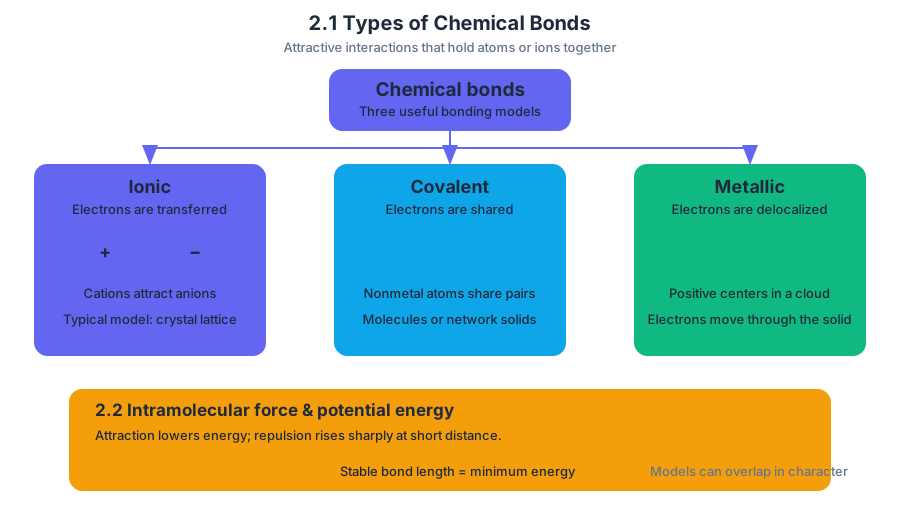
Chemical bonds are attractive interactions that hold atoms or ions together. The three broad types are ionic bonds, covalent bonds, and metallic bonds.
| Bond type | Particles involved | Electron behavior | Typical model |
|---|---|---|---|
| Ionic | Cations and anions | Electrons are transferred; oppositely charged ions attract | Extended crystal lattice |
| Covalent | Nonmetal atoms | Electrons are shared between atoms | Discrete molecules or network solids |
| Metallic | Metal atoms or cations | Valence electrons are delocalized throughout the solid | Positive centers in a mobile electron cloud |
Electronegativity and periodic trends help predict which bonding description is most useful. These categories are models rather than completely isolated boxes: a bond may have both ionic and covalent character, depending on how unevenly electrons are distributed.
Intramolecular versus intermolecular forces
Intramolecular forces act within a molecule or extended substance. Covalent bonds, such as the bonds inside a water molecule, are intramolecular forces. By contrast, intermolecular forces act between separate particles; van der Waals forces are examples of intermolecular attractions, not covalent bonds.
This distinction matters because breaking a covalent bond changes molecular identity, whereas overcoming an intermolecular attraction usually separates molecules without changing what each molecule is. Boiling water, for example, separates $H_2O$ molecules from one another but does not normally break the intramolecular $O-H$ bonds.
Key distinction: Intramolecular forces hold a chemical unit together; intermolecular forces hold separate chemical units near one another.
Potential energy and the distance between atoms
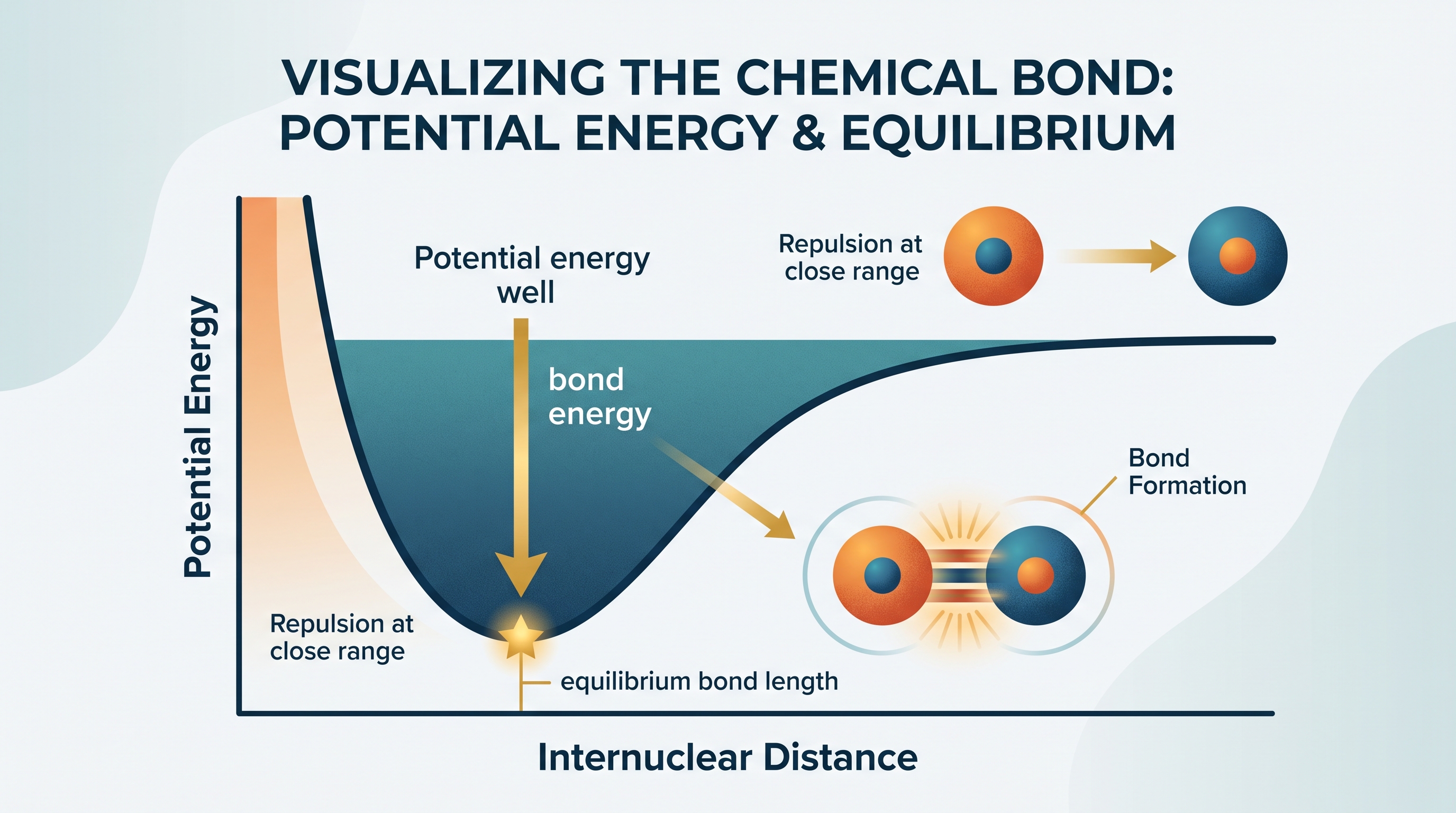
Imagine two atoms approaching like two magnets whose behavior changes dramatically with distance. At first, attraction lowers the system’s potential energy. If the atoms move too close, repulsions between nuclei and between occupied electron clouds rise sharply. The most stable distance is where these effects balance.
For a covalent bond, a graph of potential energy versus internuclear distance has a characteristic well:
The lowest point identifies the equilibrium bond length: the internuclear distance at which the bonded atoms have minimum potential energy. At this distance, the atoms are not motionless; they vibrate around the minimum.
The depth of the potential-energy well represents bond energy, the energy required to completely separate the bonded atoms. A deeper well corresponds to a stronger bond because more energy must be supplied to move the atoms from the bonded state to separated atoms.
$$ \text{bond energy} = E_{\text{separated atoms}}-E_{\text{bonded atoms}} $$
Worked example: If a covalent bond has an energy minimum at an internuclear distance of $120\ \mathrm{pm}$ and the energy of the separated atoms is $0\ \mathrm{kJ,mol^{-1}}$, while the minimum is $-460\ \mathrm{kJ,mol^{-1}}$, then the equilibrium bond length is $120\ \mathrm{pm}$ and the bond energy is $460\ \mathrm{kJ,mol^{-1}}$.
Misconception check — “closer always means stronger”: Moving atoms closer than the equilibrium distance does not strengthen the bond indefinitely. At very short distances, nucleus–nucleus and electron–electron repulsions make the potential energy increase.
Bond order, bond length, and bond strength
Bond order describes the number of shared electron pairs in a covalent bond: a single bond has order $1$, a double bond has order $2$, and a triple bond has order $3$. Increasing bond order generally concentrates more electron density between the nuclei, producing a shorter and stronger covalent bond.
The usual pattern is:
$$ \text{triple bond} > \text{double bond} > \text{single bond} $$
for bond energy, while the order reverses for bond length:
Atomic size also affects bond length. Larger bonded atoms have larger cores and generally place their nuclei farther apart, so their covalent bonds tend to be longer. Bond strength depends on the balance of attractive and repulsive Coulombic forces, not on distance alone.
Sigma and pi bonding
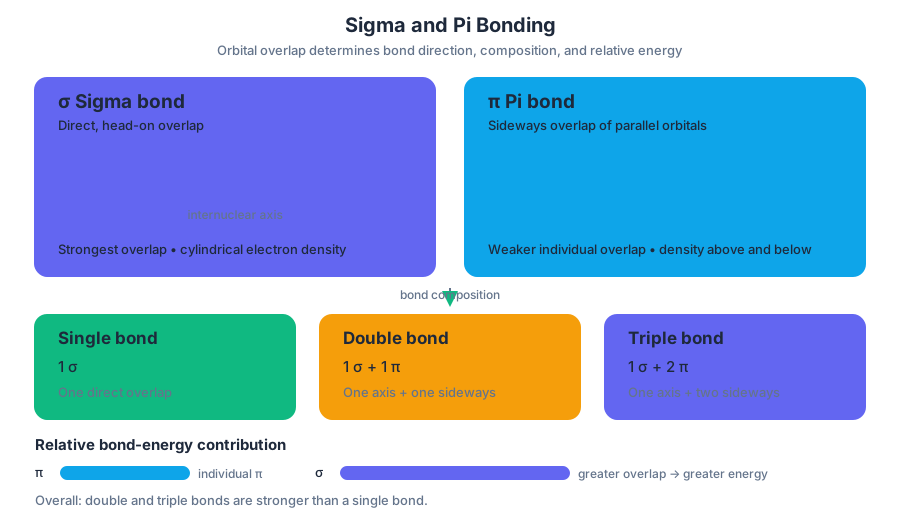
A sigma bond, written $\sigma$, forms from direct, head-on overlap of orbitals along the internuclear axis. A pi bond, written $\pi$, forms from sideways overlap of parallel orbitals above and below, or beside, that axis.
A single covalent bond contains one $\sigma$ bond. A double bond contains one $\sigma$ bond and one $\pi$ bond; a triple bond contains one $\sigma$ bond and two $\pi$ bonds.
The $\sigma$ bond has greater bond energy than an individual $\pi$ bond because head-on overlap is more effective than sideways overlap. Thus, a double bond is stronger overall than a single bond, but its additional $\pi$ bond is weaker than its $\sigma$ component.
AP science practices in this topic
This topic develops 3.A, Representing Data and Phenomena when you identify equilibrium bond length and bond energy from a potential-energy graph, and 3.B, Representing Data and Phenomena when you construct or annotate that graph. It develops 4.C, Model Analysis when you use the graph to explain why atoms attract at one distance and repel at another.
It also develops 6.A, Argumentation when you make a claim about relative bond strength and support it with bond order, atomic size, or energy-well depth, and 6.C, Argumentation when you refine that claim after comparing competing Coulombic attractions and repulsions.
Retrieval check: On a potential-energy graph, what does the horizontal coordinate of the minimum represent, and what does the vertical depth of the minimum represent? Why is a triple bond generally shorter and stronger than a single bond?
Source Materials
- AP Chemistry Course and Exam Description
- AP Chemistry Course and Exam Description Clarifications and Corrections
- AP Chemistry Course Overview
- AP Chemistry Course at a Glance
- AP Chemistry Course at a Glance Poster
- Adopt AP Chemistry
- AP Chemistry
- AP Chemistry
- AP Chemistry-AP Students
- AP/College Chemistry-Khan Academy
- Guide to the AP Chemistry Exam-The Princeton Review
- AP Chemistry-Wikipedia