From the free course AP Chemistry on Lykke
9.1 Introduction to Entropy · 9.2 Absolute Entropy and Entropy Change
Key concepts: Entropy · Introduction to entropy · Absolute entropy · Entropy change · Standard entropy change · Entropy change in chemical processes · Entropy change in physical processes · Temperature dependence of entropy · Calculating entropy change from absolute entropies · AP Chemistry science practice 6.C
Entropy measures how widely energy and matter can be distributed among the possible microscopic arrangements of a system. A warm gas in a large container has more possible molecular arrangements than a cool gas in a small container, so its entropy is greater.
9.1 Introduction to Entropy · 9.2 Absolute Entropy and Entropy Change
Entropy measures how widely energy and matter can be distributed among the possible microscopic arrangements of a system. A warm gas in a large container has more possible molecular arrangements than a cool gas in a small container, so its entropy is greater.
Investigative question: When a substance heats, melts, expands, or reacts, how can we predict whether its entropy increases or decreases—and calculate the change quantitatively?
Entropy as a particle-level idea
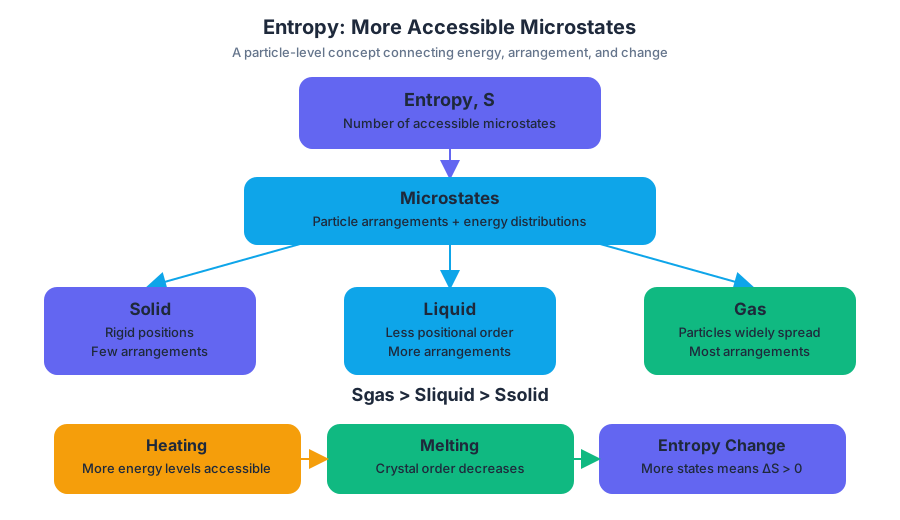
At the particulate level, entropy is connected to the number of available microstates, meaning the possible arrangements of particles and energy. More accessible arrangements correspond to greater entropy. This is why a gas generally has greater entropy than a liquid, and a liquid generally has greater entropy than a solid:
$$S_{\text{gas}} > S_{\text{liquid}} > S_{\text{solid}}$$
Heating also increases entropy. As temperature rises, particles occupy a broader range of energies and move through more possible arrangements. The change is not merely that particles “move faster”; the important point is that higher temperature makes more energy distributions accessible.
AP skill connection — 6.C: Support a claim with evidence from representations or models at the particulate level, such as the structure of atoms and/or molecules. To use 6.C, connect a macroscopic observation—such as melting or heating—to a particle-level model. For example, when ice melts, water molecules lose the rigid positional order of the crystal and can occupy many more arrangements in the liquid. That model supports the claim that $\Delta S > 0$.
9.1 Introduction to Entropy
The CED learning objective 9.1.A: Identify the sign and relative magnitude of the entropy change associated with chemical or physical processes. The symbol $\Delta S$ means entropy change, calculated as the final entropy minus the initial entropy:
$$\Delta S = S_{\text{final}} - S_{\text{initial}}$$
A positive entropy change, $\Delta S > 0$, indicates that the system has access to more arrangements after the process. A negative entropy change, $\Delta S < 0$, indicates fewer accessible arrangements. A phase change from liquid to gas, the expansion of a gas, or the production of more gas particles usually increases entropy.
For chemical reactions, compare the structures and physical states of the reactants and products. A reaction that produces more moles of gas particles generally has a larger positive entropy change than one that produces fewer gas particles. However, particle count is evidence—not an automatic rule: molecular complexity, phase, and the types of particles also matter.
Misconception check: “Entropy means disorder”
“Disorder” is a useful first image but an incomplete definition. Entropy is not a visual judgment about whether a sample looks messy; it concerns the number of microscopic arrangements available to the particles and energy. A neatly arranged gas can still have greater entropy than a disordered solid because gas particles have far more freedom to move.
9.2 Absolute entropy and entropy change
Absolute entropy is the entropy of a substance itself, not the change caused by a process. Standard molar entropy, written $S^\circ$, is the absolute entropy of $1$ mole of a substance under standard conditions, commonly reported in $\mathrm{J,mol^{-1},K^{-1}}$. Unlike enthalpy values that may be assigned relative zeros, absolute entropies can be used directly in reaction calculations.
The CED learning objective 9.2.A: Calculate the standard entropy change for a chemical or physical process based on the absolute entropies (standard molar entropies) of the species involved in the process. Its essential knowledge statement, 9.2.A.1, gives the central relationship:
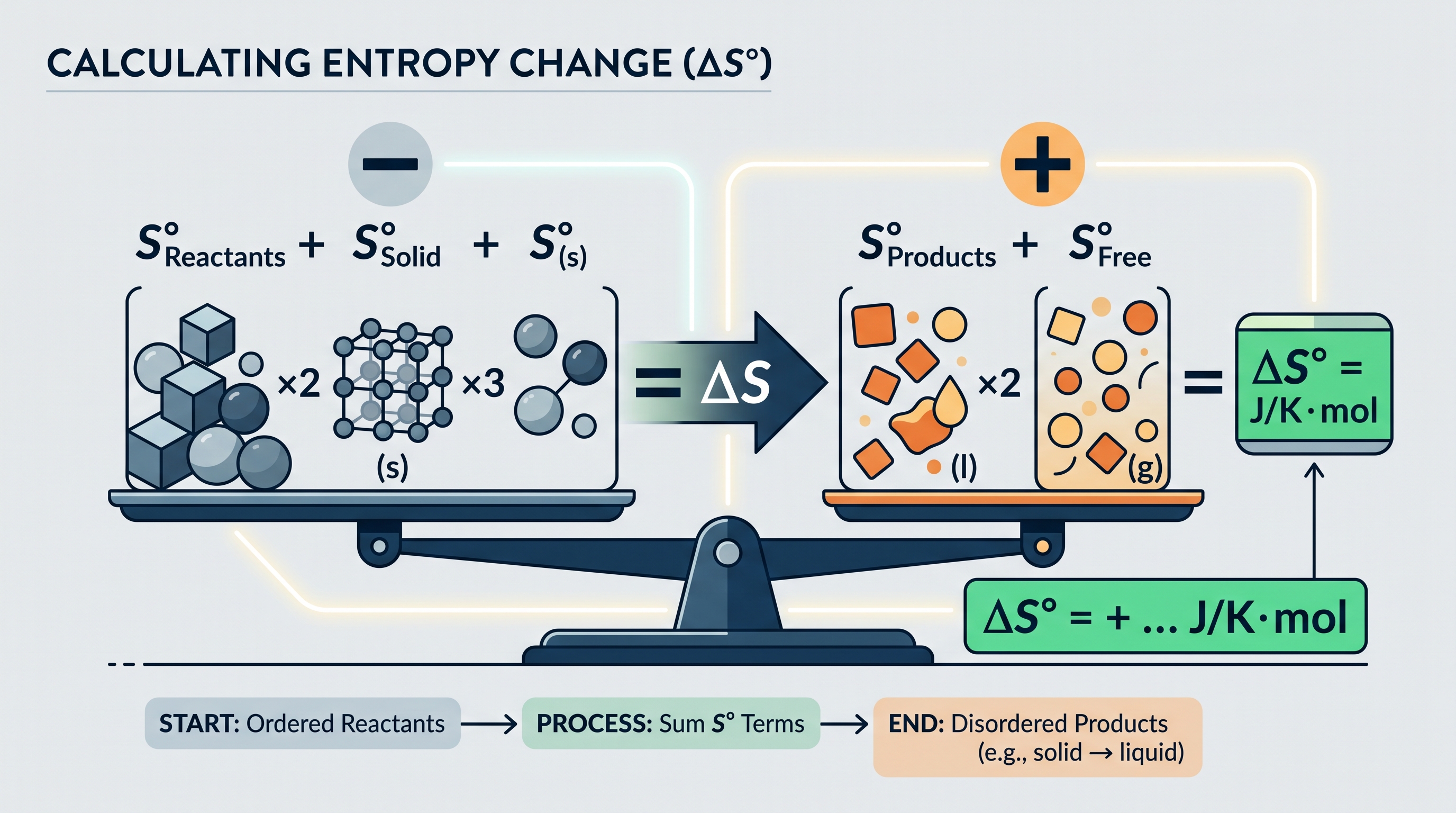
$$\Delta S^\circ_{\text{reaction}}= \sum S^\circ_{\text{products}}- \sum S^\circ_{\text{reactants}}$$
The coefficients in the balanced equation multiply the standard molar entropy values. The units remain $\mathrm{J,mol^{-1},K^{-1}}$ for a reaction as written. Always subtract reactants from products; reversing that order changes the sign.
Worked example: a chemical process
Suppose a reaction as written has the following standard molar entropies:
$$ \mathrm{A(g)+2B(g)\rightarrow C(g)} $$
$$S^\circ_{\mathrm{A}}=190\ \mathrm{J,mol^{-1},K^{-1}}$$
$$S^\circ_{\mathrm{B}}=160\ \mathrm{J,mol^{-1},K^{-1}}$$
$$S^\circ_{\mathrm{C}}=250\ \mathrm{J,mol^{-1},K^{-1}}$$
Apply the products-minus-reactants pathway:
$$\Delta S^\circ= (1)(250)- \left[(1)(190)+(2)(160)\right]$$
$$\Delta S^\circ=250-510=-260\ \mathrm{J,mol^{-1},K^{-1}}$$
The negative result means the products have fewer accessible arrangements overall. The reaction changes three moles of gaseous particles into one mole of gaseous particles, providing a strong particle-level explanation for $\Delta S^\circ<0$.
Misconception check: absolute entropy is not entropy change
A substance can have a large positive absolute entropy, $S^\circ$, while participating in a process with a negative $\Delta S^\circ$. For example, the products may each have substantial entropy, yet their stoichiometric total can still be smaller than the reactants’ total. Never interpret the sign of an individual $S^\circ$ value as the sign of the process’s $\Delta S^\circ$.
Worked example: a physical process
For vaporization,
$$ \mathrm{H_2O(l)\rightarrow H_2O(g)} $$
if $S^\circ_{\mathrm{H_2O(l)}}=70.0\ \mathrm{J,mol^{-1},K^{-1}}$ and $S^\circ_{\mathrm{H_2O(g)}}=189.0\ \mathrm{J,mol^{-1},K^{-1}}$, then
$$\Delta S^\circ= 189.0-70.0= +119.0\ \mathrm{J,mol^{-1},K^{-1}}$$
The positive value matches the physical model: liquid water molecules become gas particles with much greater freedom of translation and many more accessible arrangements. The same calculation applies to melting, freezing, sublimation, condensation, and other physical processes; only the substances and states before and after the process change.
Exam-ready calculation pathway
AP skill connection — 5.F: Calculate, estimate, or predict an unknown quantity from known quantities by selecting and following a logical computational pathway and attending to precision (e.g., performing dimensional analysis and attending to significant figures). For a standard entropy calculation:
- Balance or write the process correctly, including physical states.
- Identify every product and reactant entropy value.
- Multiply each $S^\circ$ by its stoichiometric coefficient.
- Add the product terms.
- Add the reactant terms.
- Subtract products minus reactants.
- Report the sign, units, and appropriate precision.
Retrieval check: For $\mathrm{X(s)\rightarrow X(l)}$, would $\Delta S^\circ$ usually be positive or negative? Which term belongs first in the calculation: $S^\circ_{\mathrm{X(s)}}$ or $S^\circ_{\mathrm{X(l)}}$? The answer is positive, with the liquid term first:
$$\Delta S^\circ=S^\circ_{\mathrm{X(l)}}-S^\circ_{\mathrm{X(s)}}$$
Source Materials
- AP Chemistry Course and Exam Description
- AP Chemistry Course and Exam Description Clarifications and Corrections
- AP Chemistry Course Overview
- AP Chemistry Course at a Glance
- AP Chemistry Course at a Glance Poster
- Adopt AP Chemistry
- AP Chemistry
- AP Chemistry
- AP Chemistry-AP Students
- AP/College Chemistry-Khan Academy
- Guide to the AP Chemistry Exam-The Princeton Review
- AP Chemistry-Wikipedia