From the free course AP Chemistry on Lykke
7.7 Calculating Equilibrium Concentrations · 7.8 Representations of Equilibrium
Key concepts: Writing equilibrium constant expressions from balanced chemical equations · Calculating equilibrium concentrations using stoichiometry and equilibrium relationships · Distinguishing equilibrium concentrations from initial concentrations · Calculating and interpreting the reaction quotient Q · Comparing Q with K to predict the direction of equilibrium shift · Applying Le Châtelier’s principle to stress an equilibrium system · Representing equilibrium at the particulate level · Using stoichiometric coefficients to determine ion ratios in solution · Calculating solubility equilibria with Ksp · Recognizing common student errors in equilibrium calculations and diagrams
At equilibrium, a reaction mixture is not “finished”: particles continue colliding and reacting in both directions, while the macroscopic concentrations remain constant. The central calculation is therefore to connect a balanced equation, concentration changes, and the equilibrium constant.
7.7 Calculating Equilibrium Concentrations · 7.8 Representations of Equilibrium
At equilibrium, a reaction mixture is not “finished”: particles continue colliding and reacting in both directions, while the macroscopic concentrations remain constant. The central calculation is therefore to connect a balanced equation, concentration changes, and the equilibrium constant.
Learning Objective 7.7: The student is able to calculate equilibrium concentrations by applying stoichiometry and the equilibrium constant expression.
Essential Knowledge 7.7.A: The equilibrium constant expression relates equilibrium concentrations of reactants and products.
Learning Objective 7.8: The student is able to use representations to describe the relationships between the concentrations of reactants and products in an equilibrium system.
Essential Knowledge 7.8.A: Representations of equilibrium must agree with the balanced equation and its stoichiometric relationships.
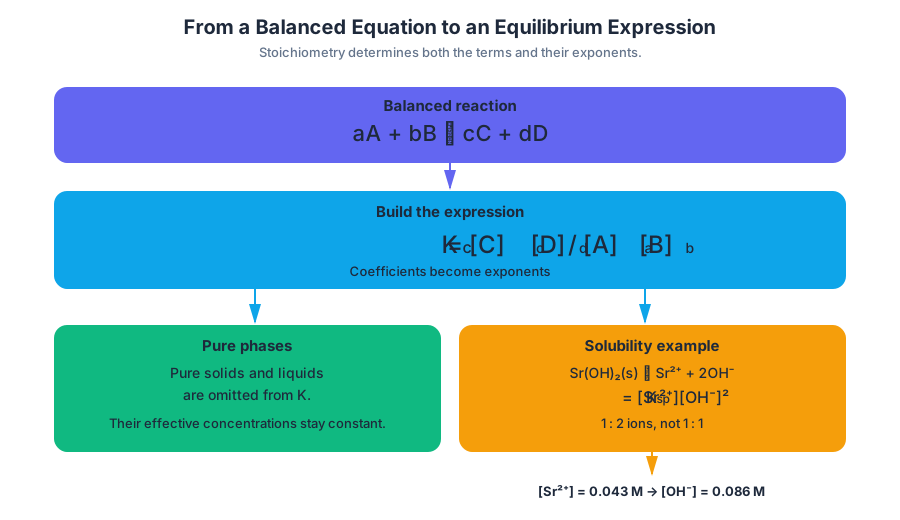
From a balanced equation to an equilibrium expression
For the general reaction
aA+bB\rightleftharpoons cC+dD
the concentration-based equilibrium constant is
$$ K_c=\frac{[C]^c[D]^d}{[A]^a[B]^b}. $$
The exponents are the stoichiometric coefficients from the balanced equation. Pure solids and pure liquids are omitted because their effective concentrations remain constant.
For example,
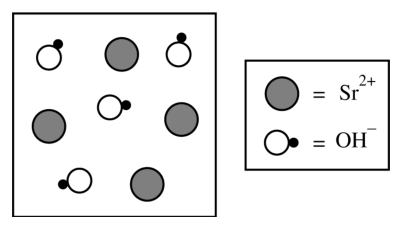
Sr(OH)_2(s)\rightleftharpoons Sr^{2+}(aq)+2OH^-(aq)
has
$$ K_{sp}=[Sr^{2+}][OH^-]^2. $$
The solid $Sr(OH)_2$ does not appear. If a saturated solution contains $[Sr^{2+}]=0.043\ \mathrm{M}$, the balanced equation requires
$$ [OH^-]=2(0.043\ \mathrm{M})=0.086\ \mathrm{M}. $$
Thus,
$$ K_{sp}=(0.043)(0.086)^2=3.18\times10^{-4}. $$
Misconception check — “The ions dissolve in a $1:1$ ratio.” They do not. Each formula unit produces one $Sr^{2+}$ ion and two $OH^-$ ions. A particulate model must therefore show twice as many hydroxide ions as strontium ions.
Calculating equilibrium concentrations with an ICE relationship
An ICE relationship records initial concentration, change, and equilibrium concentration. The change row comes directly from stoichiometry; the equilibrium row combines the initial amount with the unknown change.
Consider
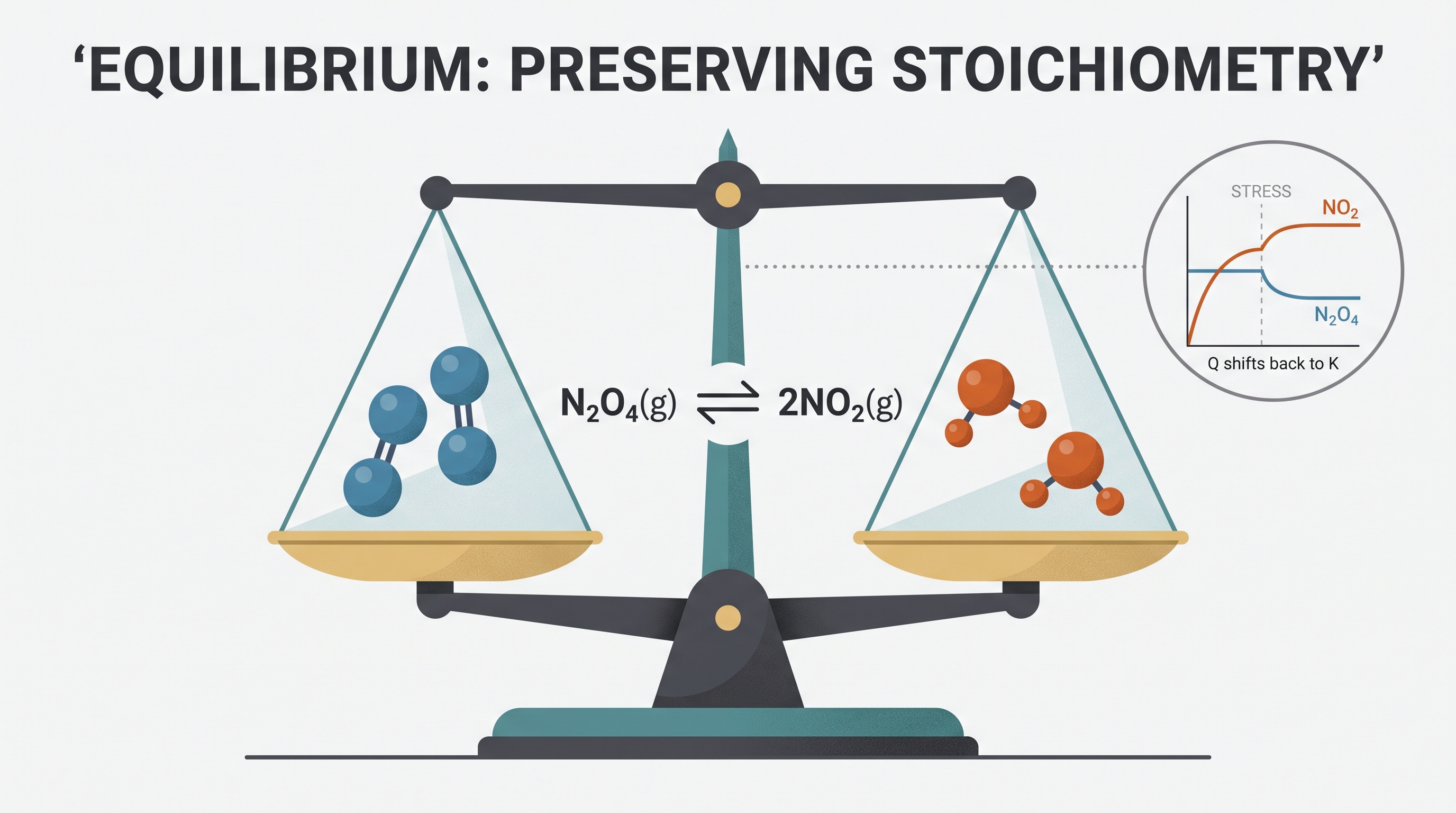
N_2O_4(g)\rightleftharpoons 2NO_2(g)
with initial concentrations $[N_2O_4]_0=1.00\ \mathrm{M}$ and $[NO_2]_0=0$, and $K_c=0.36$.
| Species | Initial | Change | Equilibrium |
|---|---|---|---|
| $N_2O_4$ | $1.00$ | $-x$ | $1.00-x$ |
| $NO_2$ | $0$ | $+2x$ | $2x$ |
Substitute the equilibrium concentrations into the expression:
$$ 0.36=\frac{[NO_2]^2}{[N_2O_4]} =\frac{(2x)^2}{1.00-x}. $$
Solving gives $x=0.258$ (the negative mathematical root is chemically impossible). Therefore,
$$ [N_2O_4]_{\mathrm{eq}}=1.00-0.258=0.742\ \mathrm{M} $$
and
$$ [NO_2]_{\mathrm{eq}}=2(0.258)=0.517\ \mathrm{M}. $$
Equilibrium check:
$$ K_c=\frac{(0.517)^2}{0.742}=0.360\approx0.36. $$
The result is self-consistent. Notice that $NO_2$ changes by $2x$, not $x$; losing that coefficient produces an incorrect equilibrium composition even if the algebra is flawless.
The reaction quotient predicts the net direction
The reaction quotient, $Q$, has the same concentration form as $K$, but it uses concentrations that are not necessarily at equilibrium:
$$ Q_c=\frac{[C]^c[D]^d}{[A]^a[B]^b}. $$
Compare $Q$ with the already-known value of $K$:
- If $Q<K$, the mixture contains too much reactant relative to equilibrium, so the net reaction proceeds toward products.
- If $Q>K$, the mixture contains too much product, so the net reaction proceeds toward reactants.
- If $Q=K$, the system is at equilibrium.
For the $N_2O_4/NO_2$ system, suppose the current concentrations are $[N_2O_4]=0.80\ \mathrm{M}$ and $[NO_2]=0.20\ \mathrm{M}$:
$$ Q_c=\frac{(0.20)^2}{0.80}=0.050. $$
Because $0.050<0.36$, the net change is toward products: more $N_2O_4$ dissociates to form $NO_2$ until $Q$ rises to $K$.
Representations must preserve stoichiometry
A correct equilibrium representation can be symbolic, graphical, particulate, or numerical, but all representations must tell the same chemical story. For $N_2O_4\rightleftharpoons2NO_2$, a particle diagram must represent each $N_2O_4$ molecule as one unit and each dissociation event as two $NO_2$ molecules; a $1:1$ product ratio contradicts the equation.
A specific stress can temporarily make $Q\ne K$. For example, adding $N_2O_4$ increases the denominator of
$$ Q_c=\frac{[NO_2]^2}{[N_2O_4]}, $$
so $Q$ becomes less than $K$. The system responds by shifting toward $NO_2$, restoring $Q=K$; the value of $K$ itself changes only if temperature changes.
Retrieval check: For
A(s)\rightleftharpoons2B(aq),
write the equilibrium expression, state the concentration change if $[A]$ dissolves by $x$, and predict the direction when $Q>K$.
Answer: $K=[B]^2$; $[B]$ changes by $+2x$; the system shifts toward reactants.
Source Materials
- AP Chemistry Course and Exam Description
- AP Chemistry Course and Exam Description Clarifications and Corrections
- AP Chemistry Course Overview
- AP Chemistry Course at a Glance
- AP Chemistry Course at a Glance Poster
- Adopt AP Chemistry
- AP Chemistry
- AP Chemistry
- (a) A student draws the particulate diagram shown to represent the ions present in an aqueous solution of
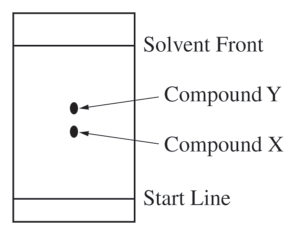
- (c) A second student conducts the same chromatography experiment but removes the chromatography paper from the chamber after 15 minutes instead of 30 minutes. Predict the effect, if any, this would ha
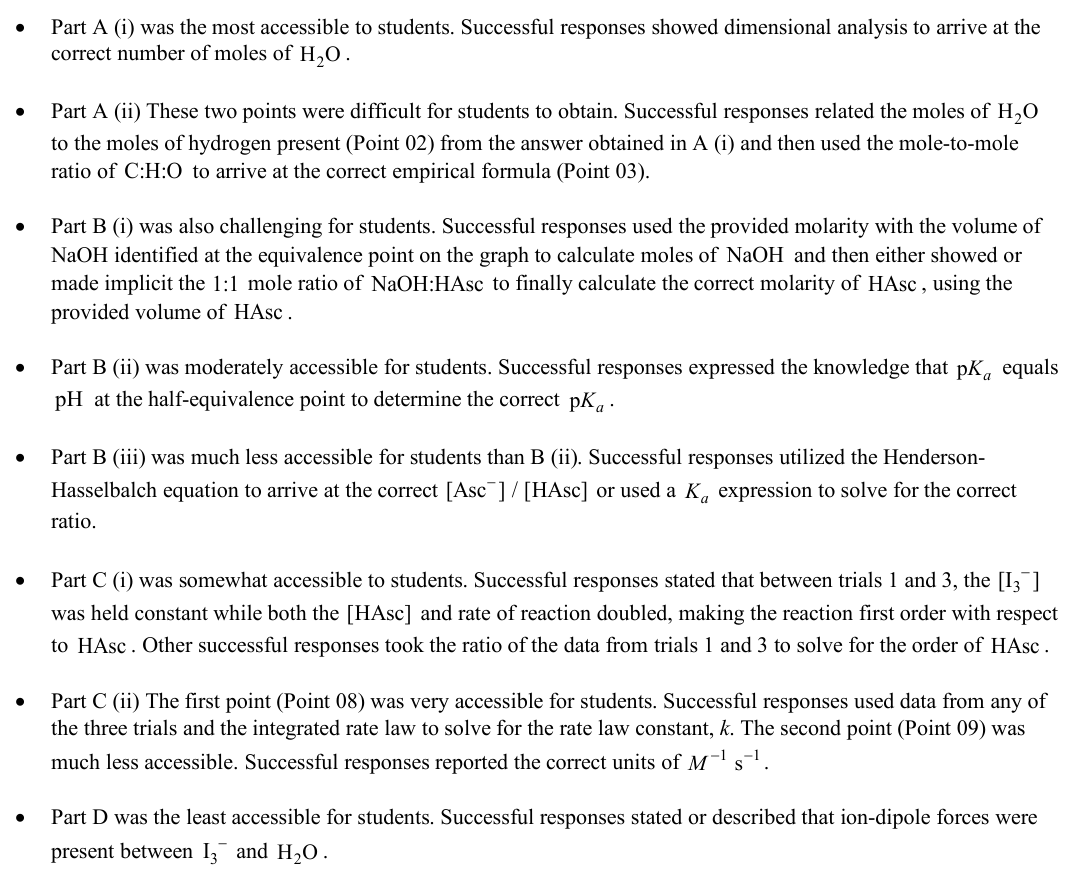
- What common student misconceptions or gaps in knowledge were seen in the responses to this question?