From the free course AP Chemistry on Lykke
7.9 Introduction to Le Châtelier’s Principle · 7.10 Reaction Quotient and Le Châtelier’s Principle
Key concepts: Le Châtelier’s principle · Dynamic chemical equilibrium · Reaction quotient (Q) and equilibrium constant (K) · Effects of concentration disturbances on equilibrium · Effects of pressure and volume changes on gaseous equilibria · Redistribution of species to restore equilibrium · Equilibrium shifts in response to removing a species · Solubility equilibria · Interpreting macroscopic and particle-level changes · Using equilibrium reasoning to explain changes in amount and concentration
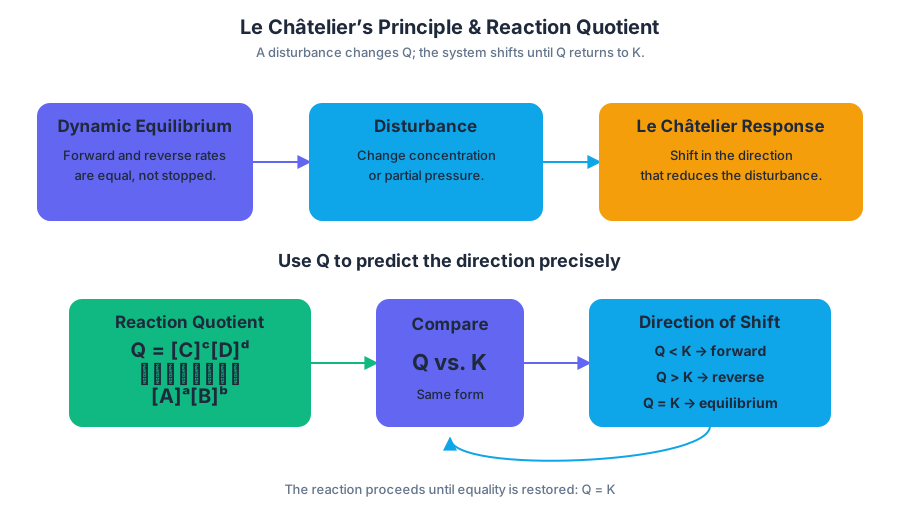
A chemical equilibrium is not frozen: particles continue reacting in both directions, but the forward and reverse reaction rates are equal. The system appears unchanged because its composition is dynamically maintained.
7.9 Introduction to Le Châtelier’s Principle · 7.10 Reaction Quotient and Le Châtelier’s Principle
A chemical equilibrium is not frozen: particles continue reacting in both directions, but the forward and reverse reaction rates are equal. The system appears unchanged because its composition is dynamically maintained.
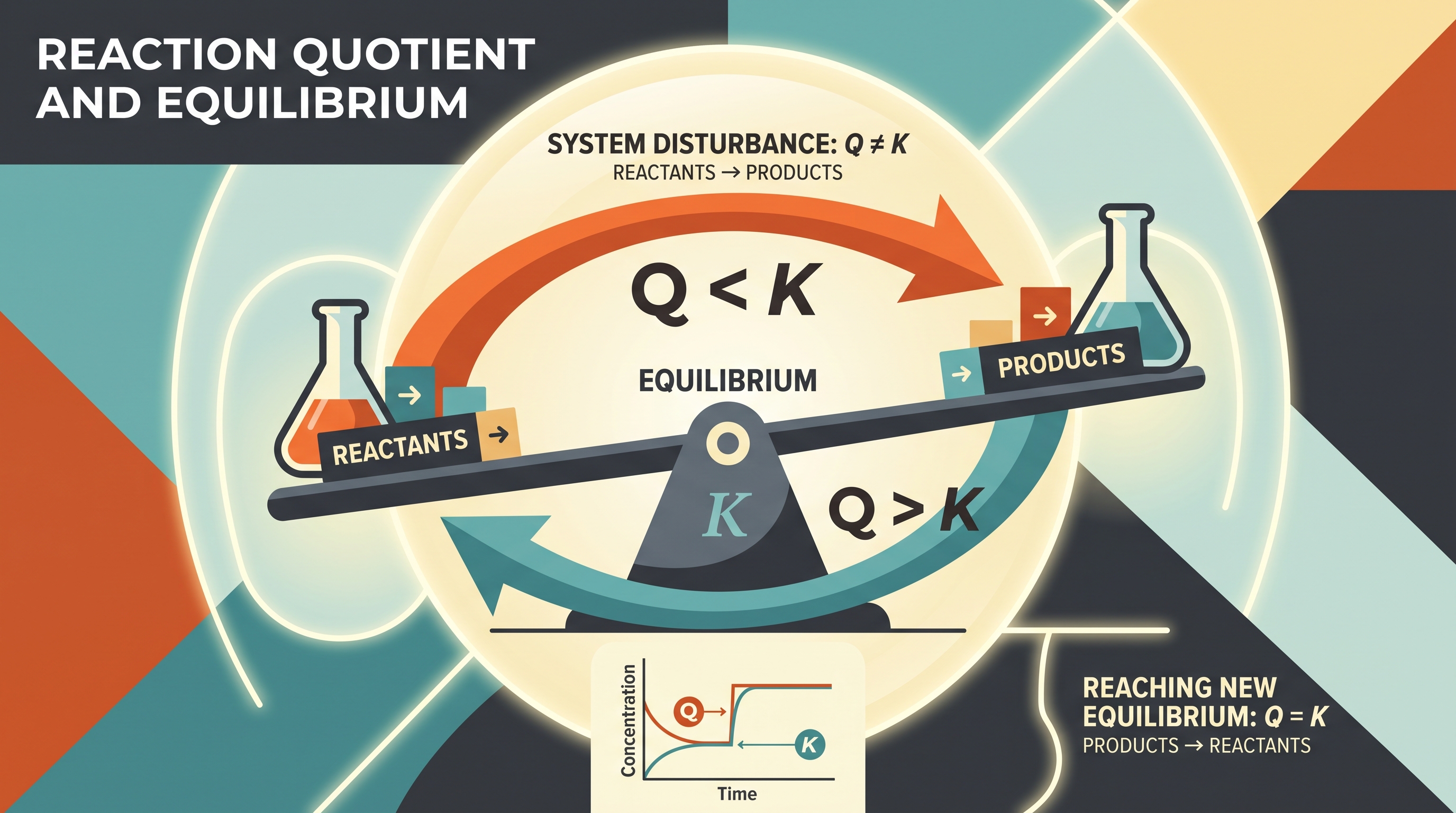
Le Châtelier’s principle: When an equilibrium system is disturbed, the system responds by shifting in the direction that reduces the effect of the disturbance.
The most precise way to predict that shift is to compare the reaction quotient, $Q$, with the equilibrium constant, $K$.
For a general reaction,
aA+bB\rightleftharpoons cC+dD
the reaction quotient has the same form as the equilibrium-constant expression:
$$ Q=\frac{[C]^c[D]^d}{[A]^a[B]^b} $$
At equilibrium,
$$ Q=K $$
A disturbance changes one or more concentrations or partial pressures. Immediately afterward, $Q$ usually no longer equals $K$, and the reaction proceeds in whichever direction restores equality.
The $Q$–$K$ decision rule
The three cases below replace vague “shift left” or “shift right” intuition with a testable prediction.
| Comparison after disturbance | System response | Chemical interpretation |
|---|---|---|
| $Q<K$ | Proceeds toward products | $Q$ must increase |
| $Q>K$ | Proceeds toward reactants | $Q$ must decrease |
| $Q=K$ | No net shift | The system is already at equilibrium |
The concentrations may change while the system re-equilibrates, but at the new equilibrium the final quotient again satisfies $Q=K$. For a temperature change, the value of $K$ itself changes; for a concentration or pressure disturbance, $K$ remains constant at the same temperature.
Worked example: adding a product
Consider
H_2(g)+I_2(g)\rightleftharpoons 2HI(g)
with
$$ Q=\frac{[HI]^2}{[H_2][I_2]} $$
If additional $HI$ is injected, the numerator increases immediately while the denominator is initially unchanged. Therefore $Q$ becomes larger than $K$:
$$ Q>K $$
The system consumes some $HI$ and produces $H_2$ and $I_2$, shifting toward reactants until $Q$ returns to $K$. Saying “the equilibrium shifts left” is incomplete unless it identifies the particle-level change: $HI$ decreases while $H_2$ and $I_2$ increase during the response.
Misconception check — “The reaction stops at equilibrium.” Equilibrium means equal rates, not equal concentrations and not zero reaction. Both directions continue, while the concentrations remain constant overall.
Concentration disturbances and a saturated magnesium hydroxide system
A saturated solution containing undissolved magnesium hydroxide can be represented by
Mg(OH)_2(s)\rightleftharpoons Mg^{2+}(aq)+2OH^-(aq)
The solid does not appear in the reaction quotient because the activity of a pure solid is treated as constant. Thus,
$$ Q=\left[Mg^{2+}\right]\left[OH^-\right]^2 $$
Suppose acid is added. The hydrogen ions react with hydroxide ions:
$$ H^+(aq)+OH^-(aq)\rightarrow H_2O(l) $$
Removing $OH^-$ decreases the numerator of $Q$, so immediately,
$$ Q<K $$
The system responds by dissolving more $Mg(OH)_2(s)$, producing additional $Mg^{2+}$ and $OH^-$. Therefore, the amount of undissolved solid decreases. The observable pH also changes because hydroxide has been consumed.
This reasoning is stronger than saying simply “the equilibrium shifts right.” It connects the observable disturbance—adding acid—to the particle-level event—hydroxide removal—and then to the macroscopic result—more solid dissolves.
Pressure and volume changes in gaseous equilibria
Changing the container volume changes the partial pressures of all gases. A decrease in volume raises every partial pressure; an increase in volume lowers every partial pressure. The equilibrium response depends on the total gaseous coefficients on each side.
For
there are two moles of gaseous reactants and two moles of gaseous products:
$$ \Delta n_{\text{gas}}=2-2=0 $$
If the volume changes, every gas concentration changes by the same factor. In the quotient,
$$ Q=\frac{[HI]^2}{[H_2][I_2]} $$
the common factor cancels, so $Q$ remains equal to $K$. There is no equilibrium shift, and the amount of $HI$ remains unchanged.
Reading an observable change
If an experiment reports that the moles of $HI(g)$ increase, that is evidence that the system moved toward products, meaning more $H_2$ and $I_2$ were converted into $HI$. Do not call $H_2$ and $I_2$ products: they are reactants in the written equation, while $HI$ is the product.
Misconception check — “Higher pressure always favors products.” Pressure changes favor the side with fewer gaseous moles only when the two sides have different gas totals. When $\Delta n_{\text{gas}}=0$, pressure or volume changes do not alter the equilibrium position.
AP Chemistry reasoning: 7.10.A and 5.F
Learning Objective 7.10.A requires explaining the relationship among $Q$, $K$, and the direction in which a reversible reaction proceeds to reach equilibrium.
Essential Knowledge 7.10.A.1: A disturbance causes $Q$ to differ from $K$, taking the system out of equilibrium; the system responds by bringing $Q$ back into agreement with $K$.
Essential Knowledge 7.10.A.2: Concentration changes generally change $Q$ only, whereas temperature changes $K$; in either case, species redistribute until $Q$ and $K$ are equal again.
Suggested Skill 5.F: Mathematical Routines is assessed when you calculate, estimate, or predict an unknown quantity by selecting a logical computational pathway and attending to precision. Here, the pathway is: write $Q$, identify what changed, compare $Q$ with $K$, and predict the direction of redistribution.
Retrieval check: For the magnesium hydroxide equilibrium, acid removes $OH^-$. Does $Q$ become greater than, less than, or equal to $K$? What happens to the amount of solid? For the hydrogen–iodine equilibrium, why does increasing volume leave the amount of $HI$ unchanged?
Source Materials
- AP Chemistry Course and Exam Description
- AP Chemistry Course and Exam Description Clarifications and Corrections
- AP Chemistry Course Overview
- AP Chemistry Course at a Glance
- AP Chemistry Course at a Glance Poster
- Adopt AP Chemistry
- AP Chemistry
- AP Chemistry
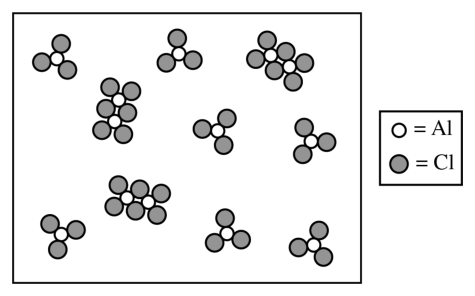
- (f) Using the particle-level diagram, calculate the value of K p for the reaction if the total pressure in the container