AP European History
171 study materials · 52 sections
AP European History students working the current College Board Course and Exam Description, including first-time students with no prior background, plus teachers reviewing the page for CED alignment.; Teach every official CED unit and every numbered topic at topic granularity.; Develop every AP skill / science-practice code explicitly and by name.; Replace description with teaching: worked contextual examples, named misconceptions, and in-flow retrieval checks.; Build an exam-practice unit covering every task type on the current exam.
Course Sections
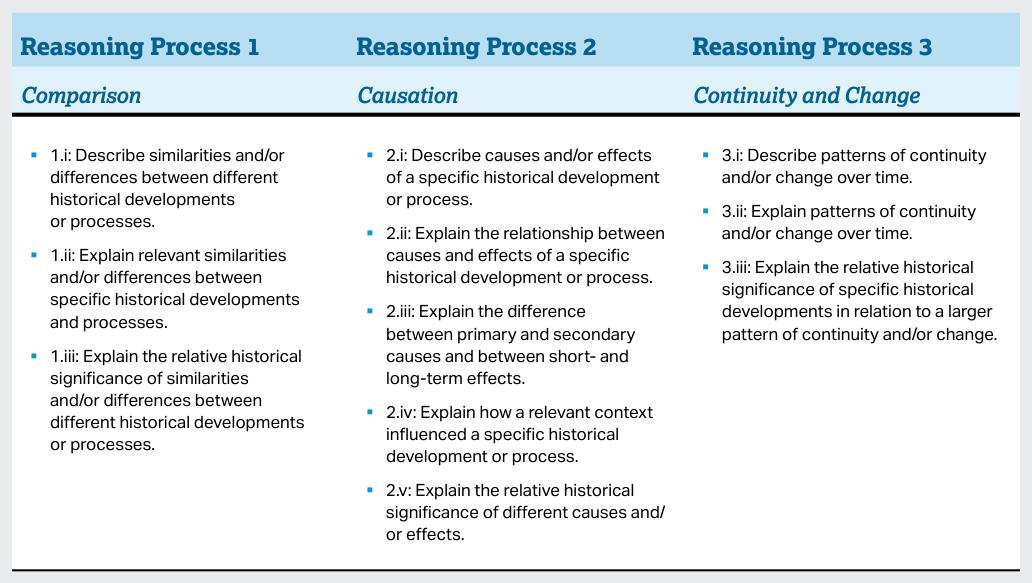
Course Framework, Skills and Reasoning Processes
Key concepts: Analyzing and interpreting historical evidence · Developing historical thinking skills · Developing historical reasoning processes · Integrating course content with skills · Using scaffolding to support skill development · Understanding major developments in European history · Learning through course units and conceptual understandings · Using cross-cutting themes to build conceptual understanding · Using progress data to identify strengths and areas for improvement · College-level modern European history survey expectations
Historical understanding begins when evidence is turned into an explanation: a painting, law, statistic, speech, map, or historian’s interpretation becomes meaningful only when its origin, context, claims, and consequences are examined together.
1.1 Contextualizing Renaissance and Discovery · 1.2 Italian Renaissance
Key concepts: Renaissance and Discovery · Contextualizing historical developments · Italian Renaissance · Revival of Greek and Roman texts and ideas · Renaissance humanism · Leonardo Bruni · Patronage and funding of artists and thinkers · Fall of Constantinople and arrival of Greek refugee scholars · Italian and Northern Renaissance comparison · AP European History Unit 1 topics 1.1 and 1.2
The Italian Renaissance began when European intellectuals and artists turned renewed attention toward the texts, values, and visual models of ancient Greece and Rome. In Italy’s wealthy, competitive city-states, this classical revival became more than an interest in old books: it reshaped education, art, political…
1.3 Northern Renaissance · 1.4 Printing
Key concepts: Northern Renaissance · Italian Renaissance · Christian humanism · Secular humanism · Printing press and expansion of literacy · Medici family patronage · Renaissance art and Greek/Roman ideals · French Protestantism and the Reformation · Religious and secular approaches to knowledge · Trade, banking, and Italian city-states
The Renaissance did not travel north as a carbon copy of Florence: it changed emphasis as it encountered different religious, social, and intellectual settings. The key contrast is not “religious art versus nonreligious art,” but the different relationships between humanist learning, Christianity, and secular life.
1.5 New Monarchies · 1.6 Technological Advances and the Age of Exploration
Key concepts: New Monarchies · Royal control over religious life and morality · Nobles of the robe · Age of Exploration · Technological and Scientific Innovation · Guns and gunpowder · Enclosure movement · Revival of classical texts · European overseas exploration and settlement · Indigenous population encounters and destruction
Between the late fifteenth and early seventeenth centuries, European rulers strengthened states at home while new technologies projected European power overseas. The same period that produced more centralized monarchies also produced oceanic exploration, colonial settlement, and devastating encounters with…
1.7 Rivals on the World Stage · 1.8 Colonial Expansion and the Columbian Exchange
Key concepts: European exploration and overseas expansion · Colonialism and the acquisition of overseas colonies · Portuguese expansion in the Indian Ocean · European colonial empires · Capitalism and commercial development · Global trade networks · The Columbian Exchange · Transatlantic exchange of plants, animals, and diseases · Social and cultural impacts of colonial expansion · The integration of Europe and the Americas into a global economy
Between approximately 1450 and 1750, European states transformed competition for wealth and power into overseas empire-building. The result was not merely more trade: Europe, Africa, Asia, and the Americas became connected through coercive colonial systems, commercial networks, and the biological exchange now…
1.9 The Slave Trade · 1.10 The Commercial Revolution
Key concepts: The Slave Trade · The Commercial Revolution · Price Revolution · Accumulation of Capital · Expansion of the Market Economy · Transatlantic Slave-Labor Systems · Middle Passage · Triangle Trade · Urbanization · Consumerism
Atlantic commerce transformed European economies through two linked processes: the expansion of transatlantic slave-labor systems and the Commercial Revolution, the growth of commercial activity, capital, markets, and long-distance exchange from the late fifteenth through seventeenth centuries.
1.11 Causation in the Renaissance and Age of Discovery
Key concepts: Causation · Renaissance · Age of Discovery · Causes and effects · European colonial expansion · Commercial and agricultural developments · Urban financial centers · Commercial and religious motives for exploration · Overseas exploration, settlement, and colonization · Renaissance visual arts and their personal, political, and religious purposes
Between approximately $1450$ and $1648$, European intellectual change and overseas expansion grew from a shared environment of urban wealth, political competition, revived classical learning, expanding trade, and religious ambition.
2.1 Contextualizing 16th- and 17th-Century Challenges and Developments · 2.2 Luther and the Protestant Reformation
Key concepts: Luther and the Protestant Reformation · Criticism of Catholic abuses · New interpretations of Christian doctrine and practice · Political, intellectual, economic, cultural, and social effects of responses to Luther · The sovereign state · Secular systems of law · Subordination of the church to the secular state · Religious conflicts as a basis for state authority · Established class, religious, and gender hierarchies · The relationship between traditional authority and differing world views
By the early sixteenth century, western Christianity resembled a vast political and cultural network—but one whose central institution faced mounting criticism. Martin Luther’s challenge to Catholic abuses did more than divide religious belief: it changed how Europeans understood authority, law, knowledge, social…
2.3 Protestant Reform Continues · 2.4 Wars of Religion
Key concepts: Protestant Reformation · religious reform and political power · religious wars · Protestant persecution · religious toleration · cuius regio, eius religio · absolutism in France · Edict of Nantes · Peace of Westphalia · decline of universal Christendom
Religious reform became politically explosive when rulers, nobles, and communities treated confessional identity as a question of sovereignty: who controls the church may also control the state.
2.5 The Catholic Reformation · 2.6 16th-Century Society and Politics
Key concepts: Catholic Reformation · Religious division within Christianity · Northern Renaissance · Printing · 16th-century society and politics · Women’s education and social roles · State control of religious institutions · Social dislocation and challenges to state authority · Secular and cultural systems of law · Historical source analysis: point of view, purpose, audience, and situation
By the mid-16th century, Christianity in Europe was no longer a single institutional world: Catholic renewal strengthened the Roman Church even as Protestant reform made religious unity impossible.
2.7 Art of the 16th Century: Mannerism and Baroque Art · 2.8 Causation in the Age of Reformation and the Wars of Religion
Key concepts: Mannerism and Baroque art · Baroque artists and musicians promoting religion or glorifying monarchs · Catholic theology from Augustine through the late Middle Ages · The Reformation and Counter-Reformation/Catholic Reformation · Religious documents and theological arguments · Monarchs’ control of religious institutions · The Peace of Westphalia and religious settlement · Causation in the Wars of Religion · Enlightenment intellectuals, including Voltaire and Diderot · Historical argumentation using claims and evidence
Explain and apply 2.7 Art of the 16th Century: Mannerism and Baroque Art · 2.8 Causation in the Age of Reformation and the Wars of Religion.
3.1 Contextualizing State Building · 3.2 The English Civil War and the Glorious Revolution
Key concepts: State building and political centralization · Monarchical control · Absolutism and constitutionalism · Sovereignty within and among states · Competition for political power · Religious conflicts and state exploitation · The English Civil War · The roles of monarchy, Parliament, and elites · Administrative expansion of state power · The Glorious Revolution
European state building after 1450 was a contest over one fundamental question: who had the right to make laws, collect taxes, command armies, and define the political order?
3.3 Continuities and Changes to Economic Practice and Development · 3.4 Economic Development and Mercantilism
Key concepts: Capitalism · Market economy · Putting-out system (cottage industry) · Financial practices and institutions · Agricultural exchange between the Americas and Europe · Mercantilism · Absolutism · Enlightenment political and economic theories · Economic development and social change · Continuities and changes in commercial and economic development
Between $1648$ and $1815$, European economies did not simply replace an old system with a new one. Traditional agriculture, state regulation, and social hierarchies continued, while expanding markets, private investment, global trade, and new labor arrangements gradually transformed how Europeans produced,…
3.5 The Dutch Golden Age · 3.6 Balance of Power
Key concepts: Dutch Golden Age · Dutch East India Company · Balance of power · Competitive state system · Diplomacy and warfare · Military revolution · Nationalism and imperialism · Treaty of Westphalia · Congress of Vienna · European state formation
The Dutch Republic became powerful without becoming Europe’s largest kingdom. Its advantage came from combining maritime commerce, overseas empire, financial expertise, and a political system capable of supporting war.
3.7 Absolutist Approaches to Power · 3.8 Comparison in the Age of Absolutism and Constitutionalism
Key concepts: Absolutist approaches to power · Comparison of absolutism and constitutionalism · Different models of political sovereignty · Limits of absolutism · Peter the Great’s westernization of Russia · Louis XIV and absolutism · Commercial and professional groups gaining political power · Language and cultural identities · Hugo Grotius · Niccolò Machiavelli
Between 1648 and 1815, European rulers tried to turn political authority into a centralized command system—but no monarch ruled without constraints. Absolutism means an approach to government in which a monarch claims extensive, centralized authority over administration, taxation, law, religion, and the military.
4.1 Contextualizing the Scientific Revolution and the Enlightenment · 4.2 The Scientific Revolution
Key concepts: Scientific Revolution · Enlightenment · Experimentation and mathematics · Challenges to classical views of the cosmos · Commercial Revolution · Changing demographic patterns in Europe · Public venues and print media · Political and economic theories challenging absolutism and mercantilism · Natural religion and religious toleration · Historical contextualization (Contextualization 4.A)
Between the sixteenth and eighteenth centuries, Europeans increasingly treated nature as something to investigate, measure, and explain rather than merely inherit from ancient authorities. The Scientific Revolution did not erase religion or tradition; it created a new contest over which methods—and which kinds of…
4.3 The Enlightenment · 4.4 18th-Century Society and Demographics
Key concepts: Enlightenment thought · Rousseau · Traditional authority and differing worldviews · Salons and the dissemination of Enlightenment culture · John Locke’s political theory · Self-interest and the origins of the state · 18th-century demographic change · Plague and smallpox inoculation · 18th-century art and literature · Women’s status and citizenship in the republic
The Enlightenment asked a disruptive question: what should happen when reason, evidence, and individual rights conflict with authority inherited from tradition? Its answer reshaped political theory, intellectual life, economic thought, and social debate across Europe from 1648 to 1815.
4.5 18th-Century Culture and Arts · 4.6 Enlightened and Other Approaches to Power
Key concepts: 18th-century culture and arts · Enlightened and other approaches to power · Cultural and intellectual development · States and other institutions of power · Social organization and development · National and European identity · Printing and public opinion · Napoleon’s rise, dominance, and defeat · Domestic reforms and practices under Napoleon · Relations with other religious communities
In the eighteenth century, culture became a political force: books, newspapers, salons, paintings, theaters, and public debate helped Europeans decide which institutions deserved obedience. At the same time, rulers borrowed Enlightenment language to strengthen states—sometimes reforming government, sometimes simply…
4.7 Causation in the Age of the Scientific Revolution and the Enlightenment
Key concepts: Scientific Revolution · Enlightenment · Empiricism and skepticism · Rationalism and classical sources of knowledge · Inductive and deductive reasoning · Observation, experimentation, and mathematics · Natural rights and the social contract · Natural religion and religious toleration · Print media and new public venues · Alchemy, astrology, and challenges to reason
Why did European thinkers begin to question inherited answers about nature, government, society, and faith? The central causal chain is:
5.1 Contextualizing 18th-century states · 5.2 The rise of global markets
Key concepts: Absolutism · Constitutionalism · Challenges to absolutism · Enlightened monarchs · Global economic networks · Colonial resource extraction · Transatlantic slave-labor system · Commercial rivalries · Diplomacy · European conflict from 1648 to 1815
Between 1648 and 1815, European rulers faced a double challenge: how to concentrate political power at home while competing for wealth and influence in an expanding world economy.
5.3 Britain’s ascendancy · 5.4 The French Revolution
Key concepts: Britain’s ascendancy · French Revolution · causes, events, and consequences of the French Revolution · bread shortages · French involvement in the American Revolution · constitutional monarchy and the Constitution of 1791 · abolition of provinces · Jacobin republic and Robespierre · Revolutionary government and mass conscription · Haitian independence and the legacy of the Revolution
By the late eighteenth century, Britain had become Europe’s leading global power just as France entered a revolution that attempted to remake political authority from the ground up.
5.5 Effects of the French Revolution · 5.6 Napoleon’s rise, dominance, and defeat
Key concepts: Effects of the French Revolution · Napoleon’s rise, dominance, and defeat · The French Revolution’s challenge to Europe’s existing political and social order · Revolutionary armies and mass mobilization · Spread of French revolutionary ideals across Europe · Napoleon’s domestic reforms · Napoleon’s curtailment of rights and manipulation of political institutions · Napoleon’s effects on European social, economic, and political life · European responses to Napoleon’s rule · Historical causation and contextualization
The French Revolution did more than replace one government with another: it challenged the assumption that Europe’s social and political order should rest on inherited privilege, dynastic monarchy, and legally distinct estates.
5.7 The Congress of Vienna · 5.8 Romanticism
Key concepts: Congress of Vienna · Romanticism · Napoleonic Wars and the collapse of the Napoleonic Empire · Restoration of monarchies in Europe · Growth of nationalism in the 1800s · Liberalism and constitutionalism after 1815 · Revolutions of 1848 · National mobilization and wars of resistance · Dreyfus Affair · Franco-Prussian War and German annexation of Alsace-Lorraine
The Congress of Vienna tried to make Europe politically stable after the Napoleonic Wars, but the settlement could not erase the forces those wars had unleashed: liberalism, the belief in constitutional government and individual rights, and nationalism, the belief that people sharing a common identity should…
5.9 Continuity and change in 18th-century states
Key concepts: Continuity and change over time (CCOT) · Argumentation using evidence from the entire unit · Identifying historical patterns and connections · Contextualization of 18th-century states · Comparison among contemporaneous European states · Change from and continuity with preceding historical developments · Similarities and differences across European states or regions · The Enlightenment · Romanticism · Absolutism and constitutionalism
Eighteenth-century Europe changed politically without abandoning its older foundations: monarchs expanded administrative power, but dynastic rule, social hierarchy, and unequal privilege remained remarkably durable. The central historical question is therefore not whether Europe “became modern,” but which…
6.1 Contextualizing industrialization, its origins, and its effects · 6.2 The spread of industry throughout Europe
Key concepts: Industrialization · Industrial Revolution · Capitalism · Economic development · Technological and scientific innovation · Political and social climates · State promotion of industry · Spread of industry from Great Britain to continental Europe · Social, political, and cultural effects of economic development · Relationship between knowledge, traditional authority, and changing worldviews
The Industrial Revolution began in Great Britain because machines, resources, markets, institutions, and political conditions reinforced one another. After 1815, industrialization spread across continental Europe, but it did not simply copy the British experience: governments, social structures, labor systems, and…
6.3 Second-wave industrialization and its effects · 6.4 Social effects of industrialization
Key concepts: Second-wave industrialization · Industrialization in Prussia and German unification · Government-sponsored industrialization · Delayed industrialization · Mass marketing and consumer society · Rising wages and demand for consumer goods · Separate spheres and women’s social roles · Women’s wartime labor during World War I · Industrialization’s social effects · Women’s rights and feminist movements
Industrialization did more than produce more iron, textiles, and machines: it changed who governed, what families bought, where women worked, and how Europeans imagined political rights.
6.5 The Concert of Europe and European conservatism · 6.6 Reactions and revolutions
Key concepts: Economic, social, and cultural exchanges · Atlantic world · Spain’s dominance in sixteenth-century Europe · Asiento · War of the Spanish Succession · Religious conflict and state power · Ottoman Empire · Landholding elites · The nuclear family · Mercantilism
The political order created after Napoleon tried to do two things at once: preserve Europe’s traditional hierarchies and prevent any single state from dominating the continent again.
6.7 Ideologies of change and reform movements · 6.8 19th-century social reform
Key concepts: 19th-century ideologies of change and reform · Liberalism · Popular sovereignty and individual rights · Social and economic reform movements · Mass-based political parties · Feminism and feminist movements · Positivism and the cult of science · Darwinism and Social Darwinism · Nietzsche and Freud · Women’s movement before World War I
Nineteenth-century reformers turned the language of liberalism—popular sovereignty, individual rights, and enlightened self-interest—into demands for political representation, economic protection, education, and gender equality. The central question was no longer simply who ruled, but whose interests counted as…
6.9 Institutional responses and reform · 6.10 Causation in the Age of Industrialization
Key concepts: Institutional responses and reform · Causation in the Age of Industrialization · European governmental and civil institutions, 1450–present · Consolidation of political power · AP Historical Reasoning Process: Causation · Suggested Skill 5.B: explaining how one historical development relates to another · Industrialization and European politics, 1800–1900 · Soviet civic culture and women’s right and obligation to work · Labor shortages caused by rapid economic growth · Historical argumentation using documents and evidence
European governments responded to industrialization by expanding the institutions through which they organized society and consolidated political power. Factories, crowded cities, labor shortages, social inequality, and political unrest transformed economic change into a problem of government.
7.1 Contextualizing 19th-century perspectives and political developments · 7.2 Nationalism
Key concepts: Nationalism as a major 19th-century political ideology · Liberal reform · Political unification · Racialism · Anti-Semitism · Chauvinism and national aggrandizement · National unity and the political power of ethnic minorities · Art expressing shared idealized values such as beauty and patriotism · The period c. 1815–c. 1914
Nationalism is the belief that people who share a common identity—such as language, culture, history, or political loyalties—should possess a strong sense of collective belonging and, often, their own political state.
7.3 National unification and diplomatic tensions · 7.4 Darwinism and Social Darwinism
Key concepts: Nationalism · Racism and antisemitism · Social Darwinism · The failure of the liberal movement in 1848 · National unification and diplomatic tensions · European imperialism in Africa · The “white man’s burden” · Causation · Source point of view, purpose, historical situation, and audience · Technological and Scientific Innovation (TSI)
National unification turned cultural identity into state power—but it also destabilized Europe’s diplomatic balance and encouraged new hierarchies among peoples. The same nineteenth-century age that celebrated national self-determination could define Africans, Jews, and other groups as supposedly inferior, using…
7.5 The Age of Progress and modernity · 7.6 New Imperialism
Key concepts: Age of Progress and modernity · Positivism and the philosophy of progress · Scientific inquiry and empirical evidence · Unintended consequences of scientific and technological change · New Imperialism · Comparison of early imperialism and New Imperialism · European overseas expansion and imperialism · Historical argument and source comparison · Social reform and women’s rights · Chronology and periodization in European history
By the late nineteenth century, many Europeans believed that science, industry, education, and empire were carrying society toward a better future. Yet the same confidence that produced railways, laboratories, and mass production also justified conquest and intensified inequality.
7.7 Global effects of imperialism · 7.8 19th-century culture and arts
Key concepts: New imperialism: causes and effects · Technological enablers of imperialism · Advanced weaponry and industrialization · Communication and transportation technologies · Medical advances and quinine · Imperial resistance and encounters · Fashoda Crisis · Sepoy Mutiny · Imperialism’s effects on European diplomacy and alliance systems · Industrialization, consumerism, and global imperialism
Imperialism transformed more than maps: it changed military power, public health, diplomacy, resistance movements, and the way Europeans imagined the wider world. The same industrial systems that produced railways, telegraphs, and mass-produced weapons also helped European states impose control overseas—and…
7.9 Causation in 19th-century perspectives and political developments
Key concepts: Causation in 19th-century political developments · Nationalism · Imperialism · Breakdown of the Concert of Europe · Unification of Italy and Germany · Technological development and European imperialism · Advances in medicine · Urbanization and changes in class structure · New ideologies and government responses · Impressionism, Post-Impressionism, and Cubism
Nationalism and imperialism reshaped nineteenth-century Europe by turning political identity and overseas expansion into forces that could strengthen states, destabilize alliances, and reorder the balance of power.
8.1 Contextualizing 20th-century global conflicts · 8.2 World War I
Key concepts: World War I as a global conflict · Long-term and short-term causes of World War I · The immense human and social losses caused by World War I · Conflicting goals of the victors and vanquished in the postwar peace · The overthrow and transformation of European empires · The creation of Middle Eastern mandate territories · Nationalist and separatist movements · Ethnic conflict and ethnic cleansing · Industrialized warfare and genocide · The long-term global consequences of 20th-century conflicts, including nuclear proliferation
World War I became a global conflict because European rivalries were transformed by industrial technology, imperial connections, and nationalist politics into a war that reached far beyond Europe.
8.3 The Russian Revolution and its effects · 8.4 The Versailles Conference and peace settlement
Key concepts: Russian Revolution and its effects · Versailles Conference and peace settlement · Conflicting goals of peace negotiators · Diplomatic idealism versus punishment of Germany · League of Nations · Political, economic, and diplomatic crises · Overthrow of European empires · Globalization of World War I · Emergence of the United States as a world power · Discontent and revolution
The Russian Revolution and the Paris Peace Conference transformed the political map of Europe because they answered the same crisis in opposite ways: revolutionaries sought to overturn the existing order, while diplomats sought to rebuild it without allowing another general war.
8.5 The global economic crisis · 8.6 Fascism and totalitarianism
Key concepts: The global economic crisis and the Great Depression · The rise of fascism after World War I · Postwar bitterness and political instability · The rise of communism and fear of revolution · Fascist propaganda and the cult of personality · Authoritarian dictatorships in Central and Eastern Europe · The Soviet Union’s rapid economic modernization · Collectivization and the Five-Year Plan · Contrasts between Nazi and communist regimes · Economic recovery in Europe through the Marshall Plan
A financial crash in New York could destabilize governments across Europe because the postwar economy depended heavily on American lending. When the United States cut off capital flows after the 1929 stock-market crash, debt, unemployment, and political distrust intensified—creating conditions that extremist…
8.7 Europe during the interwar period · 8.8 World War II
Key concepts: Militarism and alliance systems · Imperial competition · Interwar political and economic instability · The Great Depression · Fascism and fascist propaganda · Authoritarianism · Stalinism and forced modernization · The Spanish Civil War · Total war · The transition from World War II to the Cold War and transnational union
World War I began as a regional crisis in the Balkans but became a continental catastrophe because military plans, alliance systems, nationalism, and imperial competition turned one government’s decision into a chain reaction.
8.9 The Holocaust · 8.10 20th-century cultural, intellectual, and artistic developments
Key concepts: Renaissance humanism · Greek and Roman classical texts · Printing press · Andrea Palladio · Leon Battista Alberti · Filippo Brunelleschi · Reformation · Enlightenment · Public opinion · Social organization and development
The Holocaust shows what happens when ideas, institutions, technology, and social relationships are organized toward the systematic exclusion and destruction of human beings. The broader history of European cultural and intellectual development asks a linked question: How do changing ways of producing knowledge…
9.1 Contextualizing the Cold War and contemporary Europe · 9.2 Rebuilding Europe
Key concepts: Contextualizing the Cold War · Rebuilding Europe · Cold War tensions between the USSR and the West · Division of Europe · Soviet domination of Eastern Europe · COMECON · Warsaw Pact · Suppression of dissent in the Soviet bloc · Constraint of emigration in the Soviet bloc · Postwar world monetary and trade system
After 1945, Europe was not simply “at peace.” It was divided between competing political and economic systems whose rivalry shaped borders, governments, trade, military alliances, and everyday freedoms.
9.3 The Cold War · 9.4 The emergence of two superpowers
Key concepts: Thirty Years’ War · Religious motivations in warfare · Political and national interests · Interconnection of religion and politics · Swedish interests in the Baltic region · Oxenstierna and Swedish political objectives · Cold War · Emergence of two superpowers · Cult of personality under Hitler and Stalin · Communism and Nazism: private property and regime stability
The Thirty Years’ War shows why religious and political motives cannot always be separated: rulers often defended faith, territory, dynastic authority, and strategic interests at the same time.
9.5 Postwar nationalism, ethnic conflict, and atrocities · 9.6 Contemporary Western democracies
Key concepts: Postwar nationalism · Ethnic conflict and atrocities · National and European Identity (NEI) · Contemporary Western democracies · The Cold War and Contemporary Europe · Causation (Skill 5.B) · Khrushchev’s reforms and de-Stalinization · Revolts in Eastern Europe · Nationalism and the collapse of the Soviet bloc · 20th-century cultural, intellectual, and artistic developments
Nationalism did not disappear after 1945; in Eastern Europe, it became one of the forces that eventually weakened communist rule, while in parts of southeastern Europe it helped turn political breakdown into ethnic violence.
9.7 The fall of communism · 9.8 20th-century feminism
Key concepts: The fall of communism in Eastern Europe · Polish elections in 1989 · German reunification, 1989–90 · Second-wave feminism · Social equality for women · Academic research on women’s status in Europe · Women in political office in Western countries and the Soviet Union · Historical sourcing and source limitations · Using documentary evidence to support an argument · AP European History evidence and scoring criteria
In 1989, communist rule in Eastern Europe began to collapse with remarkable speed: Poland held partially free elections, the Berlin Wall fell, and Germany reunified by 1990.
9.9 Decolonization · 9.10 The European Union
Key concepts: Decolonization · European Union · European economic and political integration · Shared European identity · Nationalism · Sukarno and Indonesian nationalism · Ethiopia · De-Stalinization · Nazi regime in Germany · Communist regime in the Soviet Union
After 1945, European empires weakened while new states demanded sovereignty, and western European governments responded by replacing imperial rivalry with cooperation. The result was a double transformation: decolonization, the process by which colonies gained political independence, and European integration, the…
9.11 Technology · 9.12 Globalization
By the late twentieth century, a message could cross Europe in seconds, money could move across borders almost instantly, and a factory could depend on parts produced in several countries.
9.13 20th- and 21st-century culture, arts, and demographic trends · 9.14 Continuity and change in the 20th and 21st centuries
Key concepts: Fall of Communism · 20th-century feminism · Decolonization · European Union · Migration and immigration · Technology progress · Globalization · Continuity and change over time · Modernism and postmodernism · 20th- and 21st-century culture, arts, and demographic trends
Explain and apply 9.13 20th- and 21st-century culture, arts, and demographic trends · 9.14 Continuity and change in the 20th and 21st centuries.
AP Practice 1
Key concepts: AP European History as an introductory college-level survey of modern European history · Independent thinking, evidence, and the scientific method in AP courses · Intellectual freedom and opposition to censorship · Analyzing perspectives different from one’s own · Teacher flexibility in pacing and adapting instruction · No prerequisites for AP European History · Major course themes including cultural and intellectual development, states and institutions of power, social organization, identity, and scientific innovation · Teaching earlier historical periods when relevant · Renaissance admiration for Greek and Roman political institutions and the revival of civic ideals · Economic change, including subsistence agriculture, commercial and agricultural capitalism, and new social patterns
AP European History is designed as an introductory college or university survey of modern European history, beginning around $1450$ and continuing to the present. Its central question is not simply “What happened?” but “How did Europeans’ ideas, institutions, economies, identities, societies, and technologies…
AP Practice 2
Key concepts: Protestant and Catholic Reformations · Religious change from 1450 to 1648 · Continued social hierarchies · Landownership and aristocratic privileges · New financial practices · Insurance and banking institutions · Cesare Beccaria and criminal justice reform · Social contract theory and consent of the governed · Mercantilism · New consumer goods and public culture
Between $1450$ and $1648$, religious reform altered not only Christian theology but also political authority, social attitudes, and economic behavior. By the eighteenth century, debates about consent, property, criminal justice, and public culture extended these challenges into wider arguments about how European…
AP Practice 3
A strong Document-Based Question (DBQ) answer does more than summarize documents: it uses documents as evidence in an argument about historical change. The central challenge is to connect what a document says to why it says it and how that matters to the question.
AP Practice 4
A DBQ asks you to turn a small archive of sources into a historical argument. The winning move is not to summarize every document; it is to group documents around a defensible claim, explain why their perspectives differ, and connect the evidence to broader European developments.
AP Practice 5
A successful Document-Based Question (DBQ) is not a document-summary exercise. It is a historical argument in which the documents function as evidence, while your knowledge of the period explains why that evidence matters.
AP Practice 6
A strong Long Essay Question (LEQ) answer does not recite everything known about Europe; it makes a defensible historical argument, supports it with specific evidence, and explains why that evidence proves the argument.
Source Materials
- AP European History Course and Exam Description
- AP European History Course and Exam Description Clarifications and Corrections
- AP European History Course Overview
- AP European History Course at a Glance
- AP European History Course at a Glance Poster
- AP European History
- AP European History
- AP European History Sample Syllabus 1
- Figure — AP European History Course and Exam Description (p. 1)
- Figure — AP European History Course and Exam Description (p. 18)
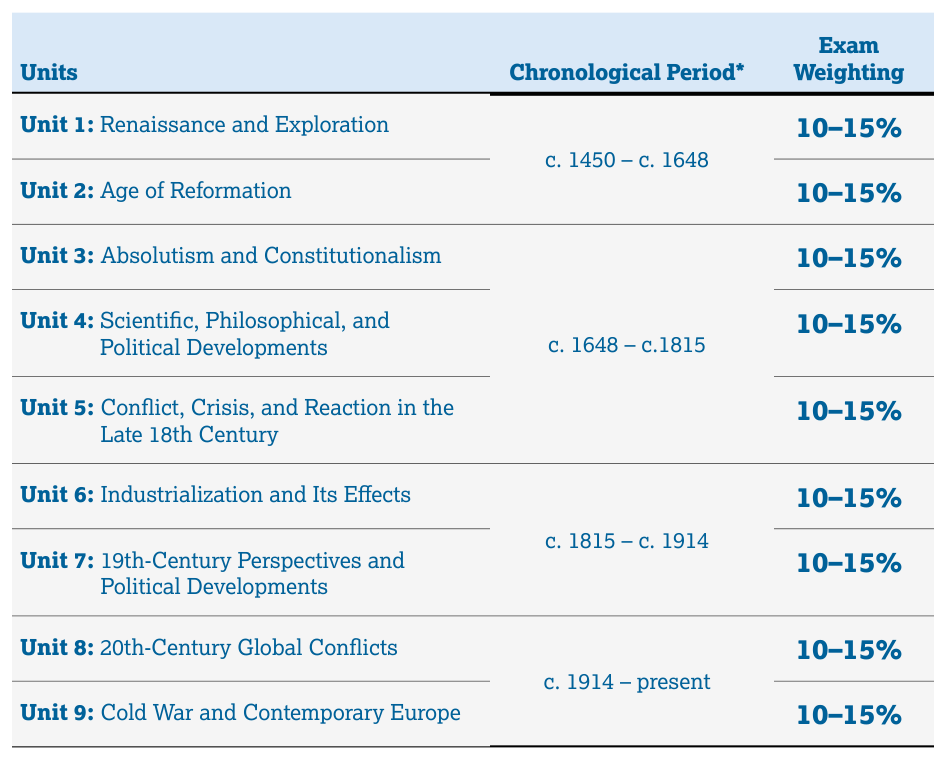
- Figure — AP European History Course and Exam Description (p. 25)
- *Events, processes, and developments are not constrained by the given dates and may begin before, or continue after, the approximate dates assigned to each unit and/or topic.

Study AP European History on Lykke
This course page is free to open: signed out, you can read its first two sections, and signing in, on any plan, opens the rest. The free Lykke Chrome extension syncs your own Canvas courses, so ChatGPT, Claude and Muse can answer from your classes and deadlines. It only reads Canvas.
Add the free extensionSign in to open every section