From the free course AP European History on Lykke
9.9 Decolonization · 9.10 The European Union
Key concepts: Decolonization · European Union · European economic and political integration · Shared European identity · Nationalism · Sukarno and Indonesian nationalism · Ethiopia · De-Stalinization · Nazi regime in Germany · Communist regime in the Soviet Union
After 1945, European empires weakened while new states demanded sovereignty, and western European governments responded by replacing imperial rivalry with cooperation. The result was a double transformation: decolonization, the process by which colonies gained political independence, and European integration, the…
9.9 Decolonization · 9.10 The European Union
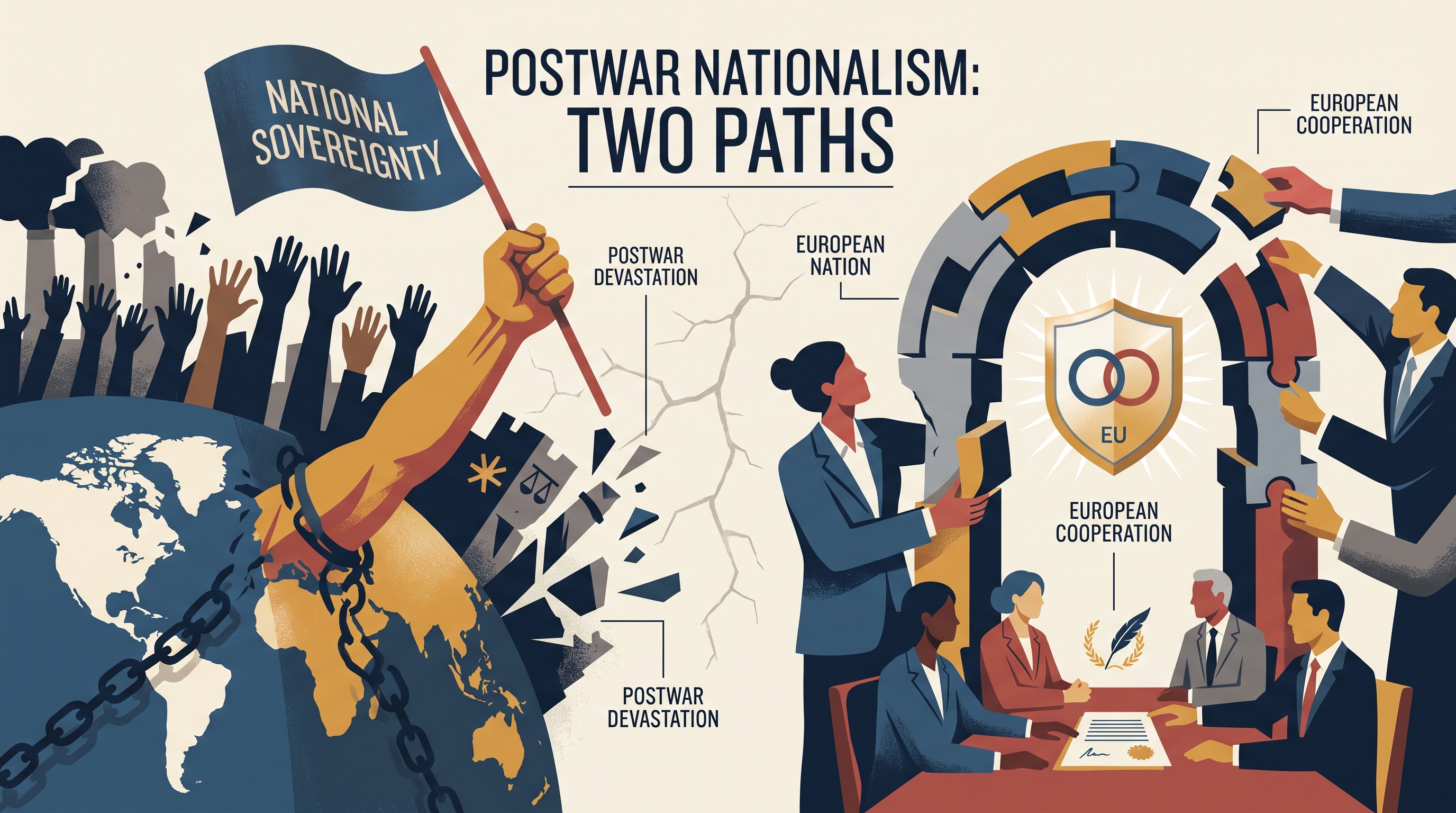
After 1945, European empires weakened while new states demanded sovereignty, and western European governments responded by replacing imperial rivalry with cooperation. The result was a double transformation: decolonization, the process by which colonies gained political independence, and European integration, the gradual construction of shared economic and political institutions.
9.9 Decolonization: From Empire to National Sovereignty
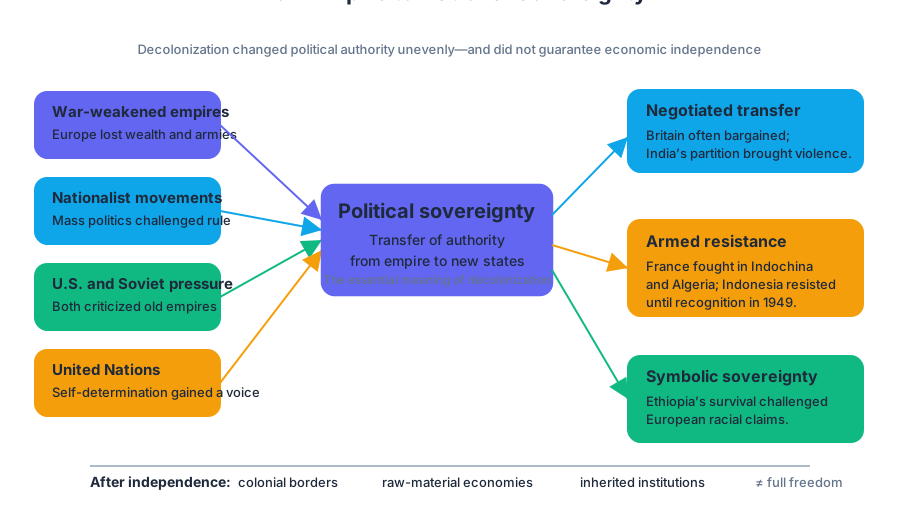
Decolonization resulted from several connected forces rather than one event. World War II weakened European economies and armies; anti-colonial nationalists organized mass movements; the United States and Soviet Union criticized traditional European imperialism for different reasons; and the newly created United Nations gave independence movements a language of self-determination.
The process was uneven. Britain often negotiated transfers of power, although conflicts such as the partition of India produced enormous violence and migration. France fought to preserve imperial authority in Indochina and Algeria. Indonesia illustrates how nationalism could combine leadership, mass mobilization, and armed struggle: Sukarno promoted Indonesian nationalism against Dutch rule, and Indonesian independence was recognized in 1949 after prolonged conflict and international pressure.
Ethiopia offers a useful contrast. It was not generally governed as a European colony, although Italy invaded and occupied it from 1935 to 1941. Its survival as an independent African state made it a powerful symbol for later anti-colonial movements: European claims of racial superiority were difficult to reconcile with the existence of an African state that had defended its sovereignty.
Decolonization changed the political map, but independence did not automatically end economic dependence. New states inherited borders drawn by imperial administrations, economies organized around exporting raw materials, and political institutions shaped by colonial rule. National leaders therefore faced a difficult choice: preserve inherited structures for stability, or attempt rapid economic and social transformation.
Essential distinction: Political decolonization means the transfer of sovereignty; it does not necessarily mean immediate economic independence, social equality, or political stability.
A common misconception is that decolonization was simply Europe “granting” freedom. In reality, independence usually emerged from the interaction of European weakness, organized anti-colonial nationalism, popular resistance, international diplomacy, and sometimes war. Colonial governments made decisions, but colonized peoples created pressure that made those decisions unavoidable.
Interwar Instability as Background
The post-1945 crisis of empire grew from interwar instability. The German Weimar Republic struggled to meet war-reparation demands imposed after World War I, contributing to inflation, political extremism, and distrust of parliamentary government. In Central and Eastern Europe, political developments in Poland, Hungary, and Romania revealed the fragility of new or expanded states facing ethnic divisions, economic problems, and pressure from larger powers.
Nazi expansion made that instability worse. Germany annexed Austria in the Anschluss of 1938. At the Munich Agreement, Britain and France permitted Germany to acquire the Sudetenland from Czechoslovakia in the hope that concessions would preserve peace; Nazi Germany violated the agreement by occupying the rest of the Czech lands in 1939. These events demonstrated the weakness of collective security and helped produce the war that ultimately weakened European imperial power.
The Soviet Union also struggled to convert ideological policy into economic success. De-Stalinization, begun under Nikita Khrushchev after Stalin’s death, condemned aspects of Stalin’s terror and relaxed some political controls, but it did not solve the Soviet economy’s structural problems. Central planning continued to produce shortages, weak consumer production, and inefficient agriculture, limiting the appeal of Soviet-style development in Eastern Europe and beyond.
9.10 The European Union: Integration as a Peace Strategy
European integration grew from the recognition that nationalism had repeatedly produced destructive rivalry. Two world wars, economic collapse, and the Holocaust convinced many western European leaders that peace required more than treaties between sovereign states. They sought institutions that would make war materially difficult and economic cooperation politically valuable.
The first major step was the European Coal and Steel Community, created in 1951 by France, West Germany, Italy, Belgium, the Netherlands, and Luxembourg. By placing coal and steel—the basic resources of industrial warfare—under shared administration, the members connected their economies. The Treaty of Rome in 1957 created the European Economic Community, expanding cooperation through a common market and the gradual removal of trade barriers.
| Integration problem | European response | Historical purpose |
|---|---|---|
| Rival national economies | Common market and reduced trade barriers | Increase mutual prosperity |
| Franco-German hostility | Shared institutions and production | Make another war less likely |
| Unequal regional development | Common funds and policies | Reduce internal tensions |
| Narrow national identities | European symbols and citizenship | Encourage a shared identity |
| Sovereignty concerns | Supranational decision-making | Coordinate policies beyond one state |
The European Union, formally established by the Maastricht Treaty in 1993, extended integration beyond economics. It promoted common political institutions, European citizenship, cooperation in foreign and security policy, and a shared currency for participating states. The euro made economic interdependence visible in everyday life, while the European Parliament and other institutions encouraged citizens to imagine themselves as both national and European.
Efforts to establish a shared European identity included common symbols, educational and cultural exchanges, mobility across borders, and the celebration of European institutions. Yet integration never erased nationalism. Member states continued to defend their languages, political traditions, borders, and national interests; disputes over economic rules and migration repeatedly exposed the limits of European unity.
Key idea: The European Union did not abolish the nation-state. It attempted to make national sovereignty compatible with shared institutions.
Worked Connection: Empire, Nationalism, and Integration
Consider the historical sequence: aggressive nationalism helped produce Nazi expansion and World War II; the war weakened European states and discredited imperial domination; anti-colonial nationalism then challenged European empires; western European governments responded to their own destructive nationalism through economic and political integration. The same broad era therefore witnessed both the breakup of empires and the creation of a new European political partnership.
For AP skill 1.A, Identify and describe historical developments and processes, name the process precisely: decolonization transferred sovereignty, while integration pooled selected powers. For AP skill 4.C, Explain the causes and effects of historical developments and processes, connect war, economic weakness, nationalism, and international pressure to decolonization, then connect fear of renewed conflict to European cooperation. For AP skill 4.B, Explain how and why historical developments and processes relate to another historical period, use the interwar crises as background rather than treating 1945 as an isolated starting point.
For AP skill 5.A, Make a historically defensible claim, a strong argument might state: Postwar Europe experienced opposite responses to nationalism: colonized peoples used national sovereignty to dismantle European empires, while western European states limited aspects of sovereignty to prevent another intra-European war. Evidence could include Sukarno and Indonesian independence, Ethiopia’s symbolic independence, the European Coal and Steel Community, and the Maastricht Treaty.
Retrieval check: Why is Sukarno an example of decolonization, while the European Coal and Steel Community is an example of integration? What common historical pressure connected these developments? A complete answer should distinguish national independence from shared governance and identify the destabilizing legacy of European nationalism and war.
Source Materials
- AP European History Course and Exam Description
- AP European History Course and Exam Description Clarifications and Corrections
- AP European History Course Overview
- AP European History Course at a Glance
- AP European History Course at a Glance Poster
- AP European History
- AP European History
- AP European History Sample Syllabus 1