From the free course AP European History on Lykke
7.3 National unification and diplomatic tensions · 7.4 Darwinism and Social Darwinism
Key concepts: Nationalism · Racism and antisemitism · Social Darwinism · The failure of the liberal movement in 1848 · National unification and diplomatic tensions · European imperialism in Africa · The “white man’s burden” · Causation · Source point of view, purpose, historical situation, and audience · Technological and Scientific Innovation (TSI)
National unification turned cultural identity into state power—but it also destabilized Europe’s diplomatic balance and encouraged new hierarchies among peoples. The same nineteenth-century age that celebrated national self-determination could define Africans, Jews, and other groups as supposedly inferior, using…
7.3 National unification and diplomatic tensions · 7.4 Darwinism and Social Darwinism
National unification turned cultural identity into state power—but it also destabilized Europe’s diplomatic balance and encouraged new hierarchies among peoples. The same nineteenth-century age that celebrated national self-determination could define Africans, Jews, and other groups as supposedly inferior, using political theories and scientific language to justify exclusion and imperial rule.
7.3 National unification and diplomatic tensions
The failure of the liberal movement in 1848 changed the route to German unification. Liberal nationalists had hoped to unite the German states through representative government and a constitution, especially through the Frankfurt Parliament. When monarchs and military forces defeated the movement, national unity did not disappear; instead, conservatives increasingly pursued it through state power, diplomacy, and war.
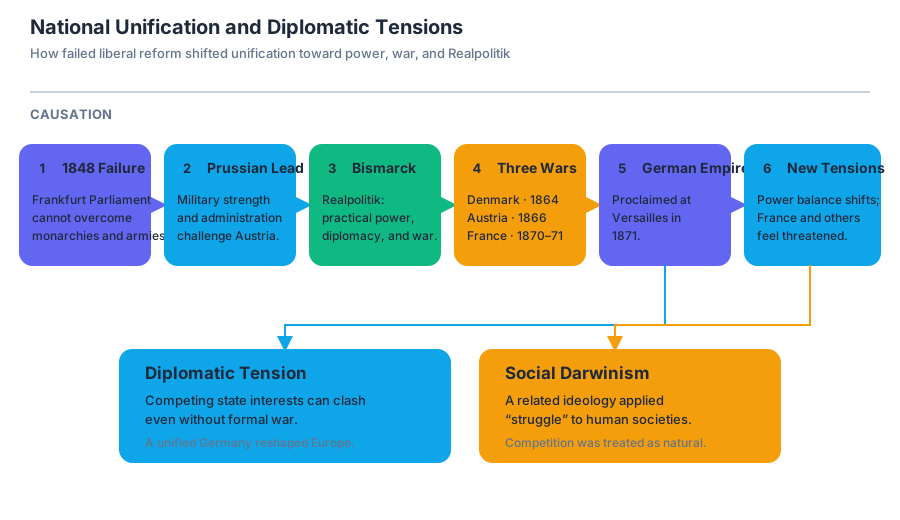
A useful chain of causation is:
- 1848 liberal failure: constitutional nationalism could not overcome monarchies, regional rulers, and military resistance.
- Prussian leadership: Prussia possessed the military and administrative strength to challenge Austria for leadership of the German states.
- Otto von Bismarck: the Prussian chancellor combined diplomacy, calculated conflict, and nationalism.
- Wars of unification: victories over Denmark, Austria, and France helped create a German Empire in 1871.
- Diplomatic tension: a unified Germany altered the European balance of power and alarmed France, Austria-Hungary, and other states.
Bismarck’s method is often summarized as Realpolitik, meaning practical politics that prioritizes power and achievable goals over ideological consistency. The wars against Denmark in 1864, Austria in 1866, and France in 1870–1871 were not isolated battles: each helped remove an obstacle to Prussian leadership or strengthen German national feeling. The defeat of France and the proclamation of the German Empire at Versailles made unification both a domestic achievement and a major diplomatic provocation.
Diplomatic tension means conflict produced by competing state interests even when countries are not formally at war. German unification created such tension because it joined many German territories into a powerful state at the center of Europe. Bismarck then tried to preserve Germany’s security by isolating France and managing relationships with Austria-Hungary and Russia; after his dismissal, weaker diplomacy and rival alliance systems contributed to a more dangerous international environment.
Nationalism, racism, and antisemitism
Nationalism could define membership in a nation through language, history, or political loyalty, but it could also define outsiders as permanently alien. In the nineteenth century, some nationalists linked national identity to supposedly fixed racial characteristics. This connection encouraged racism and antisemitism: Jews were portrayed not simply as a religious community but as an unchangeable racial threat, even when they spoke the local language or had converted to Christianity.
Misconception check — nationalism is not automatically liberal or inclusive. Nationalism helped challenge dynastic empires and support self-government, yet it could also demand cultural conformity, exclude minorities, and intensify hostility between states. To explain its historical effect, ask who was included, who was excluded, and what political goal the definition served?
7.4 Darwinism and Social Darwinism
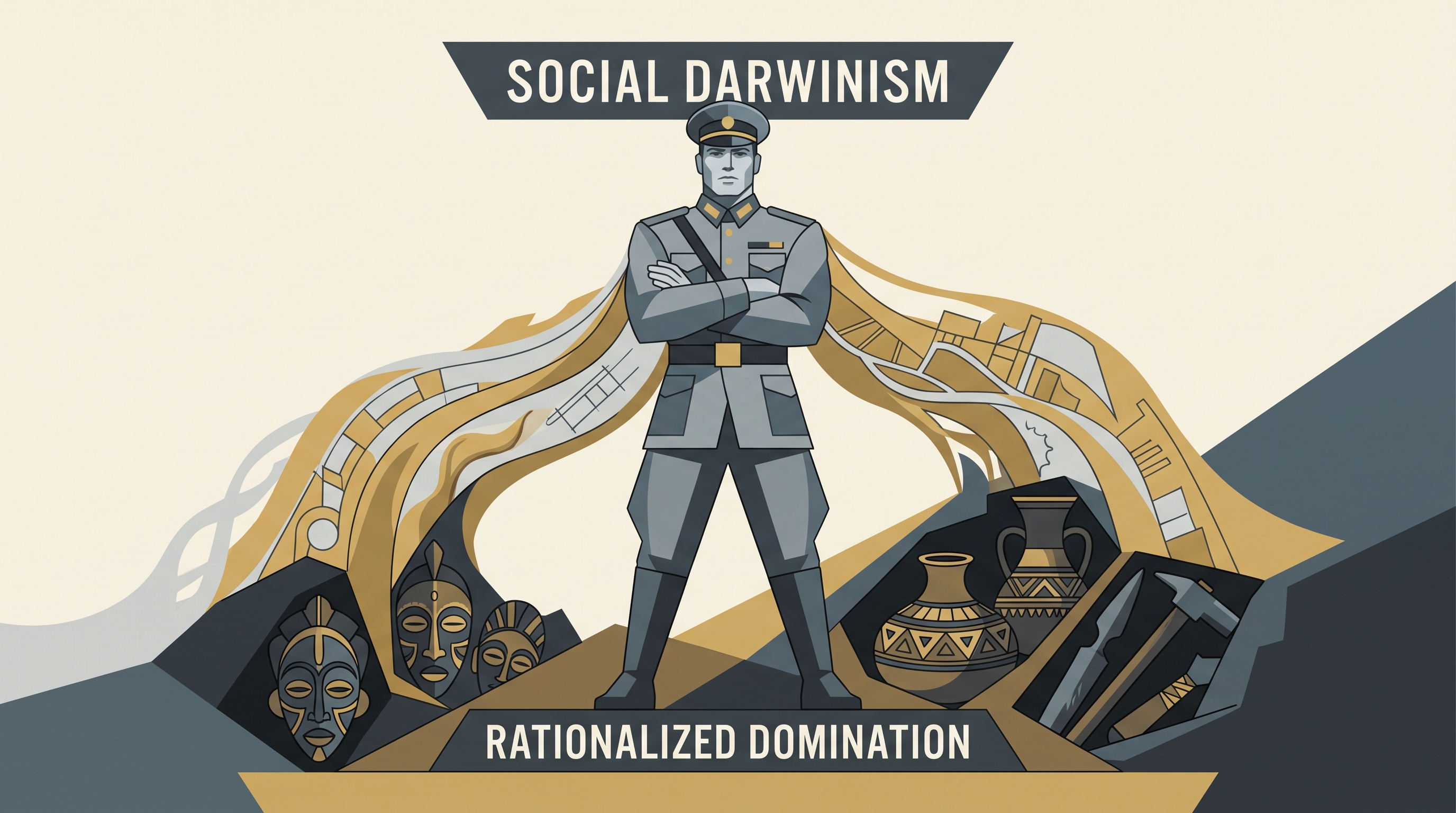
Charles Darwin’s theory of evolution explained biological change through variation and natural selection. Social Darwinism was a later and controversial application of evolutionary language to human societies and politics. Its advocates argued that competition among individuals, classes, nations, or races produced “stronger” and “weaker” groups, often treating social inequality as natural rather than historically created.
Social Darwinist reasoning frequently converted a description of competition into a moral and political prescription:
$$ \text{competition} \rightarrow \text{assumed superiority} \rightarrow \text{justified domination} $$
European imperialists used this logic to portray Africans as backward, undeveloped, or incapable of governing themselves. Belgian officials and other Europeans described African societies through stereotypes that ignored their political systems, economies, technologies, and historical complexity. The language of the “white man’s burden” presented imperial rule as a duty to civilize, but it legitimized European control over African land, labor, and resources.
The significance of Social Darwinism lies less in whether it was scientifically valid—it was not a reliable application of evolutionary biology—than in how effectively it supplied an intellectual defense for imperial power. Economic exploitation, strategic rivalry, and national competition drove imperial expansion; Social Darwinist ideas helped make domination appear benevolent, inevitable, or scientifically authorized.
Misconception check — Darwinism and Social Darwinism are not identical. Darwin’s biological theory did not require racial hierarchy or European empire. Social Darwinism selectively borrowed evolutionary vocabulary and applied it to politics, often to defend inequalities that benefited powerful groups.
Working with sources: Skill 2.C and causation
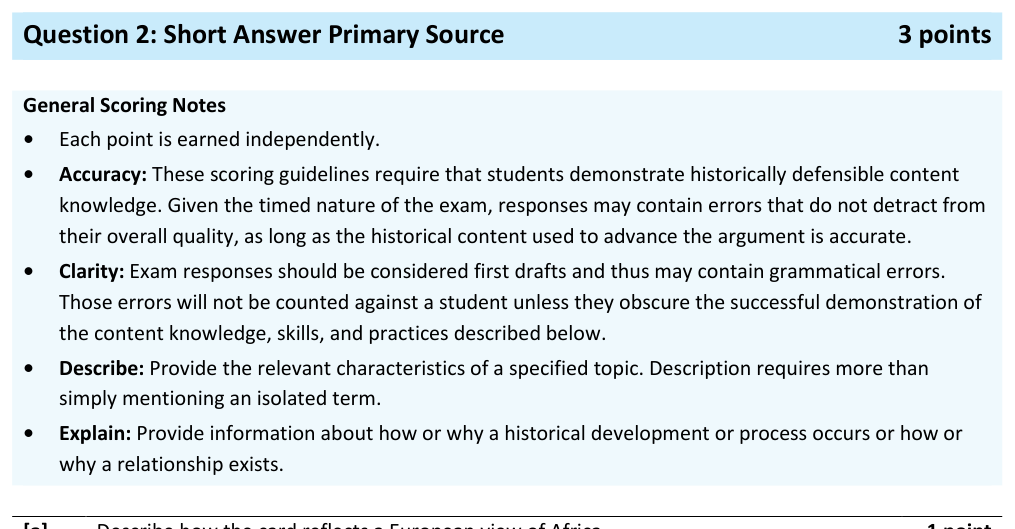
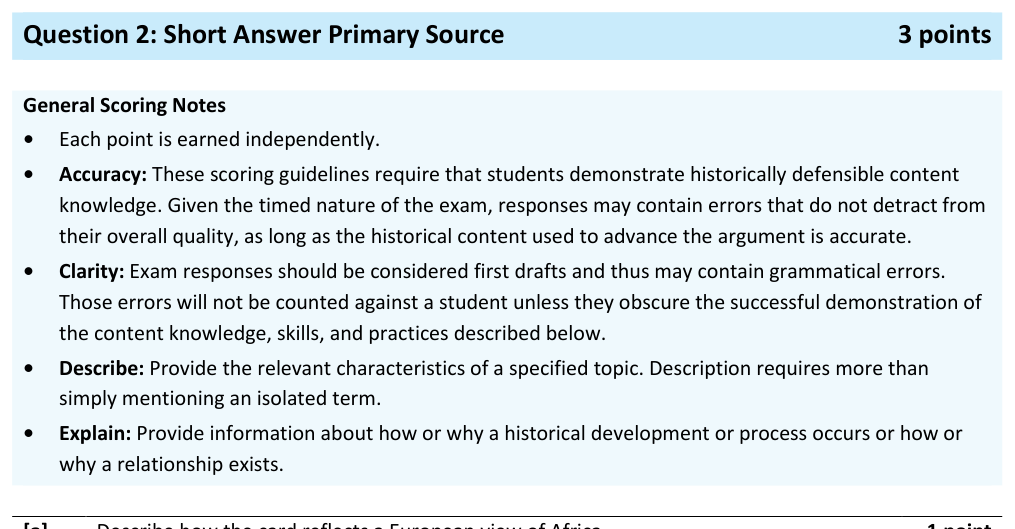
Skill 2.C: Explain the significance of a source’s point of view, purpose, historical situation, and/or audience, including how these might limit the use(s) of a source. A Belgian colonial report calling Africans “undeveloped,” for example, may reveal how imperial officials justified rule, but its purpose and audience also limit it: the report is evidence of colonial ideology, not neutral evidence about African societies.
A strong causal explanation connects ideas to outcomes without treating ideology as the only cause. European imperialism resulted from interacting forces: industrial and commercial interests, strategic competition, nationalism, technological advantages, and racialized ideologies. Social Darwinism helped explain and justify imperialism; it did not alone create the political and economic conditions that made expansion possible.
Retrieval check: Why did the failure of liberal nationalism in 1848 make Bismarck’s approach possible? Then explain how the point of view and purpose of a “white man’s burden” source would both reveal its significance and limit its reliability.
Source Materials
- AP European History Course and Exam Description
- AP European History Course and Exam Description Clarifications and Corrections
- AP European History Course Overview
- AP European History Course at a Glance
- AP European History Course at a Glance Poster
- AP European History
- AP European History
- AP European History Sample Syllabus 1
- [a] Describe how the card reflects a European view of Africa. 1 point
- [a] Describe how the card reflects a European view of Africa.