From the free course AP European History on Lykke
7.9 Causation in 19th-century perspectives and political developments
Key concepts: Causation in 19th-century political developments · Nationalism · Imperialism · Breakdown of the Concert of Europe · Unification of Italy and Germany · Technological development and European imperialism · Advances in medicine · Urbanization and changes in class structure · New ideologies and government responses · Impressionism, Post-Impressionism, and Cubism
Nationalism and imperialism reshaped nineteenth-century Europe by turning political identity and overseas expansion into forces that could strengthen states, destabilize alliances, and reorder the balance of power.
7.9 Causation in 19th-century perspectives and political developments
Nationalism and imperialism reshaped nineteenth-century Europe by turning political identity and overseas expansion into forces that could strengthen states, destabilize alliances, and reorder the balance of power.
Topic 7.9 — Causation in 19th-Century Perspectives and Political Developments
Suggested skill: 1.B — Explain a historical concept, development, or process.
The central task is not merely to name nationalism, imperialism, or unification, but to explain how one development produced consequences through identifiable steps.
The causal map
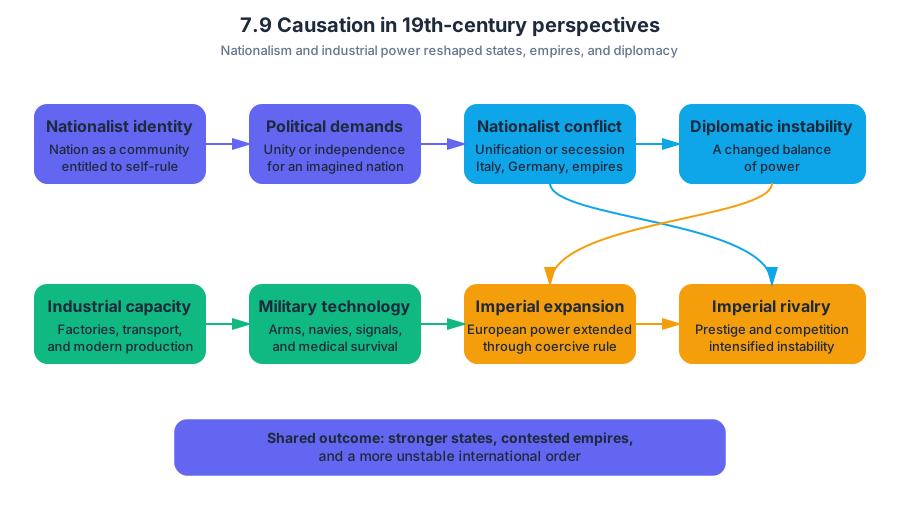
Nationalism defined the nation as a community entitled to political self-determination. That idea could unify people inside a state, as in Italy and Germany, but it could also destabilize multinational empires when ethnic groups demanded their own nation-states. Imperialism likewise increased the power and prestige of European governments, yet intensified rivalry among them and subjected colonized peoples to coercive political rule.
A useful chain is:
Nationalist identity → demands for political unity or independence → unification and nationalist conflict → altered balance of power → diplomatic instability
Industrial and technological capacity → stronger armies, navies, communications, and medical survival → imperial expansion → rivalry and political instability
From the Concert of Europe to a new diplomatic order
The Concert of Europe was the post-Napoleonic practice by which major powers—especially Austria, Britain, France, Prussia, and Russia—consulted to preserve political stability and suppress revolutionary threats. It did not create permanent peace, but it gave governments a mechanism for negotiation and helped limit unilateral challenges to the European balance of power.
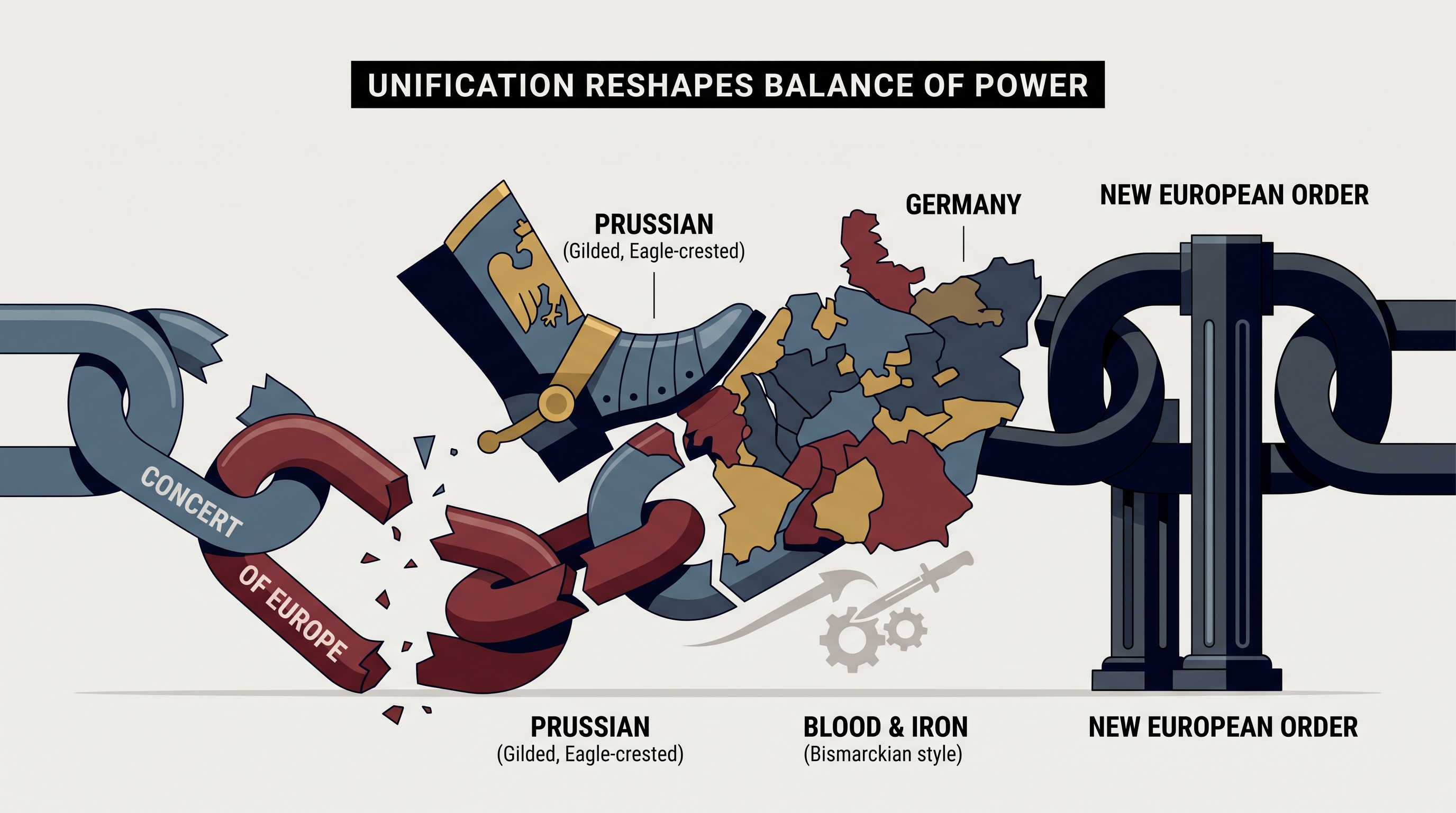
Its breakdown contributed to major political change. Nationalist movements increasingly challenged dynastic legitimacy, while rival governments pursued their own strategic interests rather than consistently cooperating. The Crimean War exposed tensions among the great powers; later, the unification of Italy and Germany disrupted the older balance. After German unification in 1871, the emergence of a powerful German Empire forced other states to reconsider alliances, military planning, and diplomatic priorities.
Causation distinction: The Concert’s breakdown did not by itself cause every later conflict. It removed or weakened a stabilizing diplomatic practice, allowing nationalism, rivalry, and state-building to produce larger consequences.
Nationalism and the unification of Italy and Germany
The unification of Italy and unification of Germany were key political developments because they transformed fragmented territories into centralized nation-states. Nationalism supplied the emotional and ideological language of unity, but political leaders, military force, diplomacy, and economic interests converted that language into state power.
In Italy, nationalists imagined a single Italian nation despite divisions among kingdoms, duchies, and the Papal States. Piedmont-Sardinia’s leaders used diplomacy and war, while figures such as Giuseppe Garibaldi mobilized popular support. The result was a larger Italian kingdom, although regional divisions and the continuing power of the Catholic Church limited complete social and political unity.
In Germany, Prussia used its military strength and economic influence to bring German states together. Otto von Bismarck manipulated diplomacy and conflict with Denmark, Austria, and France, presenting Prussia as the defender of German interests. The German Empire proclaimed in 1871 altered the European balance because a large, industrializing, militarily powerful state now stood at the center of continental politics.
Technology, medicine, and imperial power
Technological development made imperialism more practical between 1815 and 1914. Steam-powered ships shortened travel, railroads moved troops and resources inland, telegraphs accelerated communication, and improved weapons increased European military advantages. These tools did not make conquest inevitable, but they lowered the logistical costs of controlling distant territories.
Medical advances were equally important. Germ theory of disease explained illness through microorganisms, while anesthesia reduced surgical pain and antiseptics lowered infection during medical procedures. Public health projects improved sanitation and water systems, and quinine helped Europeans survive malaria in parts of Africa and Asia. Together, these developments increased European military and administrative survival in environments where disease had previously been a major barrier.
The effects reached beyond conquest. Industrialization expanded cities and changed class structure by enlarging the industrial working class and strengthening commercial and professional groups. Urban poverty encouraged public-health legislation; labor conflict encouraged socialism, trade unions, and government reform; mass newspapers and railways spread nationalist ideas rapidly. Technology therefore connected domestic political change to imperial expansion: stronger states could mobilize populations, regulate cities, project force abroad, and justify national competition.
Newtonian objectivity and political confidence
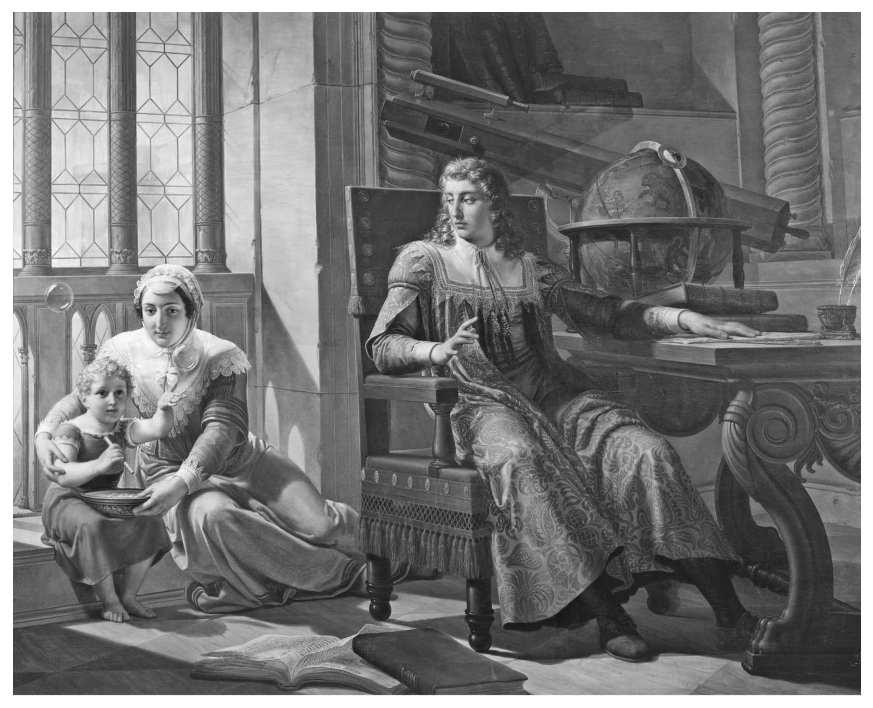
Newtonian physics presented nature as governed by discoverable, universal laws rather than by local tradition or personal authority. This image of an objective, measurable natural order encouraged confidence in scientific expertise, administrative planning, and technical control—ideas that governments often extended into claims that society and empire could also be organized rationally.
A common misconception is that technology alone caused imperialism. Technology enabled expansion, but motives such as national prestige, economic interests, strategic competition, and nationalist ideology determined why governments pursued it. The same technologies that strengthened states also intensified rivalry and made political crises more consequential.
Worked causal example
Question: How did technological development contribute to political instability in nineteenth-century Europe?
Reasoning: Steam transport and telegraphy allowed governments to move armies and communicate decisions more quickly. Industrial production supplied larger militaries, while medical advances made overseas campaigns more feasible. These changes strengthened nationalism and imperial competition; as newly unified Italy and Germany sought status and influence, older diplomatic arrangements weakened and European powers increasingly competed for strategic and colonial advantage. Thus technology was not the sole cause of instability, but it amplified nationalist state-building and imperial rivalry.
Retrieval check
Explain the sequence connecting the breakdown of the Concert of Europe to the unification of Germany and then to a new diplomatic order. In your answer, identify one nationalist cause, one political or military mechanism, and one consequence for the European balance of power.
Source Materials
- AP European History Course and Exam Description
- AP European History Course and Exam Description Clarifications and Corrections
- AP European History Course Overview
- AP European History Course at a Glance
- AP European History Course at a Glance Poster
- AP European History
- AP European History
- AP European History Sample Syllabus 1
- Pinacoteca Tosio Martinengo, Brescia, Italy© NPL - DeA Picture Library/Bridgeman Images