From the free course AP European History on Lykke
2.1 Contextualizing 16th- and 17th-Century Challenges and Developments · 2.2 Luther and the Protestant Reformation
Key concepts: Luther and the Protestant Reformation · Criticism of Catholic abuses · New interpretations of Christian doctrine and practice · Political, intellectual, economic, cultural, and social effects of responses to Luther · The sovereign state · Secular systems of law · Subordination of the church to the secular state · Religious conflicts as a basis for state authority · Established class, religious, and gender hierarchies · The relationship between traditional authority and differing world views
By the early sixteenth century, western Christianity resembled a vast political and cultural network—but one whose central institution faced mounting criticism. Martin Luther’s challenge to Catholic abuses did more than divide religious belief: it changed how Europeans understood authority, law, knowledge, social…
2.1 Contextualizing 16th- and 17th-Century Challenges and Developments · 2.2 Luther and the Protestant Reformation
By the early sixteenth century, western Christianity resembled a vast political and cultural network—but one whose central institution faced mounting criticism. Martin Luther’s challenge to Catholic abuses did more than divide religious belief: it changed how Europeans understood authority, law, knowledge, social order, and the power of the state.
Unit 2: Learning Objective B — Explain how and why religious belief and practices changed from 1450 to 1648.
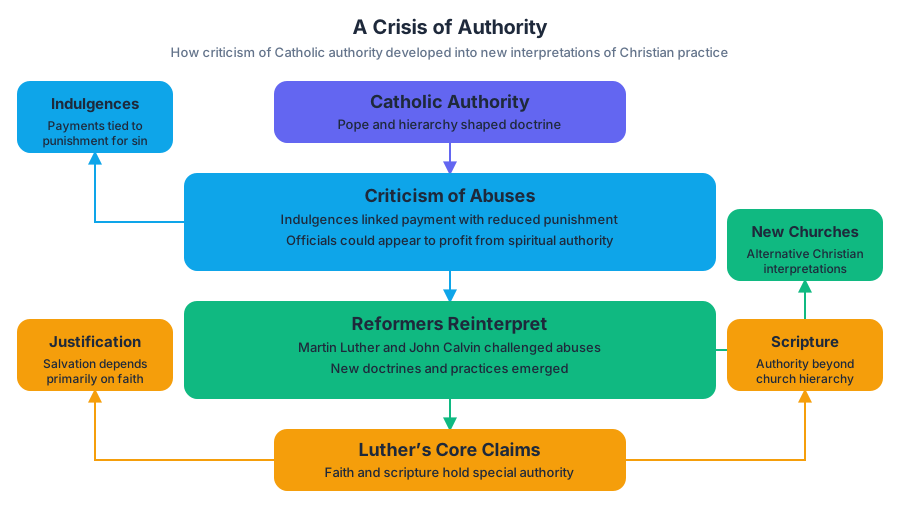
A crisis of authority
The Protestant Reformation was a movement of religious reform that challenged the authority and practices of the Roman Catholic Church. Reformers did not begin with a single plan to create separate churches. They responded to specific abuses and disagreements, then developed alternative interpretations of Christian doctrine and practice.
KC-1.2.I.B identifies two connected developments: Reformers Martin Luther and John Calvin criticized Catholic abuses and established new interpretations of Christian doctrine and practice. Criticism focused on practices such as the sale of indulgences—payments connected to the reduction of punishment for sin—and on the broader concern that church officials could appear to profit from spiritual authority.
Luther’s theological argument went deeper than opposition to one practice. He emphasized justification by faith, the belief that salvation depended primarily on faith rather than the accumulation of good works or the purchase of religious benefits. He also gave special authority to scripture and rejected the idea that the pope and church hierarchy alone controlled legitimate Christian interpretation.
From religious criticism to competing institutions
Once Luther’s ideas circulated, the conflict became political. Printing helped reformers disseminate their arguments, while sympathetic rulers could protect reformers from church or imperial punishment. KC-1.1.II.B captures this relationship between technology and belief: Protestant reformers used the printing press to spread their ideas, helping religious reform become widely established.
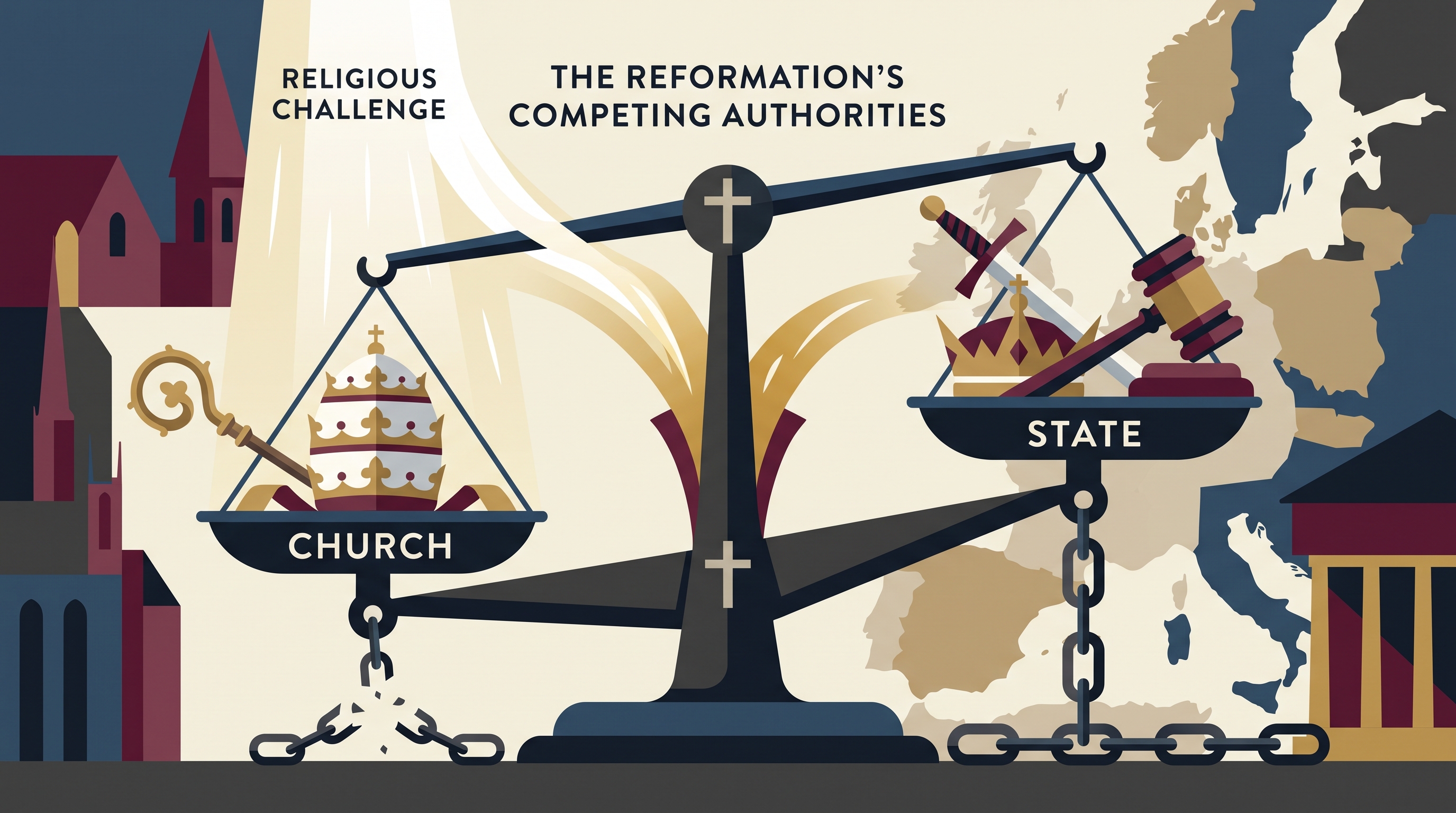
A sovereign state is a political community claiming supreme authority over its territory and population. The Reformation encouraged this development because rulers increasingly treated religion as a matter connected to governance: they appointed church officials, redirected church property, regulated worship, and asserted authority over institutions previously linked to Rome.
Secular systems of law—legal systems administered by political authorities rather than by church courts—became increasingly important in constructing new political institutions. In Protestant territories, rulers could subordinate the church to the secular state, making religious administration part of territorial government. Yet this was not universal: KC-1.2.II.B notes that some Protestants, including Calvin and the Anabaptists, refused to recognize the church’s subordination to the secular state.
Effects across European society
Responses to Luther produced significant political, intellectual, economic, cultural, and social effects. Politically, rulers gained opportunities to strengthen territorial authority. Economically, some governments acquired church lands and wealth. Intellectually, competing interpretations of scripture encouraged debate about traditional authority and the transmission of knowledge.
Social change, however, did not mean equality. Class, religious, and gender hierarchies continued in both rural and urban settings. Protestant reform could alter who controlled religious institutions without eliminating patriarchy, elite privilege, or social dependence. KC-1.2.I.C also notes that some Protestant groups interpreted wealth accumulation as evidence of God’s favor and a reward for hard work, linking religious belief to economic behavior.
Daily life retained older rhythms even amid doctrinal conflict. Leisure activities and community practices remained organized around the religious calendar, including Sundays and major festivals. Reformers sometimes reduced or criticized particular celebrations, but religion continued to structure work, rest, public ceremony, and communal identity.
Worked example: tracing causation
Suppose a territorial prince in the Holy Roman Empire protects Luther, permits Protestant preaching, and takes control of local church property. The causal chain is:
- Criticism: Luther attacks Catholic abuses and challenges church authority.
- Transmission: Printed pamphlets make the argument accessible to a wider audience.
- Political protection: The prince sees an opportunity to resist external church authority.
- Institutional change: Secular officials supervise worship, clergy, and church finances.
- Broader effect: Territorial sovereignty strengthens, while religious divisions reshape social and cultural life.
This example demonstrates Skill 6.A — Explain the causes and effects of historical developments and processes. It also uses Skill 4.A — Identify and describe a historical context, because Luther’s challenge makes greater sense within a Europe where printing, criticism of authority, and state-building were already transforming political life.
Misconception check
Misconception: “The Protestant Reformation immediately made Europe more religiously tolerant.” In practice, it created competing confessions and often intensified pressure for conformity. A ruler might replace Catholic authority with Protestant authority rather than permit complete freedom of belief.
Retrieval check: Explain why the Reformation strengthened some states even though it began as a religious challenge. In your answer, connect one criticism of Catholic abuses to one institutional change involving secular law or political authority. A strong response should identify the mechanism—not merely state that “religion affected politics.”
Source Materials
- AP European History Course and Exam Description
- AP European History Course and Exam Description Clarifications and Corrections
- AP European History Course Overview
- AP European History Course at a Glance
- AP European History Course at a Glance Poster
- AP European History
- AP European History
- AP European History Sample Syllabus 1
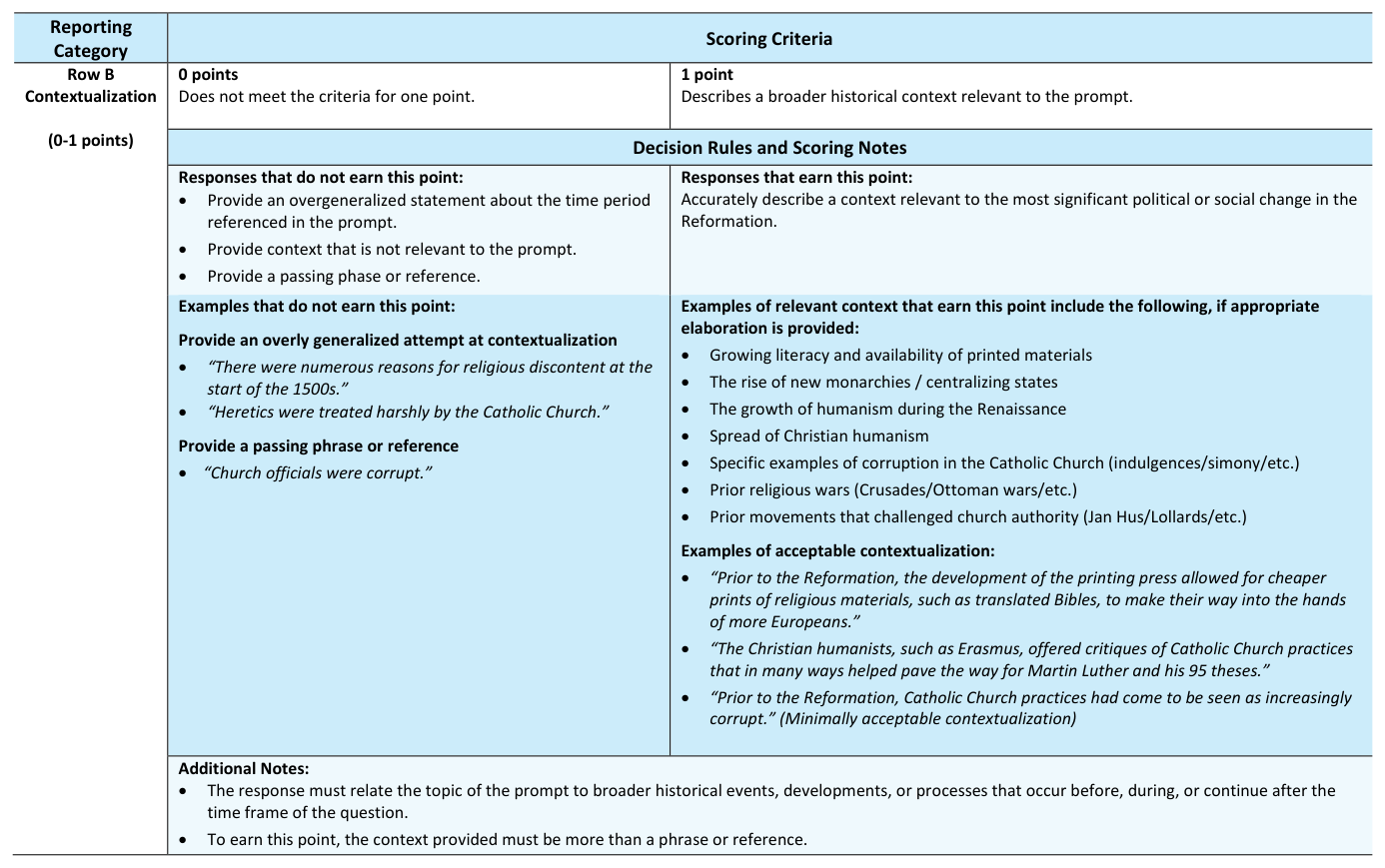
- Figure — Sample Responses - LEQ 2 - Set 1 (p. 4)
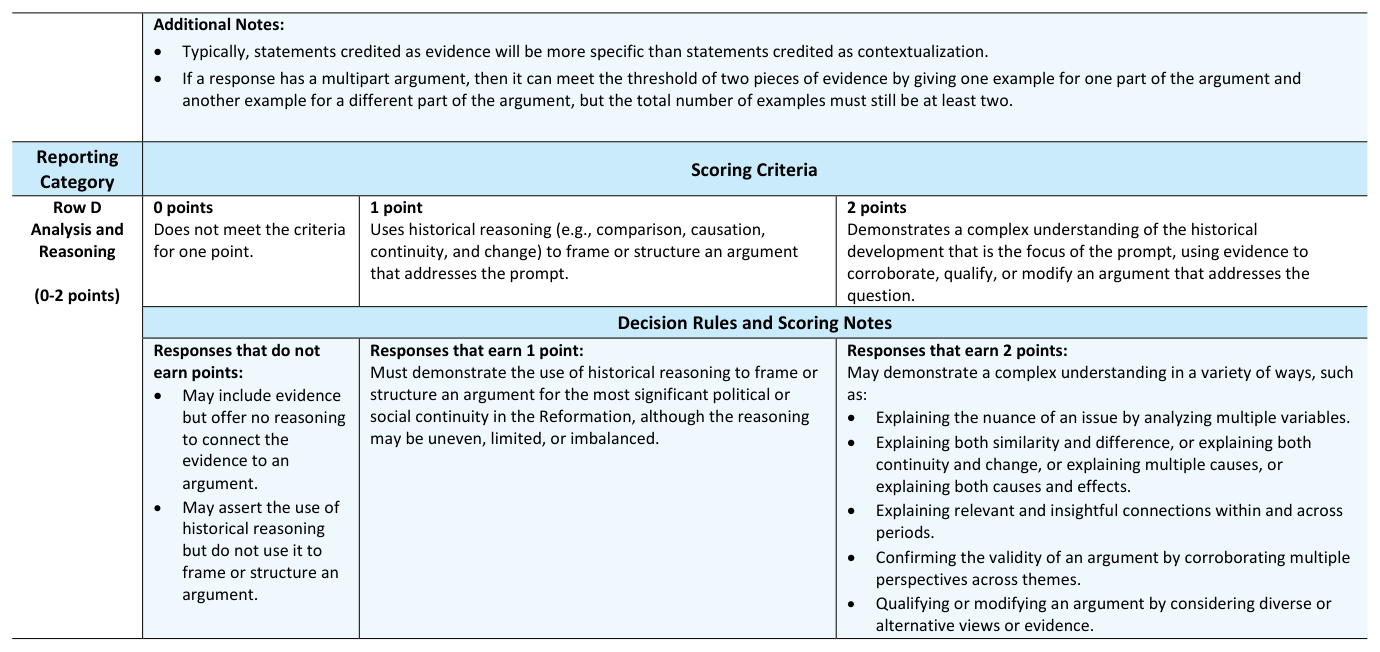
- Figure — Sample Responses - LEQ 2 - Set 1 (p. 6)
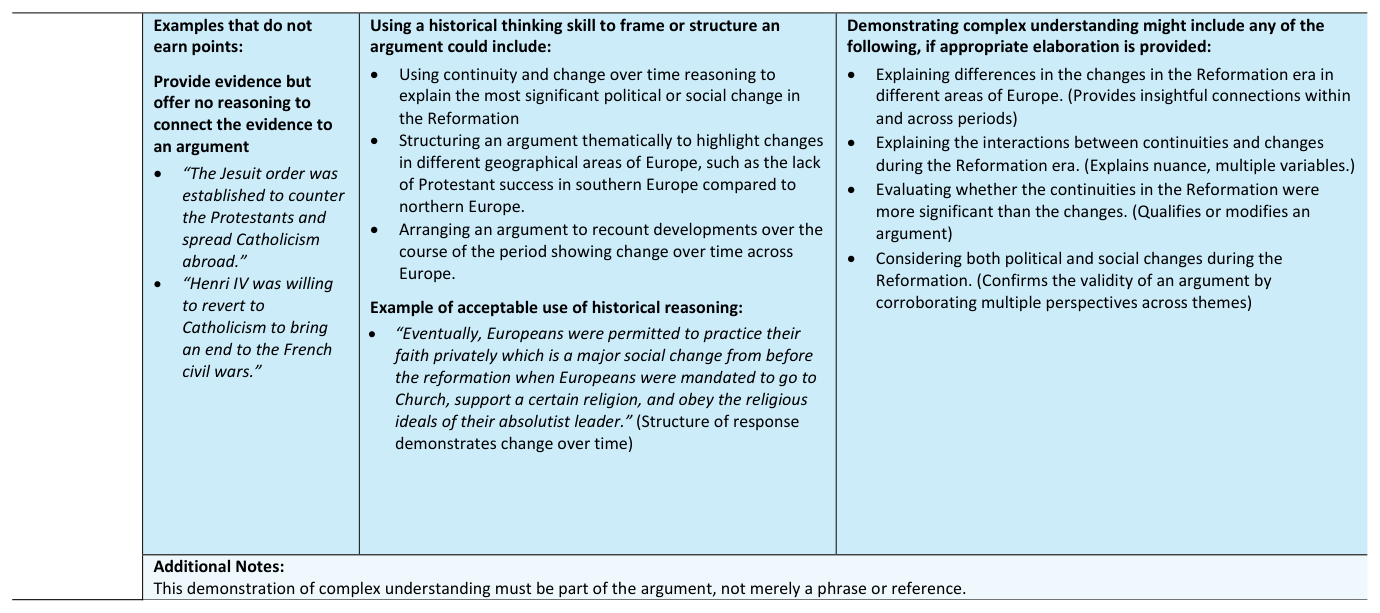
- Figure — Sample Responses - LEQ 2 - Set 1 (p. 7)
- Figure — Sample Responses - LEQ 2 - Set 2 (p. 4)