From the free course AP European History on Lykke
7.1 Contextualizing 19th-century perspectives and political developments · 7.2 Nationalism
Key concepts: Nationalism as a major 19th-century political ideology · Liberal reform · Political unification · Racialism · Anti-Semitism · Chauvinism and national aggrandizement · National unity and the political power of ethnic minorities · Art expressing shared idealized values such as beauty and patriotism · The period c. 1815–c. 1914
Nationalism is the belief that people who share a common identity—such as language, culture, history, or political loyalties—should possess a strong sense of collective belonging and, often, their own political state.
7.1 Contextualizing 19th-Century Perspectives and Political Developments · 7.2 Nationalism
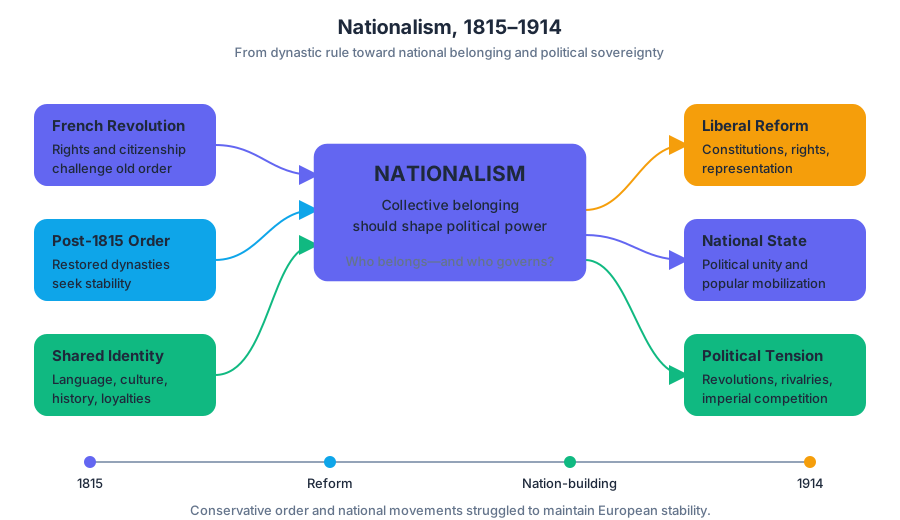
Nationalism is the belief that people who share a common identity—such as language, culture, history, or political loyalties—should possess a strong sense of collective belonging and, often, their own political state. Between 1815 and 1914, nationalism changed Europe’s central political question from “Who has the dynastic right to rule?” to “Who belongs to the nation, and who should govern it?”
After the defeat of Napoleon, European rulers attempted to restore stability, but the political pressures released by the French Revolution did not disappear. Liberal reform, meaning efforts to secure constitutional government, civil liberties, representative institutions, and equality before the law, increasingly interacted with nationalism. Some nationalists wanted political freedom for citizens; others wanted a powerful state that could mobilize the population in the name of national unity.
Topic 7.1 — Unit 7: Learning Objective A: Explain the context in which nationalistic and imperialistic sentiments developed in Europe from 1815 to 1914. The period was shaped by the tension between conservative efforts to preserve dynastic order and movements demanding constitutions, broader political participation, and recognition of national communities. This instability connects to KC-3.4, in which European states struggled to maintain international stability in an age of nationalism and revolutions.
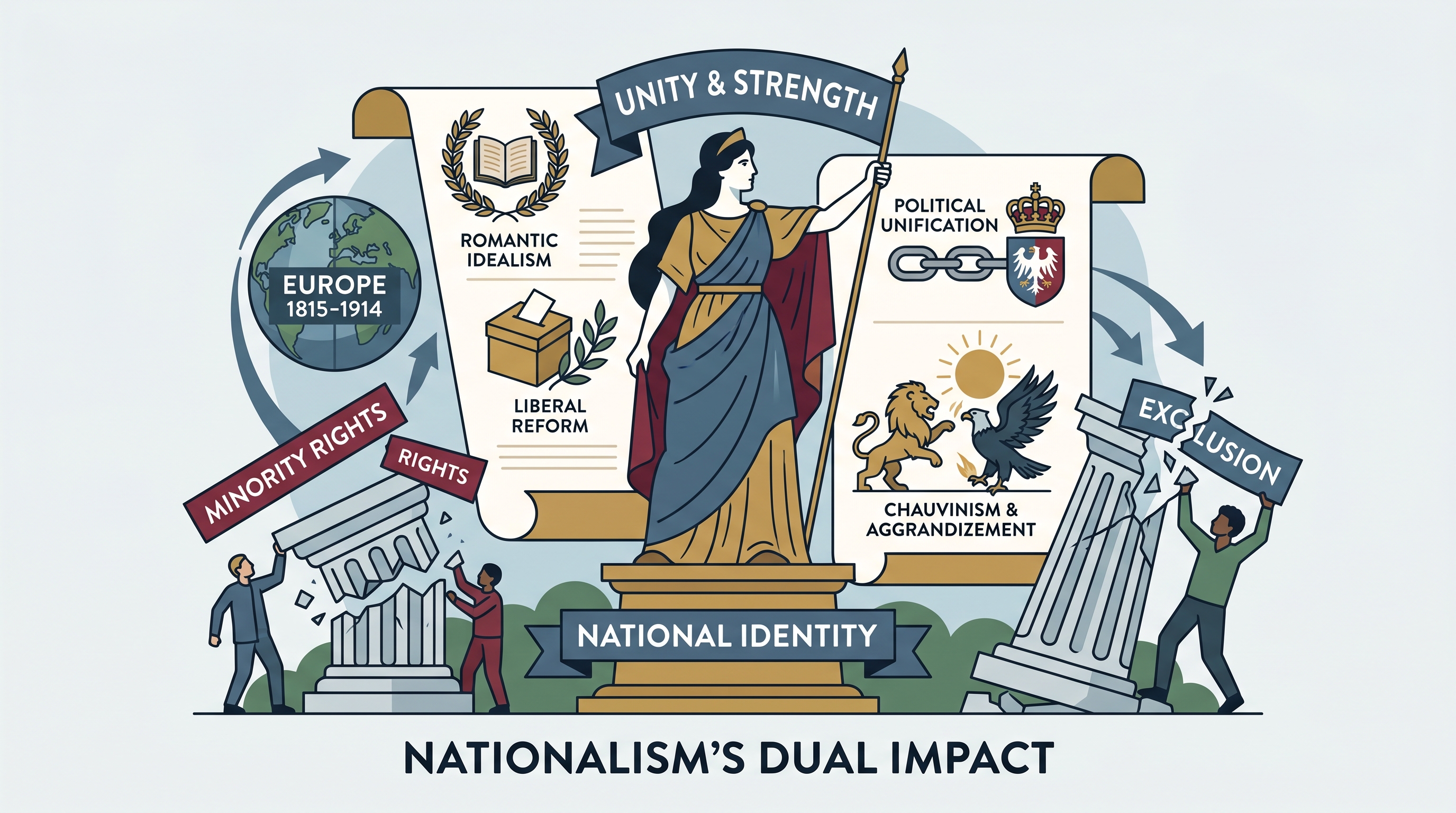
Nationalism could unify—and exclude
Nationalists created unity by presenting the nation as a shared community. They used common language, historical memories, patriotic rituals, flags, military service, public education, monuments, and literature to make large populations imagine themselves as members of one political body. Nationalism therefore operated both as an emotional identity and as a political program.
The connection to liberal reform was especially important. A liberal nationalist might argue that a people sharing a national identity deserved a constitution and representative government. Yet nationalism did not automatically produce democracy: governments could also use patriotic loyalty to demand obedience, military sacrifice, and acceptance of centralized authority.
Worked example: Hungary. Within the Habsburg Empire, Magyar political leaders sought greater recognition for Hungary’s political identity. After the crisis of 1848 and military defeat, the Compromise of 1867 reorganized the empire into Austria-Hungary. Hungary gained substantial self-government, and the arrangement stabilized the state by recognizing the political power of its largest ethnic minority—the Magyars. At the same time, Magyar leaders often pursued Magyarization, limiting the political and cultural claims of other ethnic groups within Hungary. The example reveals a crucial tension: national unity for one group could become political exclusion for others.
This is the distinction between inclusive and exclusive nationalism. A movement could demand equal citizenship from an imperial ruler while denying equal recognition to minorities inside the emerging nation. The same language of self-determination could therefore support both liberal reform and coercive centralization.
Racialism, anti-Semitism, and chauvinism
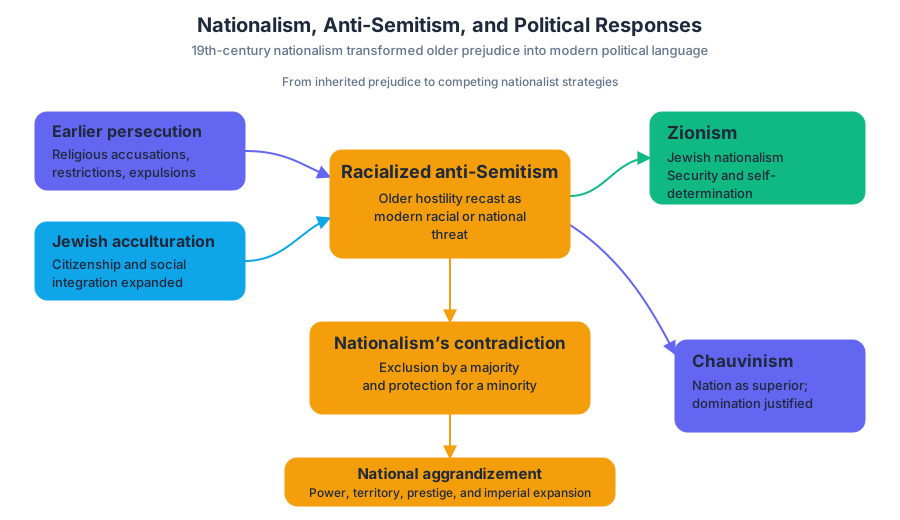
Racialism was the claim that humanity could be divided into supposedly distinct biological races with inherited differences in intelligence, character, or political capacity. It converted cultural prejudice into an alleged scientific hierarchy. In the nineteenth century, racialist thinking helped produce modern anti-Semitism, hostility toward Jews framed not merely as religious disagreement but as hostility toward Jews as an allegedly separate and threatening racial or national group.
Anti-Semitism must be understood across European history rather than treated as a sudden nineteenth-century invention. Earlier European societies had persecuted Jews through religious accusations, legal restrictions, expulsions, and violence. During the nineteenth century, western European Jews became more socially and politically acculturated in many places, but expanding citizenship did not eliminate hostility; racialist theories recast older anti-Jewish prejudices in modern political language.
KC-3.3.I.G captures this contradiction: as Jewish acculturation increased, Zionism, a form of Jewish nationalism, developed late in the century in response to growing anti-Semitism throughout Europe. Zionism illustrates how nationalism could appear simultaneously as a tool of exclusion imposed by a majority and as a strategy of security and self-determination adopted by a threatened minority.
Chauvinism is an aggressively patriotic form of nationalism that treats one’s own nation as superior and entitled to dominate others. It supports national aggrandizement—the expansion of a nation’s power, territory, prestige, or influence—by portraying military strength and imperial expansion as proof of national greatness.
Nationalism in culture
Nationalism also shaped cultural expression. Romantic idealism encouraged artists, writers, and composers to celebrate folk traditions, heroic historical figures, landscapes, and shared memories. Art could present the nation as beautiful, ancient, morally unified, and worthy of patriotic sacrifice.
That cultural ideal later provoked conflict with modern art. KC-3.6.III.D notes that Impressionism, Post-Impressionism, and Cubism moved beyond straightforward representation toward the subjective, abstract, and expressive. Artists such as Claude Monet, Paul Cézanne, Henri Matisse, Edgar Degas, Pablo Picasso, and Vincent Van Gogh challenged audiences who believed art should express shared idealized values, including beauty and patriotism. The dispute was not merely artistic: it reflected competing ideas about whether culture should reinforce a common national identity or expose individual perception and modern uncertainty.
Topic 7.2 — Unit 7: Learning Objective B: Explain how the development and spread of nationalism affected Europe from 1815 to 1914. KC-3.3.I.F identifies the varied tools nationalists used: romantic idealism, liberal reform, political unification, racialism accompanied by anti-Semitism, and chauvinism justifying national aggrandizement.
Retrieval check: Why does Hungary demonstrate that nationalism could stabilize a multinational state while also threatening minority rights? A strong answer should identify the recognition of Magyar political power, the creation of a new arrangement within the Habsburg Empire, and the resulting pressure on other ethnic communities.
Source Materials
- AP European History Course and Exam Description
- AP European History Course and Exam Description Clarifications and Corrections
- AP European History Course Overview
- AP European History Course at a Glance
- AP European History Course at a Glance Poster
- AP European History
- AP European History
- AP European History Sample Syllabus 1
- [a] Describe one major Protestant belief in the period 1517 to 1650. 1 point
- [a] Describe one major Protestant belief in the period 1517 to 1650.
- AP European History-AP Students-College Board
- AP European History-Doves Library