From the free course AP European History on Lykke
4.7 Causation in the Age of the Scientific Revolution and the Enlightenment
Key concepts: Scientific Revolution · Enlightenment · Empiricism and skepticism · Rationalism and classical sources of knowledge · Inductive and deductive reasoning · Observation, experimentation, and mathematics · Natural rights and the social contract · Natural religion and religious toleration · Print media and new public venues · Alchemy, astrology, and challenges to reason
Why did European thinkers begin to question inherited answers about nature, government, society, and faith? The central causal chain is:
4.7 Causation in the Age of the Scientific Revolution and the Enlightenment
Why did European thinkers begin to question inherited answers about nature, government, society, and faith? The central causal chain is:
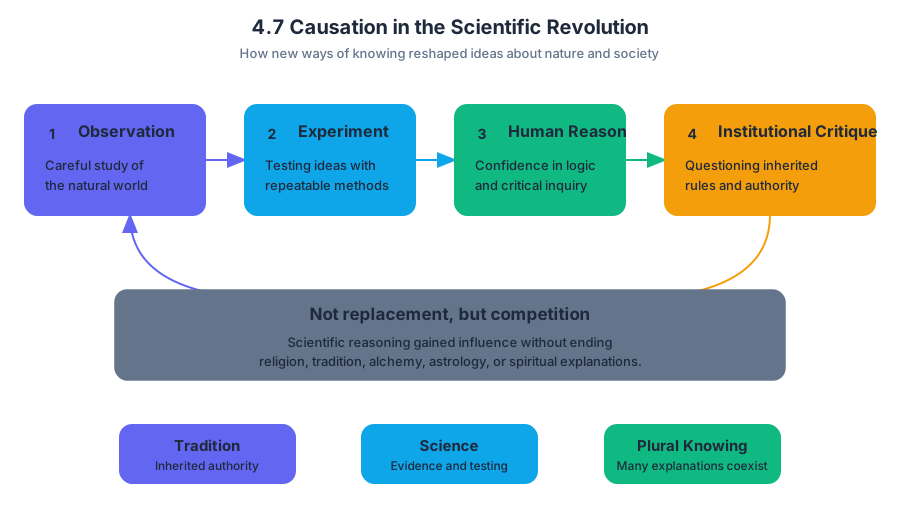
$$ \text{observation and experiment} \rightarrow \text{new scientific methods} \rightarrow \text{confidence in human reason} \rightarrow \text{criticism of European institutions} $$
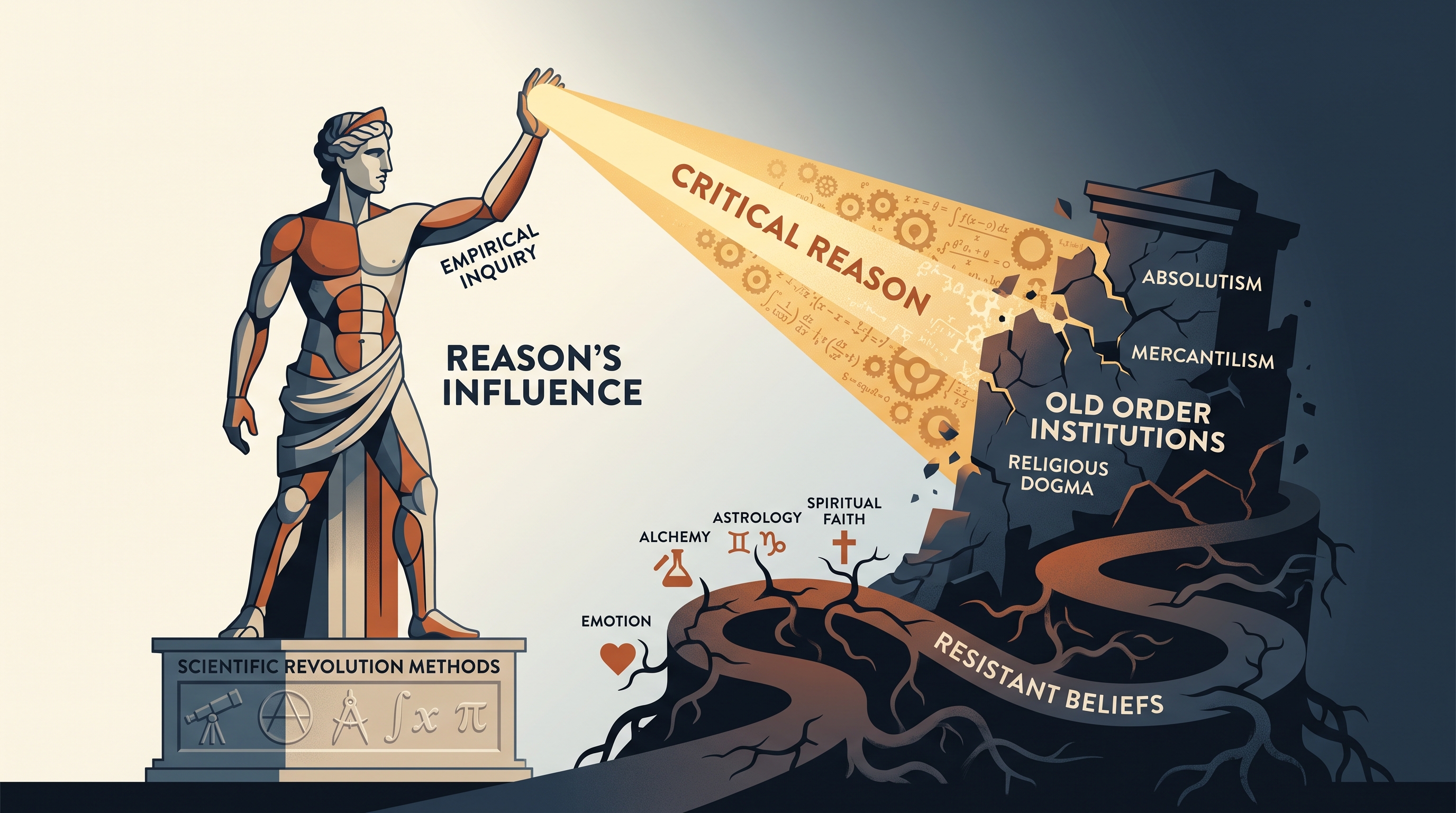
This does not mean that Europeans suddenly abandoned religion or tradition. Scientific reasoning gained influence while alchemy, astrology, spiritual explanations, and emotional approaches to culture continued to attract followers. The major historical development was therefore not simple replacement, but a widening competition among ways of knowing.
From inherited authority to tested knowledge
Empiricism means building knowledge through observation and experience. Skepticism means withholding acceptance until a claim has been examined and supported. Together, these approaches challenged older patterns of knowledge that relied heavily on inherited authorities, classical texts, or explanations that could not be tested.
The new scientific ideas depended on three connected practices:
- Observation: carefully examining the natural world.
- Experimentation: deliberately testing an explanation under controlled conditions.
- Mathematics: expressing relationships precisely rather than relying only on verbal description.
Francis Bacon emphasized inductive reasoning, moving from repeated observations toward a broader generalization. René Descartes emphasized deductive reasoning, beginning with a rational principle and drawing logically necessary conclusions. Their approaches differed, but both helped shape the scientific method by making investigation systematic rather than dependent solely on tradition.
Key distinction: Induction asks, “What general pattern emerges from these cases?” Deduction asks, “What specific result follows if this principle is true?”
Worked causal example: A natural philosopher observes that similar physical events produce similar results. Repeated observation encourages an inductive generalization about regularity in nature. A mathematical model then states the relationship precisely; deduction allows the thinker to predict what should happen in a new case. If experimentation confirms the prediction, the claim becomes stronger. This process challenged prevailing patterns of knowledge because nature appeared increasingly knowable through method rather than only through inherited explanation.
Scientific reasoning becomes social and political reasoning
The spread of Scientific Revolution concepts influenced the Enlightenment, an intellectual movement that applied human reason and rationalism—confidence in reason as a major source of knowledge—to political, social, and ethical questions. Enlightenment thinkers also drew on classical sources of knowledge, using ancient political ideas alongside newer scientific habits of analysis.
The causal shift was an extension of method:
| Scientific question | Enlightenment question |
|---|---|
| How does the natural world operate? | How should society operate? |
| What evidence supports this explanation? | What makes government legitimate? |
| Can a claim be tested logically? | Can inherited institutions survive rational criticism? |
Intellectuals including Voltaire and Diderot promoted models based on natural rights—rights believed to belong to people by nature—and the social contract, the idea that political authority rests on an agreement or relationship between rulers and the governed. Their reasoning challenged absolutism, inherited social hierarchies, and institutions that claimed authority simply because they were old.
New public venues and print media helped circulate these arguments beyond small scholarly circles. Public discussion allowed ideas to be debated, summarized, criticized, and connected to contemporary political and social problems. This communication network helped Enlightenment concepts influence European culture rather than remain isolated within scientific or philosophical communities.
Reason and faith: criticism, not automatic rejection
During the Enlightenment, rational analysis of religious practices contributed to natural religion, the belief that religious understanding could be based on reason and observation of the natural world rather than on every element of institutional doctrine. It also encouraged demands for religious toleration, meaning reduced coercion and greater acceptance of differing beliefs.
This development challenged the role of faith in European society, but it did not necessarily require atheism. Some thinkers criticized religious persecution, clerical authority, or practices they considered irrational while retaining belief in a deity or moral order.
Misconception check — “The Enlightenment destroyed religion.”
The more accurate claim is that Enlightenment thinkers subjected religious practices and institutions to rational analysis. Faith remained powerful, and many people continued to explain the cosmos through spiritual forces.
Limits of the new rationalism
The emphasis on reason remained contested. Alchemy and astrology continued to appeal to elites and natural philosophers partly because they shared with new science the assumption that the universe was predictable and knowable. Paracelsus, Johannes Kepler, and Sir Isaac Newton demonstrate that scientific innovation and older practices could coexist within the same intellectual world.
A second challenge came from the revival of public expression of emotions and feeling. This emphasis questioned the idea that reason should dominate every area of European thought and culture. The persistence of spiritual belief, traditional practices, and emotional expression shows that intellectual change produces competition and negotiation, not instant uniformity.
AP reasoning: explaining causation
For Unit 4: Learning Objective I, explain how and why the Scientific Revolution and Enlightenment challenged the existing European order and understanding of the world. A strong causal explanation distinguishes between:
- Cause: observation, experimentation, mathematics, and rational analysis provided alternative ways to evaluate claims.
- Development: these methods spread through print media and public venues.
- Effect: thinkers questioned social order, government institutions, absolutism, mercantilism, and religious practices.
- Qualification: alchemy, astrology, spiritual belief, and emotional culture continued to resist or complicate the dominance of reason.
This topic directly uses Historical Thinking Skill 3: Claims and Evidence in Sources (3.D), which asks students to explain how claims or evidence support, modify, or refute a source’s argument. It also develops Historical Thinking Skill 6: Causation, requiring explanation of how multiple causes produce an outcome, and Historical Thinking Skill 8: Argumentation, requiring a defensible claim supported by specific evidence.
Retrieval check: Explain one way Scientific Revolution practices influenced Enlightenment political thought, then identify one development that complicates the claim that reason replaced older beliefs. A complete answer should connect scientific method to rational criticism of institutions and use alchemy, astrology, spiritual belief, or emotional expression as qualifying evidence.

Source Materials
- AP European History Course and Exam Description
- AP European History Course and Exam Description Clarifications and Corrections
- AP European History Course Overview
- AP European History Course at a Glance
- AP European History Course at a Glance Poster
- AP European History
- AP European History
- AP European History Sample Syllabus 1
- Figure — Sample Responses - DBQ - Set 1 (p. 4)
- Figure — Sample Responses - DBQ - Set 1 (p. 6)
- Figure — Sample Responses - DBQ - Set 1 (p. 9)
- Figure — Sample Responses - DBQ - Set 2 (p. 6)