From the free course AP European History on Lykke
8.9 The Holocaust · 8.10 20th-century cultural, intellectual, and artistic developments
Key concepts: Renaissance humanism · Greek and Roman classical texts · Printing press · Andrea Palladio · Leon Battista Alberti · Filippo Brunelleschi · Reformation · Enlightenment · Public opinion · Social organization and development
The Holocaust shows what happens when ideas, institutions, technology, and social relationships are organized toward the systematic exclusion and destruction of human beings. The broader history of European cultural and intellectual development asks a linked question: How do changing ways of producing knowledge…
8.9 The Holocaust · 8.10 20th-century cultural, intellectual, and artistic developments
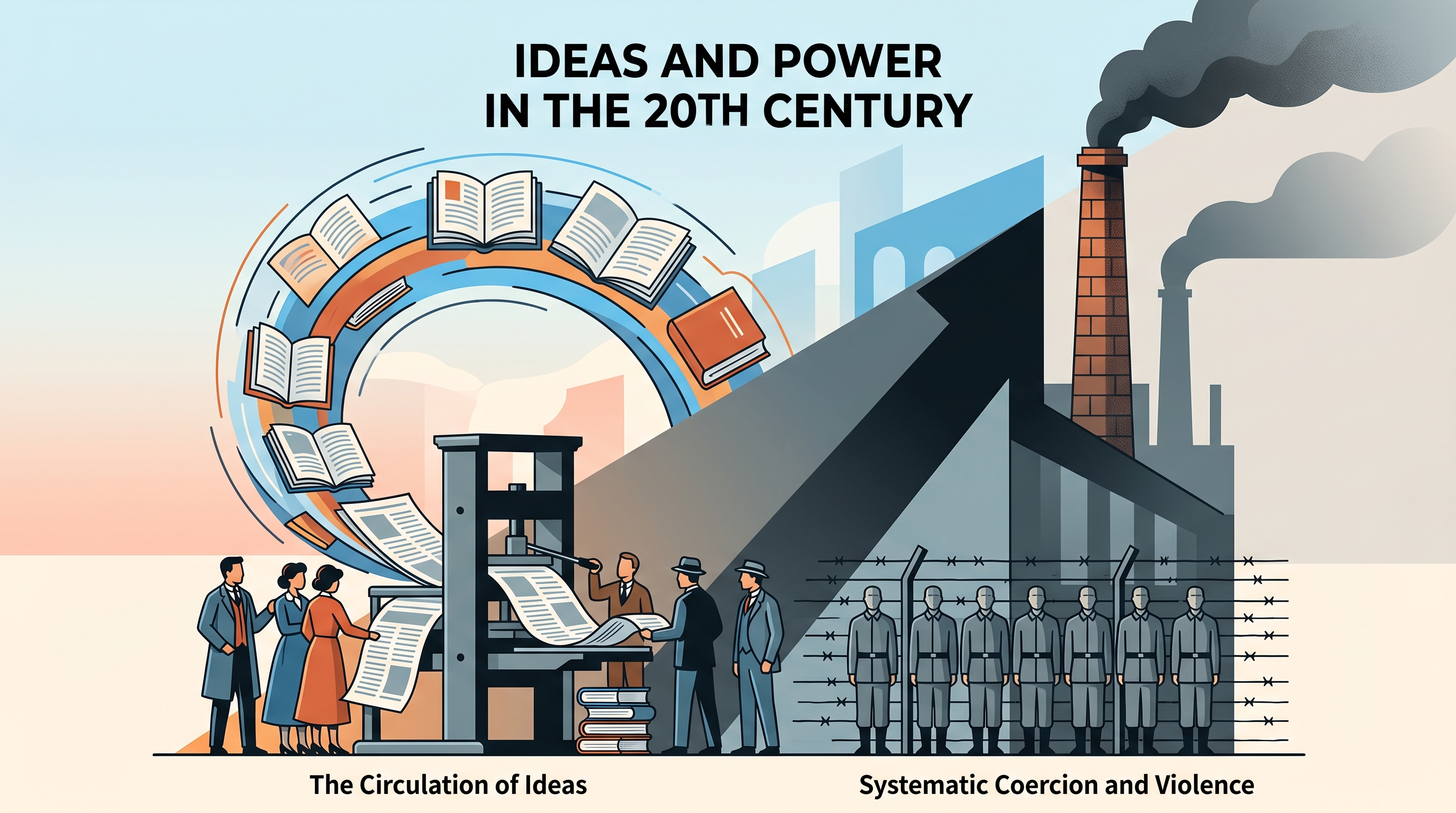
The Holocaust shows what happens when ideas, institutions, technology, and social relationships are organized toward the systematic exclusion and destruction of human beings. The broader history of European cultural and intellectual development asks a linked question: How do changing ways of producing knowledge reshape authority, individual identity, and society—and how can those same systems serve liberation or oppression?
Knowledge can redistribute authority
A useful starting point is the Renaissance humanist revival of Greek and Roman classical texts. Humanists such as Petrarch used philology—the careful study of language and manuscripts—to recover ancient literature and promote secularism, or attention to worldly life, and individualism, the idea that individuals possess distinctive value and agency. This did not simply erase religion; it widened the range of authorities that educated Europeans could consult.
Key idea — KC-1.1.I.B: The humanist revival of Greek and Roman texts, spread by the printing press, challenged the institutional power of universities and the Catholic Church. Education shifted away from a primary focus on theological writings toward classical texts and new methods of scientific inquiry.
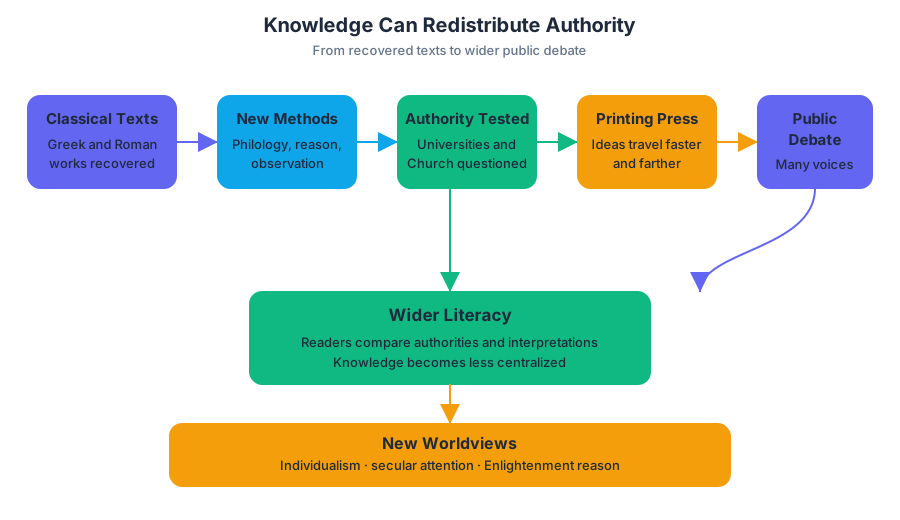
The printing press made this intellectual shift more powerful because texts could circulate beyond the small communities of manuscript readers. Printing did not automatically make every claim true, but it increased the speed, scale, and permanence with which arguments could reach readers. A larger reading public could compare authorities, debate interpretations, and gradually form what later thinkers called public opinion.
The causal chain is compact but important:
Classical texts → new interpretations → challenges to traditional authority → wider literacy → public debate and differing worldviews
The same mechanism reappeared in the Enlightenment. Enlightenment thinkers challenged traditional sources of authority and encouraged people to evaluate political, social, and religious claims through reason, observation, and debate. These developments had political, intellectual, economic, cultural, and social effects: they altered how individuals understood themselves and how communities judged institutions.
Culture makes ideas visible
Renaissance culture demonstrates that intellectual change appears not only in books but also in buildings, images, and public spaces. Filippo Brunelleschi, Leon Battista Alberti, and Andrea Palladio are identified with Renaissance cultural developments. Their architecture drew on classical forms and proportion, turning admiration for Greece and Rome into visible models of order, civic identity, and human capacity.
This is why the term cultural and intellectual developments is broader than “art history.” A building can communicate assumptions about authority, citizenship, beauty, mathematics, and the relationship between human beings and the world. Scientific and technological innovations likewise increased efficiency, improved daily life, and reshaped human development and interactions.
Institutions shape social status
Ideas never operate in a social vacuum. Economic, political, and cultural forces influenced the form and status of families, classes, and social groups throughout European history. Literacy might expand access to debate while education remained unequal; new technologies might improve production while strengthening the power of employers or states; public rituals might unite a community while humiliating those judged deviant.
Authorities enforced communal norms through rituals of public humiliation. The purpose was not merely to punish one person. Public exposure warned observers about the behavior a community rejected and demonstrated that institutions possessed the power to define acceptable conduct. This creates an important contrast with Enlightenment claims: traditional authorities emphasized conformity, while Enlightenment arguments increasingly defended inquiry, criticism, and competing worldviews.
The Holocaust as a warning about modern systems
The Holocaust must therefore be understood not as an isolated failure of culture, but as a historical demonstration that modern literacy, bureaucracy, transportation, science, and communication can be placed in the service of persecution. Intellectual sophistication does not guarantee moral progress. Institutions that classify, record, persuade, and coordinate can either protect human dignity or turn prejudice into organized policy.
A common misconception is “technological progress automatically produces social progress.” The historical pattern is more precise: technology increases human capacity, but political institutions and cultural values determine how that capacity is used. Printing could spread humanist inquiry; modern communications could spread propaganda. The crucial historical question is always: Who controls the tool, what worldview guides its use, and which groups gain or lose power?
Worked interpretation
Suppose a source describes a new educational program that replaces exclusive theological study with classical texts, scientific investigation, and wider circulation of printed books. The strongest interpretation would identify a challenge to traditional authority, connect the change to humanism and the printing press, and explain a consequence such as increased literacy or the growth of public opinion. Merely saying “people became smarter” is too vague; the historical reasoning lies in tracing how a change in knowledge altered institutions and social relationships.
Retrieval check: Name one way the printing press changed intellectual life, one Renaissance architect associated with classical revival, and one reason technological innovation should not be treated as automatically progressive.
Answer: Printing widened the circulation of humanist ideas and helped challenge established authorities; Brunelleschi, Alberti, or Palladio is an acceptable architect; and technology can improve efficiency while also being used for coercion, exclusion, or mass violence.
Source Materials
- AP European History Course and Exam Description
- AP European History Course and Exam Description Clarifications and Corrections
- AP European History Course Overview
- AP European History Course at a Glance
- AP European History Course at a Glance Poster
- AP European History
- AP European History
- AP European History Sample Syllabus 1