From the free course AP European History on Lykke
6.7 Ideologies of change and reform movements · 6.8 19th-century social reform
Key concepts: 19th-century ideologies of change and reform · Liberalism · Popular sovereignty and individual rights · Social and economic reform movements · Mass-based political parties · Feminism and feminist movements · Positivism and the cult of science · Darwinism and Social Darwinism · Nietzsche and Freud · Women’s movement before World War I
Nineteenth-century reformers turned the language of liberalism—popular sovereignty, individual rights, and enlightened self-interest—into demands for political representation, economic protection, education, and gender equality. The central question was no longer simply who ruled, but whose interests counted as…
6.7 Ideologies of change and reform movements · 6.8 19th-century social reform
Nineteenth-century reformers turned the language of liberalism—popular sovereignty, individual rights, and enlightened self-interest—into demands for political representation, economic protection, education, and gender equality. The central question was no longer simply who ruled, but whose interests counted as legitimate in modern society.
Liberalism: rights, sovereignty, and its limits
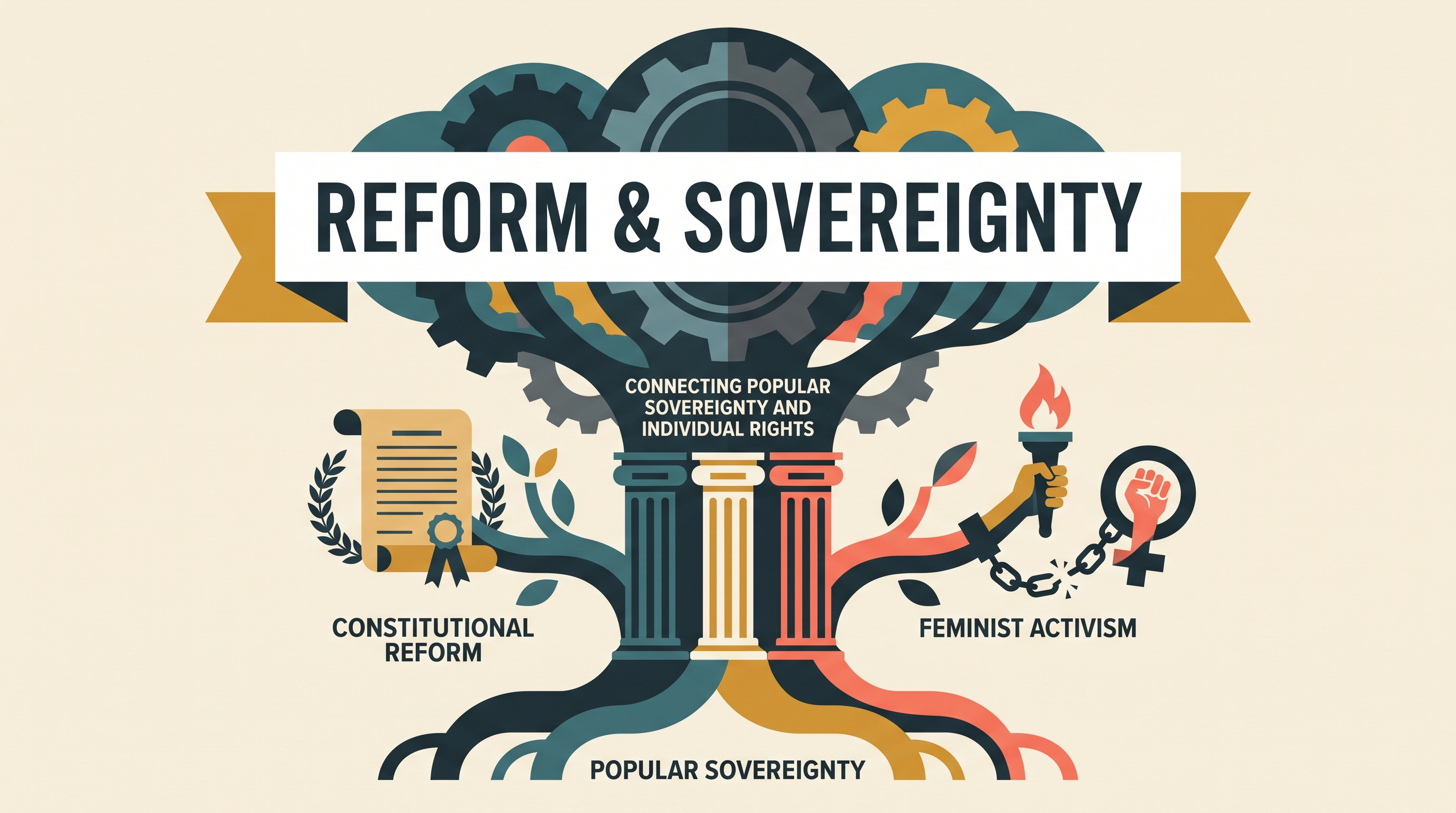
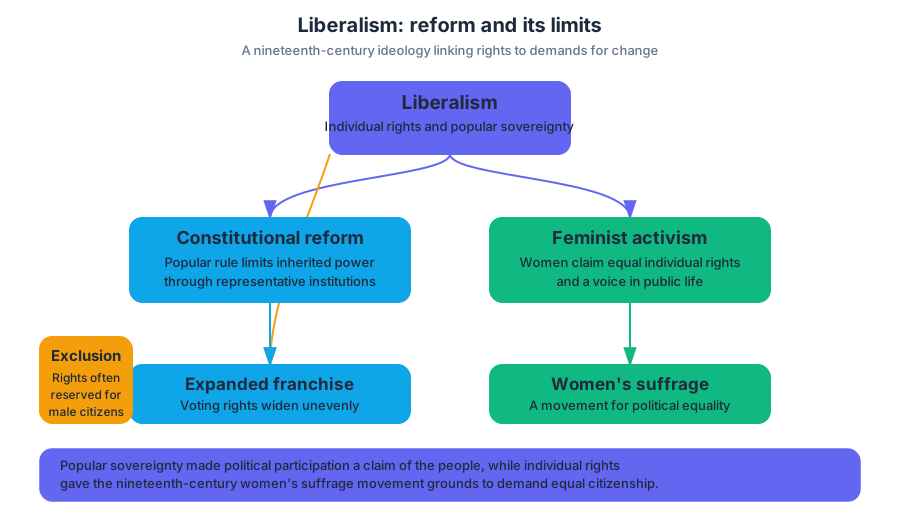
Liberalism held that legitimate government rests on the consent of the governed, that individuals possess rights, and that people can improve society through reasoned self-interest. Popular sovereignty means that political authority ultimately comes from the people; individual rights include protections such as legal equality, property rights, and freedom of expression.
Liberals did not always agree about who “the people” were. Many supported constitutional government and wider male suffrage while excluding women, the poor, or colonial subjects from political participation. They also debated the historical roles of the family, social class, and other groups: some treated the independent male citizen as the basic political unit, while others argued that social cooperation and economic inequality made purely individual rights insufficient.
Key distinction: Liberalism challenged arbitrary authority, but nineteenth-century liberal societies often limited citizenship by sex, property, class, or race.
From reform causes to mass politics
Industrialization created problems that individual action could not solve: dangerous workplaces, low wages, urban poverty, child labor, and insecure employment. In response, social and economic reform movements increasingly became organized political forces rather than isolated charitable campaigns.
The CED identifies four connected forms of reform under KC-3.3.III:
- KC-3.3.III.A: Mass-based political parties became sophisticated vehicles for reform, mobilizing large numbers of voters around organized programs.
- KC-3.3.III.B: Labor unions and political parties promoted social and economic reforms for workers.
- KC-3.3.III.C: Feminist movements pressed for legal, economic, and political rights for women.
- KC-3.3.III.D: Religious and secular nongovernmental reform movements assisted the poor and worked to end serfdom and slavery.
A useful causal chain is:
$$ \text{industrial change} \rightarrow \text{social conflict} \rightarrow \text{organized reform} \rightarrow \text{mass political participation} $$
For example, workers facing insecure wages could first form mutual-aid societies, then labor unions, and eventually support political parties that demanded workplace regulation or expanded voting rights. Reform therefore moved from private protest toward collective pressure on governments.
Feminism: applying liberal promises to women
Feminism was the organized pursuit of women’s legal, economic, social, and political equality. Feminists exposed the contradiction between liberal claims of universal rights and laws that denied married women property control, educational access, professional opportunities, or the vote.
Flora Tristan connected women’s emancipation to the condition of workers, arguing that gender inequality and class exploitation reinforced one another. In Britain, the Women’s Social and Political Union, associated especially with the Pankhurst family, used increasingly confrontational activism to demand political rights. These movements demonstrate that feminism was not limited to one goal: activists pursued both political equality, such as suffrage, and economic equality, such as access to work and protection from exploitation.
Misconception check — “Feminism meant only voting.” Suffrage mattered because political power could produce legal reform, but nineteenth-century feminists also challenged marriage laws, workplace conditions, educational restrictions, and the assumption that women belonged exclusively in the domestic sphere.
Science, reform, and social hierarchy
Positivism claimed that society could be studied through systematic observation and scientific methods. The related cult of science treated scientific knowledge as a powerful engine of progress, encouraging reformers to collect social data, investigate poverty, expand public education, and design policies intended to improve living conditions.
Charles Darwin’s theories of natural selection explained biological adaptation through variation and competition. Some thinkers then misapplied evolutionary language to human societies, producing Social Darwinism—the argument that competition among individuals, classes, or nations justified existing inequalities or imperial domination. The same scientific vocabulary could therefore support opposite conclusions: reformers used social investigation to argue that poverty was changeable, while Social Darwinists used “survival of the fittest” to argue that intervention was unnecessary or harmful.
Skills in action
A strong historical explanation uses Skill 1.A: Identify and describe a historical development or process to identify the growth of mass reform politics; Skill 4.A: Identify and describe a historical context to connect reform to industrialization; and Skill 5.B: Explain how a historical development relates to another historical development to link liberal rights, labor organization, and feminism.
For an argument, Skill 6.A: Make a historically defensible claim might produce this claim: Nineteenth-century reform movements expanded liberal politics by forcing governments to address groups that earlier definitions of citizenship excluded. Support it with Skill 6.B: Support an argument with specific relevant evidence, such as Flora Tristan, labor unions, the Women’s Social and Political Union, or the Pankhursts.
Retrieval check
Why could liberalism inspire both constitutional reform and feminist activism, yet still exclude many people? In two sentences, connect popular sovereignty and individual rights to one specific nineteenth-century reform movement.
Source Materials
- AP European History Course and Exam Description
- AP European History Course and Exam Description Clarifications and Corrections
- AP European History Course Overview
- AP European History Course at a Glance
- AP European History Course at a Glance Poster
- AP European History
- AP European History
- AP European History Sample Syllabus 1