From the free course AP European History on Lykke
AP Practice 3
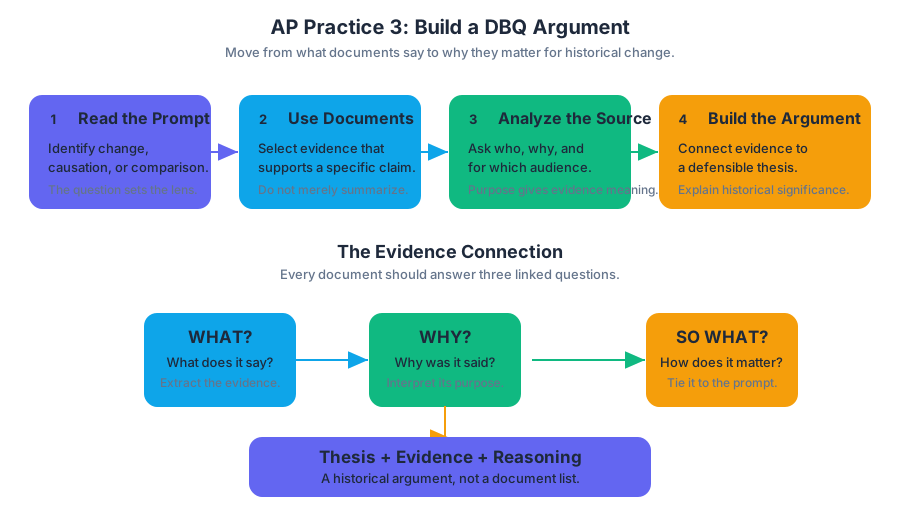
A strong Document-Based Question (DBQ) answer does more than summarize documents: it uses documents as evidence in an argument about historical change. The central challenge is to connect what a document says to why it says it and how that matters to the question.
AP Practice 3
A strong Document-Based Question (DBQ) answer does more than summarize documents: it uses documents as evidence in an argument about historical change. The central challenge is to connect what a document says to why it says it and how that matters to the question.
Original DBQ: Printing and Religious Change
Historical question: Evaluate the extent to which the spread of printing changed religious authority in Europe from approximately 1450 to 1648.
Document 1 — Johann Gutenberg, workshop account, Mainz, c. 1455
A printer describes producing large quantities of religious texts with movable metal type. He emphasizes that identical pages can be reproduced quickly, reducing the labor required from scribes.
Document 2 — Erasmus, letter to a fellow scholar, 1516
Erasmus praises the increased availability of Greek and Latin biblical texts but warns that readers may misunderstand difficult passages without education or guidance.
Document 3 — Martin Luther, preface to a German New Testament, 1522
Luther argues that ordinary Christians should be able to read Scripture in their own language. He presents access to the Bible as a challenge to religious practices that depend on clerical mediation.
Document 4 — Edict issued by the French crown, 1535
The monarchy restricts the printing and sale of religious works judged heretical. Officials are instructed to inspect presses and punish unauthorized printers.
Document 5 — Catholic theologian, report to the Council of Trent, 1546
The theologian criticizes uncontrolled religious publishing but supports carefully supervised books that defend Catholic teaching and improve clerical education.
Document 6 — English pamphlet, 1642
A political-religious pamphlet claims that printed sermons and debates have allowed people outside universities and churches to participate in arguments about belief and authority.
Document 7 — French bookseller’s inventory, 1648
The inventory lists devotional works, Protestant treatises, Catholic apologetics, political pamphlets, scientific writings, and inexpensive almanacs.
Build the argument before writing
Begin by converting the prompt into a judgment. “Evaluate the extent” requires a defensible position, not merely a list of effects. A precise thesis might argue that printing substantially weakened the monopoly of Catholic clergy over religious knowledge by expanding vernacular access and accelerating Protestant criticism, but it did not eliminate religious authority because monarchies and churches censored, supervised, and redirected print.
The thesis earns its force from qualification: printing changed the means through which authority operated more dramatically than it erased authority itself. This distinction creates a line of reasoning that can organize the entire essay.
Printing broadened participation in religious debate, but institutions adapted by controlling presses, regulating texts, and using print for their own purposes.
Contextualization: place printing inside a larger process
Before using the documents, establish the conditions that made the change possible. Renaissance humanism encouraged the recovery and criticism of classical and biblical texts; growing urban markets supported commercial production; and religious tensions within the late medieval Church created an audience for criticism. These developments explain why printing became historically disruptive rather than remaining merely a faster copying technique.
A weak contextualization says only that “Europe was changing.” A stronger one connects specific developments: humanist textual criticism supplied methods, expanding literacy supplied readers, and dissatisfaction with clerical abuses supplied controversial content.
Evidence: make documents do analytical work
Group the documents by argument rather than discussing them in numerical order.
| Argument | Useful documents | Reasoning |
|---|---|---|
| Print expanded access to religious ideas | 1, 2, 3, 6 | Faster production, vernacular texts, and public debate weakened exclusive clerical mediation. |
| Authorities resisted and adapted | 4, 5 | States and churches censored some publications while promoting approved teachings. |
| Print created a competitive religious marketplace | 7 | The variety of texts shows coexistence, conflict, and commercialization rather than one simple transfer of power. |
For each document, explain its significance. Document 3 is not merely evidence that Luther used printing; its German-language focus shows how vernacular publication could move theological interpretation beyond university-trained clergy. Document 4 demonstrates the reaction: censorship itself reveals that authorities considered print powerful enough to require intervention.
Sourcing: explain why the document says this
To earn sourcing analysis, connect a document’s point of view, purpose, audience, or historical situation to the argument. For example, Luther’s purpose in presenting Scripture in the vernacular was persuasive: he wanted readers to accept reform by treating direct engagement with the Bible as legitimate. The French edict’s purpose was regulatory, so its attempt to suppress “heresy” reveals the monarchy’s interest in maintaining religious and political order.
Do not write, “The author was biased.” Bias is not an explanation. Identify the position and show how it affects the document’s meaning.
Outside evidence and complexity
An effective piece of outside evidence could be the Council of Trent, which organized Catholic responses to Protestant criticism and supported improved clerical training while restricting unacceptable texts. This evidence strengthens the argument that the Catholic Church did not simply collapse; it reorganized authority through the Catholic Reformation.
Complexity comes from showing tension or limitation: printing encouraged religious pluralism, yet it also enabled centralized propaganda and censorship. The same technology could empower reformers, strengthen Catholic apologetics, assist monarchies, and commercialize devotion.
Timing and error review
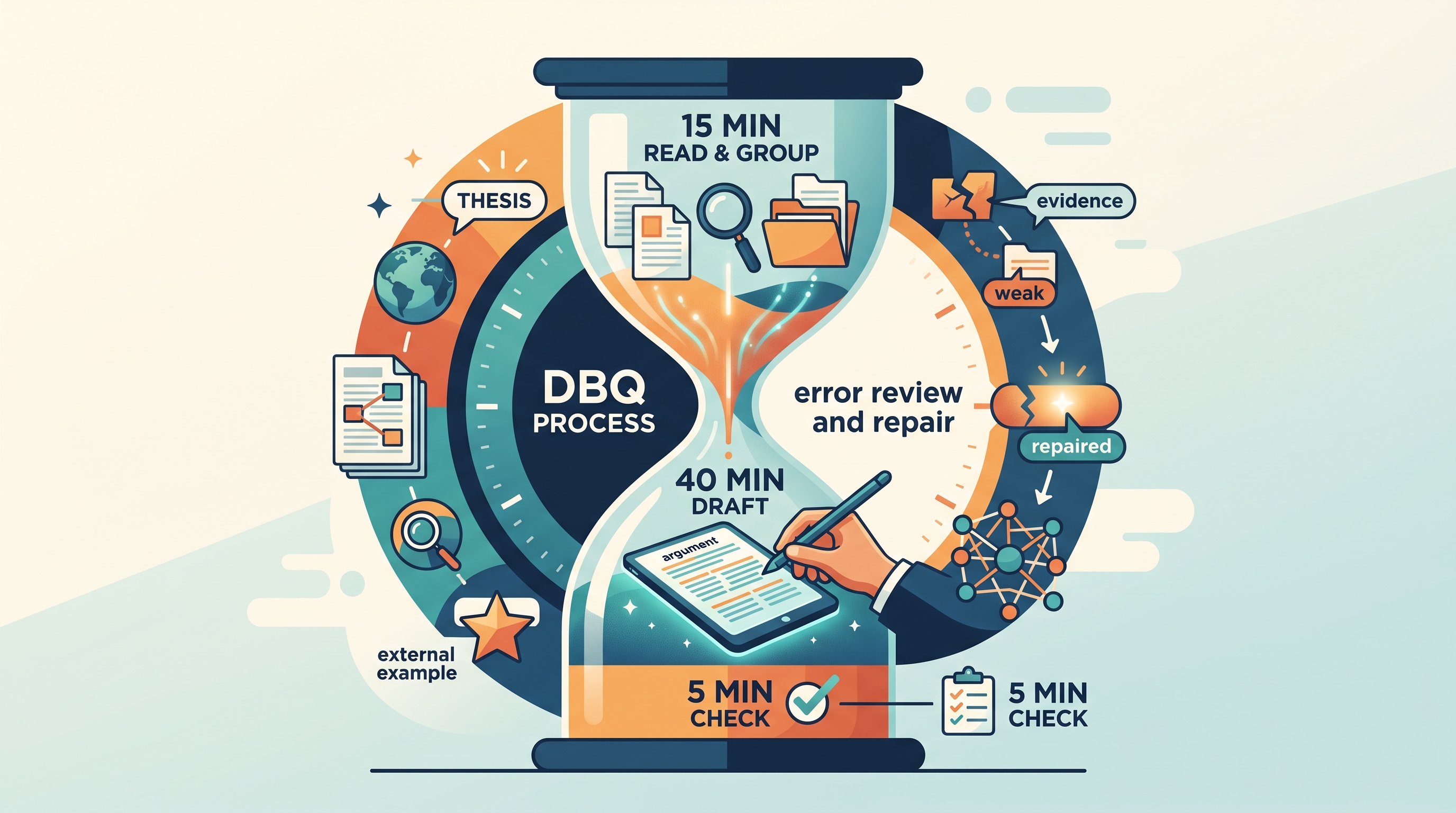
For a timed DBQ, reserve approximately fifteen minutes to read and group documents, forty minutes to draft, and five minutes to check the argument. Before submitting, verify that the essay contains a thesis, contextualization, evidence from at least four documents, sourcing analysis for at least two documents, one relevant outside example, and an explanation of complexity.
After practice, label every missing rubric element. If the essay summarizes documents but never explains their significance, the problem is evidence reasoning. If it names Luther’s purpose but does not connect that purpose to vernacular authority, the problem is sourcing reasoning. Repair the weakest operation first.
Source Materials
- AP European History Course and Exam Description
- AP European History Course and Exam Description Clarifications and Corrections
- AP European History Course Overview
- AP European History Course at a Glance
- AP European History Course at a Glance Poster
- AP European History
- AP European History
- AP European History Sample Syllabus 1
- AP European History-AP Students-College Board
- AP European History-Doves Library
- AP European History Cheat Sheets-Albert.io
- AP European History Study Guide-EBSCO