From the free course AP European History on Lykke
5.3 Britain’s ascendancy · 5.4 The French Revolution
Key concepts: Britain’s ascendancy · French Revolution · causes, events, and consequences of the French Revolution · bread shortages · French involvement in the American Revolution · constitutional monarchy and the Constitution of 1791 · abolition of provinces · Jacobin republic and Robespierre · Revolutionary government and mass conscription · Haitian independence and the legacy of the Revolution
By the late eighteenth century, Britain had become Europe’s leading global power just as France entered a revolution that attempted to remake political authority from the ground up.
5.3 Britain’s ascendancy · 5.4 The French Revolution
By the late eighteenth century, Britain had become Europe’s leading global power just as France entered a revolution that attempted to remake political authority from the ground up. The contrast is striking: Britain consolidated power through parliamentary institutions, finance, commerce, and war, while France’s fiscal crisis and social inequalities produced constitutional experiments, republican radicalism, and mass mobilization.
Britain’s ascendancy
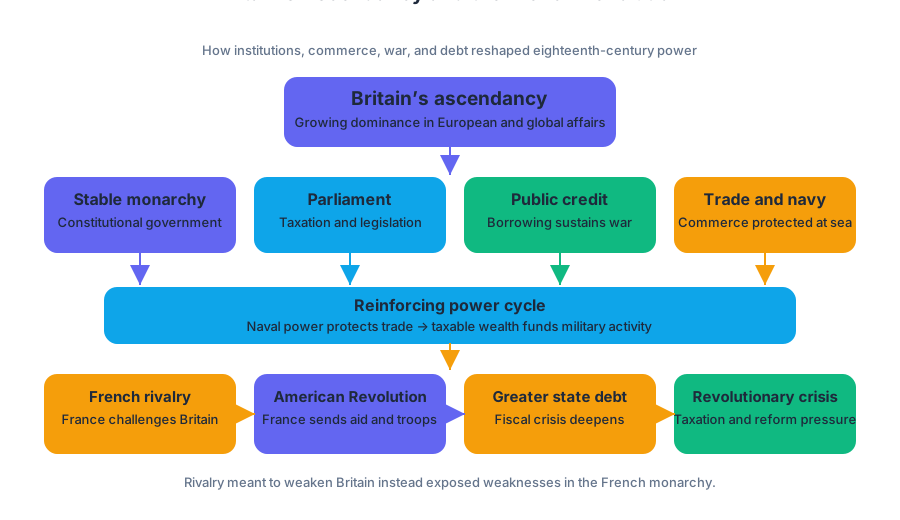
Britain’s ascendancy means its growing dominance in European and global affairs during the eighteenth century. Britain’s power rested on a combination of a relatively stable constitutional monarchy, Parliament’s role in taxation and legislation, expanding overseas commerce, a powerful navy, and the ability to borrow money through a developing financial system.
The British state could raise revenue and sustain war more effectively than many rivals because political authority was increasingly connected to representative institutions and public credit. Military victories and commercial expansion reinforced each other: naval power protected trade, trade generated taxable wealth, and taxation funded further military activity.
A crucial turning point was France’s involvement in the American Revolution. France supported the American colonists against Britain in order to weaken its geopolitical rival, providing money, troops, and naval assistance. The strategy helped the United States win independence, but the cost deepened France’s already serious fiscal problems. In this way, an attempt to restrain Britain helped expose the weaknesses of the French monarchy.
Key causal chain: French rivalry with Britain → intervention in the American Revolution → greater state debt → pressure for taxation and reform → revolutionary crisis.
Misconception check: Britain’s ascendancy did not mean that Britain was already an industrial society in the full nineteenth-century sense. Its eighteenth-century strength came from several connected advantages—Parliamentary government, finance, commerce, naval power, and military organization—not from factories alone.
Why did the French Revolution begin?
The French Revolution resulted from several causes operating at different time scales. KC-2.1.IV.A identifies the combination of long-term social and political causes, Enlightenment ideas, and short-term fiscal and economic crises. The Revolution therefore cannot be explained by a single event or by “Enlightenment ideas” alone.
Long-term grievances included resentment among peasants and the bourgeoisie toward hereditary privilege and unequal taxation. Short-term hardship made those grievances explosive. Bread shortages raised the price of the staple food on which ordinary people depended, turning economic distress into political unrest: a hungry crowd could interpret high prices not simply as an unfortunate harvest problem but as evidence that rulers had failed in their basic obligations.
The monarchy’s debt crisis intensified the emergency. France needed new revenue, but attempts to make privileged groups contribute threatened the political order that protected them. Enlightenment arguments about natural rights, popular sovereignty, and government by consent supplied a language through which social and economic complaints could become demands for institutional change.
The moderate or liberal phase
The first, or liberal, phase established a constitutional monarchy, meaning a monarchy whose powers are limited by a written constitution and representative institutions. The Declaration of the Rights of Man and Citizen expressed principles of liberty and legal equality; the Civil Constitution of the Clergy brought the Catholic Church under national control; and the Constitution of 1791 attempted to preserve a king while transferring significant authority to an elected legislature.
Revolutionary administrators also abolished France’s old provinces and divided the country into departments. This weakened inherited regional privileges and made the state more uniform and centrally administered. The change illustrates how revolution could promote both popular political participation and stronger national government.
Skill connection — Historical Thinking Skill 6: Causation: To explain the Constitution of 1791, connect causes rather than list them. Fiscal crisis created pressure for reform; Enlightenment ideas justified limits on monarchy; popular unrest made inaction dangerous; and the revolutionary assembly translated these pressures into a new political structure.
War and radicalization
The constitutional settlement did not end the crisis. Conflict with foreign monarchies, internal resistance, economic instability, and distrust of Louis XVI pushed the Revolution in a more radical direction. The execution of Louis XVI removed the possibility of restoring the earlier constitutional compromise and made the survival of the Revolution a matter of war and political control.
The radical Jacobin republic led by Robespierre responded to opposition at home and war abroad through the Reign of Terror. The Committee of Public Safety coordinated emergency government, while revolutionary leaders fixed prices and wages, pursued de-Christianization, and used coercion against suspected enemies. The levée en masse, or mass conscription, mobilized citizens for war and created revolutionary armies that sought to spread France’s changes across Europe.
The Revolution’s international consequences extended beyond Europe. In the French colony of Saint-Domingue, enslaved people and other groups transformed revolutionary language about liberty into a struggle against slavery and colonial rule. Saint-Domingue became the independent nation of Haiti in 1804, demonstrating that revolutionary claims could escape the limits intended by European political leaders.
Historical interpretation and retrieval check
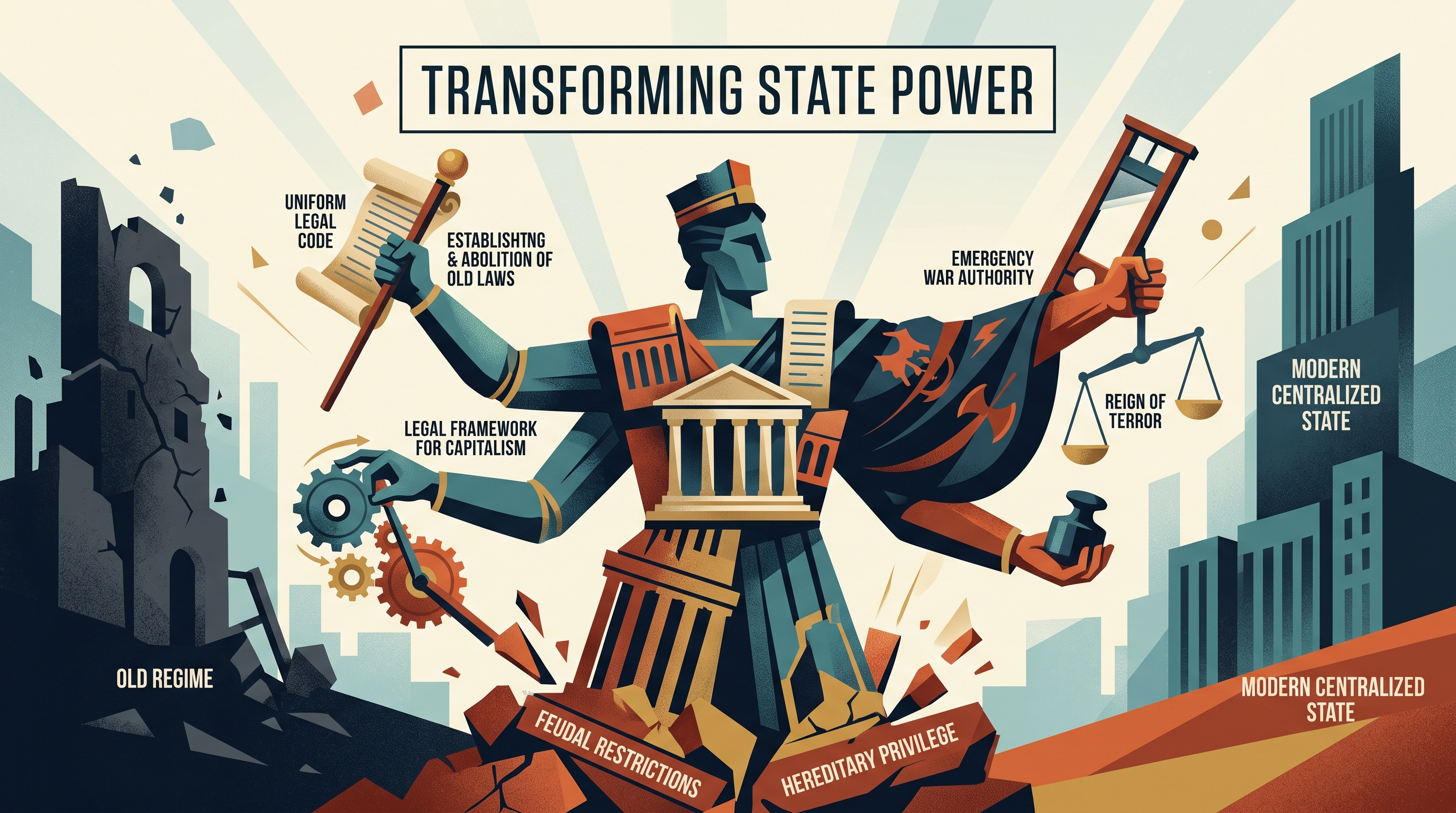
One influential interpretation holds that the Revolution weakened feudal restrictions, established a legal framework for capitalism, and brought the bourgeoisie to power. This interpretation emphasizes the destruction of hereditary privilege and the creation of uniform legal and administrative institutions, but historians also debate how fully political power became democratic and how much coercion accompanied economic and legal change.
Claims and Evidence in Sources (Historical Thinking Skill 3) requires more than naming the Reign of Terror: a strong claim would explain that emergency war conditions helped the Jacobins justify centralized authority, while evidence such as the Committee of Public Safety, price controls, and mass conscription demonstrates how the republic attempted to defend the Revolution.
Retrieval check: Explain the French Revolution using one long-term cause, one short-term cause, one moderate-phase reform, and one radical-phase development. Then answer the interpretive question: did the Revolution primarily limit state power, or did it create new forms of centralized state power? Support the answer with two specific examples.
Source Materials
- AP European History Course and Exam Description
- AP European History Course and Exam Description Clarifications and Corrections
- AP European History Course Overview
- AP European History Course at a Glance
- AP European History Course at a Glance Poster
- AP European History
- AP European History
- AP European History Sample Syllabus 1
- Figure — Sample Responses - DBQ - Set 1 (p. 7)
- Figure — Sample Responses - DBQ - Set 1 (p. 10)