From the free course AP European History on Lykke
6.5 The Concert of Europe and European conservatism · 6.6 Reactions and revolutions
Key concepts: Economic, social, and cultural exchanges · Atlantic world · Spain’s dominance in sixteenth-century Europe · Asiento · War of the Spanish Succession · Religious conflict and state power · Ottoman Empire · Landholding elites · The nuclear family · Mercantilism
The political order created after Napoleon tried to do two things at once: preserve Europe’s traditional hierarchies and prevent any single state from dominating the continent again.
6.5 The Concert of Europe and European conservatism · 6.6 Reactions and revolutions
The political order created after Napoleon tried to do two things at once: preserve Europe’s traditional hierarchies and prevent any single state from dominating the continent again.
From Atlantic rivalry to a European balance of power
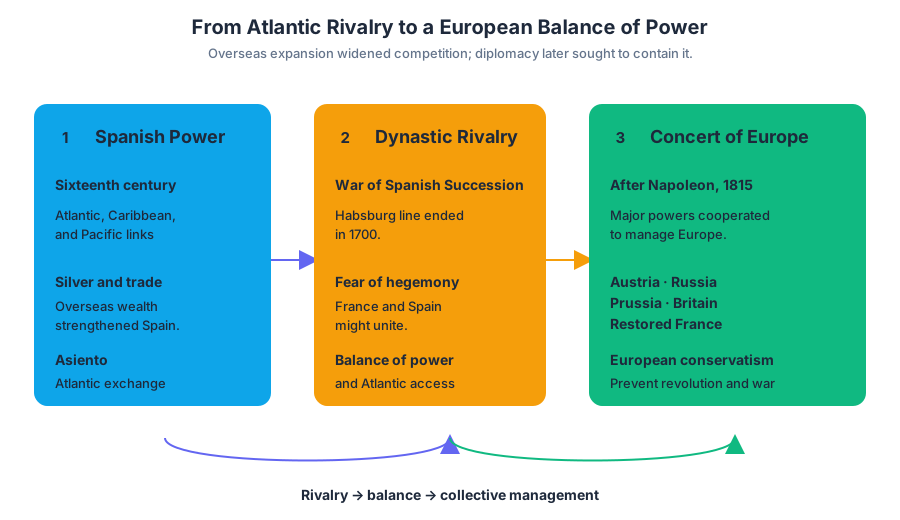
Sixteenth-century Spain demonstrated how overseas connections could magnify European power. Its Atlantic, Caribbean, and Pacific links brought silver, trade, territory, and strategic advantages that helped make Spain a dominant European state. Yet overseas wealth also intensified rivalry: the Asiento, a contract granting the right to supply enslaved Africans to Spanish America, became an important example of Atlantic exchange and competition among European powers.
The War of the Spanish Succession showed how dynastic politics, commercial interests, and fears of hegemony overlapped. When the Spanish Habsburg line ended in 1700, other European states opposed the possibility that the French Bourbon monarchy might control both France and Spain. The resulting conflict was therefore not merely a family dispute; it was a struggle over Europe’s balance of power and access to Atlantic commerce.
These earlier conflicts help explain the later Concert of Europe: a diplomatic system in which major powers cooperated to prevent revolutionary upheaval and another continent-wide war. After Napoleon’s defeat, Austria, Russia, Prussia, and Britain—joined in important ways by restored Bourbon France—attempted to manage Europe collectively rather than allow one state to dictate its future.
Conservatism after 1815
Conservatism was the political outlook that treated inherited institutions—monarchy, established religion, aristocratic authority, and social hierarchy—as valuable safeguards against disorder. Conservatives did not necessarily reject all change, but they opposed rapid popular revolution and political systems based on unrestricted national sovereignty or mass democracy.
At the Congress of Vienna in 1814–1815, diplomats redrew borders, restored ruling dynasties, and created arrangements intended to contain France. Austria’s foreign minister Klemens von Metternich became the leading symbol of this policy. The Concert’s members used conferences, alliances, censorship, and sometimes military intervention to suppress revolutions that threatened monarchical rule.
Key distinction: The Concert of Europe was a diplomatic mechanism; conservatism was the ideology that justified protecting established authority.
Religious conflict remained politically useful. European rulers could present opponents as threats to social order, Christian unity, or legitimate authority, then use those conflicts to centralize power and justify repression. Religion was therefore not simply a private belief system; it could become a language through which states defended political objectives.
A necessary correction: the Ottoman Empire and Catholic unity
The Ottoman Empire was a Muslim empire and a major rival of the Habsburgs. It attempted, unsuccessfully, to expand into central Europe, including the failed Ottoman siege of Vienna in 1683. It did not attempt to restore Catholic unity across Europe. The historically accurate interpretation is that Ottoman-Habsburg conflict shaped European religious and political anxieties, while Catholic unity was pursued by Catholic powers such as the Habsburg monarchy and the papacy.
Misconception check: “Ottoman attempts to restore Catholic unity” reverses the religious and political relationship. Ottoman expansion challenged Catholic Habsburg power; it did not promote it.
Society beneath the diplomatic order
Conservative restoration affected landholding elites differently across Europe. In eastern Europe, nobles often retained extensive estates and control over dependent agricultural laborers. In western Europe, the French Revolution and commercial development had weakened some aristocratic privileges, while property-owning middle classes gained influence. Thus, “restoration” did not recreate one identical social order everywhere.
The family remained the primary social and economic institution of early modern Europe. The nuclear family—parents and children living as a household—was one important form, although extended households and other arrangements also existed. Household organization mattered politically: inheritance determined who controlled land, marriage joined property and status, and family labor supported farms, workshops, and businesses. By protecting property transmission and male-headed households, conservative governments also defended the class structure on which post-1815 hierarchy rested.
Economic change created another tension. Mercantilism was an early modern system in which states regulated trade, promoted exports, protected domestic industries, and used colonies to strengthen national power. Over time, western Europe moved toward a freer economic system, with fewer restrictions on internal and international commerce. This shift expanded commercial opportunities but also challenged older corporate privileges and helped produce new political demands.
Reactions and revolutions
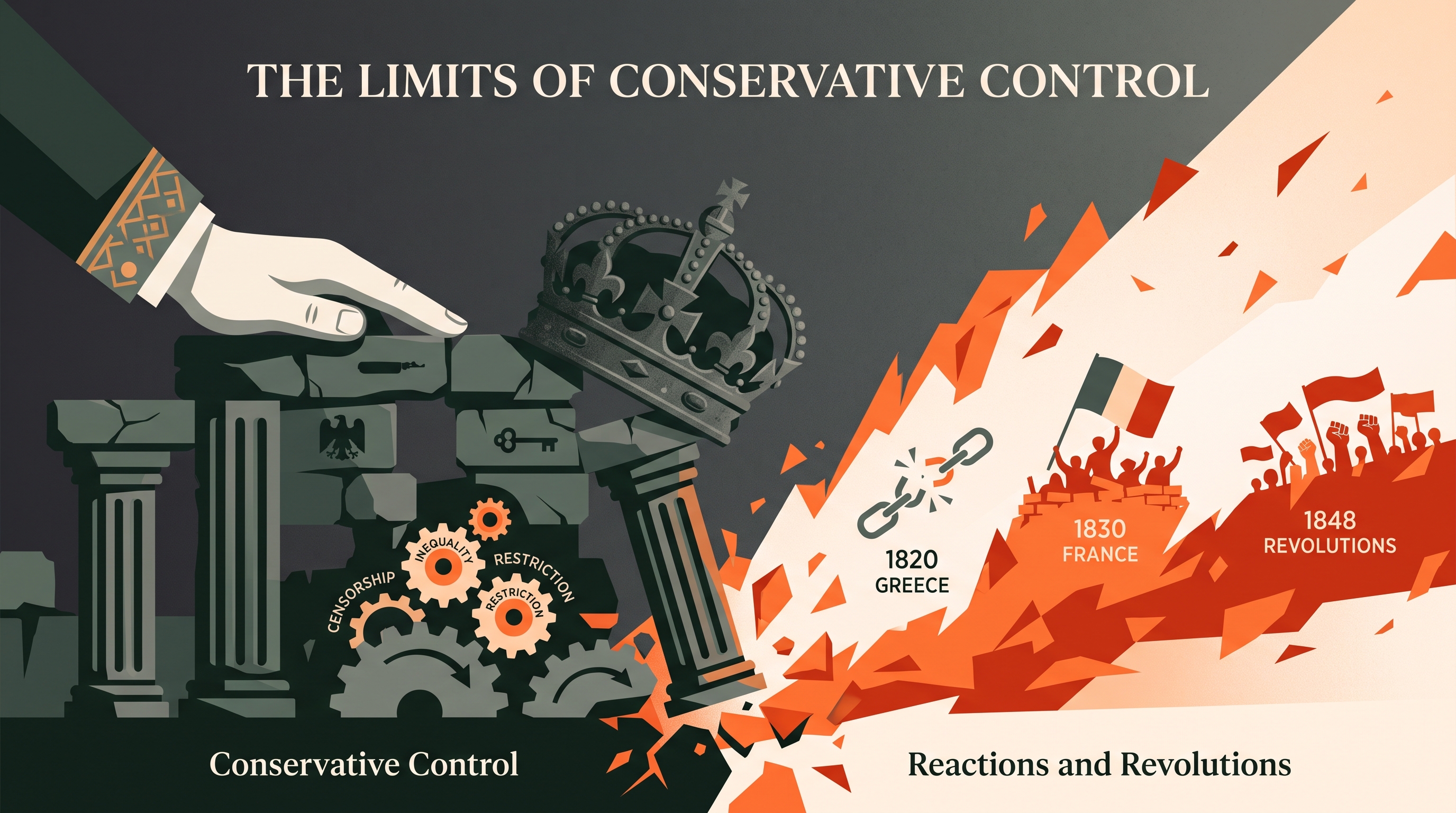
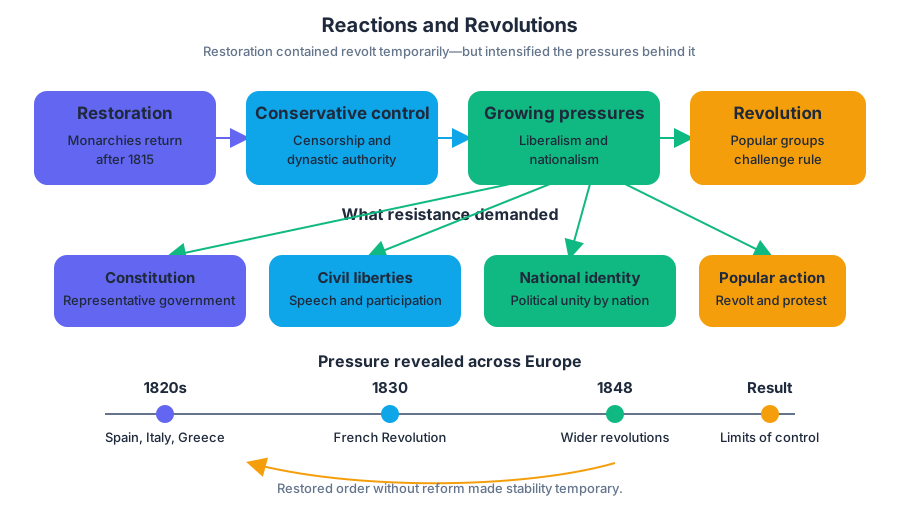
The Concert could suppress some revolutions, but it could not eliminate the pressures behind them. Liberalism demanded constitutional government and civil liberties; nationalism sought political units based on shared identity; and popular groups increasingly challenged dynastic rule. Revolts in Spain, Italy, and Greece during the 1820s, the French Revolution of 1830, and the wider revolutions of 1848 exposed the limits of conservative control.
AP skill connection: Topic 6.5 The Concert of Europe and European conservatism emphasizes Skill 5: Making Connections—linking diplomacy, economic systems, social hierarchy, and religious authority. Topic 6.6 Reactions and Revolutions emphasizes Skill 6: Argumentation—using evidence to explain why restoration produced resistance rather than permanent stability.
Worked interpretation: If a government restores a monarchy after revolution but leaves unequal landholding, restricts political participation, and censors opposition, conservative stability may be temporary. The same measures that protect elites can give liberals, nationalists, and other opponents a shared reason to resist. That causal chain explains why the post-1815 order endured for decades yet repeatedly faced revolutionary challenges.
Retrieval check: Explain one way the Asiento or the War of the Spanish Succession reveals the connection between Atlantic commerce and European state rivalry. Then explain why the family belonged to the political history of conservatism rather than existing as an isolated social topic.


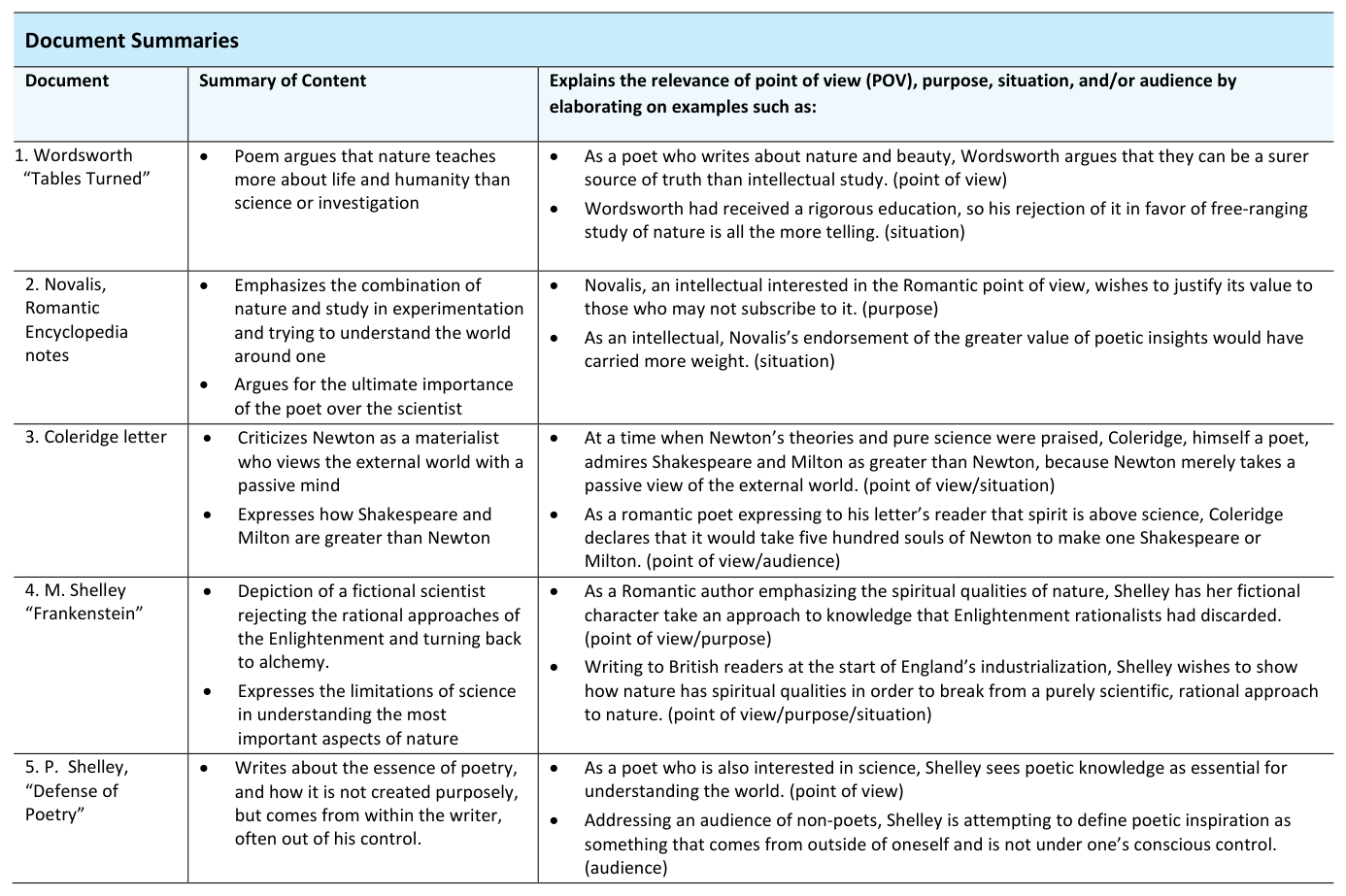
Source Materials
- AP European History Course and Exam Description
- AP European History Course and Exam Description Clarifications and Corrections
- AP European History Course Overview
- AP European History Course at a Glance
- AP European History Course at a Glance Poster
- AP European History
- AP European History
- AP European History Sample Syllabus 1
- Figure — Chief Reader Report – Set 1 (p. 1)
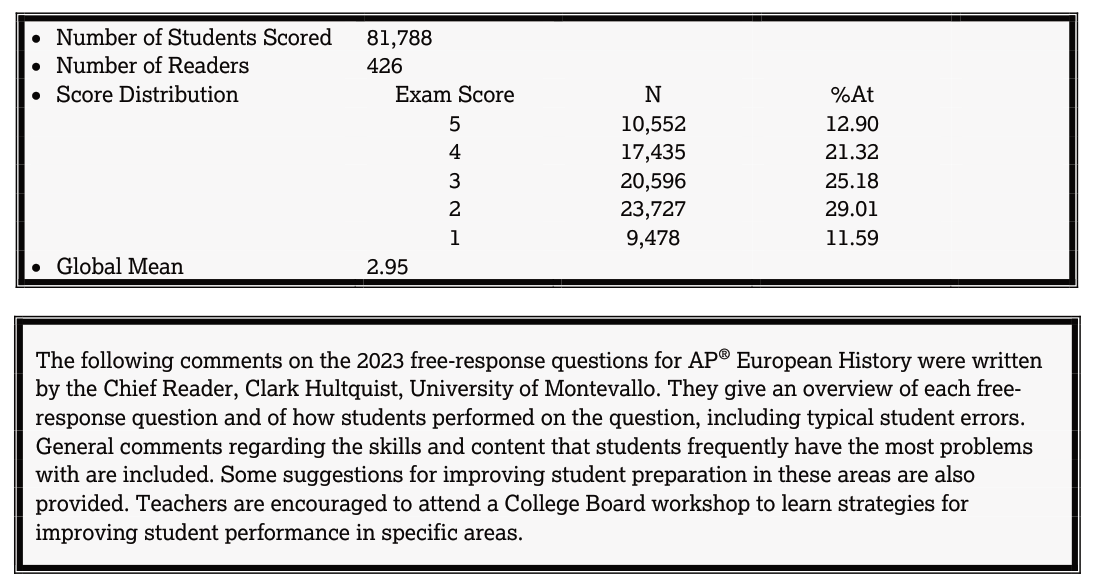
- Figure — Scoring Statistics – Set 1 (p. 1)
- Figure — Scoring Statistics – Set 2 (p. 1)
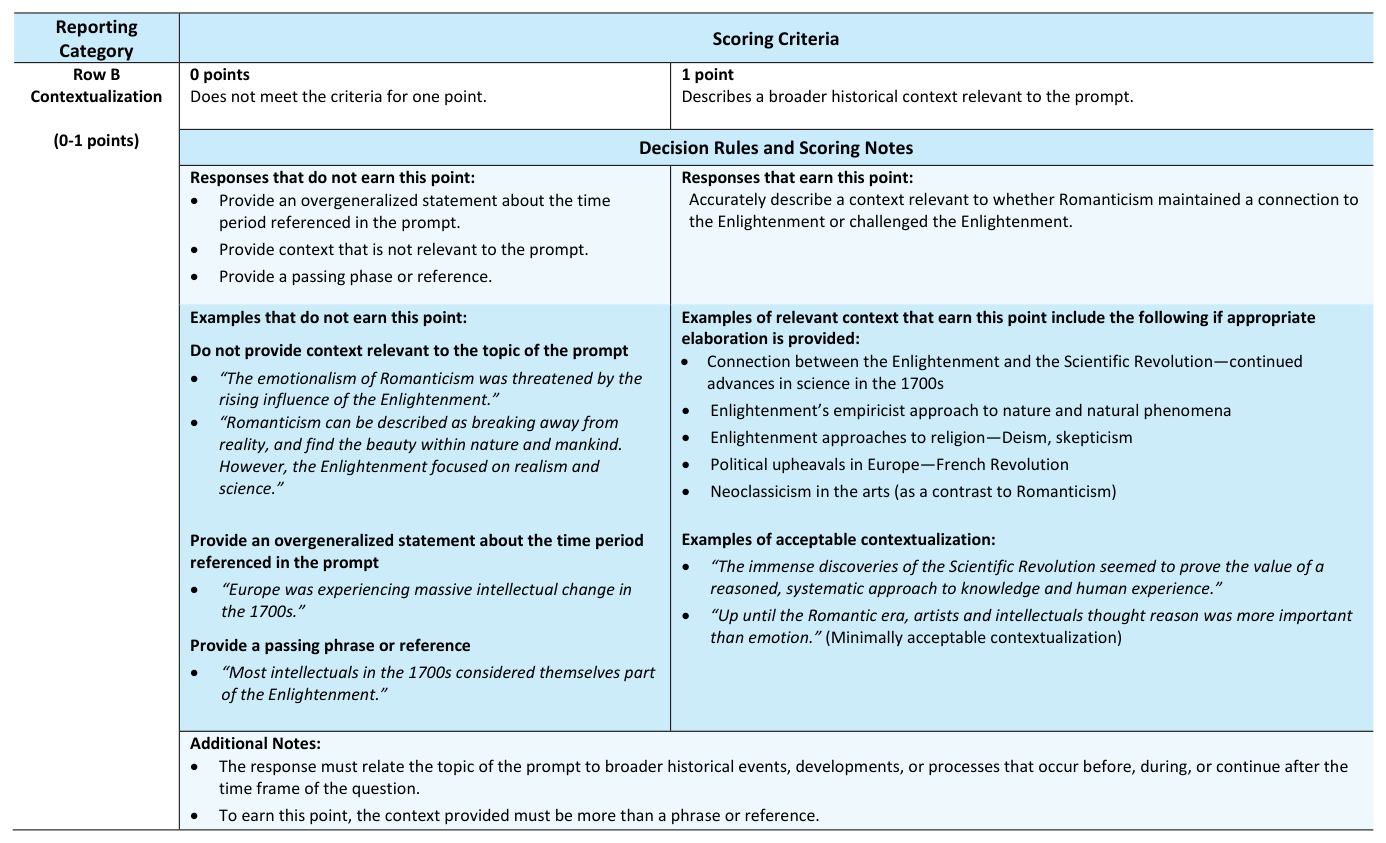
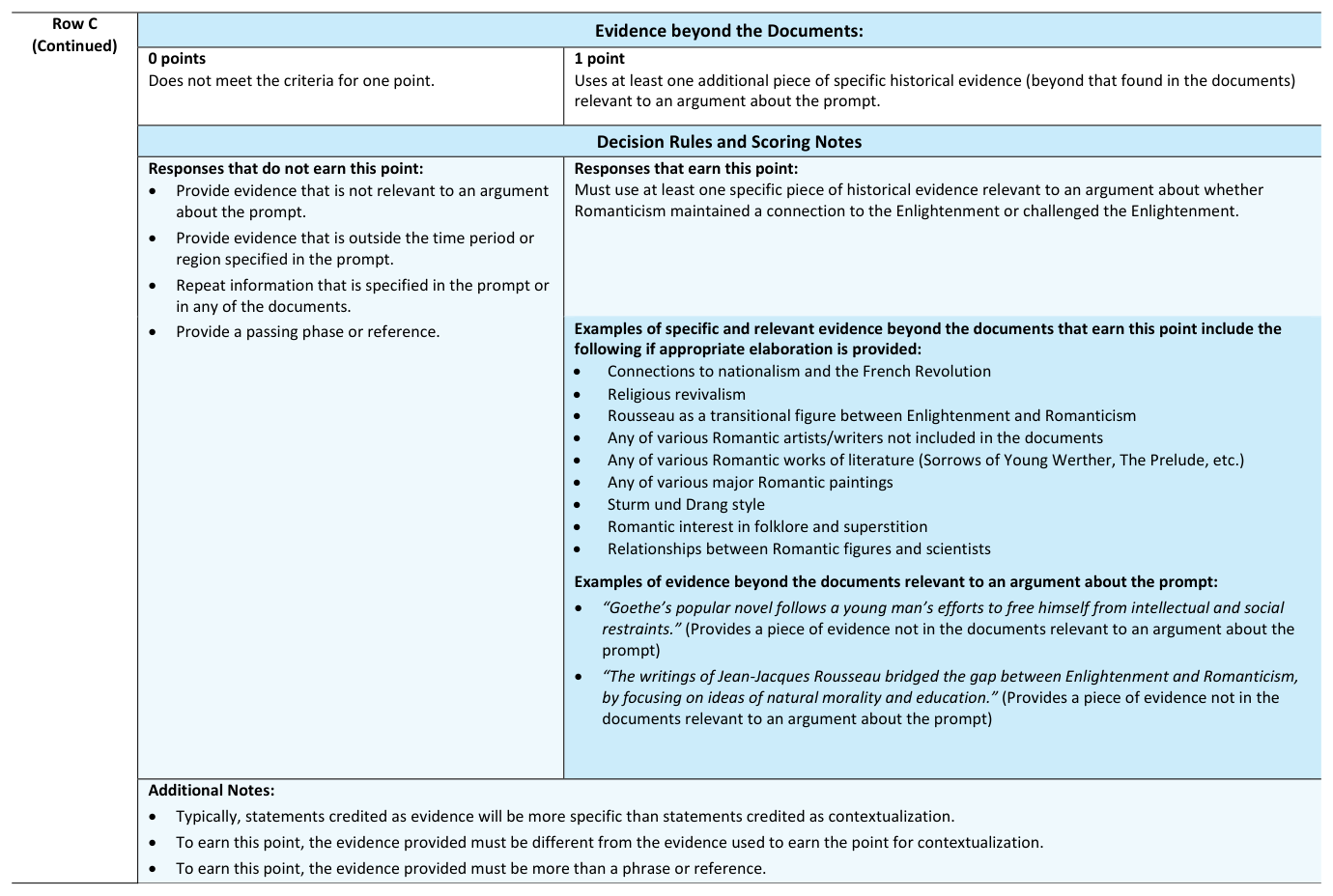
- Figure — Scoring Guidelines Set 1 (p. 12)