From the free course AP European History on Lykke
1.9 The Slave Trade · 1.10 The Commercial Revolution
Key concepts: The Slave Trade · The Commercial Revolution · Price Revolution · Accumulation of Capital · Expansion of the Market Economy · Transatlantic Slave-Labor Systems · Middle Passage · Triangle Trade · Urbanization · Consumerism
Atlantic commerce transformed European economies through two linked processes: the expansion of transatlantic slave-labor systems and the Commercial Revolution, the growth of commercial activity, capital, markets, and long-distance exchange from the late fifteenth through seventeenth centuries.
1.9 The Slave Trade · 1.10 The Commercial Revolution
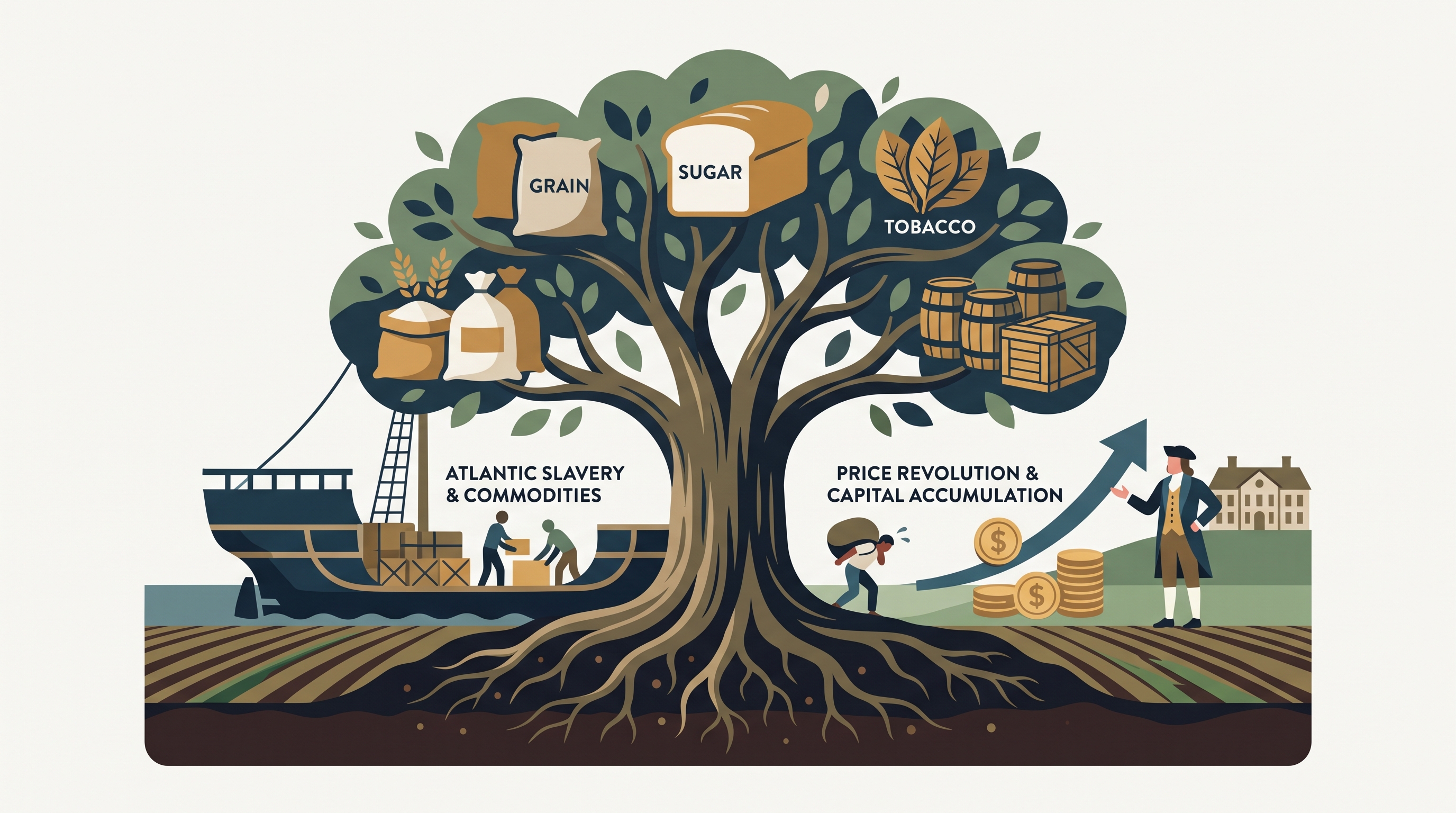
Atlantic commerce transformed European economies through two linked processes: the expansion of transatlantic slave-labor systems and the Commercial Revolution, the growth of commercial activity, capital, markets, and long-distance exchange from the late fifteenth through seventeenth centuries. The same system that moved sugar, tobacco, coffee, and other goods also moved millions of enslaved Africans under extreme violence.
Investigative question: How did expanding trade create wealth for some Europeans while turning human beings into coerced labor and commodities?
The transatlantic slave-labor system
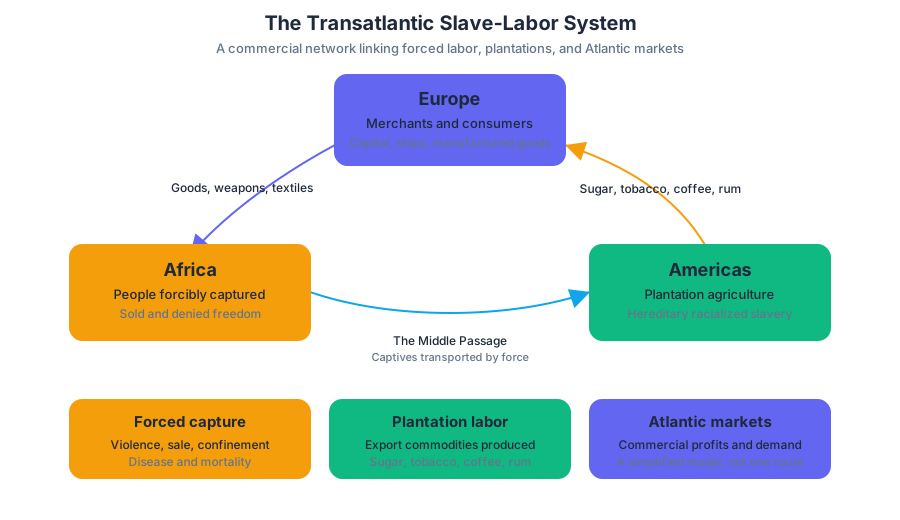
European merchants expanded the trade in enslaved Africans as plantation agriculture developed in the Americas. Enslaved labor produced export commodities—especially sugar, tobacco, coffee, and rum—for European and Atlantic markets. This was not simply “labor migration”: Africans were forcibly captured, sold, transported, and denied freedom through hereditary systems of racialized slavery.
The Middle Passage was the Atlantic crossing in which enslaved Africans were transported from Africa to the Americas. Captives endured confinement, disease, malnutrition, violence, and high mortality. The Middle Passage therefore functioned as one element within a larger commercial system, not as the entire slave trade.
The Triangle Trade describes a simplified pattern of exchange connecting Europe, Africa, and the Americas:
| Route | Typical movement | Economic purpose |
|---|---|---|
| Europe to Africa | Manufactured goods, weapons, and textiles | Merchants exchanged goods for captives |
| Africa to the Americas | Enslaved Africans across the Middle Passage | Forced labor supplied plantations |
| Americas to Europe | Sugar, tobacco, coffee, rum, and other commodities | Plantation products entered European markets |
The triangle was not a single uniform route followed by every ship. It is a useful model for seeing how European commercial enterprises connected African captives, American plantations, and European consumers. KC-2.2.II.E captures the wider pattern: foreign lands supplied raw materials, finished goods, laborers, and markets for European commercial enterprises.
The Commercial Revolution: prices become opportunity
The Commercial Revolution was the commercialization of economic activity: production increasingly aimed at exchange and profit rather than only local subsistence. Trade networks, banking, joint investment, overseas commerce, and expanding markets connected villages, ports, plantations, and cities more tightly than before.
A central development was the Price Revolution, a prolonged rise in prices during the sixteenth century. Population recovery increased demand for food, while greater supplies of precious metals and expanding trade increased the money circulating through European economies. Prices did not rise equally everywhere, but the general effect rewarded people who could sell goods while pressuring wage earners and consumers.
KC-1.4.II.B / Unit 1: Learning Objective M: The price revolution contributed to the accumulation of capital and the expansion of the market economy through the commercialization of agriculture, benefiting large landowners in western Europe.
Accumulation of capital means building up financial resources that can be reinvested to produce more wealth. A large landowner who sold grain at rising prices could use the proceeds to lease additional land, improve storage, purchase equipment, or finance further trade. The result was a reinforcing cycle: commercial agriculture generated revenue, and revenue enabled still more commercial activity.
Expansion of the market economy means that more goods, labor, and land were exchanged through prices and contracts rather than being produced only for household or village use. Agriculture remained the foundation of European life—KC-1.4.II—but rising prices encouraged landowners to produce surpluses for sale. In this way, rural production became increasingly connected to urban and overseas demand.
Worked connection: from plantation to European capital
Example: A Caribbean plantation produces sugar with enslaved labor. A merchant finances the voyage, transports the sugar to Europe, and sells it at a profit. The plantation owner and merchant now possess capital that can be reinvested in ships, land, warehouses, credit, or additional trade. European consumers’ demand for sugar expands the market, while coerced labor lowers production costs through violence rather than free wages.
This example shows why the slave trade and Commercial Revolution must be connected but not confused. Commercial expansion created wealth and wider markets; the transatlantic slave-labor system supplied coerced labor and commodities within that expansion. Profit did not make the system voluntary or morally neutral.
Misconception check
Common misconception: “The Commercial Revolution replaced agriculture with trade.”
Correction: Agriculture remained central. The change was that more agricultural production—grain, sugar, tobacco, and other goods—was organized for exchange, profit, and long-distance markets. Commercialization altered agriculture rather than eliminating it.
Later population growth, declining infant mortality, and industrialization expanded production and consumption further; however, those developments belong chiefly to later historical processes. For 1.9 and 1.10, the essential relationship is earlier and sharper: Atlantic slavery supplied commodities and labor, while the Price Revolution and commercialization helped European landowners and merchants accumulate capital and enlarge markets.
Retrieval check: Explain in two steps how the Price Revolution could benefit a large western European landowner but harm a wage laborer. Then identify which part of the Triangle Trade the Middle Passage names.



Source Materials
- AP European History Course and Exam Description
- AP European History Course and Exam Description Clarifications and Corrections
- AP European History Course Overview
- AP European History Course at a Glance
- AP European History Course at a Glance Poster
- AP European History
- AP European History
- AP European History Sample Syllabus 1
- Figure — Sample Responses - LEQ 3 - Set 2 (p. 6)
- Figure — Sample Responses - LEQ 3 - Set 2 (p. 7)
- Figure — Sample Responses - LEQ 3 - Set 2 (p. 10)
- Figure — Sample Responses - LEQ 3 - Set 2 (p. 10)