From the free course AP European History on Lykke
1.11 Causation in the Renaissance and Age of Discovery
Key concepts: Causation · Renaissance · Age of Discovery · Causes and effects · European colonial expansion · Commercial and agricultural developments · Urban financial centers · Commercial and religious motives for exploration · Overseas exploration, settlement, and colonization · Renaissance visual arts and their personal, political, and religious purposes
Between approximately $1450$ and $1648$, European intellectual change and overseas expansion grew from a shared environment of urban wealth, political competition, revived classical learning, expanding trade, and religious ambition.
1.11 Causation in the Renaissance and Age of Discovery
Between approximately $1450$ and $1648$, European intellectual change and overseas expansion grew from a shared environment of urban wealth, political competition, revived classical learning, expanding trade, and religious ambition. The key historical question is not whether one single cause “created” the Renaissance or exploration, but how several developments reinforced one another.
Learning Objective 1.11.A: Explain the causes and consequences of the Renaissance and Age of Discovery.
A causal chain: from urban wealth to global expansion
Causation means explaining why a historical development happened and what effects it produced. A strong causal explanation distinguishes between long-term conditions, immediate motivations, and consequences that changed later possibilities.
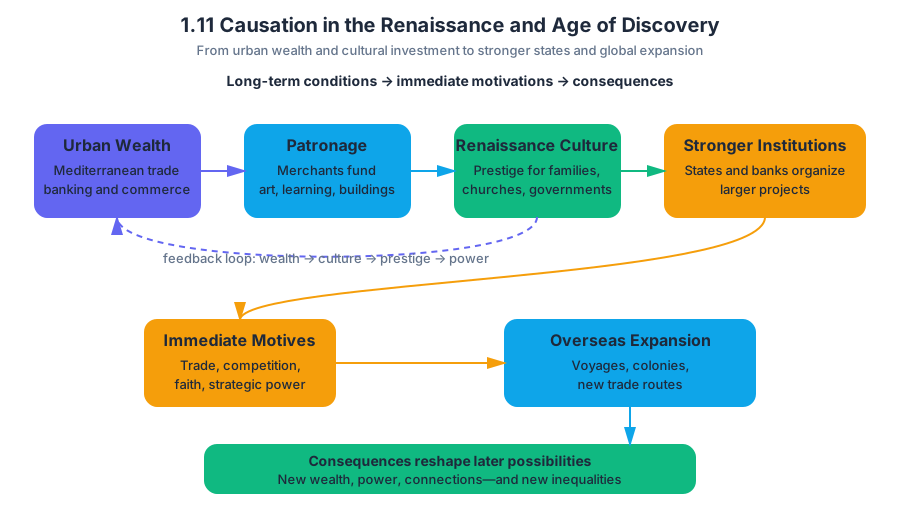
The Italian city-states—especially Florence, Venice, and Genoa—connected Mediterranean commerce, banking, and political power. Wealthy merchants and banking families funded artists, architects, scholars, and public buildings; this patronage, or financial support for cultural work, helped make urban financial centers engines of Renaissance culture. The result was a feedback loop:
- commercial wealth supported artistic and scholarly patronage;
- Renaissance culture enhanced the prestige of wealthy families, churches, and governments;
- stronger states and financial institutions could organize larger commercial and military projects;
- overseas expansion promised access to new markets, precious metals, land, and trade routes.
Agricultural and commercial developments also reshaped everyday life. Improved production and expanding markets supported population growth, encouraged specialization, and increased the importance of towns. A money economy made it easier to pay wages, taxes, rents, and loans in currency rather than relying only on customary exchange. These changes did not improve life equally: merchants and elites gained opportunities, while laborers, peasants, Indigenous peoples, and enslaved Africans often bore the costs of expansion.
Renaissance ideas and visual persuasion
KC-1.1 identifies a major intellectual cause: the rediscovery of works from ancient Greece and Rome, combined with observation of the natural world, changed many Europeans’ view of their world. KC-1.1.I emphasizes that revived classical texts encouraged new methods of scholarship and new values in society and religion.
Renaissance artists translated those ideas into visible form. Perspective, proportion, realism, and renewed interest in Greco-Roman models made paintings and architecture appear more naturalistic. Yet art was not merely “beautiful.” KC-1.1.III explains that visual arts promoted personal, political, and religious goals: a merchant family could display status, a ruler could project authority, and a church could communicate sacred power to viewers who could not read.
Misconception check — “Renaissance art was purely secular.”
Renaissance artists explored human experience and classical forms, but religious commissions remained central. Humanism did not simply reject Christianity; it often encouraged a more scholarly, individual, and historically informed engagement with Christian ideas.
Why Europeans explored and colonized overseas
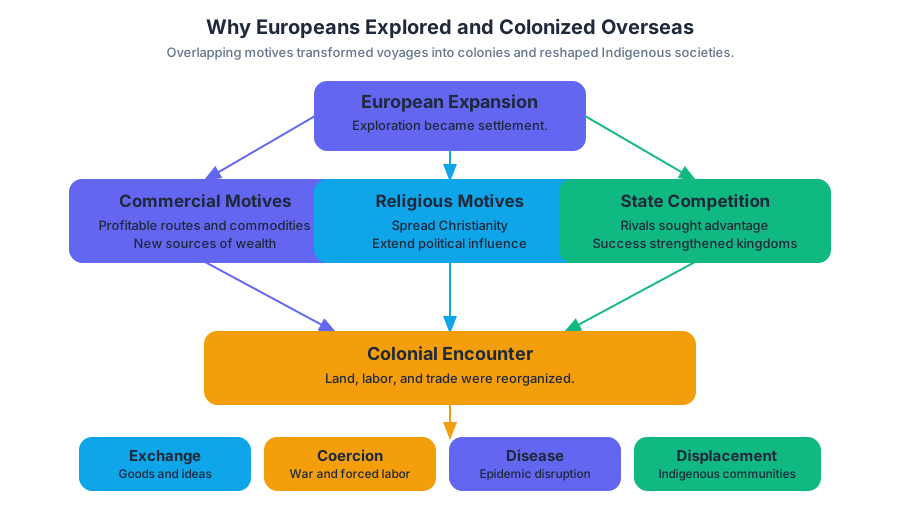
European exploration had overlapping commercial and religious motives, as stated in KC-1.3.I. Monarchs and merchants sought profitable routes, valuable commodities, and new sources of wealth. Religious authorities and rulers also sought to spread Christianity and extend political influence. Competition among European states intensified these motives: a successful voyage could strengthen one kingdom while weakening its rivals.
KC-1.3 states that Europeans explored and settled overseas territories, encountering and interacting with Indigenous populations. Exploration therefore produced colonies, not merely maps. European settlement reorganized land, labor, and trade; encounters brought exchange but also warfare, coercion, epidemic disease, forced conversion, and the displacement of Indigenous communities.
Worked causal example: Portugal and Atlantic expansion
Portugal illustrates how causes operated together. Its Atlantic position, maritime technology, commercial ambitions, and competition with other states encouraged voyages along the African coast and into the Atlantic. Royal sponsorship linked exploration to trade and Christian expansion. Once Portuguese voyages established routes and settlements, the consequences included new commercial networks, colonial footholds, altered labor systems, and deeper European involvement in the Atlantic world.
A historically defensible claim could therefore be:
European colonial expansion was driven primarily by commercial competition and state-building, while religious motives helped legitimize and accelerate expansion; together, these motives produced colonies that transformed Atlantic trade and imposed severe costs on Indigenous populations.
This claim is stronger than “Europeans explored for money” because it identifies multiple motives, ranks their importance, and connects them to consequences. Specific evidence—urban banking, royal sponsorship, Christian conversion efforts, overseas settlement, and colonial control—supports the argument.
Comparison beyond Europe
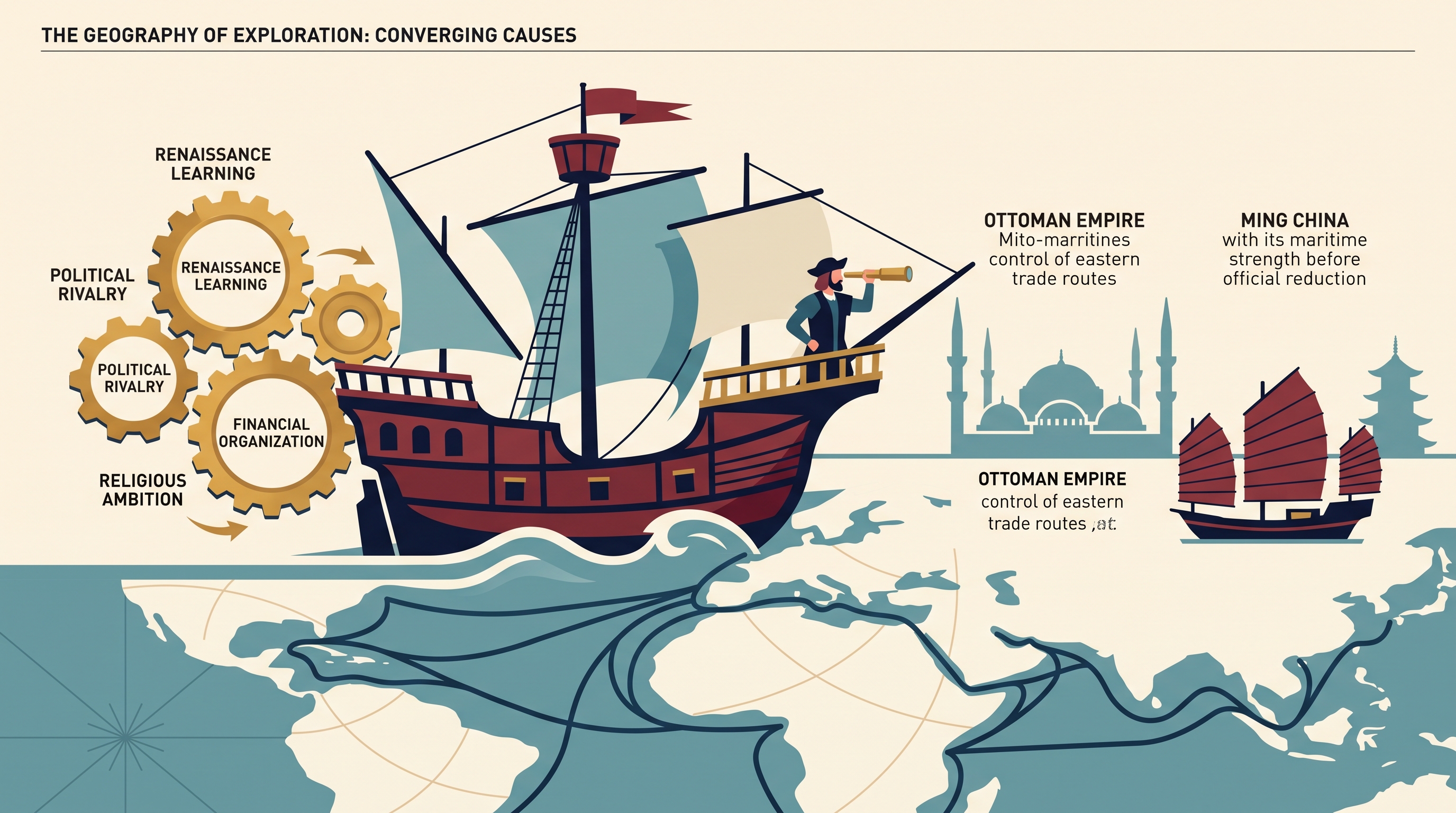
European developments were significant but not isolated. During the same broad period, the Ottoman Empire controlled major eastern Mediterranean routes and combined commercial, military, and religious power. Ming China possessed substantial maritime capacity, although the state later reduced official long-distance voyages. These comparisons show that Europe did not possess a natural monopoly on technology or exploration; European overseas expansion resulted from a particular combination of political rivalry, financial organization, maritime opportunity, and religious ambition.
Skill application: Skill 1: Developments and Processes identifies how Renaissance culture and overseas expansion unfolded over time. Skill 4: Contextualization places both developments within urbanization, political fragmentation, revived classical learning, and expanding trade. Skill 5: Making Connections links financial centers, art, exploration, and colonialism. Skill 6: Argumentation requires a defensible claim supported by specific evidence.
Retrieval check: Explain one way urban financial growth caused a Renaissance development and one way commercial or religious motives caused European colonial expansion. Then name one consequence for European society and one consequence for Indigenous peoples.
Source Materials
- AP European History Course and Exam Description
- AP European History Course and Exam Description Clarifications and Corrections
- AP European History Course Overview
- AP European History Course at a Glance
- AP European History Course at a Glance Poster
- AP European History
- AP European History
- AP European History Sample Syllabus 1
- A Describe one significant motivation for European overseas expansion in the period 1450 to 1600.
- A Describe one significant motivation for European overseas expansion in the period 1450 to 1600.