From the free course AP European History on Lykke
1.1 Contextualizing Renaissance and Discovery · 1.2 Italian Renaissance
Key concepts: Renaissance and Discovery · Contextualizing historical developments · Italian Renaissance · Revival of Greek and Roman texts and ideas · Renaissance humanism · Leonardo Bruni · Patronage and funding of artists and thinkers · Fall of Constantinople and arrival of Greek refugee scholars · Italian and Northern Renaissance comparison · AP European History Unit 1 topics 1.1 and 1.2
The Italian Renaissance began when European intellectuals and artists turned renewed attention toward the texts, values, and visual models of ancient Greece and Rome. In Italy’s wealthy, competitive city-states, this classical revival became more than an interest in old books: it reshaped education, art, political…
1.1 Contextualizing Renaissance and Discovery · 1.2 Italian Renaissance
The Italian Renaissance began when European intellectuals and artists turned renewed attention toward the texts, values, and visual models of ancient Greece and Rome. In Italy’s wealthy, competitive city-states, this classical revival became more than an interest in old books: it reshaped education, art, political thought, and ideas about human potential.
Context before interpretation: what is contextualization?
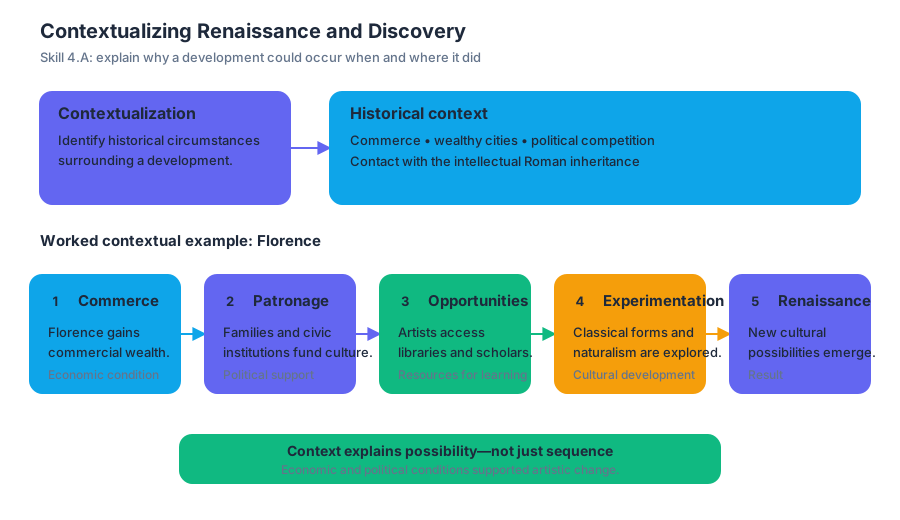
Contextualization means identifying and describing the historical circumstances surrounding a specific development or process. In AP European History, Skill 4.A: Contextualization requires more than naming an earlier event; the context must help explain why the development could occur when and where it did.
Historical context: Renaissance culture grew in a Europe shaped by expanding commerce, wealthy urban centers, competition among political powers, and continuing contact with the intellectual inheritance of the Roman world.
A useful contextual chain looks like this:
Worked contextual example: Florence’s commercial wealth helped powerful families and civic institutions fund churches, libraries, scholars, painters, and architects. That patronage created opportunities for artists to experiment with classical forms and naturalistic representation. The result was not simply “better art”; it was a cultural development supported by identifiable economic and political conditions.
The classical revival and humanism
Renaissance humanism was a cultural and intellectual movement centered on recovering, studying, and applying classical Greek and Roman literature. Italian humanists developed new philological approaches—careful methods for comparing manuscripts, language, authorship, and meaning—to reconstruct ancient texts more accurately.
The revival included texts and ideas associated with rhetoric, history, moral philosophy, political life, and civic responsibility. Humanists did not necessarily reject Christianity, but some promoted stronger secularism, meaning attention to worldly life, and individualism, meaning greater emphasis on personal ability, achievement, and reputation.
Unit 1: Learning Objective B and KC-1.1.I.A connect the revival of classical texts directly to the Renaissance in Italy. Petrarch helped establish the humanist recovery of classical literature, while Leonardo Bruni promoted Greek and Roman texts and applied classical learning to civic and political life. Leon Battista Alberti and Niccolò Machiavelli are additional illustrative examples of thinkers shaped by this classical orientation.
Misconception check — “Humanism means atheism.”
Humanism was not automatically a rejection of religion. The key distinction is that Italian humanists shifted intellectual attention toward classical literature, human experience, civic life, and individual achievement; some remained deeply religious.
Art made naturalistic—and made possible by patrons
Renaissance art differed from many medieval techniques and ideas by pursuing more naturalistic or lifelike painting and sculpture. Artists studied the human body, proportion, space, and movement, while classical models encouraged balanced forms and renewed interest in Greco-Roman subjects.
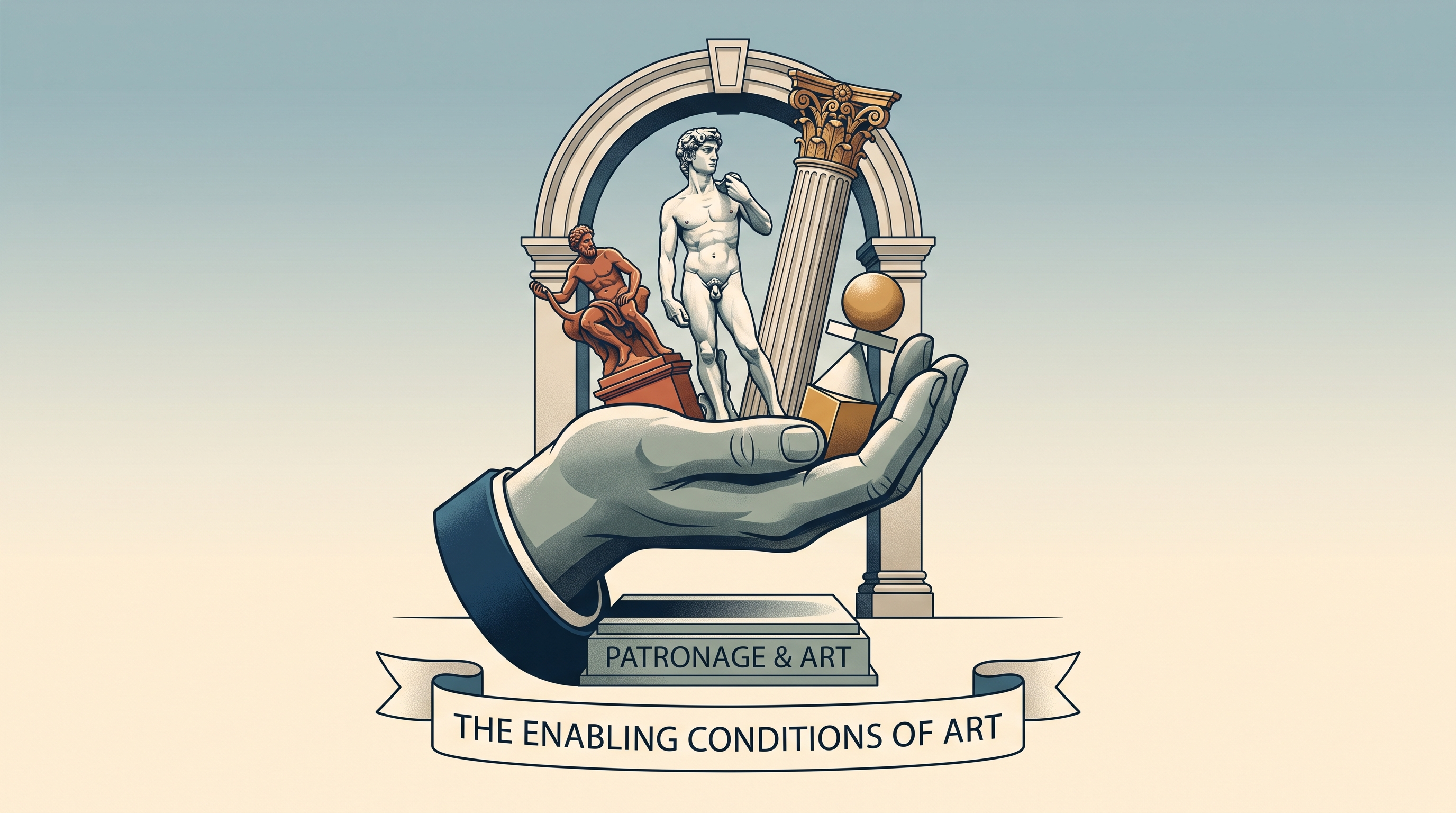
Patronage—the financial support of artists and thinkers—was a crucial political and economic factor. City governments, wealthy merchants, popes, and elite families commissioned buildings, paintings, sculptures, and scholarly work. Michelangelo, Donatello, Raphael, and Andrea Palladio illustrate how artistic production depended on patrons who could supply money, materials, commissions, and public visibility.
Unit 1: Learning Objective C and KC-1.1.I.B emphasize this connection between Renaissance culture and the institutions that funded it. To explain the Renaissance historically, connect an artistic achievement to its enabling conditions: wealth created patrons; competition encouraged display; humanism supplied classical ideals; artists translated those ideals into visible form.
Constantinople and the movement of knowledge
The fall of Constantinople to the Ottoman Empire in 1453 also facilitated the Italian Renaissance. Greek refugee scholars moved to Italy, bringing knowledge of Greek language and classical texts. Their arrival strengthened the humanist effort to recover and study ancient learning.
This event should be treated as one contributing factor rather than a single-cause explanation. Italian urban wealth, political competition, patronage, humanist scholarship, and the arrival of Greek scholars worked together. A strong historical explanation therefore uses a chain of causes instead of claiming that the fall of Constantinople “caused” the Renaissance by itself.
A first comparison—and a boundary
The Italian Renaissance is especially associated with classical texts, civic life, secular concerns, individual achievement, and naturalistic art. Renaissance developments north of the Alps formed a later contrast with stronger Christian and religious emphases; the detailed comparison belongs with Topic 1.3 Northern Renaissance, not here.
In-flow retrieval check: A response identifies Leonardo Bruni, humanism, and the fall of Constantinople. Which statement best demonstrates Skill 4.A: Contextualization?
- Bruni studied classical texts.
- Humanism valued individual achievement.
- Greek refugee scholars carried classical texts into Italy after Constantinople fell.
- Wealthy patrons funded Renaissance artists.
Answer: 3. It places the Renaissance within a specific historical circumstance and explains how that circumstance supported the revival of classical learning. Option 4 is also historically important, but by itself it identifies a contributing factor rather than fully establishing broader context.
Source Materials
- AP European History Course and Exam Description
- AP European History Course and Exam Description Clarifications and Corrections
- AP European History Course Overview
- AP European History Course at a Glance
- AP European History Course at a Glance Poster
- AP European History
- AP European History
- AP European History Sample Syllabus 1
- AP European History-AP Students-College Board
- AP European History-Doves Library
- AP European History Cheat Sheets-Albert.io
- AP European History Study Guide-EBSCO