From the free course AP European History on Lykke
5.9 Continuity and change in 18th-century states
Key concepts: Continuity and change over time (CCOT) · Argumentation using evidence from the entire unit · Identifying historical patterns and connections · Contextualization of 18th-century states · Comparison among contemporaneous European states · Change from and continuity with preceding historical developments · Similarities and differences across European states or regions · The Enlightenment · Romanticism · Absolutism and constitutionalism
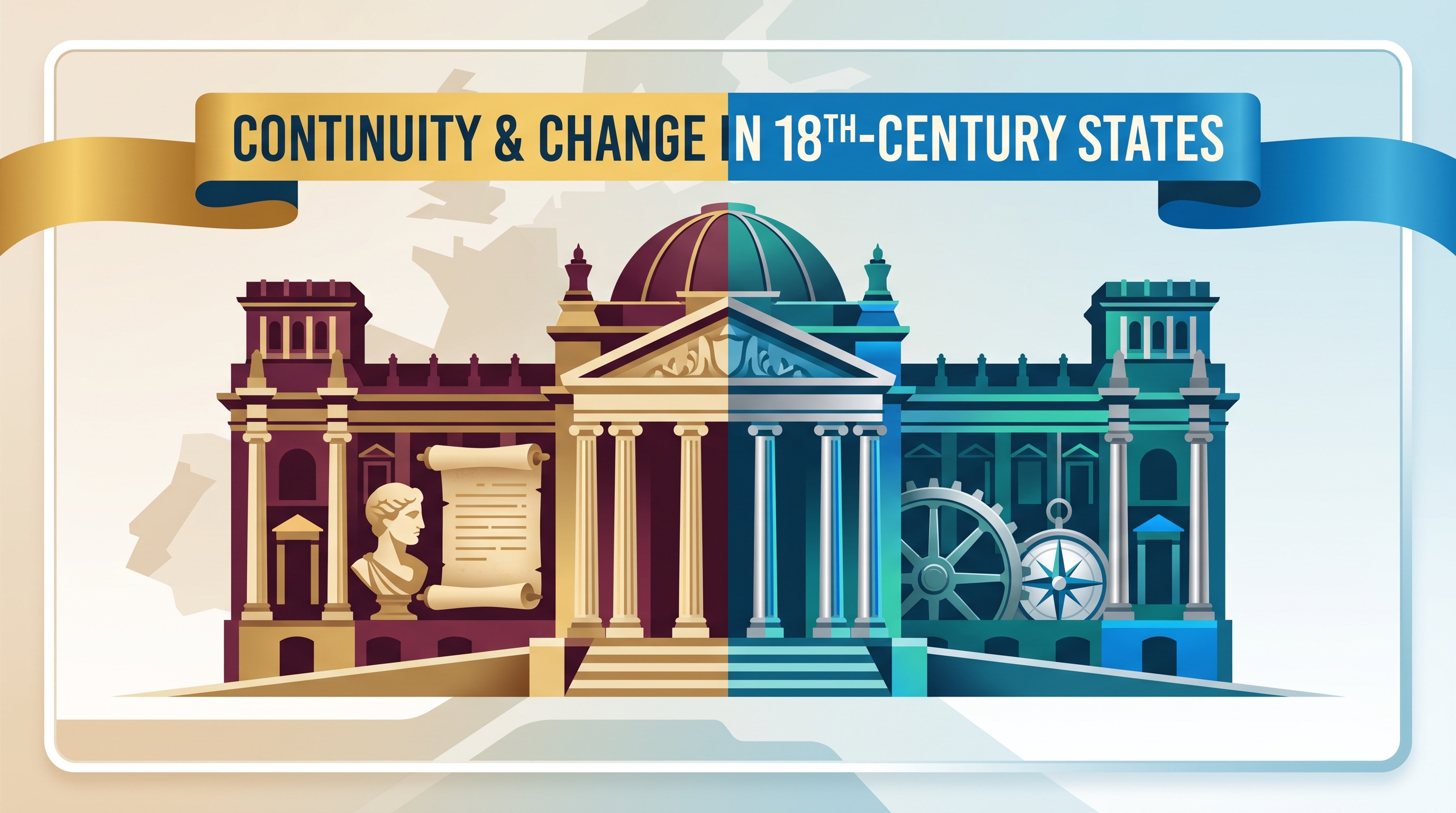
Eighteenth-century Europe changed politically without abandoning its older foundations: monarchs expanded administrative power, but dynastic rule, social hierarchy, and unequal privilege remained remarkably durable. The central historical question is therefore not whether Europe “became modern,” but which…
5.9 Continuity and change in 18th-century states
Eighteenth-century Europe changed politically without abandoning its older foundations: monarchs expanded administrative power, but dynastic rule, social hierarchy, and unequal privilege remained remarkably durable. The central historical question is therefore not whether Europe “became modern,” but which institutions changed, which survived, and why.
Continuity and change over time asks you to identify what persisted, what transformed, and how the relationship between the two produced a new historical situation.
The topic’s required reasoning is Unit 5: Learning Objective J: explain how developments and challenges to the political order in eighteenth-century Europe led to continuity and change. Its suggested historical thinking tool is Skill 5.A: Making Connections — Identify patterns among or connections between historical developments and processes. In broader exam language, this is Skill 5: Making Connections, applied through the reasoning process of continuity and change over time.
The pattern: stronger states, persistent hierarchy
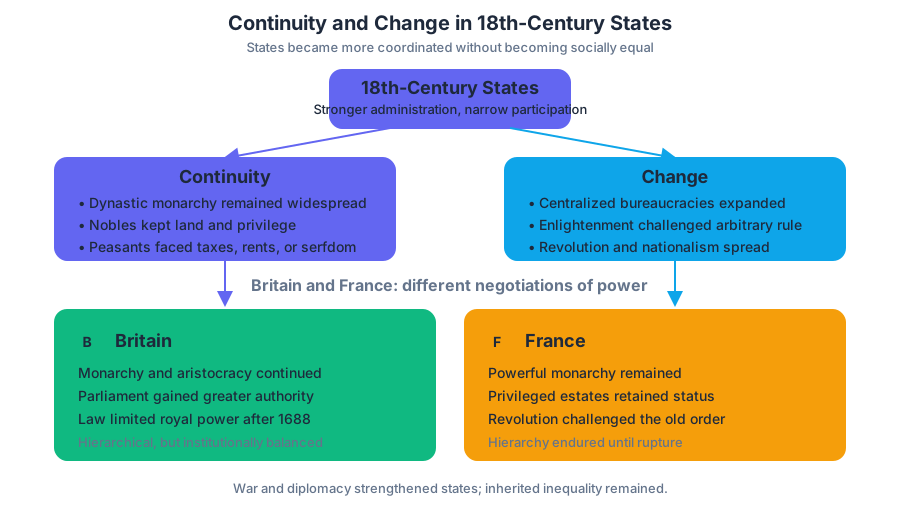
Across Europe, rulers improved taxation, expanded professional armies, and relied on more centralized bureaucracies. These changes strengthened states compared with the fragmented political arrangements of the earlier Age of Absolutism and Constitutionalism, yet they did not eliminate inherited privilege. Nobles continued to possess land and status; peasants remained subject to taxes, rents, or serfdom in much of eastern Europe; and political participation remained narrow.
| Continuing feature | Important change |
|---|---|
| Dynastic monarchy remained widespread | Governments developed more centralized administration |
| Nobles retained social and economic privilege | Enlightenment criticism challenged arbitrary authority |
| Social orders and legal inequalities persisted | Britain strengthened parliamentary government |
| States competed through war and diplomacy | Revolutionary and nationalist ideas questioned dynastic rule |
The comparison between Britain and France shows why a simple “absolutism versus democracy” story fails. Britain preserved monarchy and aristocratic privilege, but Parliament and the law limited royal authority after the Glorious Revolution. France retained a powerful monarchy and privileged estates until the French Revolution challenged the entire political order. Both states were hierarchical; they differed in how successfully institutions negotiated power.
Comparing contemporaneous European states
In Prussia, Austria, and Russia, rulers used administrative reform and military power to strengthen monarchies. Frederick the Great of Prussia, Maria Theresa and Joseph II of Austria, and Catherine the Great of Russia are often associated with enlightened absolutism—the use of selected Enlightenment ideas to improve state efficiency while preserving monarchical control. Their reforms could expand education, codify laws, or reduce certain abuses, but they rarely created political equality.
A useful comparison is the relationship between reform and power:
- Prussia: military discipline and bureaucratic administration reinforced the authority of the Hohenzollern monarchy.
- Austria: centralizing reforms attempted to govern a diverse empire more uniformly, but regional privileges and resistance limited results.
- Russia: Catherine promoted Enlightenment language while preserving autocracy and allowing noble dominance over serfs.
- Britain: parliamentary institutions constrained the crown, while aristocratic elites continued to dominate politics.
- France: fiscal crisis, social inequality, and political resistance eventually produced revolutionary rupture.
Romanticism and the limits of Enlightenment confidence
Romanticism belongs in this continuity-and-change argument because it reacted against the Enlightenment’s confidence in universal reason, rational planning, and orderly progress. Romantic writers and artists emphasized emotion, imagination, nature, historical memory, religion, and distinctive national cultures. This was not simply a rejection of all Enlightenment ideas; it was a competing response to the political and social upheavals that rational reform had not resolved.
The French Revolution illustrates the connection. Enlightenment concepts such as popular sovereignty and natural rights helped challenge the old political order, but revolutionary violence and Napoleonic domination encouraged Romantic interest in tradition, community, and national identity. The Congress of Vienna, treated here as a preceding Unit 5 development, attempted to restore dynastic stability after Napoleon while also managing the new forces of nationalism and revolution. Its settlement therefore combined continuity—monarchies and diplomacy—with change—the recognition that mass politics and national feeling could not simply be erased.
Worked argument: building a CCOT claim
Prompt: Evaluate the extent to which eighteenth-century European states changed politically while maintaining continuity with earlier forms of rule.
Step 1 — Establish a defensible claim. Eighteenth-century states changed substantially in administrative capacity and political debate, but continuity was stronger in social hierarchy and the survival of monarchy; revolutionary France represented a sharper rupture than reforming Britain or enlightened absolutist Russia.
Step 2 — Select evidence from the entire unit. Use the rise of global markets and Britain’s fiscal-military strength, the French Revolution, Napoleon’s reorganization of Europe, the Congress of Vienna, and Romanticism’s reaction against Enlightenment universalism.
Step 3 — Explain the connection. Commercial expansion gave states more resources, but unequal taxation intensified resentment. Enlightenment criticism weakened the legitimacy of absolutism, while revolution and war produced both political innovation and conservative restoration. The result was not a clean transition to liberal democracy but a contested mixture of reform, reaction, and persistence.
Misconception check
Misconception: “The French Revolution ended absolutism everywhere.” The Revolution destroyed the Bourbon monarchy for a time and spread new political principles, but monarchies returned after Napoleon. The Congress of Vienna demonstrates that conservative rulers could restore dynastic government even while adapting diplomacy to a Europe transformed by revolution and nationalism.
Retrieval and interpretation check
Name one continuity and one change between eighteenth-century European states and earlier absolutist states. Then explain why Britain, Russia, and revolutionary France should not receive the same label for their political development. A strong response must identify a pattern, use specific evidence from multiple Unit 5 topics, and explain the relationship between persistence and transformation rather than merely listing events.
Source Materials
- AP European History Course and Exam Description
- AP European History Course and Exam Description Clarifications and Corrections
- AP European History Course Overview
- AP European History Course at a Glance
- AP European History Course at a Glance Poster
- AP European History
- AP European History
- AP European History Sample Syllabus 1
- Based on your experience at the AP® Reading with student responses, what advice would you offer teachers to help them improve the student performance on the exam? Practicing the historical thinking sk