From the free course AP European History on Lykke
9.1 Contextualizing the Cold War and contemporary Europe · 9.2 Rebuilding Europe
Key concepts: Contextualizing the Cold War · Rebuilding Europe · Cold War tensions between the USSR and the West · Division of Europe · Soviet domination of Eastern Europe · COMECON · Warsaw Pact · Suppression of dissent in the Soviet bloc · Constraint of emigration in the Soviet bloc · Postwar world monetary and trade system
After 1945, Europe was not simply “at peace.” It was divided between competing political and economic systems whose rivalry shaped borders, governments, trade, military alliances, and everyday freedoms.
9.1 Contextualizing the Cold War and contemporary Europe · 9.2 Rebuilding Europe
After 1945, Europe was not simply “at peace.” It was divided between competing political and economic systems whose rivalry shaped borders, governments, trade, military alliances, and everyday freedoms. The central problem was how a continent devastated by total war would rebuild while the Soviet Union and the Western powers distrusted one another deeply.
From wartime alliance to divided Europe
The Cold War was a prolonged geopolitical conflict between the Soviet Union and the United States-led West. It rarely became a direct, full-scale war between the two principal powers; instead, tension appeared through military alliances, economic systems, political pressure, nuclear threats, espionage, proxy conflicts, and struggles over the future of European states.
Several tensions made cooperation fragile:
- The Soviet Union feared another invasion from the West after the German invasions and enormous wartime destruction experienced during the two world wars.
- Western governments feared the spread of communist revolution and the expansion of Soviet influence.
- The United States developed nuclear weapons first, and the Soviet Union soon developed its own, creating the danger of catastrophic escalation.
- The liberation of eastern European territories by the Red Army left Soviet troops positioned across Central and Eastern Europe.
The result was the division of Europe, symbolized by the Iron Curtain: a political, military, and economic boundary separating Soviet-dominated Eastern Europe from Western Europe, which generally developed under American influence and capitalist systems.
| Western Europe | Eastern Europe |
|---|---|
| Capitalist economic systems | State-directed economic systems |
| Increasing cooperation through NATO and Western European economic institutions | Soviet coordination through the Warsaw Pact and COMECON |
| Greater political pluralism, though not without conflict | One-party communist governments |
| Marshall Plan assistance and integration into Western trade and monetary structures | Central planning and specialized production within the Soviet bloc |
Soviet domination and the Soviet bloc
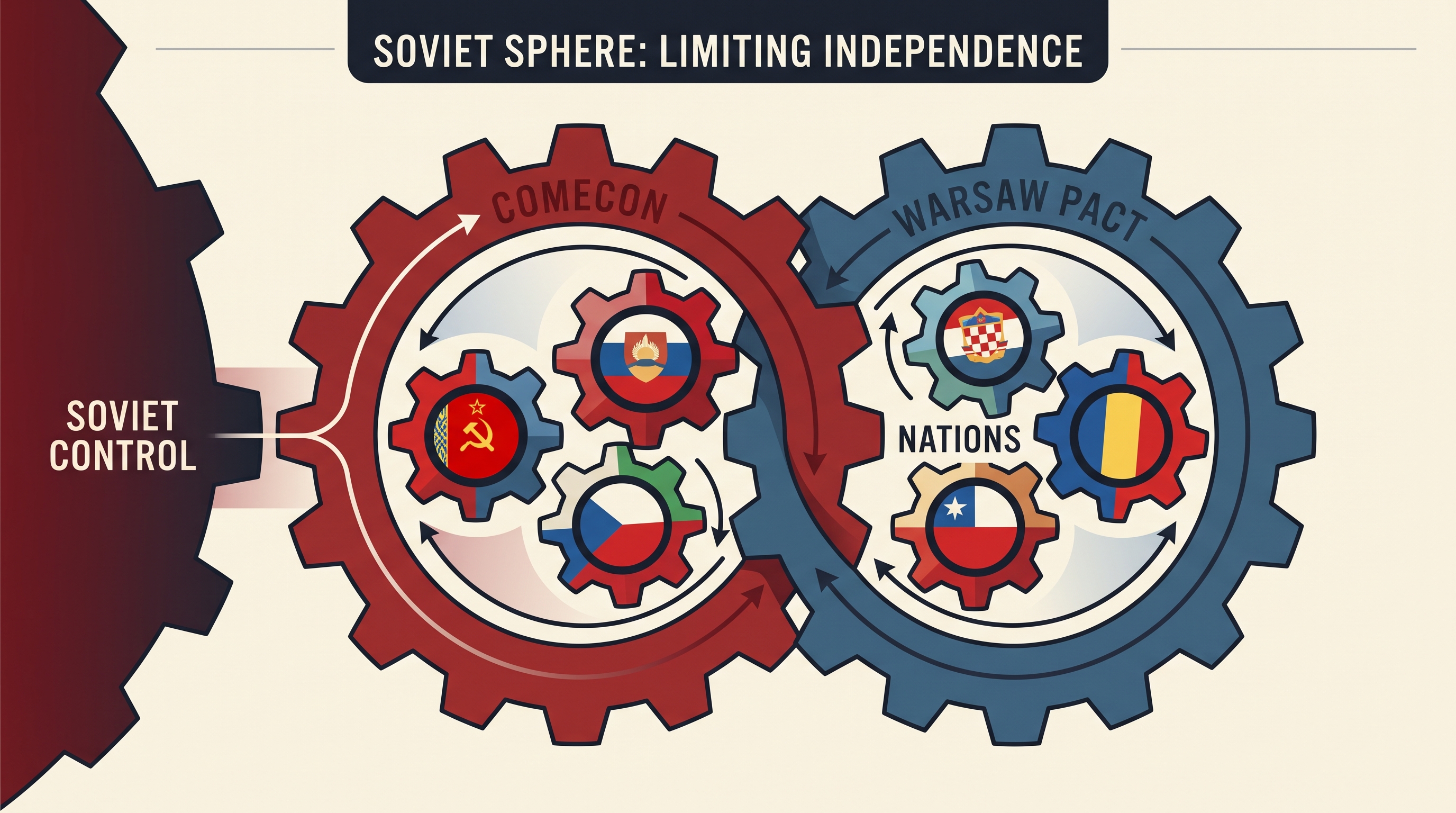
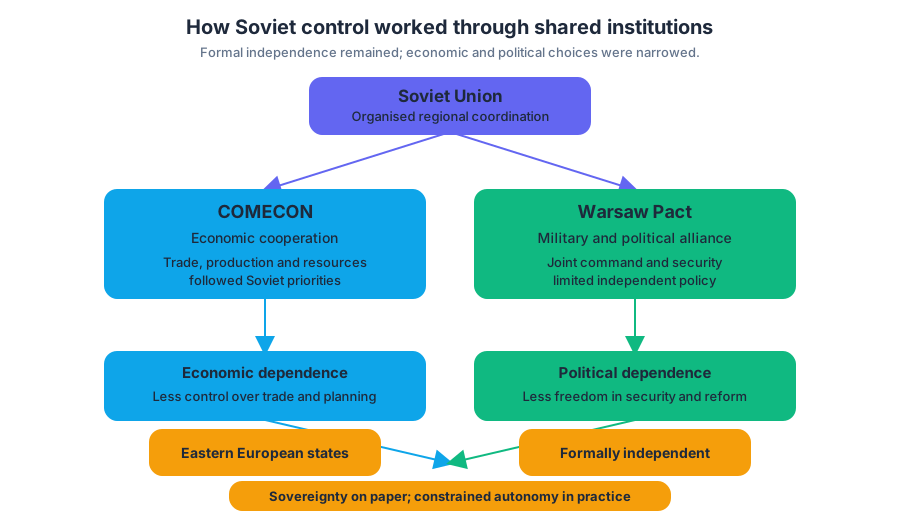
Countries east of the Iron Curtain came under the Soviet Union’s military, political, and economic domination. The Warsaw Pact coordinated the bloc’s military forces, while the Council for Mutual Economic Assistance (COMECON) coordinated economic relationships among communist states. These institutions gave the Soviet Union mechanisms for maintaining influence even when individual governments formally remained separate countries.
COMECON operated through an economic model based on central planning, meaning that governments—not competitive markets—determined major production goals, prices, investment priorities, and trade relationships. Member states often specialized in particular forms of production, linking their economies to one another and to Soviet priorities.
Key distinction: COMECON was an economic coordination system; the Warsaw Pact was a military alliance. Both, however, reinforced Soviet authority in Eastern Europe.
The Soviet-bloc model expanded social welfare and guaranteed employment in principle, but it sharply restricted political and individual freedoms. Governments suppressed dissent, censored opposition, monitored citizens, and constrained emigration for various populations. In practice, shortages of consumer goods and lower living standards than those in much of Western Europe intensified dissatisfaction.
Rebuilding Europe: cooperation under pressure
Western European reconstruction depended on both physical recovery and institutional stability. The Marshall Plan supplied American economic assistance, while the Truman Doctrine signaled American opposition to communist expansion. Western European states also participated in the postwar world monetary and trade system associated with the Bretton Woods institutions, including the International Monetary Fund and the World Bank, alongside efforts to reduce trade barriers.
These arrangements did more than repair roads, factories, and currencies. They tied Western European recovery to economic cooperation and American influence. Later institutions such as the European Economic Community further encouraged integration, while the Soviet bloc developed its own coordinated alternative through COMECON.
Rebuilding therefore produced two contrasting European paths:
- Western Europe pursued capitalist growth, expanding trade, economic cooperation, and political systems with greater room for competing parties.
- Eastern Europe pursued state planning, social welfare provision, and production coordinated within the Soviet sphere, at the cost of restricted rights and political conformity.
Cold War developments beyond Europe
Cold War tensions also shaped conflicts outside the European core. The Yom Kippur War demonstrated how a regional conflict in the Middle East could become entangled with superpower rivalry, while the Soviet invasion of Afghanistan showed the costs of Soviet military intervention beyond Eastern Europe. These examples matter because the Cold War was a global system of competition, even though its most visible political boundary ran through Europe.
Over time, the combination of economic weakness, political repression, and public dissatisfaction placed increasing stress on Soviet-bloc governments. The stresses of economic collapse and totalitarianism contributed to major changes in Europe, including challenges to communist authority and the eventual transformation of the continent’s political order.
Misconception check
Misconception: “The Cold War divided Europe only militarily.” The division was military, but it was also economic and political. NATO and the Warsaw Pact represented rival security systems; Western economic integration and COMECON represented rival economic spheres; and restrictions on dissent and emigration revealed how deeply the conflict affected ordinary life.
Assessment lens
For KC-4.1.IV.D and KC-4.2.V.A, the essential historical explanation is that Cold War rivalry produced institutional division: Soviet domination operated through the Warsaw Pact and COMECON, while the Western powers promoted reconstruction, monetary cooperation, trade, and anti-communist alignment. The associated Unit 9: Learning Objective D and DKC-4.2.V.A1.B emphasize explaining the economic and political consequences of the Cold War for Europe. The relevant skill is Developments and Processes, especially tracing how postwar tensions generated durable institutions and contrasting systems.
Retrieval check
Why did COMECON and the Warsaw Pact strengthen Soviet control even though Eastern European countries remained formally independent? Answer in two parts: identify each institution’s function, then explain how those functions limited the region’s economic or political autonomy.
Source Materials
- AP European History Course and Exam Description
- AP European History Course and Exam Description Clarifications and Corrections
- AP European History Course Overview
- AP European History Course at a Glance
- AP European History Course at a Glance Poster
- AP European History
- AP European History
- AP European History Sample Syllabus 1
- AP European History-AP Students-College Board
- AP European History-Doves Library
- AP European History Cheat Sheets-Albert.io
- AP European History Study Guide-EBSCO