From the free course AP European History on Lykke
9.7 The fall of communism · 9.8 20th-century feminism
Key concepts: The fall of communism in Eastern Europe · Polish elections in 1989 · German reunification, 1989–90 · Second-wave feminism · Social equality for women · Academic research on women’s status in Europe · Women in political office in Western countries and the Soviet Union · Historical sourcing and source limitations · Using documentary evidence to support an argument · AP European History evidence and scoring criteria
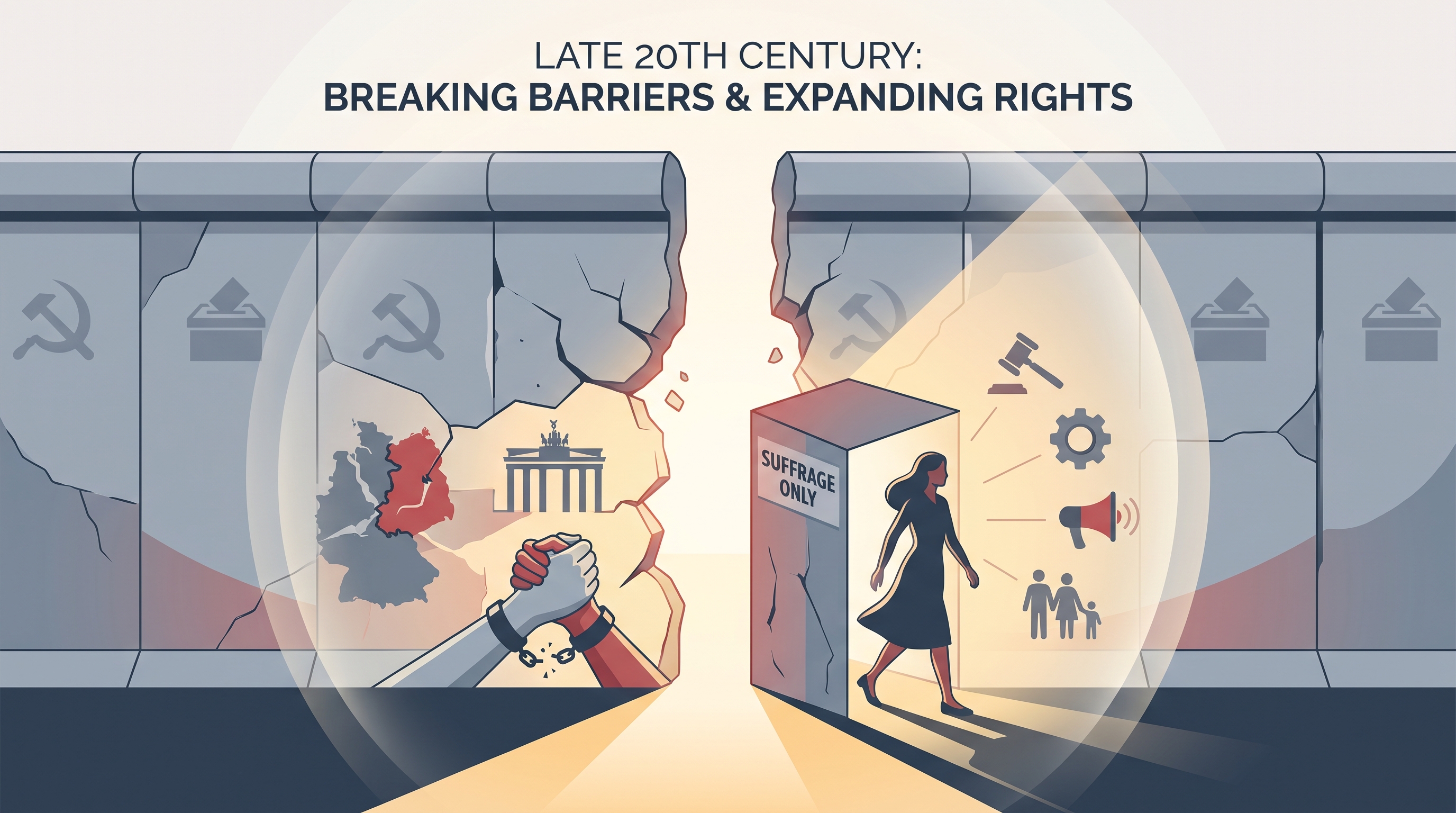
In 1989, communist rule in Eastern Europe began to collapse with remarkable speed: Poland held partially free elections, the Berlin Wall fell, and Germany reunified by 1990.
9.7 The fall of communism · 9.8 20th-century feminism
In 1989, communist rule in Eastern Europe began to collapse with remarkable speed: Poland held partially free elections, the Berlin Wall fell, and Germany reunified by 1990. At the same time, European women’s movements pressed beyond the earlier demand for voting rights toward a broader question: Could women be legally equal yet still socially and economically unequal?
From communist rule to political change
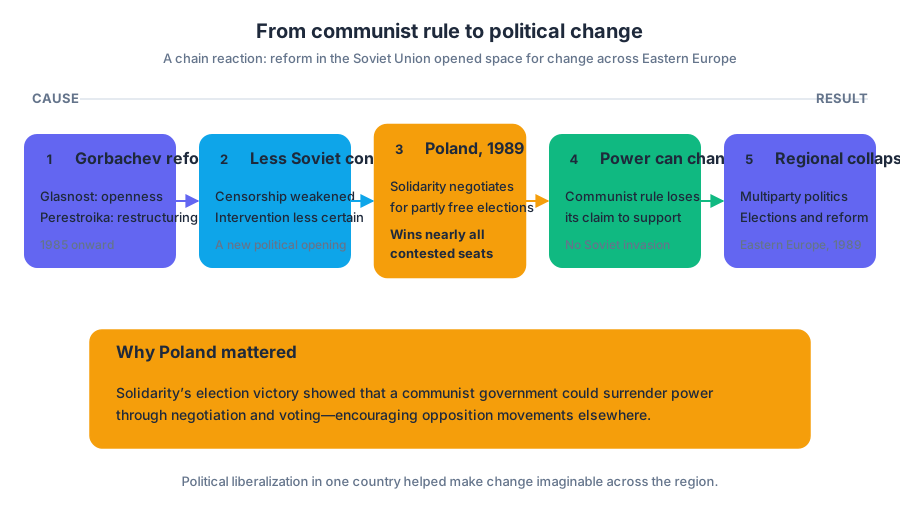
The fall of communism in Eastern Europe was the breakdown of one-party communist governments and the movement toward multiparty politics, elections, and economic restructuring. A major cause was the reform program of Soviet leader Mikhail Gorbachev. His policies of glasnost, or greater openness, and perestroika, or restructuring, weakened censorship and attempted to revive the Soviet system, but they also made it harder for communist governments in Eastern Europe to rely on Soviet military intervention.
The process can be visualized as a chain reaction:
Worked example — Poland, 1989: The independent trade union Solidarity had challenged communist rule during the 1980s. In 1989, negotiations between the government and opposition produced elections in which Solidarity candidates won nearly all the seats that were open to genuine competition. Although the election system was still partly controlled, the result demonstrated that communist governments could lose popular support and surrender power without a Soviet invasion. Poland therefore provides specific evidence for the broader claim that political liberalization in one Eastern European country encouraged the collapse of communist rule elsewhere.
The same year, the Berlin Wall fell, symbolizing the weakening of the division between communist Eastern Europe and democratic Western Europe. German reunification followed from 1989 to 1990: the German Democratic Republic ceased to exist, and its territory joined the Federal Republic of Germany. Reunification showed that the Cold War political order was being replaced by a Europe reorganized around electoral government, national self-determination, and capitalist economic institutions.
The fall of communism was not one isolated event. It was a regional political transformation in which reform, popular opposition, economic weakness, and the Soviet Union’s reduced willingness to use force reinforced one another.
Misconception check — “The Berlin Wall fell, so communism ended everywhere immediately.” The Wall’s fall was a powerful symbol, but communist governments collapsed through different national processes. Poland’s negotiated elections, for example, were not identical to the events in East Germany. A strong historical explanation distinguishes a shared regional pattern from the specific evidence that proves it.
20th-century feminism: equality beyond the vote
Second-wave feminism refers to feminist movements in the second half of the 1900s that emphasized social equality after women had achieved suffrage in many European countries. The central issue shifted from formal political citizenship alone to the conditions of everyday life: employment, wages, education, family roles, reproduction, and access to authority.
Simone de Beauvoir became an important example associated with this development. Her analysis of women’s social position encouraged people to examine how culture, institutions, and expectations—not only laws—shaped women’s lives. Feminist activism also contributed to new academic research into the status of women in Europe, including the study of women’s work, family life, political participation, and persistent economic inequality.
The political record was uneven. Women attained high political office in many Western countries, including Margaret Thatcher of Great Britain, Mary Robinson of Ireland, and Édith Cresson of France. By contrast, the Soviet Union’s limited record of women in its highest political leadership appeared to undermine its official claims that communism had already achieved gender equality.
This comparison requires care. The existence of women in high office did not eliminate discrimination in Western societies, just as Soviet legal declarations of equality did not eliminate lower wages, concentration in low-skilled labor, or social inequality. The historical point is not that one system solved gender inequality; it is that the gap between ideological claims and lived outcomes became politically important.
Source analysis: from labels to argument
This topic especially develops Skill 2: Sourcing and Situation, including Skill 2.B: Explain how the point of view, purpose, audience, and historical situation of a source affect its meaning. When reading a source about feminism or communist equality, identify not only what it says but also who created it, for whom, and why.
Simply naming “point of view,” “audience,” or “purpose” earns no historical argument by itself. For example, a 1990 Western commentator criticizing Soviet women’s inequality may have a purpose of exposing the gap between Soviet ideology and social reality. That purpose makes the source useful evidence for ideological criticism, but it may also limit the source by encouraging emphasis on Soviet failures rather than Western shortcomings.
The distinction between identifying evidence and using evidence is crucial. Identifying evidence means stating that a source mentions unequal wages. Using evidence means explaining that unequal wages support the argument that legal equality did not automatically produce social or economic equality.
Strong historical reasoning follows the pattern: specific evidence → interpretation → argument.
Retrieval check
- Why were the Polish elections in 1989 important beyond Poland?
- How did German reunification in 1989–90 reflect the collapse of the Cold War order?
- Why did second-wave feminism move beyond suffrage?
- What limitation might affect a Western source criticizing Soviet gender inequality?
A complete answer to the final question would connect the source’s purpose to its usefulness and limitation—for example, explaining that criticism could reveal genuine inequalities while also selectively contrasting the Soviet Union with the West.
Source Materials
- AP European History Course and Exam Description
- AP European History Course and Exam Description Clarifications and Corrections
- AP European History Course Overview
- AP European History Course at a Glance
- AP European History Course at a Glance Poster
- AP European History
- AP European History
- AP European History Sample Syllabus 1