From the free course AP European History on Lykke
9.13 20th- and 21st-century culture, arts, and demographic trends · 9.14 Continuity and change in the 20th and 21st centuries
Key concepts: Fall of Communism · 20th-century feminism · Decolonization · European Union · Migration and immigration · Technology progress · Globalization · Continuity and change over time · Modernism and postmodernism · 20th- and 21st-century culture, arts, and demographic trends
Explain and apply 9.13 20th- and 21st-century culture, arts, and demographic trends · 9.14 Continuity and change in the 20th and 21st centuries.
9.13 20th- and 21st-century Culture, Arts, and Demographic Trends · 9.14 Continuity and Change in the 20th and 21st Centuries
Europe’s twentieth century was shaped by a double movement: societies gained new personal choices and political possibilities, while wars, genocide, migration, and ideological conflict produced unprecedented destruction. The central historical problem is therefore not simply “progress or decline,” but continuity and change—what transformed, what persisted, and why both could occur at once.
Culture after 1900: breaking older forms
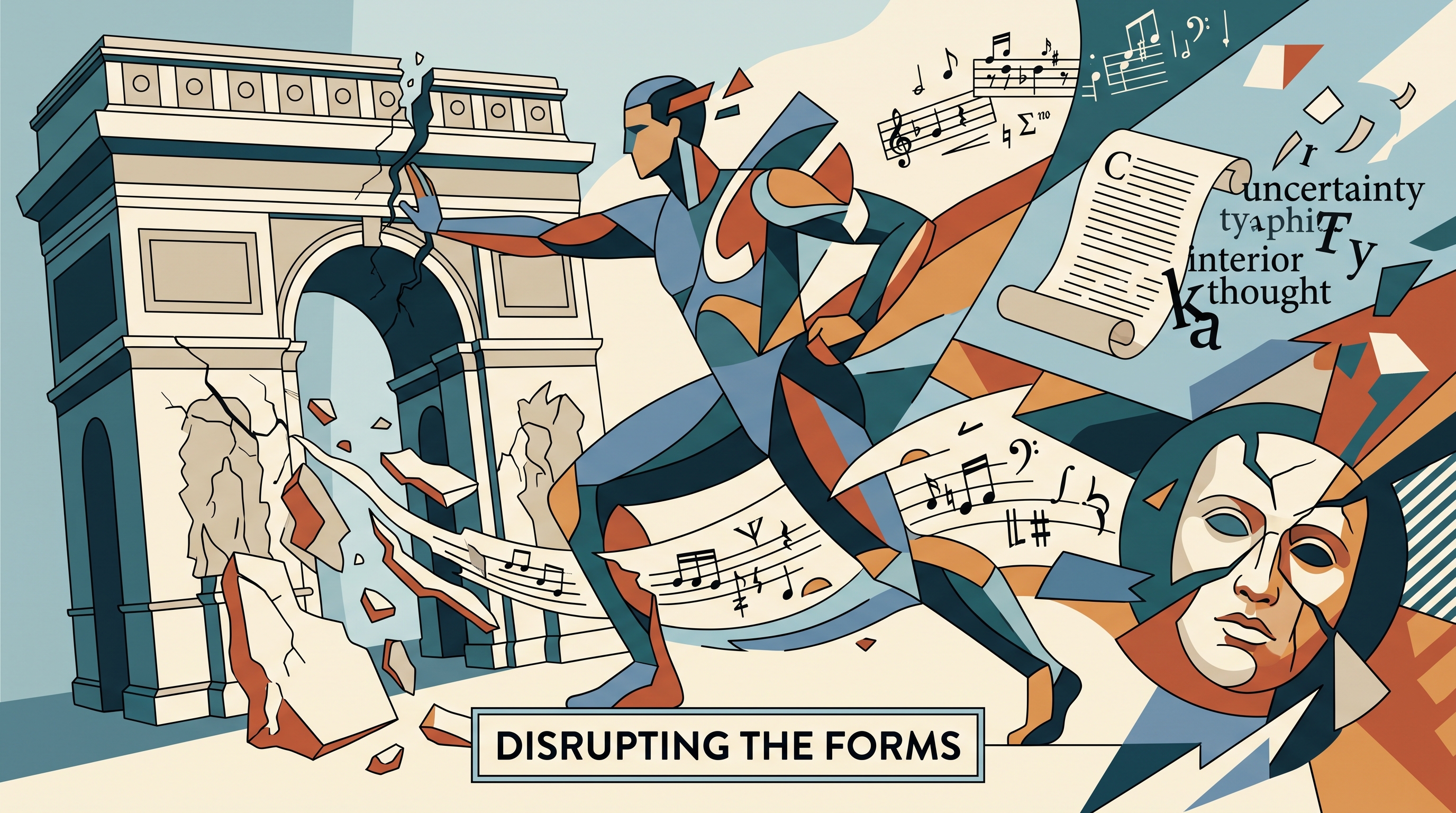
Modernism rejected the assumption that art should imitate the visible world in orderly, realistic forms. Composers such as Igor Stravinsky and Arnold Schoenberg disrupted familiar musical structures; writers including Franz Kafka, James Joyce, and Virginia Woolf experimented with fragmented narration, interior thought, and uncertainty. Jean-Paul Sartre, associated with existentialism, emphasized human freedom and responsibility in a world that seemed unstable and without guaranteed meaning.
Postmodernism, especially after the mid-twentieth century, questioned the idea that one style, ideology, or explanation could claim universal authority. The important continuity is that artists continued to respond to rapid social change; the major change is that many twentieth-century artists increasingly treated fragmentation, ambiguity, and alienation as subjects rather than problems to conceal.
War, genocide, and ideological nationalism
The experience of war intensified nationalism, the belief that political loyalty should center on the nation, but it also intensified racist ideologies that defined some populations as biologically inferior or dangerous. The First World War normalized mass mobilization and industrial killing. The failure of appeasement—the attempt to preserve peace by conceding demands to aggressive states—helped allow Nazi expansion to proceed, contributing to the catastrophe of the Second World War.
The Holocaust was the systematic Nazi genocide of Europe’s Jews, carried out through persecution, deportation, forced labor, mass shootings, and extermination camps. Auschwitz and other death camps are examples of the Nazi genocide; they were not ordinary wartime prisons but institutions designed to murder on an industrial scale. Other targeted groups included Roma, people with disabilities, political opponents, and others whom Nazi racial ideology excluded from the imagined national community.
Key distinction: Nationalism can create solidarity, but racial nationalism turns belonging into a hierarchy. That transformation helps explain how national identity could mobilize entire societies while also legitimizing exclusion and mass murder.
Women’s status and twentieth-century feminism
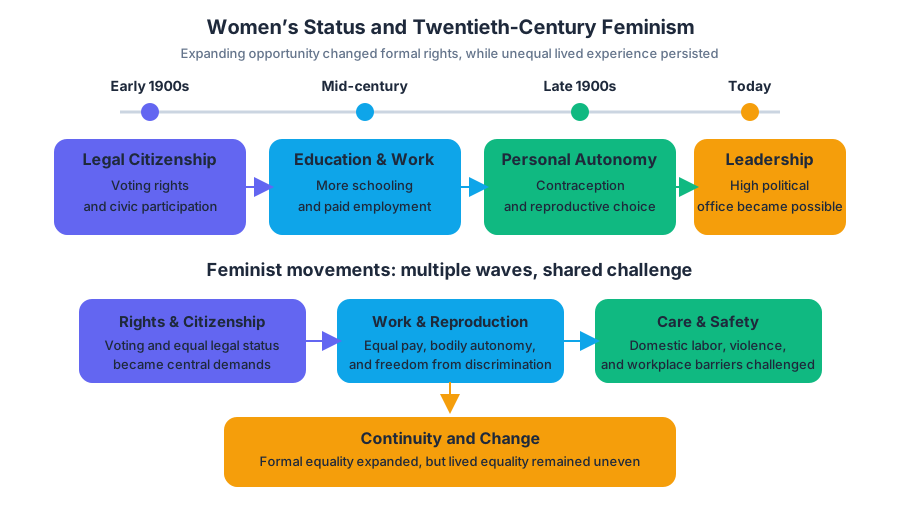
Women’s roles and status changed throughout the twentieth and twenty-first centuries through expanded access to education, paid employment, contraception, political participation, and public leadership. Women attained high political office, demonstrating a significant change in formal political opportunity, although unequal wages, unequal domestic responsibilities, discrimination, and violence continued.
Twentieth-century feminism included multiple movements rather than one uniform program. Early campaigns emphasized voting rights and legal citizenship; later movements challenged workplace inequality, reproductive restrictions, sexual discrimination, and the assumption that unpaid care was naturally women’s responsibility. The Soviet example illustrates the difference between formal equality and lived equality: governments could declare women equal while women still faced lower wages, concentration in lower-skilled work, or a double burden of employment and household labor.
Decolonization and migration
Decolonization was the process by which colonial groups sought independence from European rule. After the Second World War, European states faced weakened economies, stronger anticolonial nationalism, and increasing international criticism of empire. Independence movements therefore transformed the political map, even when new states inherited borders, economic dependencies, ethnic tensions, or conflicts created under colonial rule.
Migration and immigration became major social and demographic developments in the twentieth and twenty-first centuries. People moved because of war, persecution, labor demand, decolonization, economic opportunity, and political instability. Migration reshaped cities, labor markets, languages, religions, and debates over national identity; it also produced tensions when host societies treated newcomers as permanently foreign.
Demographic change, childcare, and the European Union
Modern demographic change included neonatalism—social or governmental encouragement of childbirth—and the expansion of childcare facilities. These developments reveal a practical problem: as women entered education and paid employment, families and states had to reconsider who would provide care for children. Childcare could support women’s employment, respond to declining birthrates, or serve state goals of population growth.
The formation and existence of the European Union influenced economic developments throughout Europe. European integration reduced barriers among participating states, encouraged trade and investment, and connected national economies through shared institutions and policies. It also created debates over national sovereignty, democratic accountability, migration, and the proper balance between national and European identity.
Continuity and change: a worked synthesis
Consider Europe across three connected developments:
- Change: Colonial empires declined as independence movements created new states.
- Change: Women gained broader legal, educational, professional, and political opportunities.
- Continuity: National identity remained powerful, sometimes producing solidarity and sometimes exclusion.
- New pressure: Migration and European integration challenged older ideas that citizenship, culture, and economy must fit within one nation-state.
- Unresolved tension: Technology, globalization, and institutions such as the European Union expanded connection without eliminating inequality or conflict.
The strongest historical explanation links these developments rather than listing them. World wars weakened European empires; decolonization increased migration; migration challenged national identities; European integration attempted to manage economic interdependence; and feminism transformed expectations about citizenship and family life. Yet racism, nationalism, demographic anxiety, and unequal power persisted—showing why twentieth- and twenty-first-century history contains both profound transformation and stubborn continuity.
Retrieval check: Explain one way the twentieth century changed women’s status, one way it preserved inequality, and one way migration or European integration challenged the older political order. Then distinguish modernism from postmodernism using one named cultural figure for each.
Source Materials
- AP European History Course and Exam Description
- AP European History Course and Exam Description Clarifications and Corrections
- AP European History Course Overview
- AP European History Course at a Glance
- AP European History Course at a Glance Poster
- AP European History
- AP European History
- AP European History Sample Syllabus 1