From the free course AP European History on Lykke
1.5 New Monarchies · 1.6 Technological Advances and the Age of Exploration
Key concepts: New Monarchies · Royal control over religious life and morality · Nobles of the robe · Age of Exploration · Technological and Scientific Innovation · Guns and gunpowder · Enclosure movement · Revival of classical texts · European overseas exploration and settlement · Indigenous population encounters and destruction
Between the late fifteenth and early seventeenth centuries, European rulers strengthened states at home while new technologies projected European power overseas. The same period that produced more centralized monarchies also produced oceanic exploration, colonial settlement, and devastating encounters with…
1.5 New Monarchies · 1.6 Technological Advances and the Age of Exploration
Between the late fifteenth and early seventeenth centuries, European rulers strengthened states at home while new technologies projected European power overseas. The same period that produced more centralized monarchies also produced oceanic exploration, colonial settlement, and devastating encounters with Indigenous peoples.
1.5 New Monarchies: Building Centralized Power
A new monarchy was a late-medieval or Renaissance state whose ruler expanded direct control over taxation, justice, military force, and religious policy. Instead of relying mainly on semi-independent nobles, monarchs built institutions that reached more consistently into local communities.
Key idea — KC-1.5.I.A: New monarchies laid foundations for the centralized modern state by monopolizing tax collection, employing military force, dispensing justice, and gaining the right to determine the religion of their subjects.
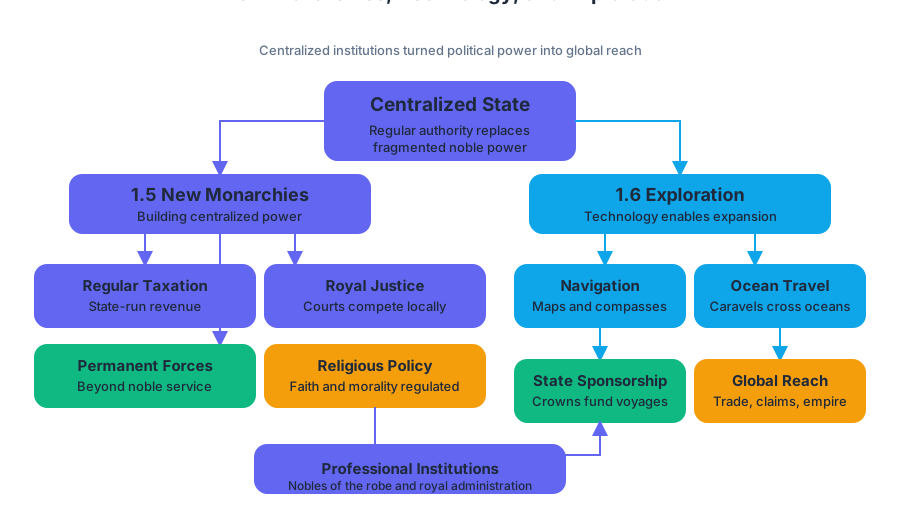
The process resembled replacing a patchwork of privately controlled roads with a single state-run network. Monarchs sought regular taxes rather than occasional feudal payments, permanent or semi-permanent military forces rather than temporary noble service, and royal courts that competed with local jurisdictions.
New monarchies also sought greater control over religious life and morality. Rulers could support one officially favored religion, regulate religious practice, and use law or royal institutions to enforce standards of behavior. Religious policy therefore became not only a spiritual matter but also an instrument of state-building.
France illustrates how monarchs used new administrative personnel. Nobles of the robe were members of the French judicial and administrative elite who held offices connected to royal courts and government. Their authority helped the monarchy govern through professional institutions rather than depending entirely on older warrior nobles.
The expansion of state power did not mean that every European monarch ruled without resistance. It meant that rulers increasingly claimed the institutions needed to make decisions directly: collecting revenue, enforcing law, organizing armed force, and defining religious order.
Worked historical example: France
Suppose a French monarch wants to enforce a religious policy across a large kingdom. The ruler needs officials to interpret and apply royal orders, courts to dispense justice, taxation to fund enforcement, and military power to overcome resistance. The growth of royal offices—including those associated with the nobles of the robe—made that policy more feasible. The evidence supports a development-and-process explanation: centralized government grew through several mutually reinforcing institutions.
Misconception check — “New monarchy” means absolute monarchy. Not necessarily. New monarchies increased royal authority, but rulers still faced limits from nobles, representative bodies, local privileges, and religious institutions. The important change was the expansion of direct state capacity, not instant or unlimited royal control.
1.6 Technological Advances and the Age of Exploration
European exploration depended on a combination of motives and tools. European states and merchants sought direct access to gold, spices, and luxury goods because overseas trade could increase personal wealth while strengthening state power. Commercial and religious motives worked together: rulers and explorers pursued profit, strategic advantage, and the expansion of Christianity.
Learning Objective 1.G: Explain the technological factors that facilitated European exploration and expansion from 1450 to 1648.
KC-1.3.II: Advances in navigation, cartography, and military technology enabled Europeans to establish overseas colonies and empires.
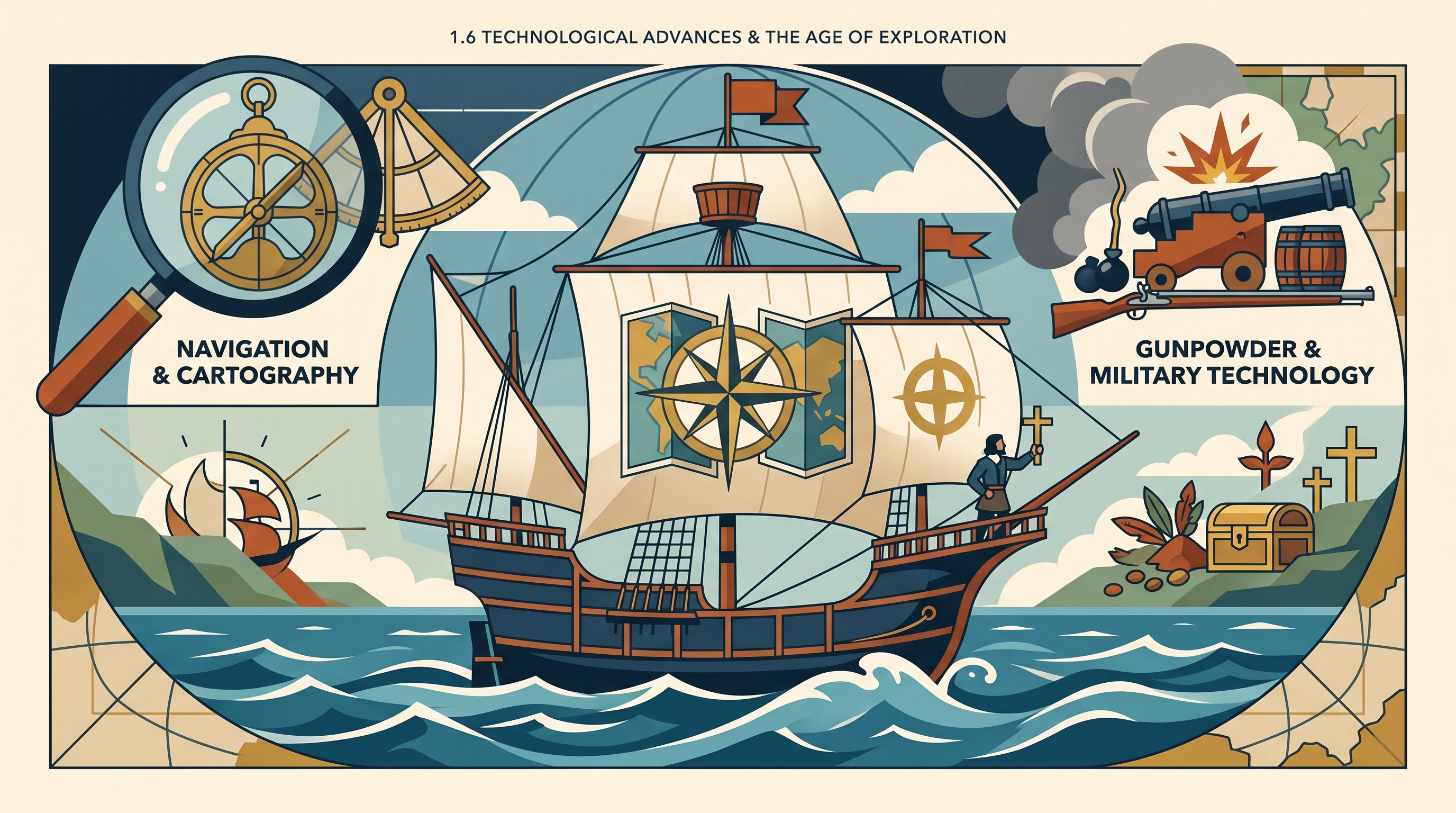
Navigation and cartography made long-distance voyages more manageable by improving the ability to determine position, plan routes, and represent coastlines. Military technology—especially guns and gunpowder—gave European expeditions greater power in armed encounters and helped them defend ships, forts, and settlements.
Technology did not operate alone. The Renaissance and Age of Discovery changed many Europeans’ understanding of the world, while the revival of classical Greek and Roman texts encouraged new scholarship and new perspectives. These intellectual developments supported curiosity about geography and nature; navigation, maps, ships, and firearms turned curiosity and ambition into expansion.
KC-1.1: The rediscovery of ancient Greek and Roman works, combined with observation of the natural world, changed many Europeans’ view of their world. KC-1.1.I connects the revival of classical texts to new methods of scholarship and new values in society and religion. These ideas did not automatically cause exploration, but they contributed to a wider setting in which investigation and overseas ambition seemed increasingly possible.
Europeans explored and settled overseas territories, producing encounters and interactions with Indigenous populations. Those encounters were not equal exchanges: European expansion caused the destruction of Indigenous peoples, particularly in the Americas, through violence, conquest, forced labor, and the disruption of established societies.
KC-1.3: Europeans explored and settled overseas territories, encountering and interacting with Indigenous populations.
KC-1.3.I: European nations were driven by commercial and religious motives to explore overseas territories and establish colonies.
The enclosure movement provides a related example of transformation within Europe. Enclosure reorganized agricultural land by consolidating scattered holdings and restricting some customary uses of common land. It changed agricultural practices and could increase efficiency for landowners while placing pressure on rural people who depended on shared resources.
Skill application: following a causal chain
For Skill 1: Developments and Processes, trace change rather than merely listing inventions: classical learning and observation encouraged new perspectives; improved navigation and cartography made voyages more practical; guns and gunpowder strengthened military expansion; commercial and religious motives pushed states outward; exploration produced colonies and destructive encounters.
For Skill 3: Claims and Evidence in Sources, distinguish what a source shows from what you infer. A royal decree praising overseas settlement may provide evidence of religious or commercial motives, but its celebratory language may conceal coercion and Indigenous destruction. Ask who produced the source, what action it supports, and whose experience it omits.
Retrieval check
Explain in two linked sentences why new monarchies and overseas exploration developed during the same period. Then identify one technological factor and one human motive that enabled European expansion. A strong response connects centralized taxation or military power to the ability of rulers to finance and enforce exploration, while naming navigation, cartography, guns, or gunpowder as technology and wealth, religion, or state power as motive.
Source Materials
- AP European History Course and Exam Description
- AP European History Course and Exam Description Clarifications and Corrections
- AP European History Course Overview
- AP European History Course at a Glance
- AP European History Course at a Glance Poster
- AP European History
- AP European History
- AP European History Sample Syllabus 1