From the free course AP European History on Lykke
2.5 The Catholic Reformation · 2.6 16th-Century Society and Politics
Key concepts: Catholic Reformation · Religious division within Christianity · Northern Renaissance · Printing · 16th-century society and politics · Women’s education and social roles · State control of religious institutions · Social dislocation and challenges to state authority · Secular and cultural systems of law · Historical source analysis: point of view, purpose, audience, and situation
By the mid-16th century, Christianity in Europe was no longer a single institutional world: Catholic renewal strengthened the Roman Church even as Protestant reform made religious unity impossible.
2.5 The Catholic Reformation · 2.6 16th-Century Society and Politics
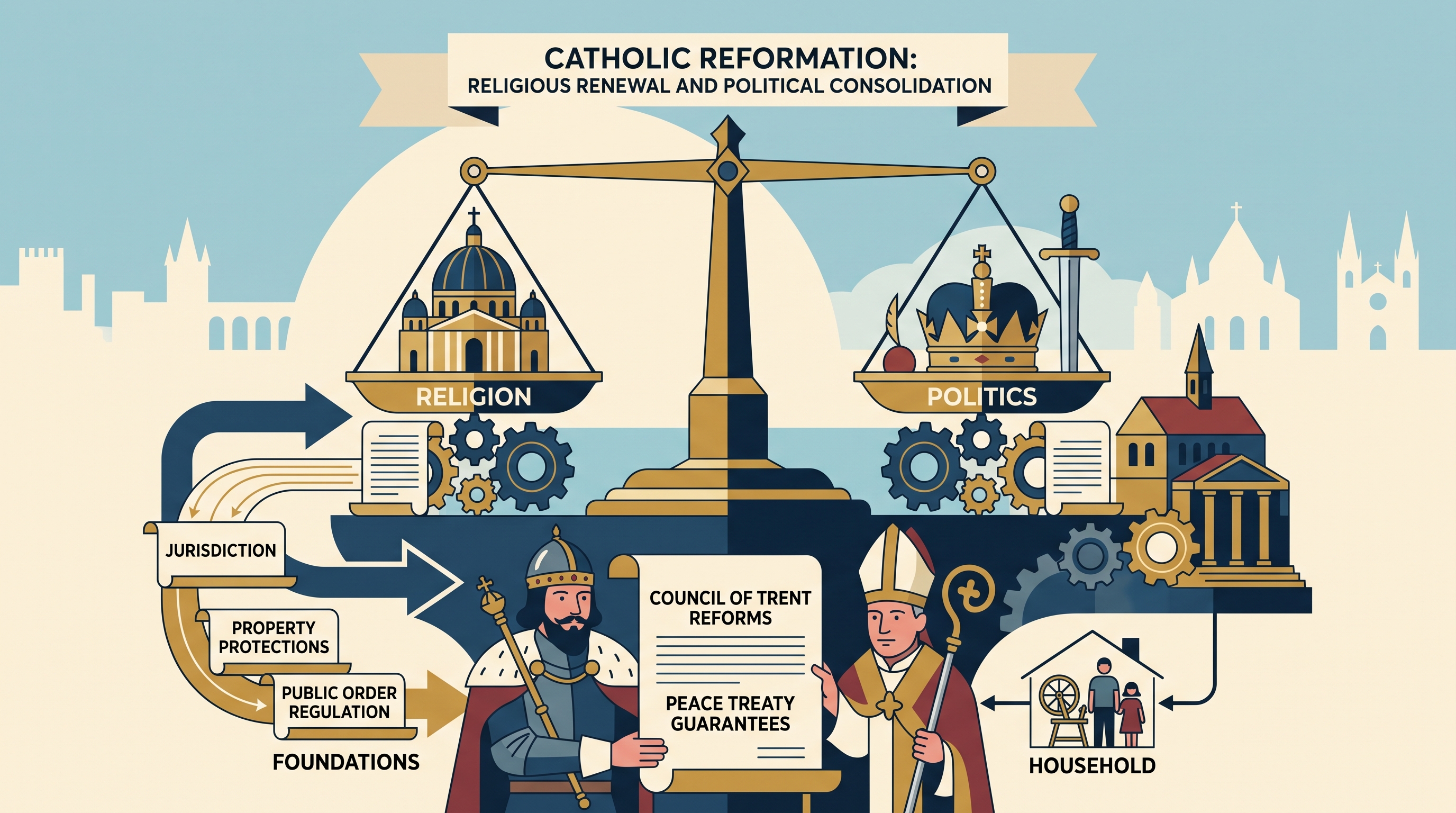
By the mid-16th century, Christianity in Europe was no longer a single institutional world: Catholic renewal strengthened the Roman Church even as Protestant reform made religious unity impossible. The same period also transformed everyday life, because households, city governments, monarchies, and religious institutions all competed to regulate work, morality, education, and authority.
Catholic Reformation: the Catholic Church’s internal program of spiritual, institutional, and disciplinary renewal in response to both long-standing problems and Protestant challenges.
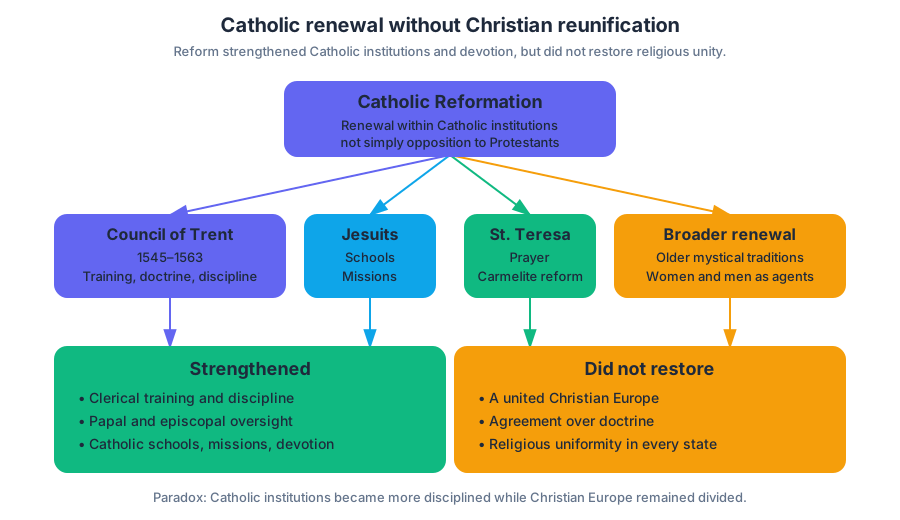
Catholic renewal without Christian reunification
The Catholic Reformation did not simply mean “Catholics fighting Protestants.” It also involved Catholic efforts to correct clerical abuses, improve education, strengthen discipline, and renew personal religious devotion. The Council of Trent, meeting intermittently from 1545 to 1563, reaffirmed Catholic teachings while requiring better training for priests and greater oversight of clerical behavior. New and reformed religious orders, especially the Jesuits, expanded Catholic education, missionary activity, and obedience to the papacy.
St. Teresa of Avila illustrates the movement’s emphasis on disciplined personal spirituality. Her writings and reforms of Carmelite convents promoted intense prayer, self-examination, and a simpler religious life. Her influence shows that Catholic renewal was not only a bureaucratic response to Protestantism; it also drew energy from women and men seeking a deeper spiritual experience within Catholic institutions.
The result was a historical paradox:
| Catholic Reformation strengthened | Catholic Reformation did not restore |
|---|---|
| Clerical training and discipline | A united Christian Europe |
| Papal and episcopal oversight | Agreement over doctrine |
| Catholic schools and missions | Religious uniformity in every state |
| Personal devotion and mysticism | The political independence of religion from rulers |
Named misconception check — “The Catholic Reformation was only a reaction.” Protestant criticism exposed serious weaknesses, but Catholic reform also continued older traditions of mystical devotion, religious discipline, and institutional renewal. Its effects were therefore both defensive and constructive: it revitalized Catholicism while cementing religious division within Christianity.
For Learning Objective 2.B, explain both causes and effects rather than listing reforms. A strong causal chain is: criticism of corruption and Protestant competition encouraged Catholic institutional reform; reform improved discipline and expanded Catholic influence; strengthened confessional identities then made European religious division more durable.
Households, women, and social organization
In 16th-century Europe, the household was usually an economic unit rather than merely a private family space. Rural households combined agricultural labor, animal care, food processing, and textile production; urban households often joined residence, workshop, retail activity, and apprenticeships. Men and women performed separate but complementary tasks, although the division varied by occupation, region, wealth, and marital status.
KC-1.4.IV.A: Households in both rural and urban settings functioned as economic units with men and women performing separate but complementary tasks.
The Renaissance and Reformation also sparked arguments about women’s education and women’s roles in the family, church, and society. Humanist writers debated whether education would make women better wives and mothers, while religious reformers and Catholic institutions debated women’s spiritual responsibilities, convent life, and authority. These debates could expand recognition of women’s intellectual or religious capacities without eliminating legal, political, and economic inequality.
KC-1.4.IV.B: The Renaissance and Reformation sparked debates regarding women's education and their roles in family, church, and society.
Interpretation check: A woman managing a household workshop demonstrates economic participation, but it does not by itself prove social equality. What distinction must an argument make? Economic contribution and social status are related but not identical.
Political authority and public morality
Religious disruption shifted responsibility for social order. As religious institutions lost or contested authority, city governments increasingly regulated public morals: behavior, sexuality, poor relief, festivals, schooling, and acceptable religious practice. Leisure remained communal and tied to the religious calendar and agricultural cycles, but authorities increasingly tried to control how those gatherings occurred.
KC-1.4.III.C: Social disruption and the shifting power of religious institutions during the Reformation led city governments to take on the role of regulating public morals.
At the same time, social dislocation and changing political conditions supplied arguments for challenging state authority. Cultural and secular legal systems helped create new political institutions, even while rulers expanded control over churches and religious practice. Thus, the period produced a double movement: states gained authority over religion and morality, while subjects developed increasingly powerful arguments about legitimate government.
A treaty passage promising protection for “the Catholic religion,” the “Roman Apostolic See,” ecclesiastical authority, jurisdictions, privileges, possessions, and rights is valuable evidence because its language reveals what political settlement was trying to preserve. Under Skill 2.A: Identify a source’s point of view, purpose, historical situation, and/or audience, ask:
- Situation: Was the passage written after prolonged religious conflict?
- Purpose: Was it designed to reassure Catholic institutions and make peace enforceable?
- Audience: Would rulers, church officials, and subjects interpret these guarantees differently?
- Argument: How does the detailed protection of jurisdiction and property show that religion was also a political and legal question?
Under Skill 5.A: Identify patterns among or connections between historical developments, connect the household and the state: both organized daily life, assigned roles, and regulated conduct. The major pattern is not the disappearance of older structures, but their adaptation—Catholic institutions renewed themselves, households remained economically interdependent, and governments assumed greater responsibility for public order.
Retrieval check: Why did the Catholic Reformation strengthen Catholicism while deepening division? Name one institutional reform, one spiritual example, and one political consequence. A complete answer should connect Catholic renewal to the Council of Trent or Jesuits, St. Teresa of Avila, and the growing authority of states and city governments.
Source Materials
- AP European History Course and Exam Description
- AP European History Course and Exam Description Clarifications and Corrections
- AP European History Course Overview
- AP European History Course at a Glance
- AP European History Course at a Glance Poster
- AP European History
- AP European History
- AP European History Sample Syllabus 1
- 1 point
- 1 point
- 1 point
- 1 point