From the free course AP European History on Lykke
6.1 Contextualizing industrialization, its origins, and its effects · 6.2 The spread of industry throughout Europe
Key concepts: Industrialization · Industrial Revolution · Capitalism · Economic development · Technological and scientific innovation · Political and social climates · State promotion of industry · Spread of industry from Great Britain to continental Europe · Social, political, and cultural effects of economic development · Relationship between knowledge, traditional authority, and changing worldviews
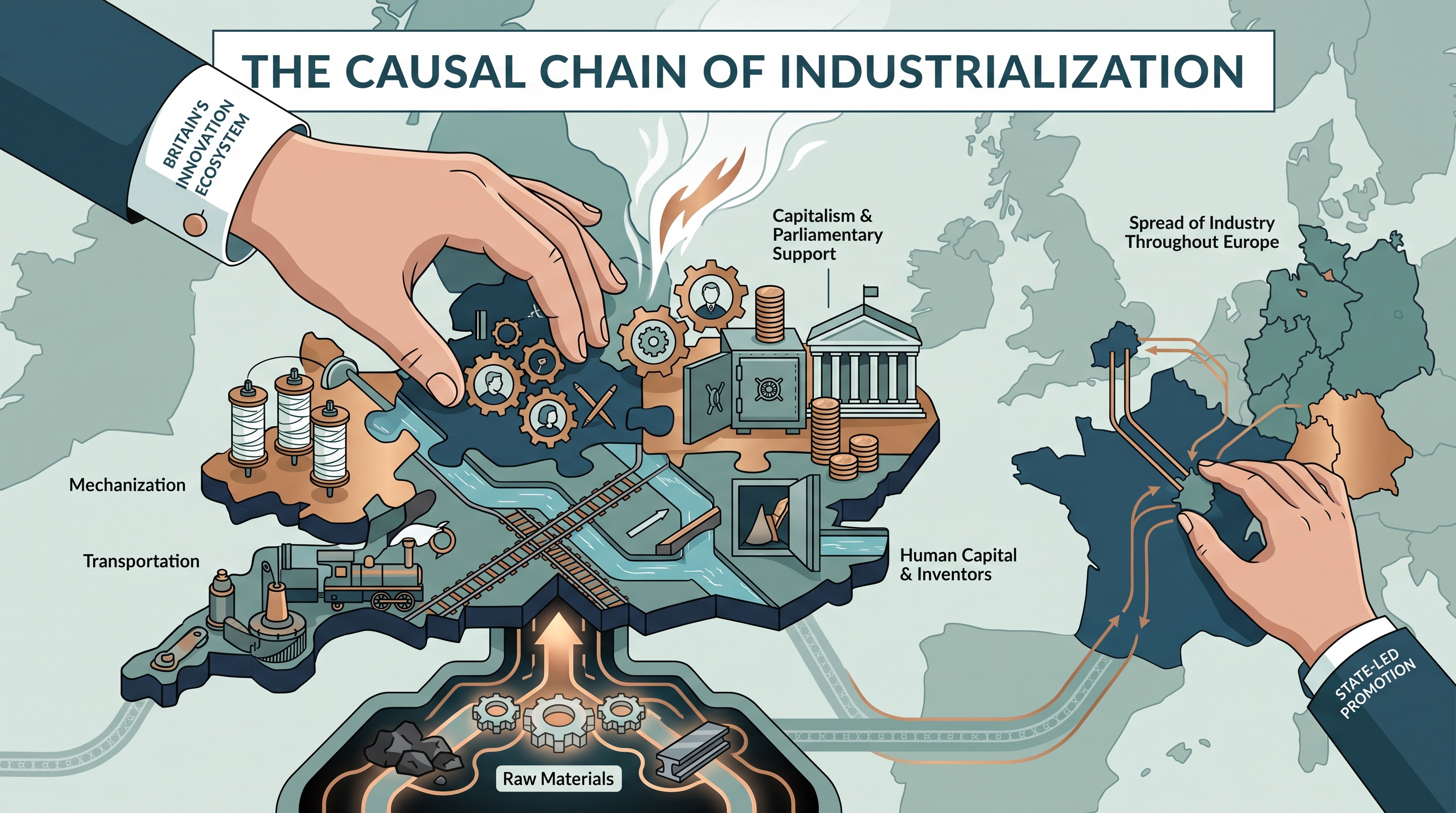
The Industrial Revolution began in Great Britain because machines, resources, markets, institutions, and political conditions reinforced one another. After 1815, industrialization spread across continental Europe, but it did not simply copy the British experience: governments, social structures, labor systems, and…
6.1 Contextualizing industrialization, its origins, and its effects · 6.2 The spread of industry throughout Europe
The Industrial Revolution began in Great Britain because machines, resources, markets, institutions, and political conditions reinforced one another. After 1815, industrialization spread across continental Europe, but it did not simply copy the British experience: governments, social structures, labor systems, and access to capital shaped each region’s path.
Industrialization is the sustained transformation from predominantly hand-based production and agricultural economies toward mechanized production, factory organization, wage labor, and expanding commercial markets.
Britain’s early industrial lead
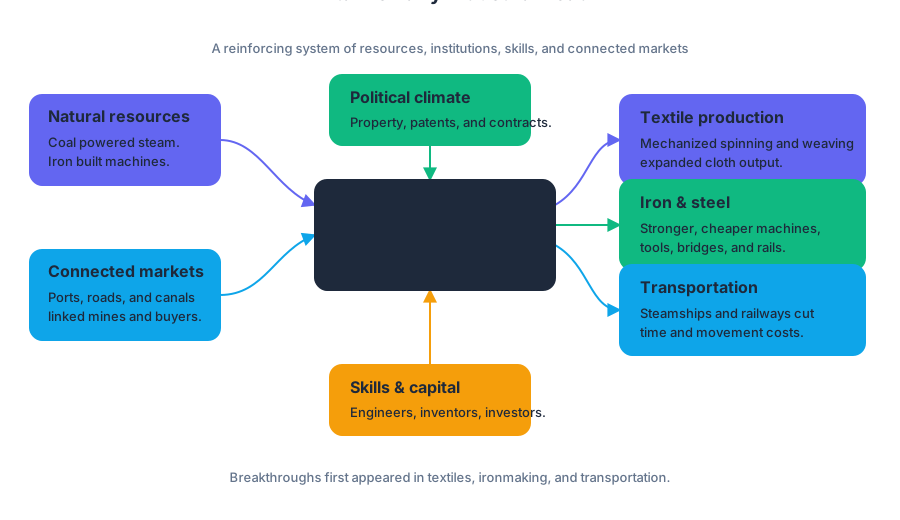
Britain’s ready supplies of coal, iron ore, and other raw materials promoted industrial growth (KC-3.1.I.A). Coal supplied energy for steam engines; iron supported machines, tools, bridges, and railways. These resources mattered most because Britain also possessed transportation networks, commercial ports, and investors able to connect mines, factories, and consumers.
The decisive breakthroughs appeared first in textile production, iron and steel production, and transportation (KC-3.1.I). Mechanized spinning and weaving increased the speed and volume of cloth production. Improved ironmaking produced stronger, cheaper machinery, while canals, roads, steamships, and railways lowered the cost and time of moving raw materials and finished goods.
Britain’s advantage depended on a favorable political and social climate. Parliamentary government promoted commercial and industrial interests because merchants, manufacturers, and financiers were represented in Parliament (KC-3.1.I.C). A relatively secure property system, enforceable contracts, patent protections, and a culture that valued enterprise encouraged private investors to risk capital on unfamiliar technologies.
Economic institutions and human capital—the practical knowledge and skills of engineers, inventors, mechanics, and capitalists—also supported British leadership (KC-3.1.I.B). Industrialization was therefore not caused by one invention. It emerged when resources, skilled people, private investment, markets, and political influence formed a mutually reinforcing system.
Scientific knowledge and applied invention
Scientific innovation produces new knowledge about the natural world; technological innovation applies knowledge, materials, and techniques to solve practical problems. The two frequently interacted, but they were not identical. Early industrialization often began with skilled mechanics and experimenters solving production problems before scientists fully explained the underlying processes.
Scientific institutions nevertheless created an environment in which useful knowledge could be tested, recorded, and transmitted. Learned societies such as the Royal Society, expanding networks of engineers and inventors, printed technical publications, and improving educational institutions encouraged measurement, experimentation, and the circulation of ideas. Newtonian physics helped make motion, force, and mechanics intelligible, while advances in experimental chemistry—including more precise analysis of materials—supported improvements in metallurgy, fuels, and manufacturing.
A steam engine illustrates the relationship. The engine was an applied technology designed to pump water and provide power; its improvement depended on practical experimentation, precision engineering, and growing knowledge of heat, pressure, and mechanics. Scientific understanding did not automatically produce factories, but it made industrial problems more measurable and solvable. The creation and transmission of knowledge consequently challenged traditional authorities and reshaped European views of human control over nature.
Why industrialization spread unevenly
The Industrial Revolution spread from Great Britain to the continent, where the state played a greater role in promoting industry (KC-3.1). Continental governments often sponsored railways, built infrastructure, protected domestic industries with tariffs, established technical schools, and directed investment toward mining and heavy industry. In Britain, private initiative generally led the process; on the continent, state sponsorship frequently compensated for weaker private capital markets or fragmented economies (KC-3.1.II).
Political and social climates determined whether new technology could take root. Governments with administrative capacity could standardize laws, build transportation, and mobilize funds. Social structures also mattered: labor relations, access to land, urban markets, the availability of wage workers, and elite attitudes toward commerce could either encourage or obstruct factory growth. Regions divided by internal tariffs, dominated by rigid labor systems, or lacking investors and skilled workers generally industrialized more slowly.
Worked contextual example: Britain’s textile industry combined imported cotton, mechanized spinning and weaving, coal-powered factories, commercial ports, and investors seeking profit. Parliament protected commercial interests, while engineers and mechanics improved machines. When continental governments later financed railways or supported coal and iron production, they adapted the British model to different political conditions rather than reproducing it exactly.
Economic development and wider historical change
Capitalism is an economic system organized around private ownership, investment, markets, wage labor, and the pursuit of profit. Its expansion made economic development a major force in Europe’s social, political, and cultural history (ECD). Industrial capitalism connected mines, factories, banks, transport systems, workers, and consumers into increasingly interdependent markets.
Industrialization increased efficiency, expanded production, improved transportation, and changed daily life and human interaction. It also gave states and businesses greater power to organize labor, extract resources, circulate information, and shape national identities. The social consequences of factory work and urban growth belong chiefly to 6.3 Second-wave industrialization and its effects · 6.4 Social effects of industrialization; here, the key point is that the industrial system created the conditions for those later transformations.
Misconception check: Britain did not industrialize simply because it “had coal.” Resources were necessary but insufficient. Britain’s lead resulted from the interaction of raw materials, mechanization, transportation, human capital, capitalism, parliamentary influence, and favorable attitudes toward enterprise.
AP skill connection — 1.B, “Explain a historical concept, development, or process”: A strong explanation does more than identify Britain as the birthplace of industrialization. It connects specific factors in a causal chain: coal and iron enabled energy and machinery; private capital and skilled inventors developed technologies; parliamentary institutions protected commercial interests; transportation linked production to markets; and continental states later promoted industry where private initiative alone was weaker.
Retrieval check: Why did industrialization begin in Great Britain, and why did continental European governments generally play a larger role in spreading it? In one sentence, distinguish a scientific advance from an applied invention, then connect both to the wider process of industrialization.
Source Materials
- AP European History Course and Exam Description
- AP European History Course and Exam Description Clarifications and Corrections
- AP European History Course Overview
- AP European History Course at a Glance
- AP European History Course at a Glance Poster
- AP European History
- AP European History
- AP European History Sample Syllabus 1
- Figure — Sample Responses - LEQ 4 - Set 2 (p. 7)
- AP European History-AP Students-College Board
- AP European History-Doves Library
- AP European History Cheat Sheets-Albert.io