From the free course AP European History on Lykke
Course Framework, Skills and Reasoning Processes
Key concepts: Analyzing and interpreting historical evidence · Developing historical thinking skills · Developing historical reasoning processes · Integrating course content with skills · Using scaffolding to support skill development · Understanding major developments in European history · Learning through course units and conceptual understandings · Using cross-cutting themes to build conceptual understanding · Using progress data to identify strengths and areas for improvement · College-level modern European history survey expectations
Historical understanding begins when evidence is turned into an explanation: a painting, law, statistic, speech, map, or historian’s interpretation becomes meaningful only when its origin, context, claims, and consequences are examined together.
Course Framework, Skills and Reasoning Processes
Historical understanding begins when evidence is turned into an explanation: a painting, law, statistic, speech, map, or historian’s interpretation becomes meaningful only when its origin, context, claims, and consequences are examined together. The central goal of AP European History is therefore to analyze and interpret historical evidence to understand major developments in European history, from approximately 1450 to the present.
Core idea: Historical knowledge is not merely remembering what happened. It is using evidence and reasoning to explain why developments occurred, how they changed societies, and what persisted across time.
The framework at a glance
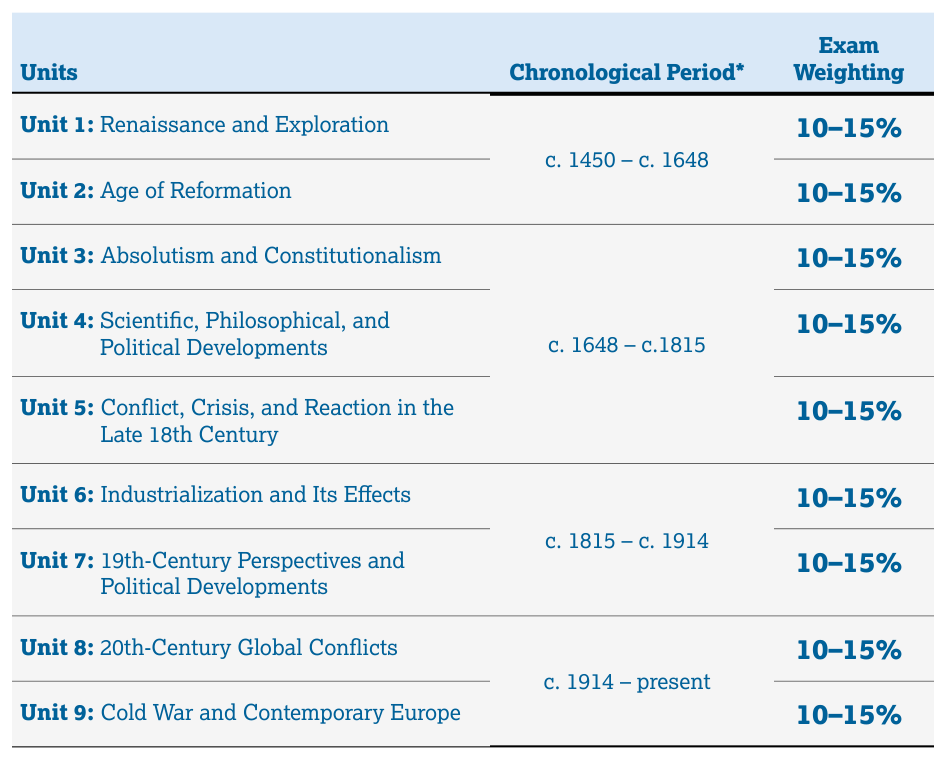
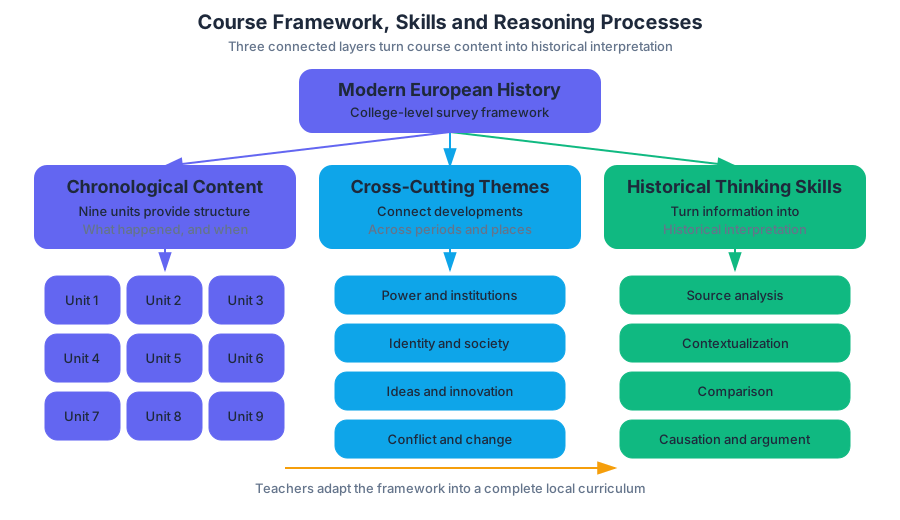
The framework combines three layers: chronological content, cross-cutting themes, and historical thinking skills. The nine units provide the chronological structure; the themes connect developments across periods; and the skills turn information into historical interpretation.
The course framework reflects the expectations of a college-level modern European history survey course. Its units contain content and conceptual understandings that colleges and universities typically expect students to master for credit or placement, while teachers still adapt the framework into a complete local curriculum.
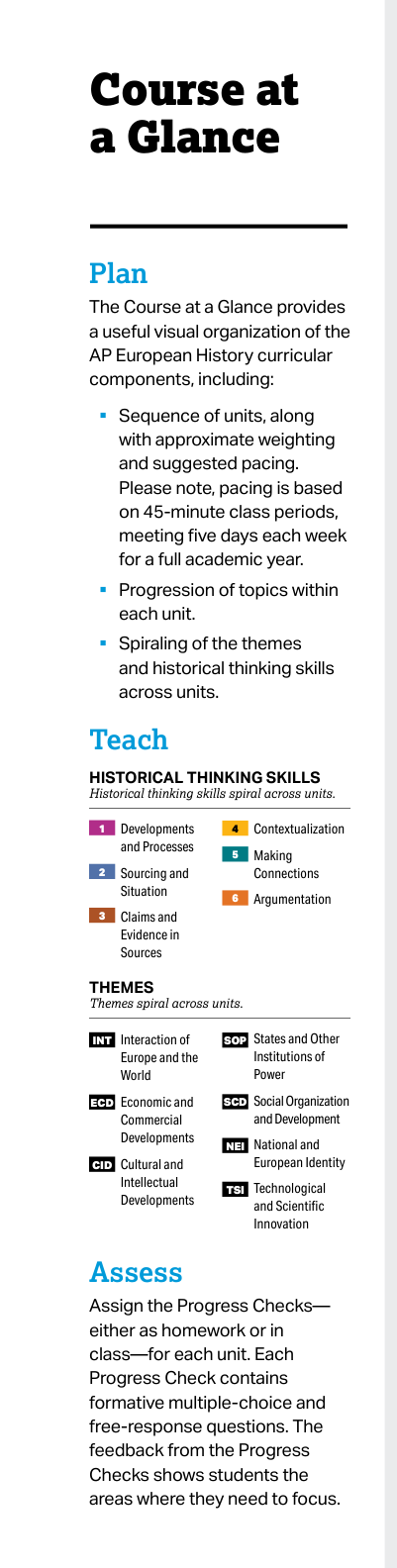
Six Historical Thinking Skills
Each skill names a different operation historians perform. A strong response usually combines several rather than treating them as isolated steps.
- Skill 1: Developments and Processes — Identify and explain significant historical developments and processes. For example, industrialization is not one invention but a process involving factories, energy sources, transportation, labor, urbanization, and changing social relations.
- Skill 2: Sourcing and Situation — Analyze a source’s point of view, purpose, audience, and historical situation. A royal decree, workers’ petition, and newspaper editorial may describe the same crisis differently because each was produced for a different audience and purpose.
- Skill 3: Claims and Evidence in Sources — Identify a source’s claim and explain how specific evidence supports, qualifies, or challenges it.
- Skill 4: Contextualization — Connect a historical development to broader circumstances before, during, or after it. The Reformation becomes clearer when placed alongside Renaissance humanism, printing, church criticism, and the political interests of rulers.
- Skill 5: Making Connections — Apply the three historical reasoning processes: comparison, causation, and continuity and change.
- Skill 6: Argumentation — Make historically defensible claims and support them with specific, relevant evidence and historical reasoning.
These skills appear across the assessment system: stimulus-based multiple-choice questions emphasize evidence and interpretation; short-answer questions require concise claims, evidence, and explanation; the document-based question combines sourcing, contextualization, evidence, and argumentation; and the long essay question requires a defensible argument supported by reasoning and specific historical evidence. Beginning with the May 2027 exams, updated short-answer and long-essay formats will apply, but the course content remains unchanged.
Three reasoning processes
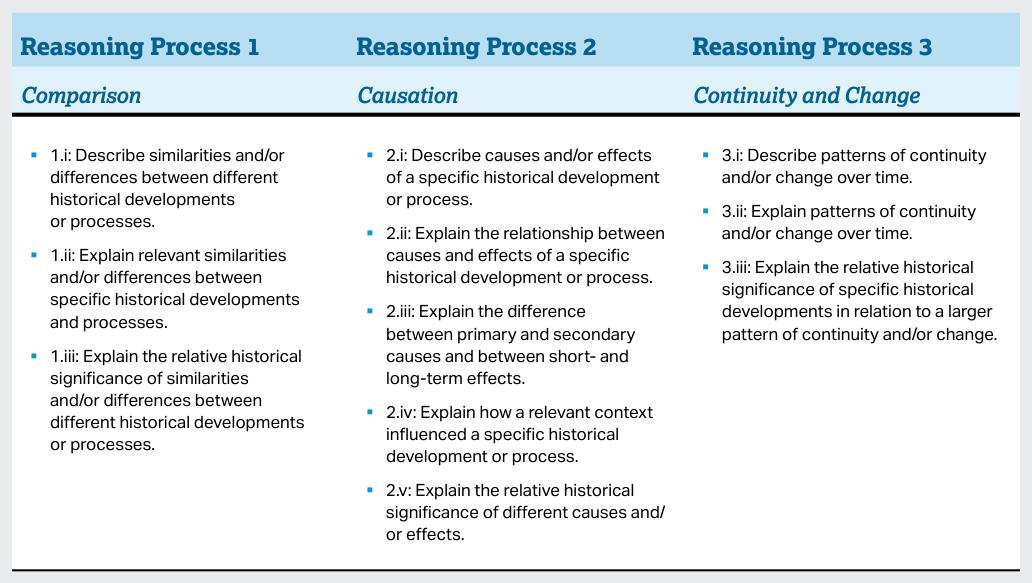
The reasoning processes are the engine of historical explanation. Comparison examines similarities, differences, and relationships; causation explains the factors producing a development and its effects; and continuity and change identifies what persisted, what changed, and why the pattern was uneven.
| Reasoning process | Historical question | Example |
|---|---|---|
| Comparison | How were two developments alike and different? | How did British and French state-building differ? |
| Causation | Why did a development occur, and what did it produce? | Why did industrialization begin in Britain? |
| Continuity and change | What persisted, what changed, and why? | How did women’s work change during industrialization while inequality persisted? |
Themes as conceptual threads
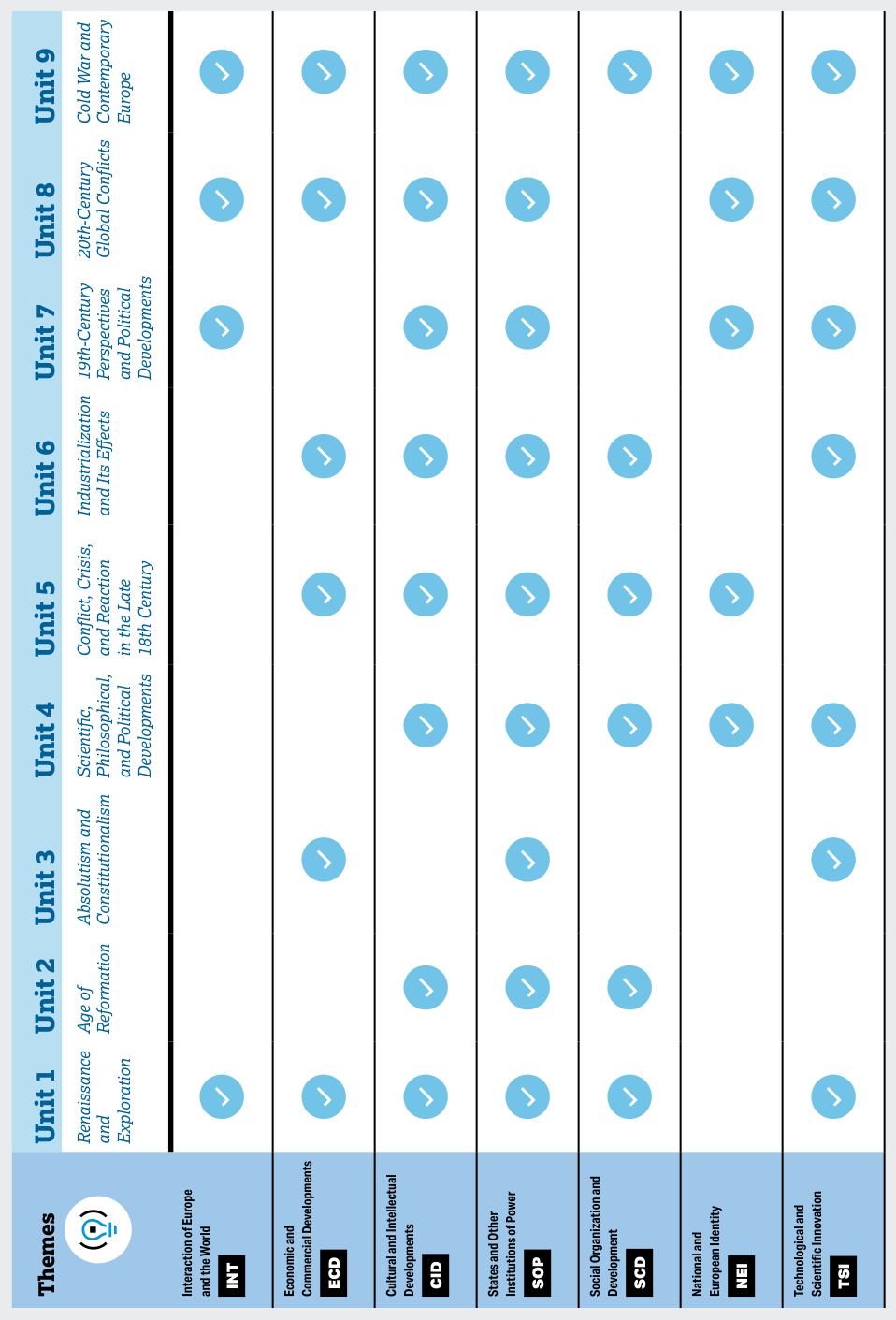
The seven themes are not labels placed beside topics; they are cross-cutting concepts that build understanding and spiral throughout the course:
- INT: Interaction of Europe and the World
- ECD: Economic and Commercial Developments
- CID: Cultural and Intellectual Developments
- SOP: States and Other Institutions of Power
- SCD: Social Organization and Development
- NEI: National and European Identity
- TSI: Technological and Scientific Innovation
Consider SOP: States and Other Institutions of Power as a thread. In Unit 1, students can trace how new monarchies and exploration increased state capacity; in Unit 3, absolutist rulers used armies, taxation, and court ritual to centralize authority; in Unit 4, Enlightenment thinkers challenged inherited power; in Unit 5, the French Revolution claimed to relocate sovereignty from monarch to nation; and in Units 8 and 9, totalitarian states and democratic institutions offered competing models of political power. The conceptual understanding becomes more precise over time: power is not simply “held by kings,” but is built through institutions, justified through ideas, contested by groups, and reorganized during crises.
Integrating content, skills, and scaffolding
Teachers should use the topic pages in the unit guides to identify required content, then integrate that content with a skill. A lesson on the printing press might begin with Skill 1: Developments and Processes, move to Skill 2: Sourcing and Situation through a printed religious text, and finish with Skill 6: Argumentation about whether print accelerated religious division.
Scaffolding means temporary support that helps students perform a complex historical task before they can do it independently. A useful progression is: model how to identify a source’s audience; complete a sourcing organizer together; compare two sources with prompts; then write an independent claim using evidence. The support should gradually disappear, while the historical reasoning remains.
Monitoring progress
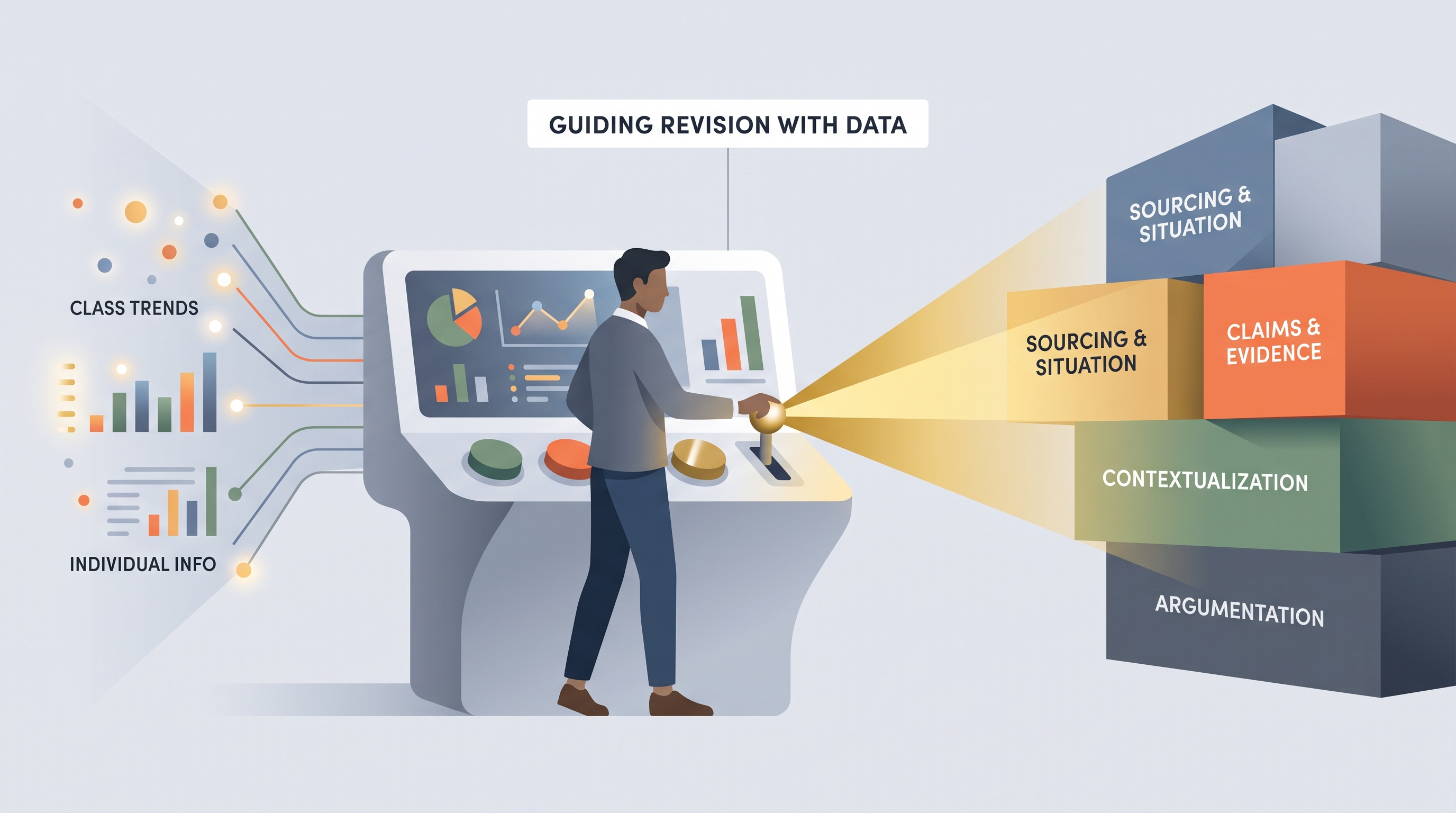
The Progress Dashboard lets teachers review class and individual student progress throughout the year. Class trends can reveal, for example, strong content recall but persistent difficulty with contextualization; individual information helps students identify which content and skills need focused attention. Progress data is most useful when it leads to a specific revision: rereading sources for purpose, practicing causal links, or strengthening evidence in an argument.
Retrieval check: A student compares two sources, explains why each author presents an event differently, connects the event to its wider setting, and makes a defensible claim. Which skills are being combined? A complete answer should identify Skill 2: Sourcing and Situation, Skill 3: Claims and Evidence in Sources, Skill 4: Contextualization, and Skill 6: Argumentation, with Skill 5: Making Connections added if the response explicitly compares, explains causation, or analyzes continuity and change.

Source Materials
- AP European History Course and Exam Description
- AP European History Course and Exam Description Clarifications and Corrections
- AP European History Course Overview
- AP European History Course at a Glance
- AP European History Course at a Glance Poster
- AP European History
- AP European History
- AP European History Sample Syllabus 1
- Figure — AP European History Course and Exam Description (p. 1)
- Figure — AP European History Course and Exam Description (p. 18)
- Figure — AP European History Course and Exam Description (p. 25)
- *Events, processes, and developments are not constrained by the given dates and may begin before, or continue after, the approximate dates assigned to each unit and/or topic.