From the free course AP European History on Lykke
AP Practice 5
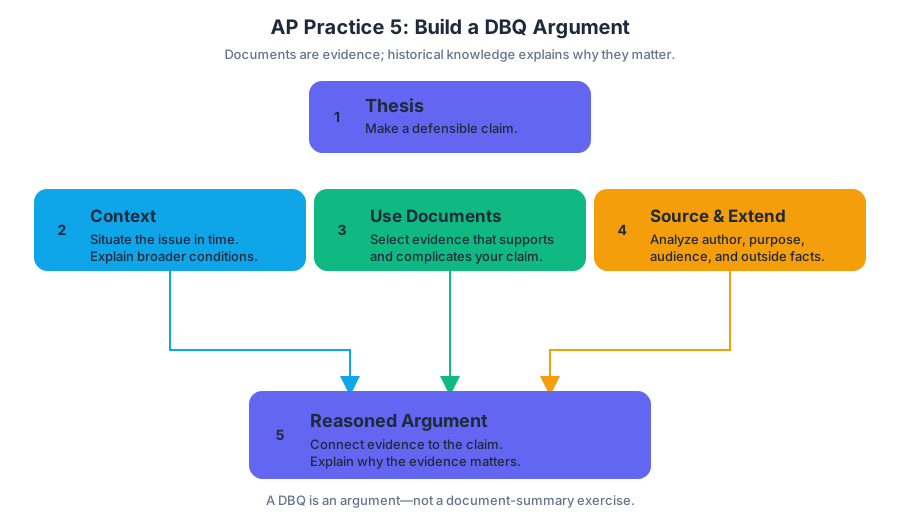
A successful Document-Based Question (DBQ) is not a document-summary exercise. It is a historical argument in which the documents function as evidence, while your knowledge of the period explains why that evidence matters.
AP Practice 5
A successful Document-Based Question (DBQ) is not a document-summary exercise. It is a historical argument in which the documents function as evidence, while your knowledge of the period explains why that evidence matters.
Task: Develop and support an argument using the documents, historical context, and relevant outside knowledge.
Original DBQ: Did economic expansion strengthen European states, c. 1450–1750?
Prompt: Evaluate the extent to which expanding commercial activity strengthened the power of European states in the period c. 1450–1750.
Document 1: A Portuguese royal directive, early sixteenth century
The king orders officials in the Indian Ocean to regulate the movement of spices and require ships trading near Portuguese fortresses to carry royal licenses. Unlicensed merchants may have their cargo seized.
Document 2: A Dutch merchant’s account, seventeenth century
Amsterdam’s merchants prosper because ships, credit, insurance, and overseas trade operate together. Profits flow through private companies, although the government protects Dutch commercial privileges and naval routes.
Document 3: A French ministerial memorandum, late seventeenth century
France must sell more goods abroad, rely less on foreign manufactures, and organize its colonies so that raw materials enter France and finished products leave French ports. Economic policy should increase royal revenue and military strength.
Document 4: An English political pamphlet, 1690s
The nation’s wealth depends upon merchants, but merchants require secure property, predictable laws, and parliamentary confidence. Government should support trade without allowing the crown to control taxation or commerce arbitrarily.
Document 5: A West African ruler’s letter to a European trading company, eighteenth century
European merchants request exclusive access to coastal trade. The ruler responds that foreign traders may operate only through agreements with local authorities and must pay customary fees. European ships cannot assume that military power gives them automatic control inland.
Document 6: An enslaved person’s testimony recorded after escape, eighteenth century
The witness describes forced transportation across the Atlantic, separation from family, and labor on a plantation producing a valuable export crop. European merchants and governments gain wealth from this commerce, while enslaved people bear its violence.
Document 7: A political economist writing in Britain, 1770s
The division of labor can greatly increase production, but governments that grant monopolies may protect inefficient companies. Commercial growth may therefore produce wealth while also creating political arguments over regulation, privilege, and economic freedom.
How to read the evidence
Group the documents by argument, not by date. Documents 1, 3, and 6 support the claim that states strengthened themselves through regulation, colonial systems, taxation, and coerced labor. Documents 2, 4, and 7 complicate that claim by showing that private merchants, financial institutions, legal protections, and political limits were also essential. Document 5 warns against treating European expansion as complete or uncontested.
A strong thesis might argue: Commercial expansion substantially strengthened European states by increasing revenue, supporting navies, and linking colonies to state policy; however, this power depended on private merchants and coercive labor systems, and constitutional limits or local resistance prevented governments from controlling commerce completely.
Worked planning model
| Paragraph | Historical job | Evidence |
|---|---|---|
| Context | Explain conditions before or around the period | Renaissance trade, exploration, stronger monarchies, Atlantic expansion |
| Claim 1 | Commercial activity increased state power | Documents 1 and 3; mercantilism; colonial monopolies |
| Claim 2 | States relied on private networks and institutions | Documents 2 and 4; Dutch financial innovation; English constitutionalism |
| Qualification | Expansion produced limits and unequal power | Documents 5 and 6; African resistance; Atlantic slavery |
| Conclusion | Explain the degree of change | Stronger fiscal-military states, but not total economic control |
Outside evidence could include the English Navigation Acts, the Dutch East India Company, France’s use of colonial mercantilism, the Atlantic slave trade, or the development of joint-stock companies. Do not merely name one: explain how it supports your argument.
Rubric-targeted reasoning
- Thesis/Claim: Make a defensible claim that answers “to what extent,” including a qualification.
- Contextualization: Connect commercial expansion to Renaissance banking, overseas exploration, state centralization, or earlier Mediterranean trade.
- Evidence from the Documents: Use at least six documents accurately; use at least four to support an argument rather than summarize them.
- Evidence Beyond the Documents: Explain one relevant historical example not supplied above.
- Sourcing and Situation: Explain how the author’s purpose, audience, point of view, or historical situation affects the meaning of at least two documents. For example, the French memorandum favors state-directed commerce because its author seeks stronger royal revenue.
- Complexity: Demonstrate a relationship such as state power and private enterprise reinforcing one another, while coercion and resistance limited the benefits of commercial growth.
Timing and error review
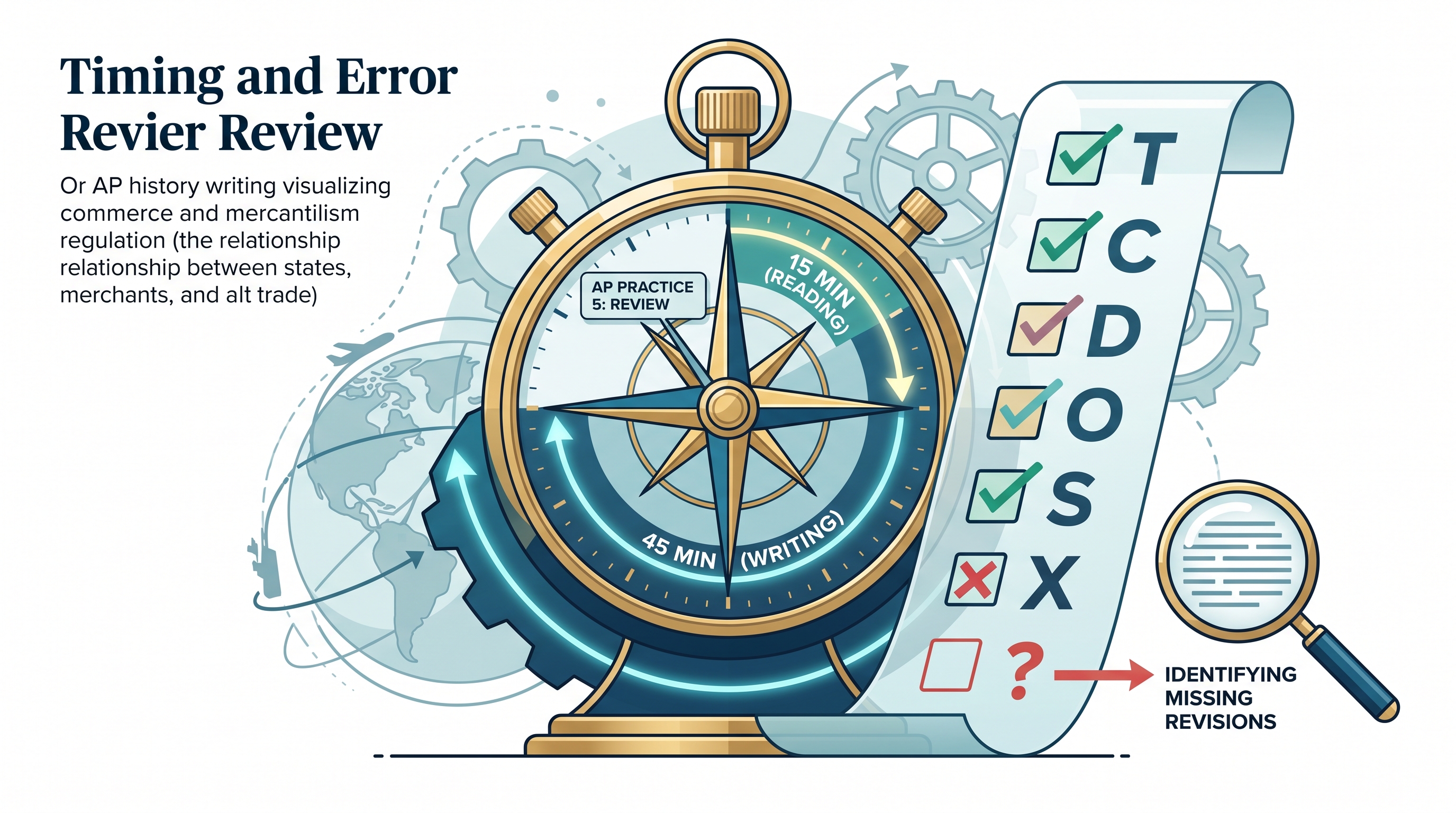
Use approximately 15 minutes to read and group documents, then 45 minutes to write. Before submitting, mark each paragraph: T for thesis, C for context, D for document evidence, O for outside evidence, S for sourcing, and X for complexity. Any missing letter identifies the most useful revision.
Misconception check: “Mercantilism means governments replaced private merchants.” Not quite. Mercantilist states regulated trade and granted privileges, but they often depended on merchants, investors, shipping companies, and credit networks to make imperial commerce work.
Retrieval check: Which document most clearly complicates the argument that expanding commerce gave European governments unlimited power, and what historical development supports that complication?
Source Materials
- AP European History Course and Exam Description
- AP European History Course and Exam Description Clarifications and Corrections
- AP European History Course Overview
- AP European History Course at a Glance
- AP European History Course at a Glance Poster
- AP European History
- AP European History
- AP European History Sample Syllabus 1
- AP European History-AP Students-College Board
- AP European History-Doves Library
- AP European History Cheat Sheets-Albert.io
- AP European History Study Guide-EBSCO