From the free course AP European History on Lykke
3.3 Continuities and Changes to Economic Practice and Development · 3.4 Economic Development and Mercantilism
Key concepts: Capitalism · Market economy · Putting-out system (cottage industry) · Financial practices and institutions · Agricultural exchange between the Americas and Europe · Mercantilism · Absolutism · Enlightenment political and economic theories · Economic development and social change · Continuities and changes in commercial and economic development
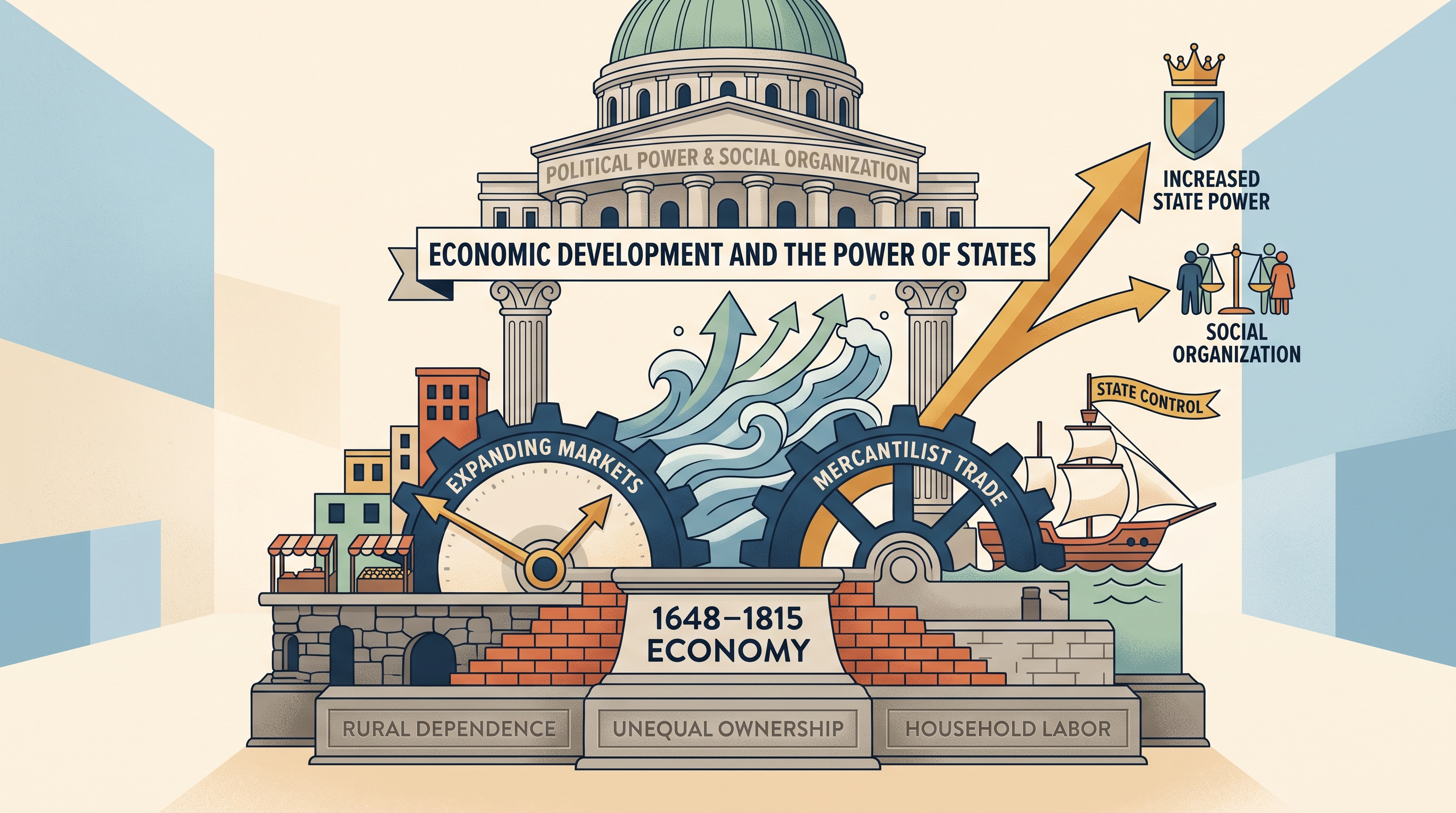
Between $1648$ and $1815$, European economies did not simply replace an old system with a new one. Traditional agriculture, state regulation, and social hierarchies continued, while expanding markets, private investment, global trade, and new labor arrangements gradually transformed how Europeans produced,…
3.3 Continuities and Changes to Economic Practice and Development · 3.4 Economic Development and Mercantilism
Between $1648$ and $1815$, European economies did not simply replace an old system with a new one. Traditional agriculture, state regulation, and social hierarchies continued, while expanding markets, private investment, global trade, and new labor arrangements gradually transformed how Europeans produced, exchanged, and consumed goods. The central tension was this: how could economic activity become more flexible and international while governments still tried to control it?
Unit 3: Learning Objective C: Explain the continuities and changes in commercial and economic developments from $1648$ to $1815$.
From regulated exchange to a market economy
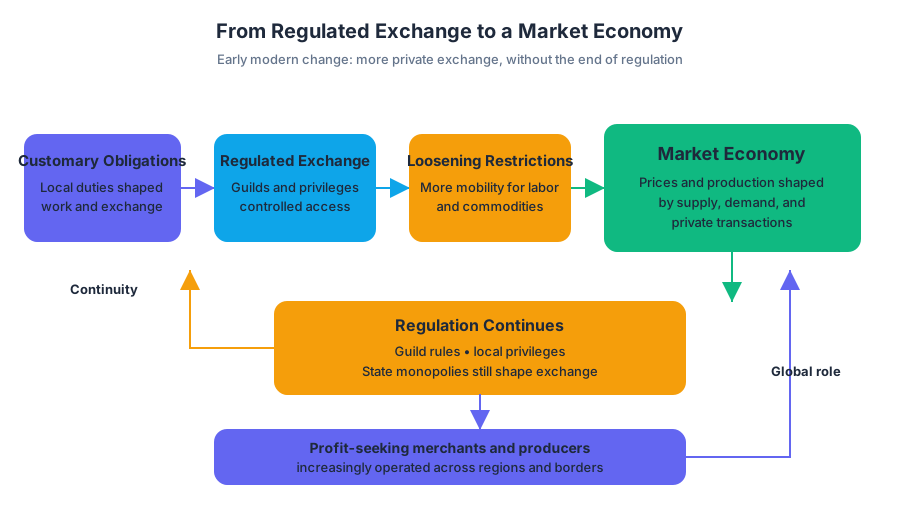
A market economy is an economic system in which prices, production, and exchange are increasingly shaped by supply, demand, and private transactions rather than exclusively by customary obligations or direct government commands. Early modern Europe developed a market economy that provided the foundation for its global role (KC-2.2.I).
This development did not mean that governments disappeared from economic life. Instead, labor and commodity trade were increasingly freed from traditional restrictions imposed by governments and corporate entities (KC-2.2.I.A). Guild rules, local privileges, and state monopolies remained important, but merchants and producers gained more opportunities to pursue profit across regions and borders.
Capitalism and new financial institutions
Capitalism is an economic system in which individuals or private organizations invest capital—money, property, or other resources—in production and trade with the goal of earning profit. Its expansion influenced European society far beyond commerce: it affected social relationships, political power, cultural values, and imperial competition.
The growth of the market economy created risks that older local arrangements could not easily manage. Merchants therefore developed new financial practices and institutions, including insurance (KC-2.2.I.D). Insurance allowed investors and traders to distribute risk: if a ship carrying valuable cargo sank, the loss did not necessarily destroy one merchant’s entire fortune. Credit, banking, investment partnerships, and expanding commercial networks similarly made larger and more distant transactions possible.
Worked example—why insurance mattered: A merchant finances a voyage carrying textiles and spices across the Atlantic. The voyage promises substantial profit but faces storms, piracy, and war. By purchasing insurance, the merchant pays a smaller known cost in exchange for protection against catastrophic loss. This encourages more voyages, which expands trade, strengthens port cities, and increases demand for credit and labor.
Key connection: Financial institutions did not merely reflect economic growth; they helped make larger-scale economic growth possible.
The putting-out system
The putting-out system, also called cottage industry, was a form of production in which laborers worked in their homes or small workshops while merchants or workshop owners supplied materials, organized distribution, and sold the finished products. Increasing numbers of people participated in production through this system (KC-2.2.I.C).
A merchant might distribute raw wool to rural families, collect the spun thread or woven cloth, and then sell it in a regional or international market. This arrangement expanded production beyond urban guild workshops and gave merchants greater control over commodities. It also brought wage labor into households, where women and children often contributed alongside men.
The system therefore combined change and continuity. Production changed because it became more commercial, dispersed, and responsive to market demand. Yet continuity remained in the household as a major economic unit, in agriculture as the dominant livelihood for much of Europe, and in social inequality between owners, merchants, and laborers.
The Columbian Exchange and Europe’s food supply
The importation and transplantation of agricultural products from the Americas contributed to an increased food supply in Europe (KC-2.2.II.D). Crops such as potatoes and maize could supplement older grains and, in some regions, support population growth because they produced substantial calories in difficult soils or conditions.
This exchange was not simply a story of European benefit. European colonization, coerced labor, epidemic disease, and the violent restructuring of American societies formed the broader context in which these crops moved. Economic development connected European markets to global systems whose consequences were unequal and often destructive.
Mercantilism and its challengers
Mercantilism was a system of state-directed economic policy that sought to strengthen the power of the state by regulating trade, promoting exports, protecting domestic industries, and securing access to colonial resources and markets. Governments used tariffs, monopolies, navigation laws, and colonial restrictions to make economic activity serve political and military goals.
Mercantilism and capitalism could coexist, but they represented different emphases. Capitalism prioritized private investment and profit; mercantilism prioritized state power and national competition. As market relationships expanded, new political and economic theories challenged absolutism and mercantilism by arguing for fewer restrictions, broader commercial freedom, or a different relationship between government and the economy.
Misconception check—“capitalism replaced mercantilism overnight”: This is inaccurate. European states continued to regulate trade and exploit colonies even as private investors, merchants, and manufacturers gained influence. The period is best understood as an overlap: state control remained powerful while market-oriented practices expanded.
Continuity-and-change reasoning
To identify patterns in commercial and economic development, compare both what changed and what endured (Suggested Skill 5.A: Making Connections). From $1648$ to $1815$, change included expanding markets, financial institutions, commercial agriculture, cottage production, and Atlantic exchange. Continuity included rural dependence, unequal property ownership, government intervention, and the importance of household labor.
The broad effect was cumulative: economic development influenced political power, intellectual debate, social organization, cultural values, and relationships between Europe and the wider world. The economy was not a separate sphere. It helped shape the societies and states that Europeans built.
Retrieval check: A merchant-owned textile network uses rural households, borrowed capital, and insurance while operating under state trade regulations. Identify one change, one continuity, and one reason this example demonstrates both capitalism and mercantilism operating at the same time.
Source Materials
- AP European History Course and Exam Description
- AP European History Course and Exam Description Clarifications and Corrections
- AP European History Course Overview
- AP European History Course at a Glance
- AP European History Course at a Glance Poster
- AP European History
- AP European History
- AP European History Sample Syllabus 1