From the free course AP European History on Lykke
6.3 Second-wave industrialization and its effects · 6.4 Social effects of industrialization
Key concepts: Second-wave industrialization · Industrialization in Prussia and German unification · Government-sponsored industrialization · Delayed industrialization · Mass marketing and consumer society · Rising wages and demand for consumer goods · Separate spheres and women’s social roles · Women’s wartime labor during World War I · Industrialization’s social effects · Women’s rights and feminist movements
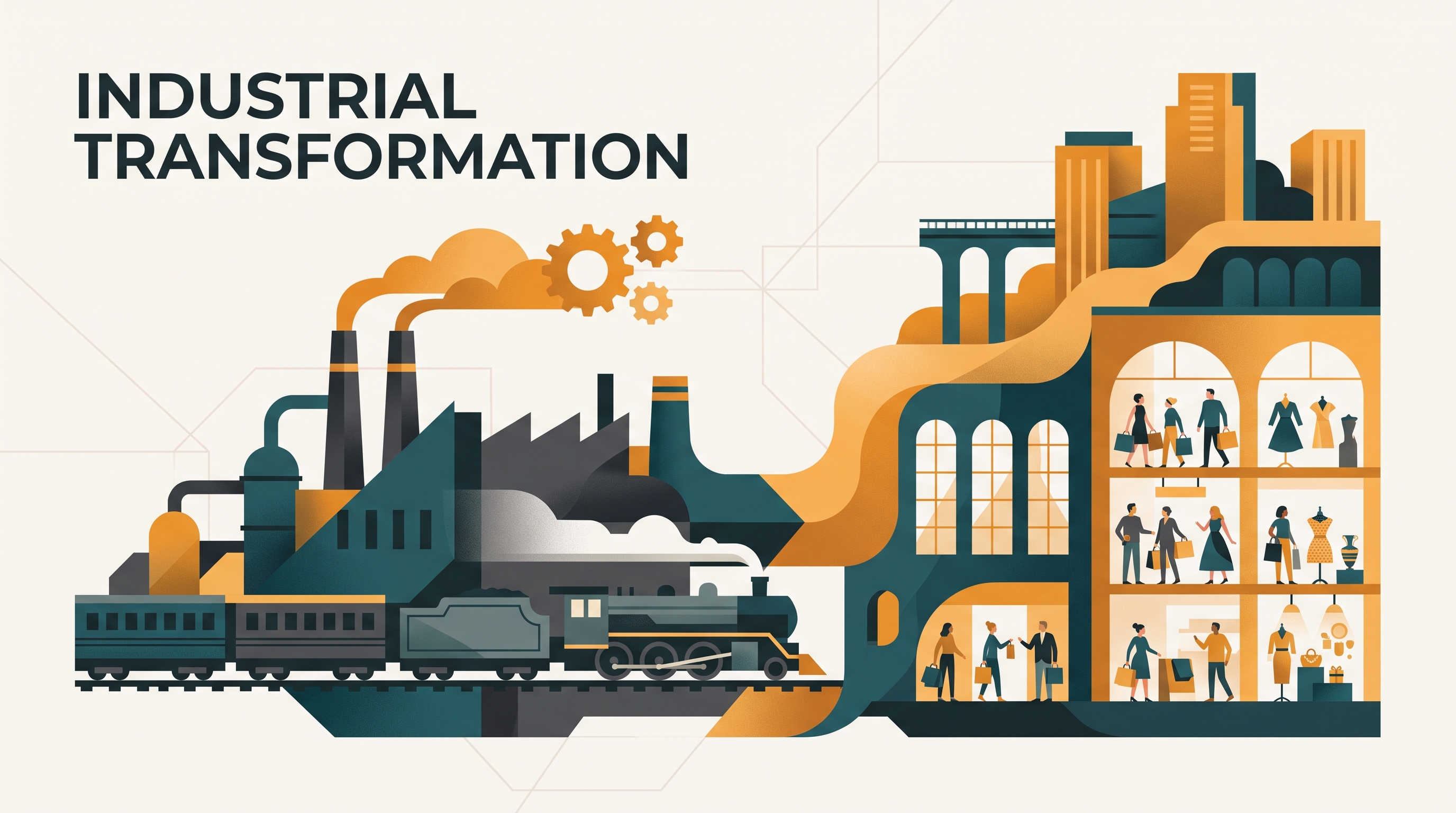
Industrialization did more than produce more iron, textiles, and machines: it changed who governed, what families bought, where women worked, and how Europeans imagined political rights.
6.3 Second-wave industrialization and its effects · 6.4 Social effects of industrialization
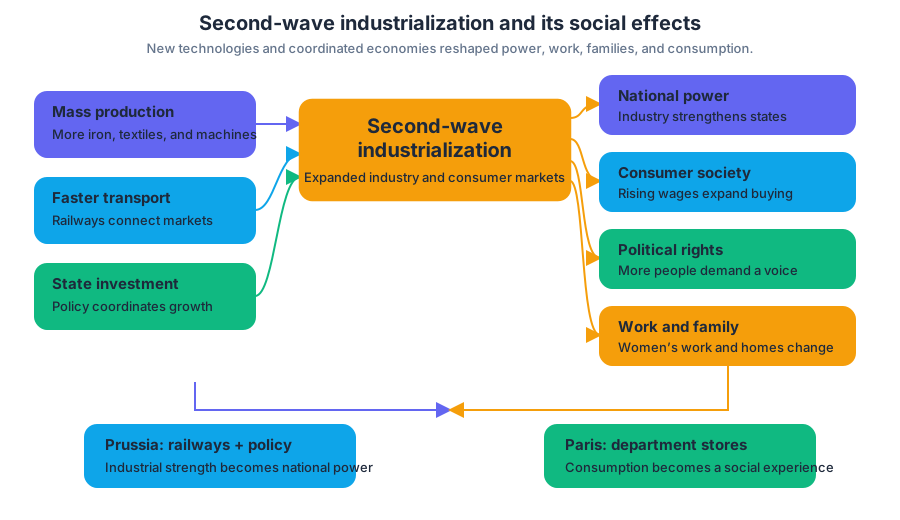
Industrialization did more than produce more iron, textiles, and machines: it changed who governed, what families bought, where women worked, and how Europeans imagined political rights. In Prussia, railways and coordinated economic policy helped turn industrial strength into national power; in Paris, department stores transformed rising wages into a new consumer society.
Second-wave industrialization was the later phase of European industrial growth, marked by expanded manufacturing, improved transportation, state investment, mass production, and the rapid growth of consumer markets.
From Prussian industry to German power
Prussia’s industrialization helped it become the leader of a unified Germany. The Zollverein, a customs union that reduced internal trade barriers among many German states, allowed goods, capital, and raw materials to circulate more efficiently. Investment in transportation networks—especially railways—connected coalfields, factories, cities, and military centers, while improved manufacturing methods increased productive capacity.
The political consequence was substantial: economic integration strengthened Prussia’s ability to lead German unification. After unification, Germany experienced rapid, government-sponsored industrialization, meaning that the state actively supported economic development rather than simply allowing private entrepreneurs to act alone. This included transportation investment, industrial coordination, and policies associated with Friedrich List’s National System, which argued that national economic strength required protective and developmental policies.
KC-3.2.IV.A: Industrialization in Prussia allowed it to become the leader of a unified Germany, which subsequently underwent rapid, government-sponsored industrialization.
The sequence matters. Industrial development did not merely follow political unification; it helped make Prussian leadership possible, and the newly unified German state then accelerated industrial development. This is a relationship of mutual reinforcement:
Zollverein and railways → larger integrated market → stronger Prussian industry → German unification under Prussian leadership → state-sponsored industrial expansion
Why industrialization was uneven
Not every region industrialized at the same speed. Delayed industrialization means that a region entered large-scale industrial development later than earlier industrial centers. Geographic obstacles could make transportation expensive; surviving serfdom or powerful landed elites could limit labor mobility and investment; and weak government support could leave entrepreneurs without the infrastructure needed for growth.
Delayed industrialization could produce serious negative outcomes. Governments or businesses might borrow heavily to catch up, creating debt, while inadequate transportation and agricultural weakness could contribute to famine. Industrial delay therefore was not simply “being behind”; it could intensify economic and social vulnerability.
Misconception check: Delayed industrialization did not mean that a society had no economy or technology. It meant that industrial growth was later, more limited, or less effectively supported than in leading regions.
Mass marketing and the consumer society
Industrialization increased the supply of manufactured goods, but factories also needed buyers. Mass marketing connected mass production to mass consumption through advertising, department stores, and catalogs. These techniques persuaded customers that manufactured goods were affordable, desirable, and connected to modern social life.
Rising wages among lower- and middle-class consumers increased demand for consumer goods. As demand grew, businesses expanded production and retailing, helping create a modern consumer society, in which purchasing manufactured goods became a regular and socially meaningful part of life.
Department stores illustrate the connection. Large urban stores depended on high sales volumes and continuing economic growth. They displayed many products under one roof, reached a wider customer base than traditional shops, and encouraged middle-class women to spend on clothing, household items, and other consumer goods. Urbanization made large stores possible, while industrial production filled them with affordable merchandise.
Gender, work, and consumption
Consumer society did not erase class differences between women. Middle-class women were generally expected to remain within the home and manage domestic consumption. Shopping could therefore be presented as part of respectable household management rather than as paid employment.
Many lower-class women, by contrast, worked outside the home. Department stores created new jobs as clerks and salespeople, even while those jobs often preserved unequal wages and limited advancement. The same economy that encouraged middle-class women to consume could employ lower-class women in retail labor.
World War I disrupted these expectations. As men were drafted and sent to fight, women’s participation in work outside the home increased. Industrial and social change also contributed to new political movements and rights, including feminism, while reforms such as the Factory Acts connected changing working conditions to government regulation.
Misconception check: Industrialization did not produce a single, universal “women’s experience.” Class shaped whether a woman was expected to consume at home, earn wages outside it, or do both.
Worked historical reasoning
Claim: Department stores reflected broader industrial and social change. Context: Second-wave industrialization expanded the mass production of consumer goods, while urbanization created dense customer markets. Development: Rising wages increased demand; department stores used advertising and high-volume sales to meet that demand. Social effect: Middle-class women gained a prominent role as consumers, while lower-class women gained retail employment. Political consequence: Critiques of inequality and consumerism helped encourage movements for expanded rights, including feminism.
This chain demonstrates Historical Thinking Skill 1.A: Identify and describe a historical concept, development, or process, Historical Thinking Skill 4.B: Explain how a historical context relates to a historical development, and Historical Thinking Skill 5.B: Explain patterns and processes of continuity and change over time. An AP response must explain how or why the relationship existed, not merely name “industrialization” or “women’s rights.”
Retrieval check
Why did Prussia’s industrialization contribute to German unification, and why did department stores depend on rising wages? In two sentences, connect one economic development to one political outcome and one economic development to one social or gender outcome.
Source Materials
- AP European History Course and Exam Description
- AP European History Course and Exam Description Clarifications and Corrections
- AP European History Course Overview
- AP European History Course at a Glance
- AP European History Course at a Glance Poster
- AP European History
- AP European History
- AP European History Sample Syllabus 1