From the free course AP European History on Lykke
1.3 Northern Renaissance · 1.4 Printing
Key concepts: Northern Renaissance · Italian Renaissance · Christian humanism · Secular humanism · Printing press and expansion of literacy · Medici family patronage · Renaissance art and Greek/Roman ideals · French Protestantism and the Reformation · Religious and secular approaches to knowledge · Trade, banking, and Italian city-states
The Renaissance did not travel north as a carbon copy of Florence: it changed emphasis as it encountered different religious, social, and intellectual settings. The key contrast is not “religious art versus nonreligious art,” but the different relationships between humanist learning, Christianity, and secular life.
1.3 Northern Renaissance · 1.4 Printing
The Renaissance did not travel north as a carbon copy of Florence: it changed emphasis as it encountered different religious, social, and intellectual settings. The key contrast is not “religious art versus nonreligious art,” but the different relationships between humanist learning, Christianity, and secular life.
Northern and Italian humanism
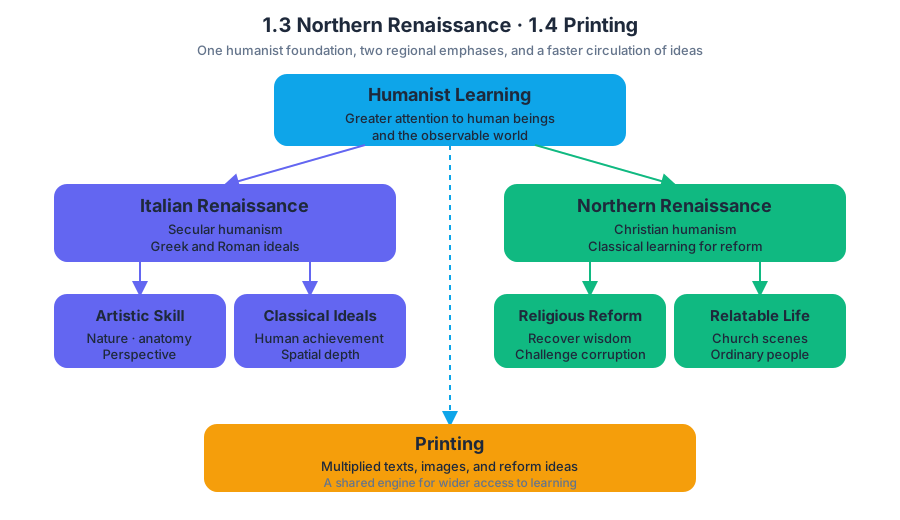
Humanism was an intellectual movement that gave greater attention to human beings, their capabilities, and the practical or secular knowledge of the world. Italian humanists looked especially to Greek and Roman texts and ideals. Their work increasingly emphasized human achievement, artistic skill, nature, anatomy, perspective, and subjects that could be studied apart from explicitly Christian theology.
The Northern Renaissance, by contrast, emphasized Christianity and Christian humanism. Christian humanists used the study of classical languages and texts to improve Christian life rather than to separate intellectual exploration from Christianity. They treated humanist learning as a way to recover religious wisdom, criticize corruption, and encourage more sincere belief.
Christian humanism: the attempt to reconcile classical learning about human beings and the ancient world with Christian theology and moral reform.
This produced a difference in artistic subject matter. Northern artists often represented religious scenes in churches, including frescoes on walls and ceilings, but they also focused on ordinary people and recognizable daily life. Italian Renaissance artists could also create religious works, yet their art more often highlighted classical ideals, human talent, natural movement, spatial depth, and the beauty of the observable world.
| Feature | Italian Renaissance | Northern Renaissance |
|---|---|---|
| Dominant intellectual emphasis | Secular humanism and Greek and Roman ideals | Christian humanism and religious reform |
| Relationship to Christianity | Increasing separation of intellectual exploration from Christian theology | Classical learning placed within Christian theology |
| Common artistic emphasis | Human achievement, nature, perspective, classical subjects | Religious themes, ordinary life, and relatable people |
| Social setting | Wealthy trading city-states, especially Florence | Northern European cities and religious communities |
| Shared foundation | Greater attention to human beings, learning, observation, and classical knowledge | Greater attention to human beings, learning, observation, and classical knowledge |
Wealth, patronage, and Florence
Italian city-states gained power and wealth through trade. Florence became especially rich, and the Medici family shows how commercial wealth could become cultural power. The Medicis made money through the wool trade, then used that wealth to fund banking and the arts. Patronage—financial support given to artists, scholars, or institutions—allowed Renaissance culture to flourish because creators could work with resources supplied by wealthy families and governments.
Worked comparison: Imagine two paintings of human beings. An Italian Renaissance painter might use mathematical perspective, careful observation of nature, and a classical ideal of bodily proportion to emphasize human accomplishment. A Northern Renaissance painter might place a biblical scene among familiar people, objects, and domestic details, making Christian meaning visible within everyday life. Both paintings value human observation; their difference lies in whether classical and practical learning chiefly serves secular human achievement or Christian interpretation.
Printing and the movement of ideas
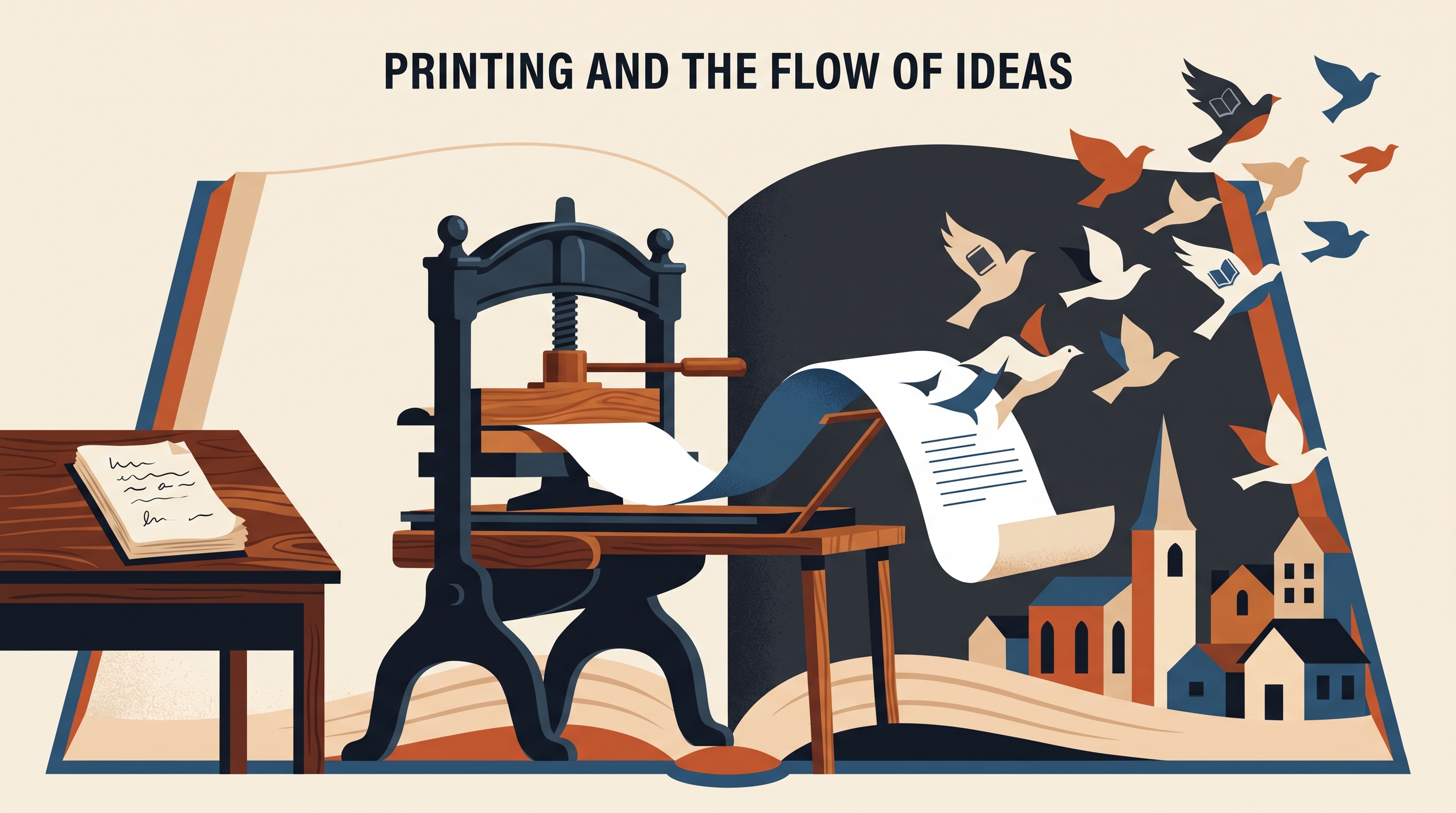
The printing press transformed the speed and scale of cultural transmission. Before knowledge became systematized, much useful everyday knowledge—about work, household production, healing, and local practice—was transmitted within and between households. Printing did not instantly make everyone literate, but it made written material cheaper, more numerous, and easier to circulate. As literacy expanded, Renaissance ideas and religious arguments reached audiences far beyond courts, universities, and wealthy patrons.
Printing therefore connected cultural change to religious conflict. In France, Protestantism emerged as part of the wider Protestant Reformation and challenged Catholic authority. French Protestants, often called Huguenots, faced periods of persecution and violent conflict with Catholics; the struggle involved doctrine, political loyalty, and the authority of the French monarchy and Catholic Church. A French Protestant cartoon titled The Missionary Soldier from 1686 should therefore be read as evidence of confessional conflict, not merely as an illustration of Renaissance art. Its date places it immediately after the French monarchy’s intensified pressure on Protestantism, including the revocation of the Edict of Nantes in 1685.
Skill focus: comparison and evidence
CED 1.3 — Northern Renaissance and CED 1.4 — Printing are assessed especially through Historical Thinking Skill 1: Developments and Processes, with connections to Historical Thinking Skill 3: Claims and Evidence in Sources and Historical Thinking Skill 5: Making Connections. A strong answer does more than label one movement “religious” and the other “secular”: it identifies a shared humanist interest, supplies a specific example, and explains the different relationship to Christianity and secular learning.
Misconception check — “The Northern Renaissance was only religious.” Not quite. Northern humanists studied classical learning and paid close attention to human beings and ordinary life. The more accurate distinction is that northern humanism placed those interests within Christian theology, while Italian humanism increasingly gave greater space to secular learning and Greek and Roman ideals.
Retrieval check: A wealthy wool merchant funds painters and bankers in Florence; a northern painter places a Christian scene among familiar household details; a printed Protestant image attacks or comments on confessional conflict. Which example best demonstrates patronage, which demonstrates Northern Renaissance subject matter, and which demonstrates printing’s role in religious debate? Explain one answer in a complete sentence.
Source Materials
- AP European History Course and Exam Description
- AP European History Course and Exam Description Clarifications and Corrections
- AP European History Course Overview
- AP European History Course at a Glance
- AP European History Course at a Glance Poster
- AP European History
- AP European History
- AP European History Sample Syllabus 1
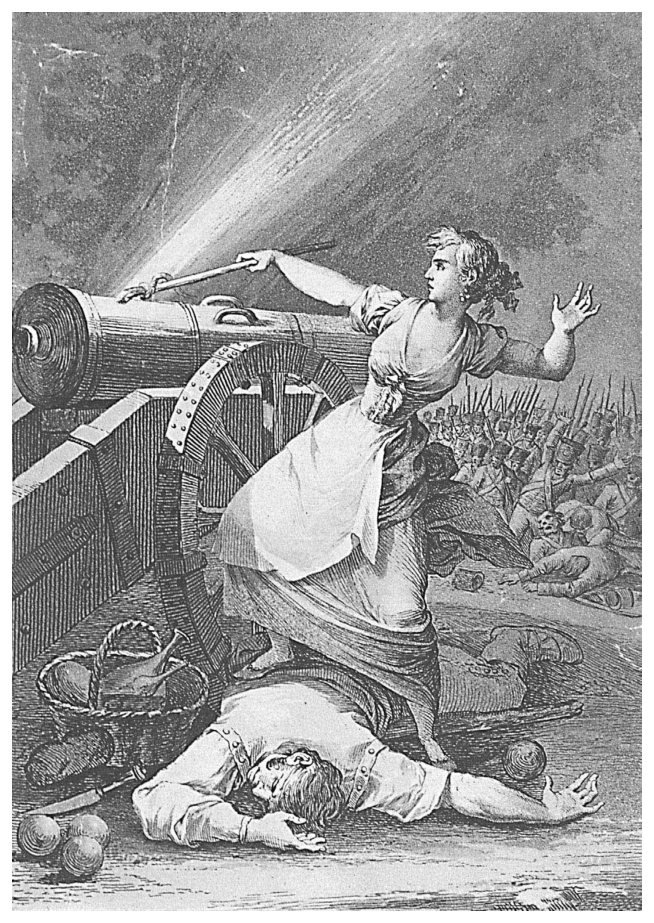
- The engraving was part of a series of illustrations of the siege of Zaragoza commissioned by the Spanish commander who led the successful defense of the city.