From the free course AP European History on Lykke
3.7 Absolutist Approaches to Power · 3.8 Comparison in the Age of Absolutism and Constitutionalism
Key concepts: Absolutist approaches to power · Comparison of absolutism and constitutionalism · Different models of political sovereignty · Limits of absolutism · Peter the Great’s westernization of Russia · Louis XIV and absolutism · Commercial and professional groups gaining political power · Language and cultural identities · Hugo Grotius · Niccolò Machiavelli
Between 1648 and 1815, European rulers tried to turn political authority into a centralized command system—but no monarch ruled without constraints. Absolutism means an approach to government in which a monarch claims extensive, centralized authority over administration, taxation, law, religion, and the military.
3.7 Absolutist Approaches to Power · 3.8 Comparison in the Age of Absolutism and Constitutionalism
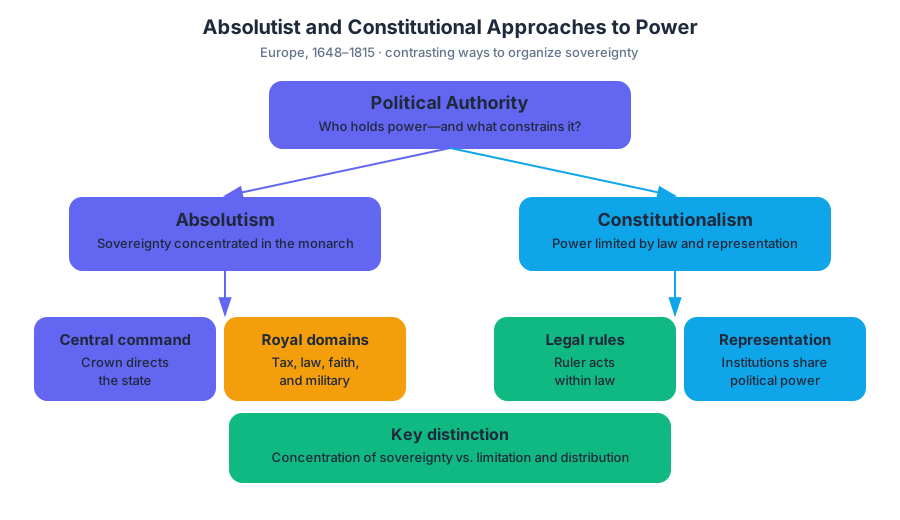
Between 1648 and 1815, European rulers tried to turn political authority into a centralized command system—but no monarch ruled without constraints. Absolutism means an approach to government in which a monarch claims extensive, centralized authority over administration, taxation, law, religion, and the military. Constitutionalism, by contrast, places political power within legal rules and representative institutions that limit the ruler.
Key distinction: Absolutism describes a concentration of sovereignty; constitutionalism describes a distribution and limitation of sovereignty.
Two models of political sovereignty
Political sovereignty means the supreme authority to make and enforce laws. In an absolutist model, sovereignty is concentrated in the monarch, who may justify rule through divine-right theories, inherited status, or the claim that centralized authority preserves order. In a constitutional model, sovereignty is constrained by law and shared with institutions such as parliaments, provincial estates, courts, or representative assemblies.
| Question | Absolutist approach | Constitutional approach |
|---|---|---|
| Where is authority concentrated? | Primarily in the monarch and royal bureaucracy | Among the ruler, representative bodies, courts, and local institutions |
| How are taxes raised? | Through royal officials and negotiated or imposed taxation | Through laws and approval by representative institutions |
| What happens to elites? | Nobles may lose political independence but retain privileges | Elites and commercial groups may gain formal political influence |
| What limits power? | Custom, privilege, geography, finance, resistance, and administrative capacity | Written or customary law, assemblies, courts, and political opposition |
| Typical European examples | France under Louis XIV; Russia under Peter the Great | England after the Glorious Revolution; the Dutch Republic |
The comparison is not simply “king versus democracy.” Constitutional states still contained hierarchy, restricted voting, and powerful elites, while absolutist monarchies often had to bargain with nobles, churches, towns, and regional authorities. The essential historical question is therefore: who could make decisions, through which institutions, and with what effective limits?
Absolutist power and social relationships
Absolute monarchies generally reduced the nobility’s independent political power while allowing nobles to preserve social status and legal privileges (KC-2.1.I.A). This was a bargain: nobles accepted greater royal control in exchange for continued exemption, rank, landholding rights, or access to offices. The monarchy became stronger, but aristocratic society did not disappear.
Across Europe, commercial and professional groups also gained power and played a greater role in political affairs (KC-1.5.I.C). Merchants, financiers, lawyers, civil servants, and administrators supplied rulers with loans, expertise, and bureaucratic labor. Their growing importance gradually complicated the older political order, in which birth mattered more than education, wealth, or professional skill.
Political authority also interacted with cultural identity. Minority communities defined by language and culture could resist dominant national groups (KC-1.5.I.D). A centralized state might standardize administration and religion, but that same pressure could intensify local resistance when communities believed their language, customs, or regional privileges were threatened.
Peter the Great: westernization from above
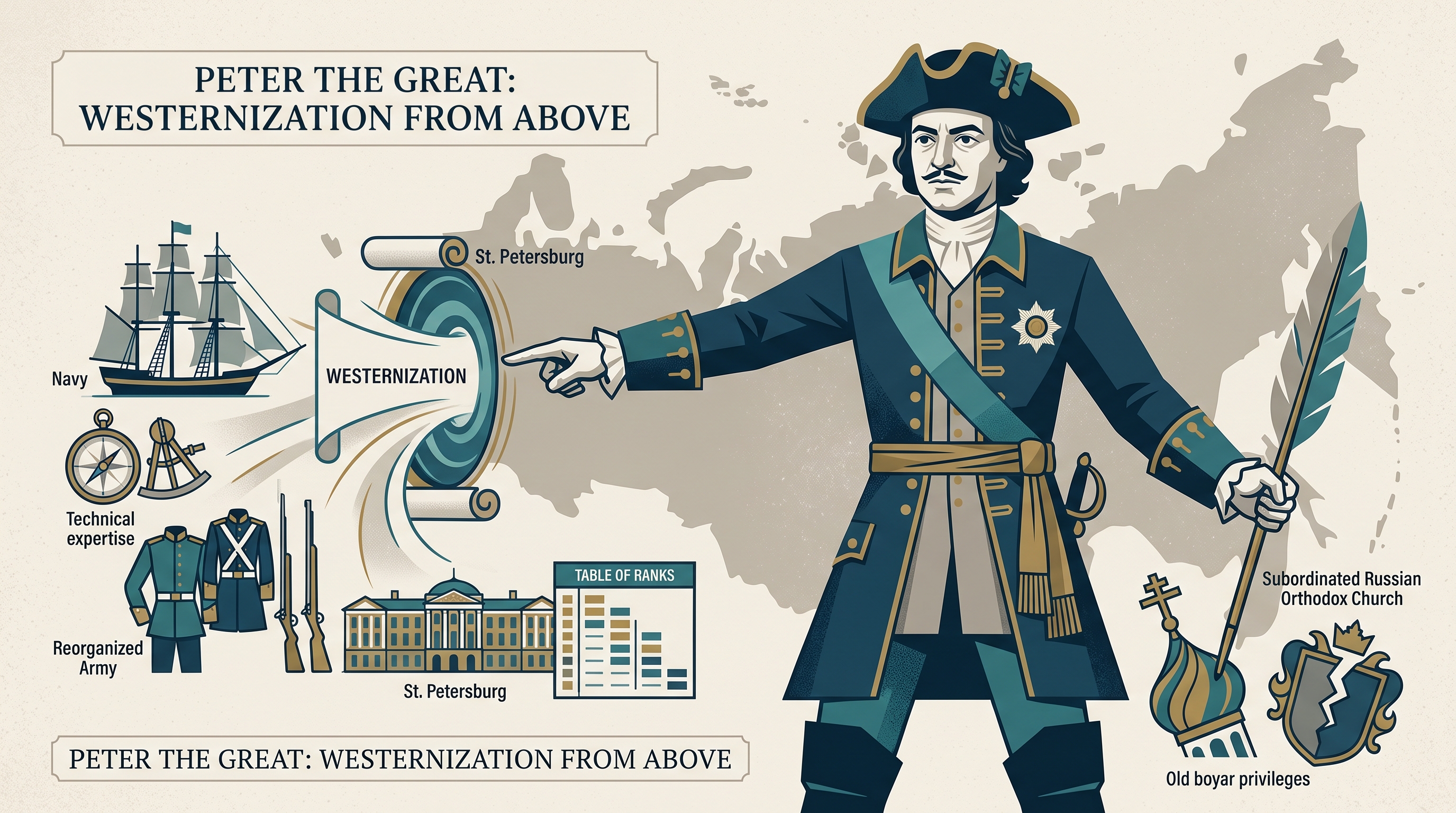
Peter the Great of Russia used absolutist authority to transform the state’s institutions. Westernization means adopting selected political, military, cultural, and technological practices associated with western Europe. Peter reorganized the army and navy, expanded state administration, encouraged technical expertise, imposed court reforms such as western dress, and founded St. Petersburg as a “window” toward Europe.
Peter also subordinated the Russian Orthodox Church to state authority and reorganized elites through service. The Table of Ranks made advancement increasingly dependent on state employment rather than ancestry alone. His reforms therefore strengthened the military-bureaucratic state, but they did not create social equality: peasants remained heavily burdened, and elite privilege persisted.
Louis XIV: power—and its limits
Louis XIV is a major example of absolutist rule because he and his finance minister, Jean-Baptiste Colbert, extended royal administrative, financial, military, and religious control over France (KC-2.1.I.B). Versailles helped discipline nobles by drawing them into a competitive court culture, while intendants carried royal authority into the provinces.
Yet Louis XIV’s absolutism was never unlimited. The crown still depended on tax collectors, local officials, creditors, military officers, and cooperation from privileged groups. Nobles retained social and legal advantages; regional institutions and customary rights complicated uniform control; and repeated warfare placed enormous pressure on royal finances. Revoking the Edict of Nantes in 1685 also strengthened religious conformity but encouraged Protestant flight and removed skilled subjects from the kingdom.
Misconception check: “Absolutism means the king could do anything.”
Correction: Absolutism means the ruler claimed broad authority. Actual power depended on money, information, officials, military capacity, geography, and the willingness of subjects to comply.
Grotius and Machiavelli: competing ideas about power
Niccolò Machiavelli analyzed political power in practical, secular terms. In The Prince, effective rulers appear willing to use force, deception, or carefully managed reputation when necessary to preserve the state. Machiavelli did not simply praise cruelty; he emphasized political survival and the difference between moral ideals and the behavior required in unstable political circumstances.
Hugo Grotius contributed to debates about sovereignty, natural law, and relations among states. His work helped develop the idea that political authority and international conduct could be discussed through rational legal principles rather than only through religious claims. Together, Machiavelli and Grotius illustrate the period’s movement toward secular analysis of state power.
Worked comparison: France and England
Claim: France and England both strengthened the state after the seventeenth-century crises, but they organized sovereignty differently.
Evidence and reasoning: Louis XIV concentrated authority through royal officials, the army, court culture, and control over religion, although privilege and finance limited his reach. England’s Glorious Revolution established a stronger constitutional pattern: Parliament gained greater influence over taxation and lawmaking, and the monarch governed within a framework of legal and institutional constraints. Both states developed more powerful administrations, but France emphasized royal sovereignty while England institutionalized negotiated sovereignty.
This comparison earns stronger historical reasoning when it explains both similarity and difference. A weak answer says, “France was absolute and England was constitutional.” A stronger answer identifies the shared process—state centralization—and then explains how different institutions distributed power.
Skill focus: Making Connections (Skill 5.A) and Argumentation (Skill 6)
Making Connections (Skill 5.A) requires identifying patterns among historical developments and processes. Connect Peter’s westernization and Louis XIV’s centralization through their shared goal of strengthening state capacity, then distinguish their methods: Peter forcibly reorganized institutions and elite service, while Louis relied more heavily on court culture, intendants, and fiscal administration.
Argumentation (Skill 6) requires supporting a claim with specific, relevant evidence. An effective argument about absolutism should name evidence—such as the Table of Ranks, Versailles, Colbert’s financial administration, Parliament after 1688, or the survival of noble privilege—and explain how each example supports, modifies, or complicates the claim.
Retrieval check: Why did absolutist monarchies reduce noble political independence without eliminating noble privilege? Give one example from Louis XIV’s France or Peter the Great’s Russia, and explain one limit on the ruler’s power.
Source Materials
- AP European History Course and Exam Description
- AP European History Course and Exam Description Clarifications and Corrections
- AP European History Course Overview
- AP European History Course at a Glance
- AP European History Course at a Glance Poster
- AP European History
- AP European History
- AP European History Sample Syllabus 1