From the free course AP European History on Lykke
7.5 The Age of Progress and modernity · 7.6 New Imperialism
Key concepts: Age of Progress and modernity · Positivism and the philosophy of progress · Scientific inquiry and empirical evidence · Unintended consequences of scientific and technological change · New Imperialism · Comparison of early imperialism and New Imperialism · European overseas expansion and imperialism · Historical argument and source comparison · Social reform and women’s rights · Chronology and periodization in European history
By the late nineteenth century, many Europeans believed that science, industry, education, and empire were carrying society toward a better future. Yet the same confidence that produced railways, laboratories, and mass production also justified conquest and intensified inequality.
7.5 The Age of Progress and modernity · 7.6 New Imperialism
By the late nineteenth century, many Europeans believed that science, industry, education, and empire were carrying society toward a better future. Yet the same confidence that produced railways, laboratories, and mass production also justified conquest and intensified inequality. The central question is therefore not simply Was Europe progressing? but Who defined progress, who benefited from it, and what did it cost?
7.5 The Age of Progress and modernity
The Age of Progress describes the nineteenth-century belief that human societies could improve through scientific knowledge, technological innovation, education, rational government, and economic development. Modernity, the condition of living in a rapidly changing industrial and urban society, was visible in railroads, telegraphs, factories, public health measures, expanding schools, and increasingly powerful states.
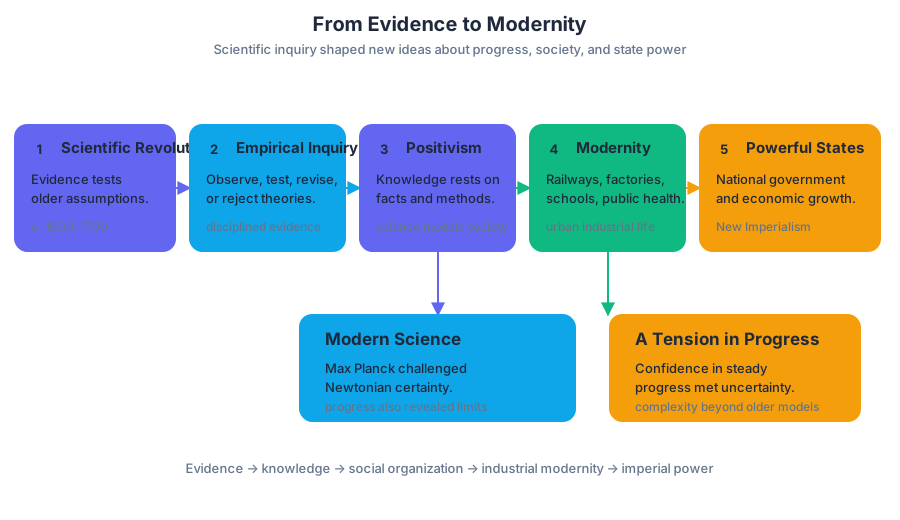
A major intellectual expression of this confidence was Positivism, a philosophy associated with the Age of Progress. Positivists argued that reliable knowledge should rest on observable facts and systematic investigation rather than inherited authority or speculation. In this sense, science became more than a method for studying nature: it became a model for organizing society.
Positivism: the belief that knowledge should be based primarily on empirical observation, evidence, and scientific methods.
This idea developed from the Scientific Revolution’s emphasis on evidence. Between approximately 1600 and 1700, scientific inquiry became more regimented: theories were tested against observable evidence, revised when necessary, and rejected when they failed to explain what investigators could see or measure. Michael Strevens’s description of empirical inquiry as a process that could “raise up” or “tear down” theories captures the essential historical development: scientific progress was not always linear, but it increasingly depended on disciplined evidence.
Modern science continued to challenge older assumptions. Max Planck, associated with the development of modern physics, helped demonstrate that scientific change did not end with Newtonian mechanics. This creates an important distinction: nineteenth-century faith in progress often assumed that science would steadily produce certainty, while modern science also revealed complexity, uncertainty, and limits to earlier models.
Progress and its unintended consequences
Scientific and technological change produced genuine benefits, including improved transportation, communication, medicine, and agricultural productivity. European expansion after 1492 had already connected overseas colonies to European markets and supplied commodities such as tobacco, sugar, and potatoes. By the nineteenth century, industrial technology increased Europe’s capacity to extract resources, transport armies, and control distant territories.
But progress could encounter entrenched interests, prejudices, and long-standing habits. Industrial growth generated crowded cities, dangerous labor, environmental damage, and unequal wealth. Scientific language could also be misused to defend racial hierarchy, imperial domination, or exclusion from political rights. The nineteenth-century recognition of women’s rights as a reform principle accepted by “civilized nations” illustrates both sides of modernity: reformers challenged older inequalities, but the language of civilization could simultaneously rank peoples and justify European rule.
Misconception check: “Progress” did not automatically mean equality. A society could expand education, industry, and political reform while preserving class, gender, and racial hierarchies.
7.6 New Imperialism
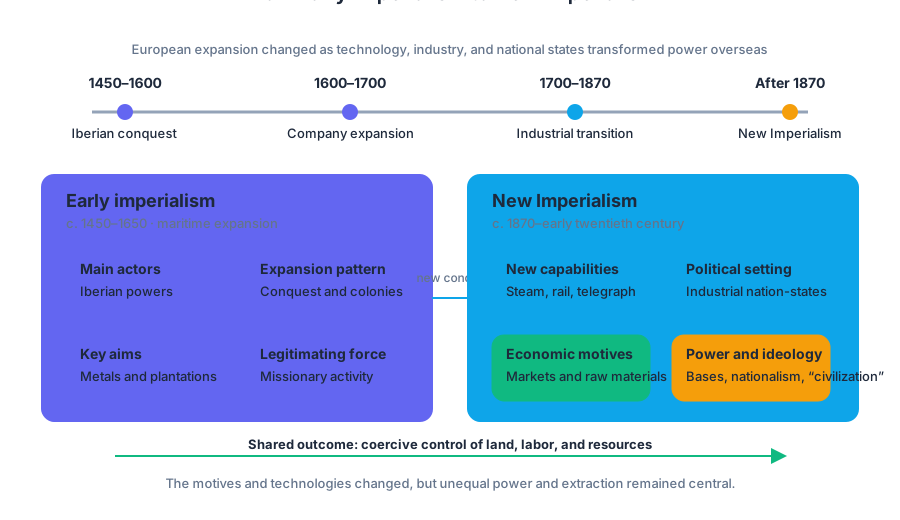
New Imperialism refers to the intensified European competition for overseas territories beginning approximately in 1870 and continuing into the early twentieth century. It must be distinguished from early imperialism, approximately 1450–1650, even though both involved European expansion, unequal power, and economic extraction.
The comparison becomes clearer when European overseas imperialism is divided into three chronological periods:
| Period | Main pattern of expansion | Distinctive emphasis |
|---|---|---|
| Approximately 1450–1600 | Iberian exploration and conquest | Colonies, missionary activity, precious metals, and plantation commodities |
| Approximately 1600–1700 | Expansion by the Dutch, English, and French alongside Iberian empires | Trading companies, Atlantic commerce, plantations, and rivalry |
| Approximately 1700–1900 | Industrial-era imperial expansion, especially after 1870 | Strategic competition, industrial markets, raw materials, nationalism, and claims of civilization |
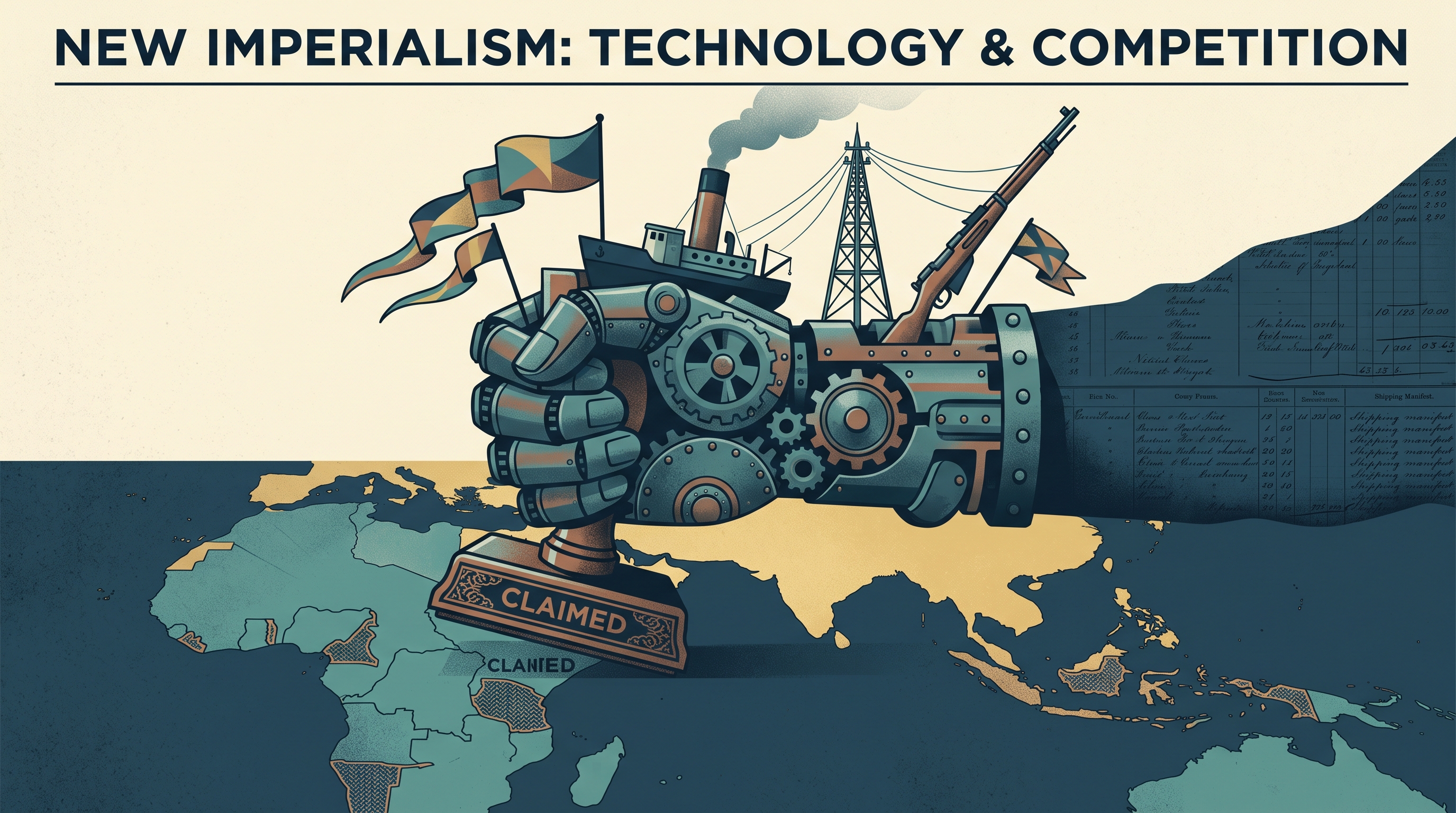
Early imperialism was closely connected to maritime exploration, conquest, missionary activity, and the commercial systems created after 1492. New Imperialism operated in a different technological and political environment. Steamships, railways, improved weapons, telegraphs, industrial production, and centralized national states enabled European governments to occupy and administer much larger territories more rapidly.
New Imperialism therefore combined economic, political, and ideological motives. Industrial states sought raw materials and markets; governments pursued naval bases and strategic routes; nationalist leaders treated colonies as evidence of national greatness; and imperial advocates claimed that European rule brought civilization, Christianity, education, or scientific advancement. These claims often concealed coercion and the transfer of land, labor, and resources to European control.
Comparing historical arguments
Eric Hobsbawm’s argument in The Age of Empire emphasizes the relationship between imperialism and the economic and political pressures of industrial capitalism, nationalism, and great-power rivalry. David Landes’s argument in Effects of Imperialism places greater weight on the unequal economic consequences of imperial relationships and on the ways imperial rule shaped development. The arguments overlap, but they ask different causal questions: Hobsbawm highlights why imperialism expanded; Landes stresses what imperialism did to economies and societies.
An effective historical comparison does not merely declare one historian correct. It uses evidence to support, modify, or refute an argument. Industrial demand for commodities and strategic competition may support Hobsbawm, while evidence of imposed trade structures or uneven development may support Landes. A strong argument can also modify both: imperialism had multiple causes, and its consequences varied by region and period.
Worked comparison
Suppose the claim is: New Imperialism differed from early imperialism because industrial technology and nationalist state competition made territorial control more systematic after 1870. Evidence such as steam transportation, modern weapons, telegraph lines, and competing national claims supports the claim. To add complexity, recognize continuity: both periods used military force, economic extraction, and cultural justification.
AP historical-thinking focus: Skill 1: Developments and Processes identifies how imperialism changed across 1450–1900. Skill 5: Making Connections links industrialization, nationalism, technology, and overseas expansion. Skill 6: Argumentation requires a defensible comparison supported by specific evidence. Skill 3: Claims and Evidence in Sources is essential when comparing Hobsbawm and Landes: identify each historian’s claim, select relevant evidence, and explain how that evidence supports or qualifies the interpretation. This topic also develops Skill 4: Contextualization by placing New Imperialism within industrialization and modern state-building.
Retrieval check: Name one important continuity and one important difference between early imperialism and New Imperialism. Then state whether evidence about industrial markets better supports Hobsbawm, Landes, or a modified version of both—and explain why in one sentence.
Source Materials
- AP European History Course and Exam Description
- AP European History Course and Exam Description Clarifications and Corrections
- AP European History Course Overview
- AP European History Course at a Glance
- AP European History Course at a Glance Poster
- AP European History
- AP European History
- AP European History Sample Syllabus 1
- [a] Describe an argument made in the excerpt.