From the free course AP European History on Lykke
4.3 The Enlightenment · 4.4 18th-Century Society and Demographics
Key concepts: Enlightenment thought · Rousseau · Traditional authority and differing worldviews · Salons and the dissemination of Enlightenment culture · John Locke’s political theory · Self-interest and the origins of the state · 18th-century demographic change · Plague and smallpox inoculation · 18th-century art and literature · Women’s status and citizenship in the republic
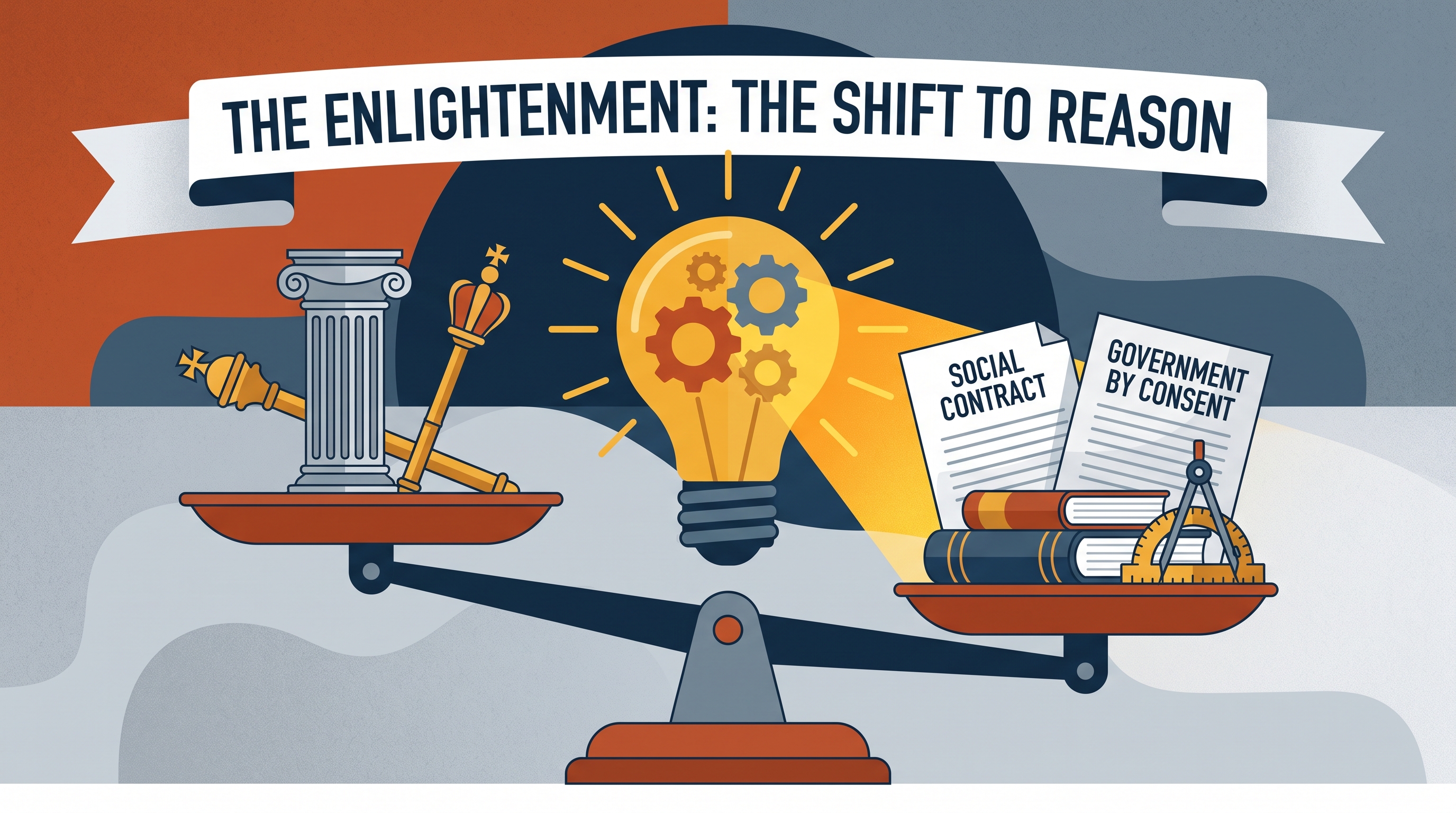
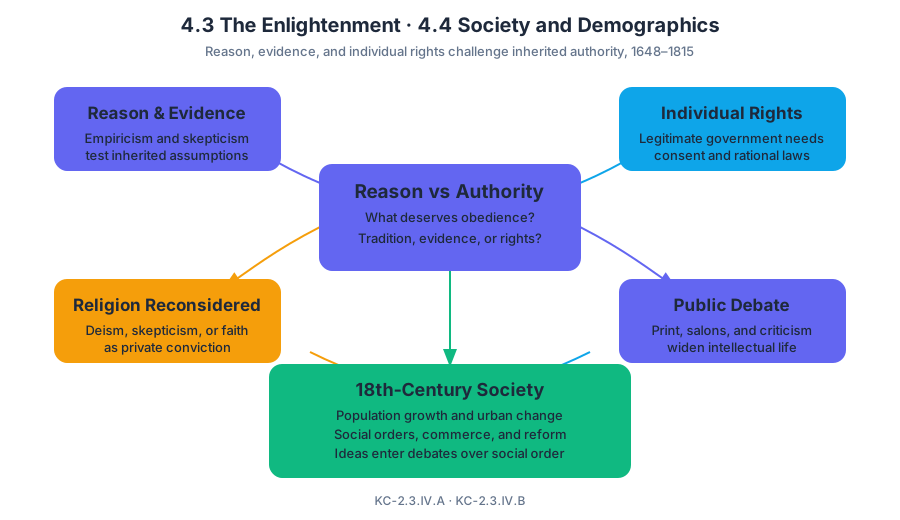
The Enlightenment asked a disruptive question: what should happen when reason, evidence, and individual rights conflict with authority inherited from tradition? Its answer reshaped political theory, intellectual life, economic thought, and social debate across Europe from 1648 to 1815.
4.3 The Enlightenment · 4.4 18th-Century Society and Demographics
The Enlightenment asked a disruptive question: what should happen when reason, evidence, and individual rights conflict with authority inherited from tradition? Its answer reshaped political theory, intellectual life, economic thought, and social debate across Europe from 1648 to 1815.
Enlightenment thought emphasized empiricism, skepticism, human reason, rationalism, and classical sources of knowledge. It challenged established assumptions about social order, government, institutions, and the public role of faith.
The central conflict was not simply “science versus religion.” Enlightenment thinkers questioned whether monarchs, churches, aristocracies, and customs should command obedience merely because they were old or sacred. Some intellectuals defended religious belief in new forms, such as deism, while others moved toward skepticism or atheism. Religion increasingly became a matter of private conviction rather than a uniform public authority, as expressed in KC-2.3.IV.A and KC-2.3.IV.B.
Authority, worldviews, and the public sphere
Different worldviews produced different answers to the same political question: Who has the right to rule? A traditional answer pointed to divine right, inherited rank, or established church teaching. An Enlightenment answer examined government as a human institution that could be judged by reason, natural rights, and its effects on society.
This shift affected nearly every dimension of European life. Politically, it challenged arbitrary authority; intellectually, it encouraged criticism and debate; economically, it weakened unquestioned mercantilist assumptions; socially, it raised arguments about equality and citizenship. Unit 4: Learning Objective C asks students to explain the causes and consequences of Enlightenment thought on European society, while KC-2.3.I identifies its challenge to prevailing patterns of thought.
Locke: self-interest and the origins of the state
John Locke’s political theory began with individuals rather than inherited communities. People possess interests and natural rights, including security and property, but isolated individuals cannot reliably protect themselves. In a hypothetical state of nature, each person may pursue safety and advantage, yet disputes over rights can produce conflict, insecurity, and retaliation.
The causal chain is therefore:
$$ \text{individual interests} \rightarrow \text{insecurity and conflict} \rightarrow \text{agreement to form government} \rightarrow \text{protection of rights} $$
Individuals create political society through consent: a social contract, or agreement establishing government for the common protection of rights. Government is legitimate because it serves the governed, not because tradition or divine right automatically makes rulers legitimate. If government violates its purpose, Locke’s reasoning implies that people may resist or replace it. This argument appears in KC-2.3.III.A and KC-2.3.I.B.
Misconception check: Locke did not argue that self-interest makes government unnecessary. He argued that competing interests make common rules and rights-protecting government necessary.
Adam Smith extended related criticism into economic thought. KC-2.3.III.B identifies how mercantilist theory and practice were challenged by ideas of free trade and a free market. The broader pattern is consistent: institutions should be evaluated by how they coordinate human activity, not accepted solely because rulers or tradition endorse them.
Rousseau and the limits of reason
Jean-Jacques Rousseau shared the Enlightenment interest in political legitimacy but questioned whether rational calculation alone could explain human freedom and community. He emphasized the general will—the collective political interest of the community—and argued that legitimate political life required civic participation rather than passive obedience.
Rousseau also exposed a contradiction within Enlightenment universalism. Enlightenment language proclaimed equality and natural rights, yet Rousseau offered controversial arguments supporting the exclusion of women from political life. KC-2.3.I.C therefore matters: equality could be presented as universal while citizenship remained restricted by gender. The French Revolution would make this contradiction especially visible as republican citizenship was soon limited to men.
Salons: where ideas became social power
A salon was a gathering, often organized in an urban private home and frequently hosted by an educated woman, where writers, philosophers, and patrons discussed ideas. Salons did more than entertain: they connected authors to readers, circulated criticism, and translated abstract arguments about government, religion, and society into conversation.
This institutional role is captured by KC-2.3.II.A: salons explored and disseminated Enlightenment culture. They demonstrate that intellectual change depended not only on famous books but also on networks that allowed knowledge to travel.
18th-century society and demographics
European society changed demographically, though growth remained constrained. Plague disappeared as a major epidemic disease, and inoculation reduced the incidence of smallpox. These developments lowered some mortality pressures, but the European marriage pattern limited population growth: many people married relatively late, and a significant number never married, reducing the years available for childbearing.
Women’s status remained contested. Women could host salons and participate in intellectual exchange, yet political citizenship in the emerging republic was increasingly defined as male. The result was a sharp distinction between participating in public debate and possessing formal political rights.
Skills in action
This topic most directly develops Skill 1.A: Identify and explain the historical developments and processes through the chain from traditional authority to social-contract theory; Skill 4.A: Identify and describe a historical context by connecting Enlightenment arguments to earlier religious and political authority; Skill 6.A: Identify and explain the causes and effects of historical developments through Locke’s state-of-nature argument; and Skill 8.A: Make a historically defensible claim about whether Enlightenment ideas expanded equality or preserved exclusion.
Retrieval check: Why, in Locke’s argument, does the pursuit of self-interest lead individuals toward government rather than away from it? Name one way eighteenth-century demographic change improved survival and one reason population growth nevertheless remained limited.
Source Materials
- AP European History Course and Exam Description
- AP European History Course and Exam Description Clarifications and Corrections
- AP European History Course Overview
- AP European History Course at a Glance
- AP European History Course at a Glance Poster
- AP European History
- AP European History
- AP European History Sample Syllabus 1