From the free course AP European History on Lykke
5.1 Contextualizing 18th-century states · 5.2 The rise of global markets
Key concepts: Absolutism · Constitutionalism · Challenges to absolutism · Enlightened monarchs · Global economic networks · Colonial resource extraction · Transatlantic slave-labor system · Commercial rivalries · Diplomacy · European conflict from 1648 to 1815
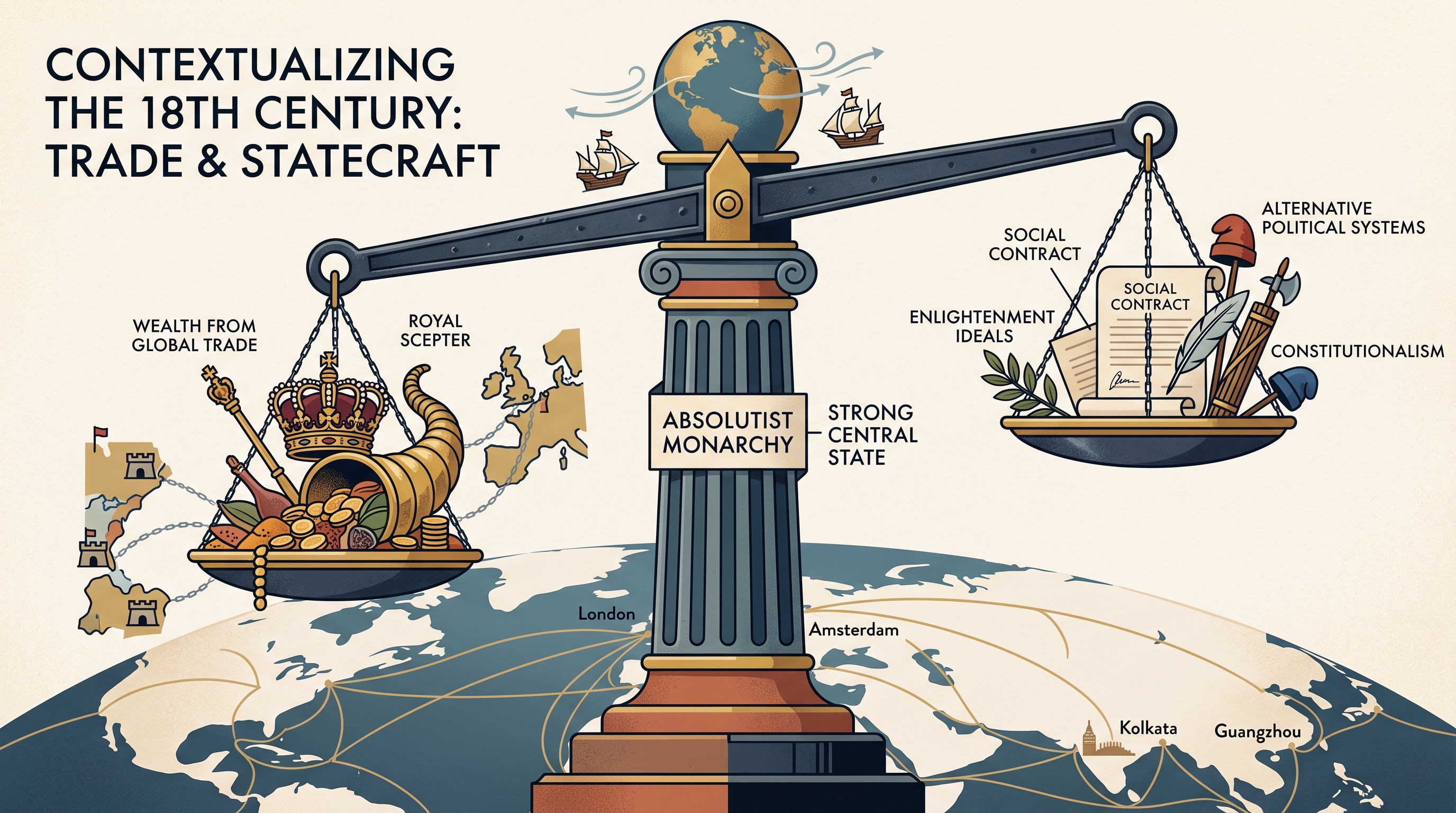
Between 1648 and 1815, European rulers faced a double challenge: how to concentrate political power at home while competing for wealth and influence in an expanding world economy.
5.1 Contextualizing 18th-century states · 5.2 The rise of global markets
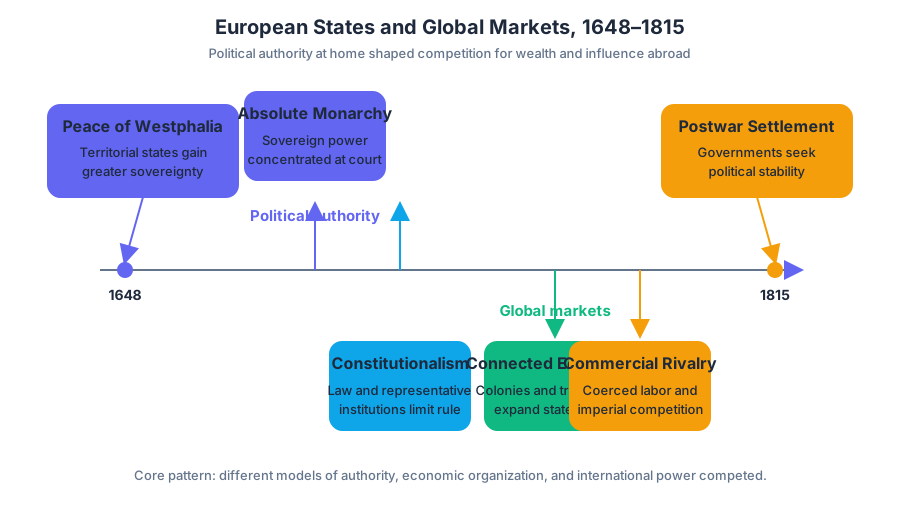
Between 1648 and 1815, European rulers faced a double challenge: how to concentrate political power at home while competing for wealth and influence in an expanding world economy. Absolute monarchy strengthened the authority of the sovereign; constitutionalism limited government through representative institutions and law. At the same time, colonies, coerced labor, trade routes, and commercial rivalry tied European state power to global markets.
Learning Objective: Unit 5: Learning Objective A — Explain the context in which the European states experienced crisis and conflict from 1648 to 1815.
The period begins with the end of the Thirty Years’ War in 1648, when the Peace of Westphalia helped reinforce the importance of territorial states and state sovereignty. It ends around 1815, after the Napoleonic Wars, when European governments attempted to restore political stability. The central pattern is not simply “strong kings versus weak kings,” but a competition among different models of political authority, economic organization, and international power.
Political sovereignty: who gets to rule?
Political sovereignty means the recognized right to exercise supreme authority. Under KC-2.1, different models of sovereignty shaped both relationships among European states and relationships between rulers and their subjects.
In much of Europe, absolute monarchy was established during the seventeenth and eighteenth centuries. An absolute monarch claimed broad authority over lawmaking, taxation, administration, religion, and military affairs. This did not mean that the ruler could literally control every decision; monarchs still depended on nobles, officials, churches, courts, and local communities. It means that political authority was increasingly organized around the crown rather than shared equally among representative bodies.
One important development was the rise of enlightened monarchs. These rulers adopted selected Enlightenment ideas—such as administrative rationalization, religious toleration, and legal reform—while preserving monarchical authority. In parts of the Holy Roman Empire, governments extended religious toleration, showing how rulers could modernize administration without accepting popular sovereignty.
Constitutionalism offered an alternative political system. It holds that government power should be defined and limited by laws, institutions, or a constitution. Challenges to absolutism therefore produced political arrangements in which monarchs shared authority with representative bodies or operated under legal restraints. The key contrast is not “democracy versus monarchy” in the modern sense: constitutional systems could still restrict political participation to property-owning or privileged groups.
Worked contextual example: explaining political change
Suppose a historian asks why constitutionalism became an important alternative between 1648 and 1815. A strong reasoning chain would be:
- Context: The wars of the seventeenth century increased the need for taxation, armies, and centralized administration.
- Development: Monarchs expanded royal authority to meet these demands, encouraging absolutist government.
- Challenge: Subjects and representative institutions resisted unlimited taxation or arbitrary rule.
- Alternative: Constitutionalism emerged as a way to organize state power through law and representation.
- Significance: European states developed different political models rather than following one universal path.
This applies Skill 4.B: Explain how a specific historical development or process is situated within a broader historical context. It also practices the Continuity and Change reasoning process required for Topic 5.1 Contextualizing 18th-Century States.
Misconception check: Absolutism did not mean that every European monarch ruled without limits, and constitutionalism did not automatically mean universal democracy. Both terms describe systems of political authority with internal qualifications.
Global markets and colonial extraction
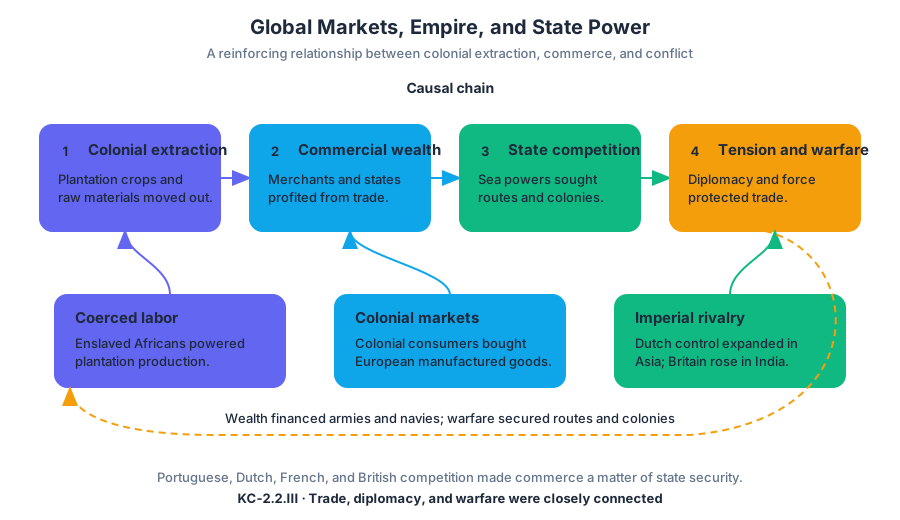
Under KC-2.2, the expansion of European commerce accelerated the growth of a worldwide economic network. European states drew resources from colonies in the New World and elsewhere, connected distant markets through maritime trade, and used imperial power to secure profitable exchanges.
Colonial resource extraction means taking valuable goods, labor, or revenue from colonized territories for the benefit of imperial powers. European economies received agricultural products and raw materials from overseas colonies, while colonial consumers became markets for European goods. The transatlantic slave-labor system expanded during the seventeenth and eighteenth centuries, making coerced African labor central to the production of plantation commodities and the wealth of merchants, states, and commercial elites.
This network was not merely economic. Trade influenced diplomacy and warfare. Portuguese, Dutch, French, and British competition for Atlantic influence, Asian commerce, and colonial resources made commercial rivalry a matter of state security. Under KC-2.2.III, European sea powers competed for overseas influence, while rivalries in Asia contributed to the expansion of Dutch control in the East Indies and British dominance in India by the end of the period.
The connection can be expressed as a causal chain:
$$ \text{colonial extraction} \rightarrow \text{commercial wealth} \rightarrow \text{state competition} \rightarrow \text{diplomatic tension and warfare} $$
However, the relationship ran in both directions: warfare protected trade routes and colonies, while commercial wealth financed armies and navies. This is why warfare and diplomacy were closely connected to expanding trade and commercial competition.
Worked contextual example: from market expansion to conflict
Imagine two European states competing for access to the same overseas market. Each wants raw materials, profitable trading rights, and strategic ports. Their governments may impose trade restrictions, protect chartered companies, send naval forces, or pressure rival states diplomatically. A dispute that begins with merchants can therefore become a conflict between states.
This explanation applies Skill 1.B: Explain a historical concept, development, or process and the Causation reasoning process assigned to Topic 5.2 The Rise of Global Markets. It also connects the theme ECD: Economic and Commercial Developments with SOP: States and Other Institutions of Power and INT: Interaction of Europe and the World.
Misconception check: “Global markets” did not mean equal or voluntary participation. European dominance depended heavily on imperial coercion, unequal trade, colonial extraction, and the expansion of the transatlantic slave-labor system.
Retrieval check
Explain in two sentences why the period from 1648 to 1815 produced both stronger monarchies and alternative political systems. Then complete the chain: expanding European commerce intensified competition because __________, which influenced diplomacy and warfare by __________.
Source Materials
- AP European History Course and Exam Description
- AP European History Course and Exam Description Clarifications and Corrections
- AP European History Course Overview
- AP European History Course at a Glance
- AP European History Course at a Glance Poster
- AP European History
- AP European History
- AP European History Sample Syllabus 1
- § Classroom Resource >
- 5 12,185 14.0
- AP European History-AP Students-College Board
- AP European History-Doves Library