From the free course AP European History on Lykke
7.7 Global effects of imperialism · 7.8 19th-century culture and arts
Key concepts: New imperialism: causes and effects · Technological enablers of imperialism · Advanced weaponry and industrialization · Communication and transportation technologies · Medical advances and quinine · Imperial resistance and encounters · Fashoda Crisis · Sepoy Mutiny · Imperialism’s effects on European diplomacy and alliance systems · Industrialization, consumerism, and global imperialism
Imperialism transformed more than maps: it changed military power, public health, diplomacy, resistance movements, and the way Europeans imagined the wider world. The same industrial systems that produced railways, telegraphs, and mass-produced weapons also helped European states impose control overseas—and…
7.7 Global effects of imperialism · 7.8 19th-century culture and arts
Imperialism transformed more than maps: it changed military power, public health, diplomacy, resistance movements, and the way Europeans imagined the wider world. The same industrial systems that produced railways, telegraphs, and mass-produced weapons also helped European states impose control overseas—and generated opposition both abroad and within Europe.
KC-3.5.III: Imperial endeavors significantly affected society, diplomacy, and culture in Europe and created resistance to foreign control abroad.
7.7 Imperialism’s global effects
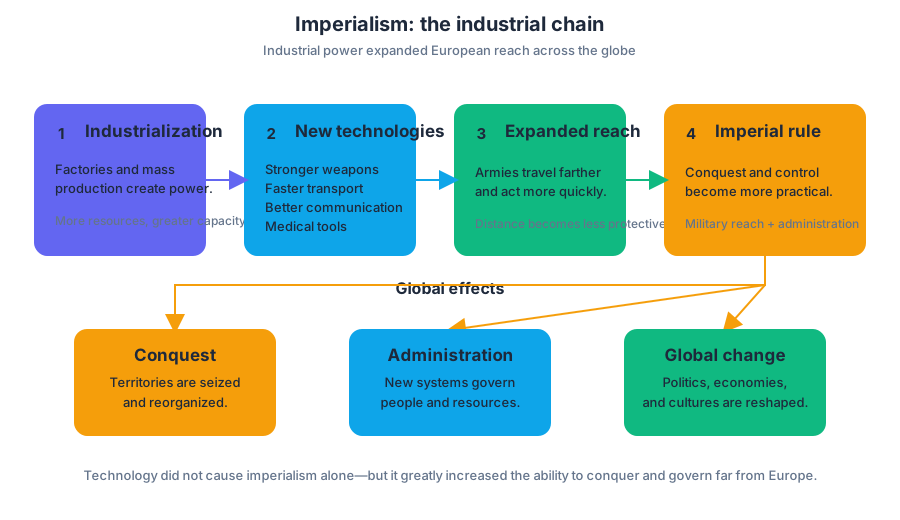
The central mechanism was a chain:
Industrialization produced stronger weapons, faster transport, improved communication, and medical tools. These technologies increased European military reach and administrative capacity, making it possible to conquer and govern territories far from Europe.
Technology as an enabler of conquest
European armies equipped with advanced, industrially produced weapons possessed a major advantage over many opponents. Mass-produced firearms and increasingly powerful artillery allowed smaller European forces to defeat or intimidate larger local armies, while industrial economies supplied ammunition, equipment, and replacement troops.
Transportation and communication converted imperial rule from a distant claim into an operating system. Railroads moved soldiers, officials, raw materials, and manufactured goods across conquered territories; steamships shortened ocean travel; and telegraph networks allowed governments to send instructions and receive reports much more rapidly than earlier imperial administrations.
Medical knowledge solved another barrier: European mortality in tropical regions. Quinine, a treatment derived from the cinchona tree, helped prevent and treat malaria. Because malaria had made long-term European military and administrative activity extremely dangerous, quinine became an essential technological factor in late-19th-century expansion into tropical regions.
Misconception check: Technology did not make conquest automatic. Weapons and quinine created possibilities, but European states still needed organization, financing, diplomacy, local allies, and sustained military campaigns. Non-European societies resisted, adapted, and sometimes defeated imperial forces.
Imperial control and local resistance
The Sepoy Mutiny of 1857 demonstrates that imperial control provoked organized resistance. Indian soldiers serving the British East India Company rebelled, and the uprising expanded into a broader challenge to foreign authority. Britain suppressed the revolt, but its consequences were significant: the British government took direct control of India, replacing Company rule.
Imperial encounters also encouraged new forms of resistance. As non-European peoples encountered Western education, political ideas, and economic institutions, some used those tools against imperialism. Nationalist movements could therefore combine European-derived political language with local histories, religions, and demands for sovereignty.
Diplomacy, society, and culture
Imperial competition strained European diplomacy. In the Fashoda Crisis of 1898, Britain and France confronted one another over competing claims in Sudan. Although the crisis ended without war, it revealed how overseas expansion could create dangerous tensions between European powers and place pressure on existing alliance systems.
KC-3.5.III.A: Imperialism created diplomatic tensions among European states that strained alliance systems.
Imperialism also reshaped European society. Rapid urbanization concentrated people in crowded cities, where pollution and infectious disease became urgent problems. Medical knowledge encouraged governments to build public-health infrastructure, especially sewers and improved sanitation systems. Imperial rule, meanwhile, tied European factories and consumers to overseas raw materials, markets, and labor systems.
The Belgian Congo illustrates the contradiction between economic development and imperial justification. European accounts often portrayed colonized regions as places requiring European “civilization,” while imperial systems extracted valuable resources and imposed coercive labor. Such representations turned economic exploitation into a moral and cultural argument for empire.
7.8 19th-century culture and arts
Imperial encounters influenced European artists and writers by supplying new subjects, settings, objects, and visual styles. Travel accounts, exhibitions, colonial displays, and reports from overseas made non-European peoples and landscapes part of European cultural production—often through unequal and stereotyped perspectives.
Nineteenth-century artistic expression combined continuity and change. Artists continued to address recognizable human experiences, political power, nature, conflict, and social life, but they increasingly changed how those subjects were represented. Greater attention to contemporary life, urban experience, empire, and unfamiliar places challenged older assumptions about what deserved artistic treatment.
This development can be analyzed through Skill 2: Sourcing and Situation. When examining an imperial-era painting, travel narrative, or literary work, ask who created it, for which audience, and within what imperial context. A European artist depicting the Belgian Congo, for example, may reveal more than scenery: the work may reproduce colonial assumptions, defend imperial expansion, or expose anxiety about the morality of empire.
For Skill 5: Making Connections, connect cultural representation to political and economic systems. A painting or novel about an overseas society may reflect imperial contact; a public-health project may reflect urbanization and medical knowledge; and a colonial exhibition may connect industrial production, consumer culture, national prestige, and racial hierarchy.
Worked interpretation
Suppose a source describes a European railway built in a colony and praises it as evidence of “progress.” First, identify the material change: rail transport increased movement and administrative control. Next, examine its purpose: if the line connected mines or plantations to a port, it likely served extraction as well as transportation. Finally, evaluate the perspective: the language of progress may justify imperial rule while concealing coercion and unequal economic benefits.
Retrieval check
Explain the connection among industrialization, imperial control, and resistance in one chain of reasoning. Then identify one way imperialism affected European diplomacy and one way it affected 19th-century art. A strong response should include a technology such as railroads, mass-produced weapons, telegraphs, or quinine; an example such as the Sepoy Mutiny or Fashoda Crisis; and a clear explanation of cause and effect.

Source Materials
- AP European History Course and Exam Description
- AP European History Course and Exam Description Clarifications and Corrections
- AP European History Course Overview
- AP European History Course at a Glance
- AP European History Course at a Glance Poster
- AP European History
- AP European History
- AP European History Sample Syllabus 1