From the free course AP European History on Lykke
3.1 Contextualizing State Building · 3.2 The English Civil War and the Glorious Revolution
Key concepts: State building and political centralization · Monarchical control · Absolutism and constitutionalism · Sovereignty within and among states · Competition for political power · Religious conflicts and state exploitation · The English Civil War · The roles of monarchy, Parliament, and elites · Administrative expansion of state power · The Glorious Revolution
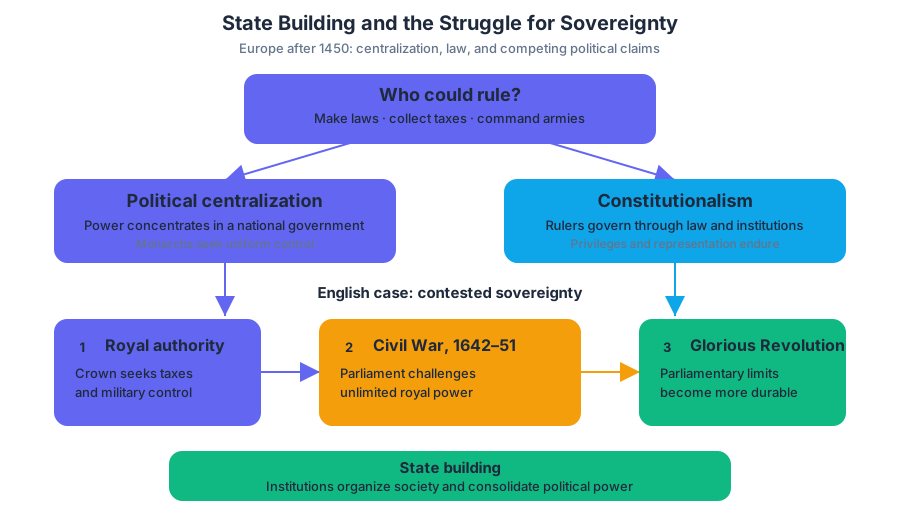
European state building after 1450 was a contest over one fundamental question: who had the right to make laws, collect taxes, command armies, and define the political order?
3.1 Contextualizing State Building · 3.2 The English Civil War and the Glorious Revolution
European state building after 1450 was a contest over one fundamental question: who had the right to make laws, collect taxes, command armies, and define the political order? Monarchs sought to centralize authority, while nobles, representative bodies, religious groups, and local elites defended older privileges.
State building is the development of governmental and civil institutions that organize society and consolidate political power.
The key distinction is between political centralization—power increasingly concentrated in a national government—and constitutionalism—the principle that rulers must govern through established laws and institutions. European states did not all move toward the same endpoint: the struggle for sovereignty within and among states produced varying degrees of centralization.
3.1 Contextualizing State Building
From 1450 onward, states and nations developed institutions to make authority more durable. Monarchs expanded bureaucracies, courts, taxation systems, and military structures; at the same time, representative bodies and privileged groups negotiated, resisted, or limited royal power.
| Political problem | State-building response | Result |
|---|---|---|
| Armies were controlled by competing nobles | Monarchs consolidated military authority | Stronger central governments |
| Local courts and privileges fragmented law | Royal courts and secular systems of law expanded | More uniform administration |
| Religious and political divisions threatened unity | States managed or exploited religious conflict | Greater control, but often deeper conflict |
| Elites resisted taxation or royal commands | Monarchs bargained with or confronted representative bodies | Different forms of absolutism or constitutionalism |
Monarchical control means the use of royal institutions to supervise justice, administration, taxation, and political opposition. The Star Chamber is an example: this royal court allowed the English monarchy to pursue influential opponents and enforce royal authority outside ordinary local power structures.
Ferdinand and Isabella demonstrated another route to centralization by consolidating Spain’s control of the military. Charles V likewise exemplified a monarch involved in state building. These rulers did not erase every regional privilege, but they strengthened the monarchy’s ability to coordinate territory, religion, administration, and warfare.
Catholic Spain also shows how a state could exploit religious conflicts. Religious unity could be presented as necessary for political order, allowing the monarchy to portray religious dissent as a threat to the state. This strategy could increase royal legitimacy while narrowing toleration and intensifying social conflict.
Misconception check — “state building always meant absolute monarchy.” It did not. State building describes the growth of political institutions; those institutions could support royal absolutism, parliamentary government, or a negotiated mixture. The important historical question is not simply whether a state became “strong,” but which groups gained authority and which institutions constrained them.
3.2 The English Civil War and the Glorious Revolution
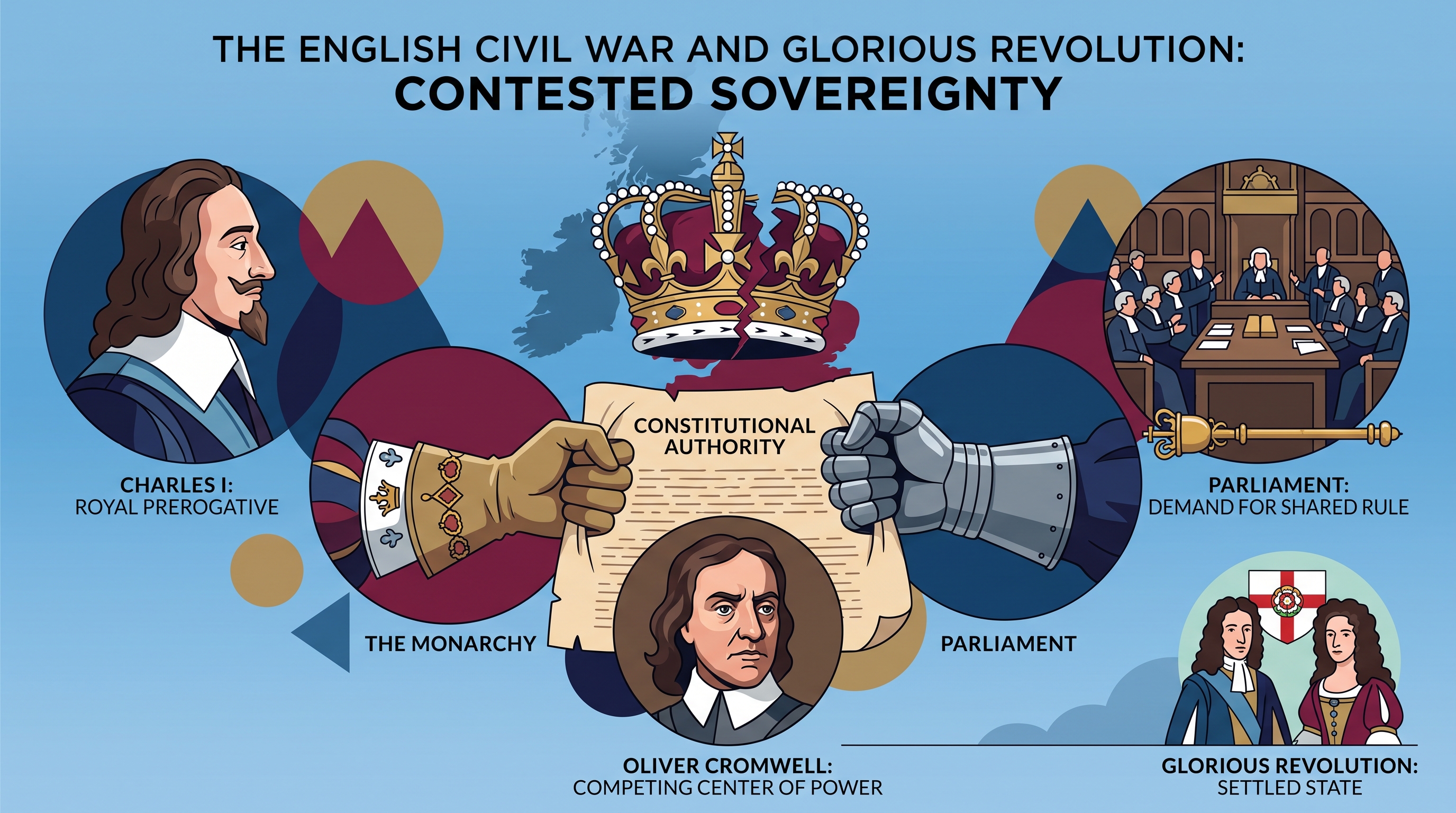
The English Civil War was a conflict among the monarchy, Parliament, and other elites over their respective roles in the political structure. It therefore illustrates competition for political power, not merely a religious quarrel or a simple rebellion against a bad king.
James I defended strong monarchical authority; Charles I continued the struggle over royal prerogative, taxation, and Parliament’s role; Oliver Cromwell emerged as a competing center of power during and after the conflict. Their rivalry shows that sovereignty was contested not only between states, but also within a state.
Worked causal chain
Royal claims to authority → conflict with Parliament and other elites over taxation and political roles → English Civil War → temporary challenge to monarchy under Cromwell → Glorious Revolution and stronger parliamentary assertions → protection of gentry and aristocratic rights from absolutism.
The intended consequence of the conflict was to redefine political authority by limiting unchecked monarchy. An unintended consequence was that removing or overpowering one monarch did not automatically create stable constitutional government: the struggle itself revealed how difficult it was to balance military power, royal authority, Parliament, and elite privilege.
The outcome of the English Civil War and the Glorious Revolution protected the rights of the gentry and aristocracy from absolutism through assertions of the rights of Parliament. Constitutionalism, in this context, did not mean universal democracy; it meant that political authority increasingly operated through recognized laws and representative institutions, especially Parliament.
Skill connection — 4.A, Contextualization: Identify and describe a historical context for a specific historical development or process. To contextualize the English Civil War, connect it to the broader post-1450 struggle to build centralized states. Monarchs were expanding administration and military capacity, while corporate groups and elites defended inherited rights and political influence.
Skill connection — 1.B, Developments and Processes: Explain a historical concept, development, or process. A strong explanation identifies the participants, the institutional dispute, and the consequence: James I and Charles I represented competing visions of monarchical power; Parliament and other elites resisted unchecked authority; the resulting conflict strengthened parliamentary claims and limited absolutist possibilities.
Misconception check — “Parliament defeated the monarchy permanently.” The English settlement did not abolish monarchy forever. Instead, the Civil War and Glorious Revolution altered the balance of power by protecting parliamentary rights and limiting absolutism. England therefore followed a constitutional path distinct from the more absolutist model associated with Louis XIV.
Louis XIV and his finance minister, Jean-Baptiste Colbert, extended the administrative power of the French state, demonstrating the contrasting absolutist approach. France strengthened centralized royal administration, while England’s political crisis produced a more constrained monarchy. Both cases involved state building; they differed in how sovereignty was distributed.
Retrieval check: In two sentences, explain why the English Civil War exemplifies both state building and competition for power. Then identify one difference between the English constitutional outcome and the French absolutist approach under Louis XIV and Colbert.

Source Materials
- AP European History Course and Exam Description
- AP European History Course and Exam Description Clarifications and Corrections
- AP European History Course Overview
- AP European History Course at a Glance
- AP European History Course at a Glance Poster
- AP European History
- AP European History
- AP European History Sample Syllabus 1
- Figure — Sample Responses - LEQ 3 - Set 2 (p. 8)
- AP European History-AP Students-College Board
- AP European History-Doves Library
- AP European History Cheat Sheets-Albert.io