From the free course AP European History on Lykke
AP Practice 2
Key concepts: Protestant and Catholic Reformations · Religious change from 1450 to 1648 · Continued social hierarchies · Landownership and aristocratic privileges · New financial practices · Insurance and banking institutions · Cesare Beccaria and criminal justice reform · Social contract theory and consent of the governed · Mercantilism · New consumer goods and public culture
Between $1450$ and $1648$, religious reform altered not only Christian theology but also political authority, social attitudes, and economic behavior. By the eighteenth century, debates about consent, property, criminal justice, and public culture extended these challenges into wider arguments about how European…
AP Practice 2
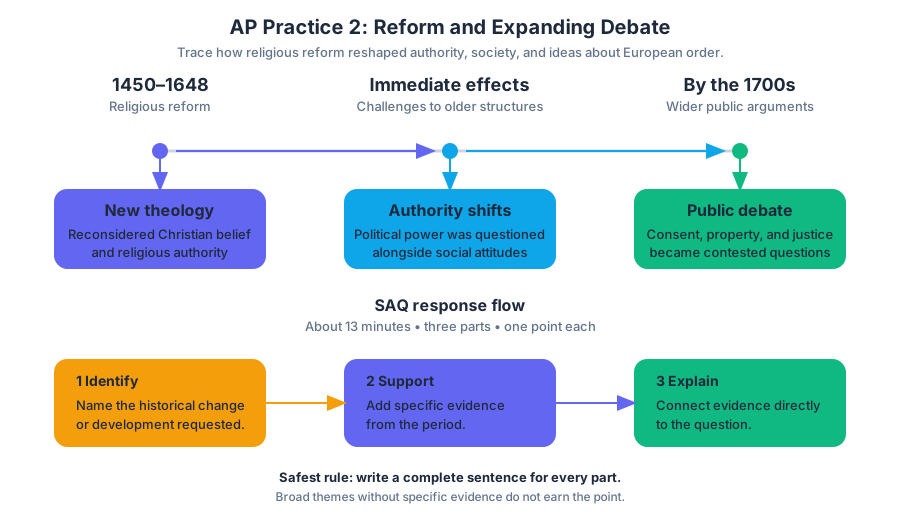
Between $1450$ and $1648$, religious reform altered not only Christian theology but also political authority, social attitudes, and economic behavior. By the eighteenth century, debates about consent, property, criminal justice, and public culture extended these challenges into wider arguments about how European society should be organized.
Task type: Short-Answer Question (SAQ)
Timing target: About $13$ minutes for one three-part question.
Scoring target: Each part earns $1$ point for a historically accurate, directly relevant response. A complete sentence is safest; a broad theme without specific evidence is not enough.
Original practice question
Read the historical situation below and answer parts (a), (b), and (c).
In several European societies, religious reformers challenged the authority of established churches. Later thinkers questioned divine-right monarchy and argued that government rested on the consent of the governed. At the same time, expanding commerce encouraged banking, insurance, investment, and the consumption of goods such as mirrors and printed images.
(a) Identify one way the Protestant and Catholic Reformations changed European society between $1450$ and $1648$.
(b) Explain one way Enlightenment political thought challenged an existing form of authority.
(c) Explain one way economic or cultural developments affected European society during the period from approximately $1450$ to $1815$.
Worked reasoning
Part (a): Religious change
High-scoring response: The Protestant Reformation challenged the authority of the Catholic Church by emphasizing salvation through faith and the importance of the Bible, while Protestant churches increasingly used vernacular languages. The Catholic Reformation responded by reaffirming Catholic teachings and attempting to correct abuses within the Church.
Why this earns the point: The response identifies a specific historical change rather than merely stating that “religion changed.” It connects theology—faith, Scripture, and church authority—to institutional and cultural consequences, matching KC-1.2.I. A response could also earn the point by explaining that religious conflict increased state control over religious institutions or provided justifications for challenging state authority, as described in KC-1.2.II.
Common misconception — “The Reformation was only a disagreement about doctrine.” Religious disagreements mattered, but they also affected political power, education, print culture, social discipline, and attitudes toward wealth and prosperity. Protestant and Catholic reformations fundamentally changed theology, institutions, culture, and social attitudes.
Part (b): Political authority
High-scoring response: Social-contract thinkers challenged divine-right monarchy by arguing that government originated in the consent of the governed. This meant that political authority could be judged by whether it protected the interests of individuals rather than being accepted automatically because of tradition or God’s will.
Why this earns the point: The response names the concept—social contract—and explains its consequence. It establishes a contrast between authority based on consent and authority based on divine right or inherited tradition. The answer does not need to name John Locke, but Locke would be valid supporting evidence.
Extension: Cesare Beccaria applied related arguments about reason and individual rights to criminal justice in On Crimes and Punishments. He challenged traditional approaches that relied on arbitrary punishments, arguing that law should serve rational social purposes rather than merely express the ruler’s power.
Common misconception — “The Enlightenment immediately created democracy.” Enlightenment thinkers challenged established authority, but European states remained unequal. Debates about rights, citizenship, property ownership, and possible extensions of rights to women developed gradually and did not produce universal political participation.
Part (c): Economic or cultural development
High-scoring response: New financial institutions such as banks and insurance companies helped turn private savings into investment, supporting commercial expansion and the growth of a more complex market economy. These developments existed alongside mercantilism, which remained an important economic system and institution of the period.
Why this earns the point: The response identifies a concrete financial practice and explains its effect. It does not confuse “banking developed” with an explanation; the crucial reasoning is the mechanism: savings could be mobilized as investment, making larger-scale commerce easier.
Alternative high-scoring response: The growth of public culture appeared in theaters, opera houses, salons, and increased consumption of household goods such as mirrors and prints. These developments created new spaces and habits for social interaction beyond older court-centered forms of culture.
Common misconception — “Economic modernization erased social hierarchy.” Commercial and financial change created new opportunities, but landownership and aristocratic privileges continued to confer prestige and power. Social mobility and continued hierarchy existed at the same time.
Examiner-rewarded reasoning at a glance
| Part | Evidence that earns credit | Explanation that makes it effective |
|---|---|---|
| (a) | Faith, Scripture, vernacular religion, Catholic reform, or state control of churches | Connects religious change to institutions, culture, or authority |
| (b) | Social contract, consent of the governed, Locke, or Beccaria | Explains how reason and consent challenged divine right or arbitrary power |
| (c) | Banking, insurance, investment, mercantilism, theaters, opera, mirrors, or prints | Shows a mechanism or social effect rather than listing an example |
Error-review routine
After completing the question, label each response E for evidence and R for reasoning. If a sentence contains only a name or term, add what changed and why it mattered. If the answer makes a sweeping claim such as “everyone gained rights” or “the old hierarchy disappeared,” replace it with a qualified statement showing both change and continuity.
Retrieval check: Which development best demonstrates continuity rather than change: the spread of banking, the prestige of landownership, or the rise of salons? Explain your choice in one sentence.


Source Materials
- AP European History Course and Exam Description
- AP European History Course and Exam Description Clarifications and Corrections
- AP European History Course Overview
- AP European History Course at a Glance
- AP European History Course at a Glance Poster
- AP European History
- AP European History
- AP European History Sample Syllabus 1
- continued on next page
- continued on next page
- continued on next page
- Figure — Score Distributions (p. 1)