From the free course AP European History on Lykke
4.1 Contextualizing the Scientific Revolution and the Enlightenment · 4.2 The Scientific Revolution
Key concepts: Scientific Revolution · Enlightenment · Experimentation and mathematics · Challenges to classical views of the cosmos · Commercial Revolution · Changing demographic patterns in Europe · Public venues and print media · Political and economic theories challenging absolutism and mercantilism · Natural religion and religious toleration · Historical contextualization (Contextualization 4.A)
Between the sixteenth and eighteenth centuries, Europeans increasingly treated nature as something to investigate, measure, and explain rather than merely inherit from ancient authorities. The Scientific Revolution did not erase religion or tradition; it created a new contest over which methods—and which kinds of…
4.1 Contextualizing the Scientific Revolution and the Enlightenment · 4.2 The Scientific Revolution
Between the sixteenth and eighteenth centuries, Europeans increasingly treated nature as something to investigate, measure, and explain rather than merely inherit from ancient authorities. The Scientific Revolution did not erase religion or tradition; it created a new contest over which methods—and which kinds of evidence—could establish reliable knowledge.
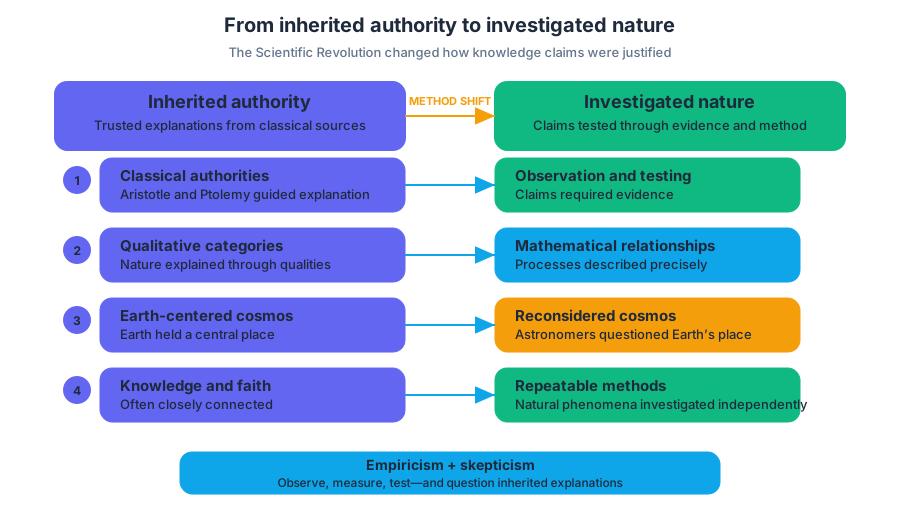
From inherited authority to investigated nature
Before the Scientific Revolution, educated Europeans often relied on classical sources of knowledge, especially Aristotle and Ptolemy, whose ideas had been preserved and interpreted through Christian and Islamic intellectual traditions. The new approach emphasized experimentation, meaning the controlled testing of an idea through observation, and mathematics, which allowed natural processes to be described precisely rather than only philosophically.
The shift was therefore methodological, not simply a list of discoveries. A scholar who measured planetary motion, dissected a body, or tested a physical claim was asking nature to provide evidence. This encouraged empiricism, the use of observation and experience as sources of knowledge, and skepticism, the willingness to question inherited explanations.
| Older pattern of explanation | Emerging Scientific Revolution approach |
|---|---|
| Classical authorities supplied trusted explanations | Claims required observation and testing |
| Nature was often interpreted through qualitative categories | Nature could be represented through mathematical relationships |
| The cosmos was understood as ordered around Earth | Astronomers reconsidered Earth’s place in the cosmos |
| Knowledge and faith were frequently treated as closely connected | Natural phenomena could be investigated through repeatable methods |
A revolution that still contained older beliefs
The people who advanced scientific inquiry were not uniformly modern in every belief. Paracelsus pursued new medical approaches while retaining ideas associated with alchemy. Andreas Vesalius challenged inherited anatomical errors through human dissection, yet he lived in a culture shaped by religious assumptions. Johannes Kepler used mathematical astronomy while also accepting astrology, and Sir Isaac Newton investigated gravity while devoting substantial attention to alchemy and biblical interpretation.
This coexistence matters because “science versus superstition” is a misleading simplification. Historical change often works by combination: investigators adopted new evidence-gathering practices while preserving some traditional cosmological, religious, or occult beliefs.
Key distinction: The Scientific Revolution changed how many Europeans justified knowledge, but it did not instantly produce secularism or modern science in every area of thought.
Challenging the classical cosmos
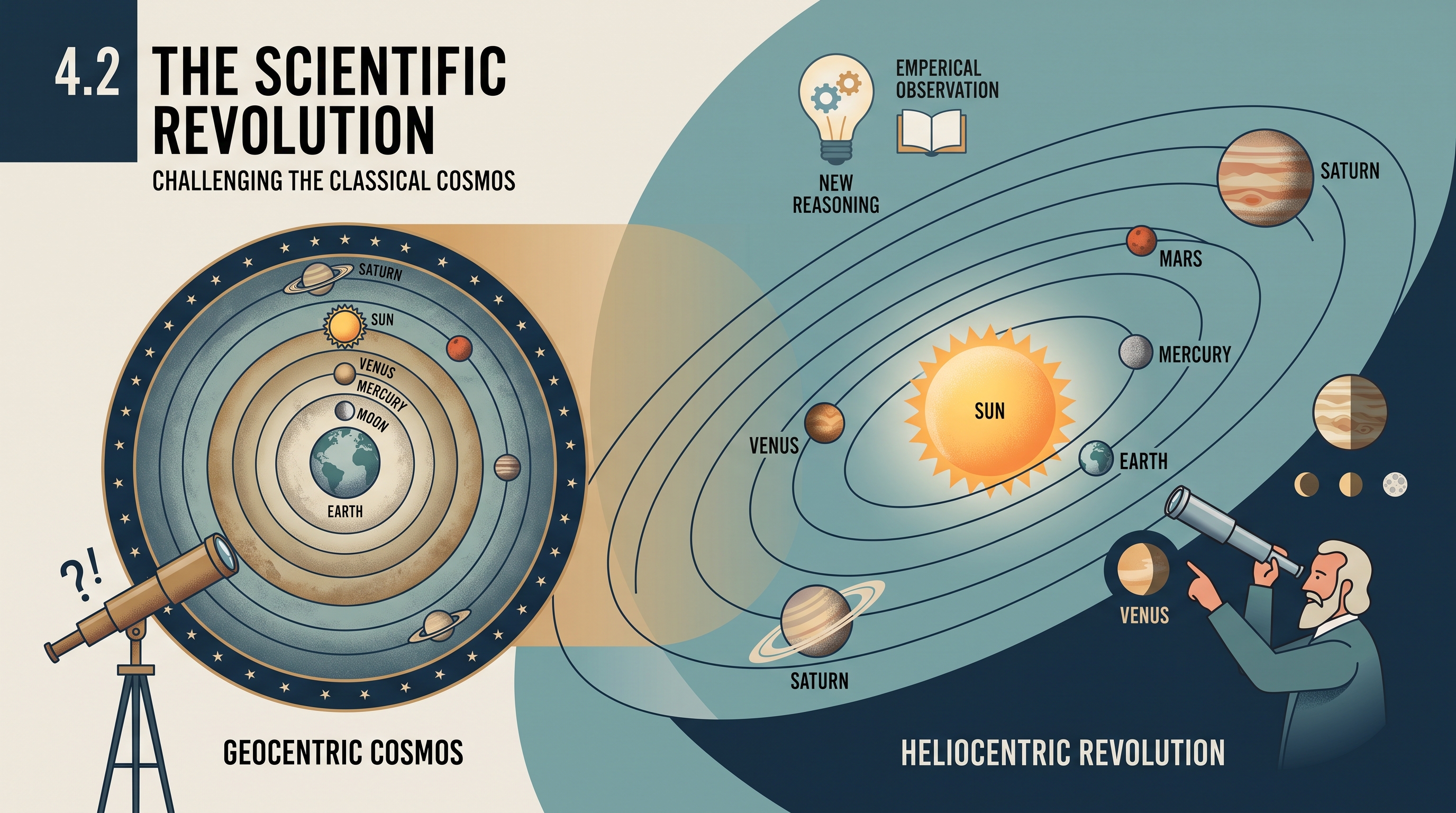
Classical astronomy generally placed Earth at the center of a hierarchical universe. The heliocentric model associated with Nicolaus Copernicus placed the Sun at the center of planetary motion instead. Kepler used mathematics to describe elliptical planetary orbits, and Newton’s laws of motion and universal gravitation provided a wider explanation for why objects moved as they did.
These discoveries challenged more than a diagram of the heavens. If Earth was not the fixed center of the cosmos, then long-standing assumptions about humanity’s position in creation—and the authority of inherited explanations—could be questioned. Galileo’s telescopic observations, including evidence inconsistent with a perfect, unchanging celestial realm, intensified the conflict between new observations and established authorities.
Worked contextual example — from telescope to social challenge: Galileo observes features of the Moon and moons orbiting Jupiter. Those observations weaken the assumption that all celestial bodies revolve around Earth. The immediate issue is astronomical, but the broader consequence is epistemological: if direct observation contradicts an established authority, observation may deserve greater weight. That reasoning later supported broader Enlightenment criticism of inherited political and religious institutions.
Commercial and demographic context
The Scientific Revolution and Enlightenment developed within the Commercial Revolution, the expansion of trade, banking, markets, and consumer activity that accelerated after the era of exploration. Commercial growth created wealth for patrons, publishers, merchants, and state governments. It also linked scientific knowledge to navigation, cartography, military engineering, medicine, and improved management of expanding economies.
By the eighteenth century, changing demographic patterns also reshaped everyday life. Population growth in some regions, expanding cities, migration, and changing family and private life reflected both commercial development and shifting economic opportunities. These material changes did not mechanically cause new ideas, but they created larger audiences, denser networks of communication, and practical reasons to value calculation, observation, and improvement.
KC-2.4.III connects “family and private life” to new demographic patterns and the effects of the Commercial Revolution. The intellectual history of Unit 4 therefore belongs alongside changes in work, consumption, population, and domestic life—not above them.
From scientific method to Enlightenment criticism
The Enlightenment extended confidence in reason, evidence, and criticism from the natural world into human society. KC-2.3.I identifies empiricism, skepticism, human reason, rationalism, and classical sources of knowledge as ideas that challenged assumptions about social order, government, and faith. Public lectures, salons, coffeehouses, academies, newspapers, and printed books helped circulate these arguments beyond universities and courts, fulfilling KC-2.3.II.
Enlightenment thinkers also challenged absolutism and mercantilism. KC-2.3.III describes new political and economic theories that questioned concentrated monarchical authority and state-directed economic systems. Rational analysis of religious practices encouraged natural religion—belief in a creator or moral order grounded in reason rather than exclusively in church doctrine—and strengthened demands for religious toleration, as expressed in KC-2.3.IV.
Misconception check: The Enlightenment was not simply “the Scientific Revolution applied to politics,” and it did not reject religion altogether. It redirected criticism toward authority, demanded reasons and evidence, and produced both religious skepticism and new forms of religious belief.
AP historical reasoning: Argumentation 6.C
Argumentation 6.C: Use historical reasoning to explain relationships among pieces of historical evidence. A strong argument connects evidence instead of listing names. For example: commercial expansion supported patrons and print networks; print networks spread scientific and philosophical claims; those claims encouraged criticism of absolutism, mercantilism, and religious intolerance. The relationship is not automatic, but the connected evidence shows why intellectual change could reach institutions and everyday life.
Retrieval check: Explain why the statement “the Scientific Revolution made Europe secular” is too simple. Include one scientific development, one continuing traditional belief, and one connection to Enlightenment criticism.
Source Materials
- AP European History Course and Exam Description
- AP European History Course and Exam Description Clarifications and Corrections
- AP European History Course Overview
- AP European History Course at a Glance
- AP European History Course at a Glance Poster
- AP European History
- AP European History
- AP European History Sample Syllabus 1
- AP European History-AP Students-College Board
- AP European History-Doves Library
- AP European History Cheat Sheets-Albert.io
- AP European History Study Guide-EBSCO