From the free course AP European History on Lykke
8.1 Contextualizing 20th-century global conflicts · 8.2 World War I
Key concepts: World War I as a global conflict · Long-term and short-term causes of World War I · The immense human and social losses caused by World War I · Conflicting goals of the victors and vanquished in the postwar peace · The overthrow and transformation of European empires · The creation of Middle Eastern mandate territories · Nationalist and separatist movements · Ethnic conflict and ethnic cleansing · Industrialized warfare and genocide · The long-term global consequences of 20th-century conflicts, including nuclear proliferation
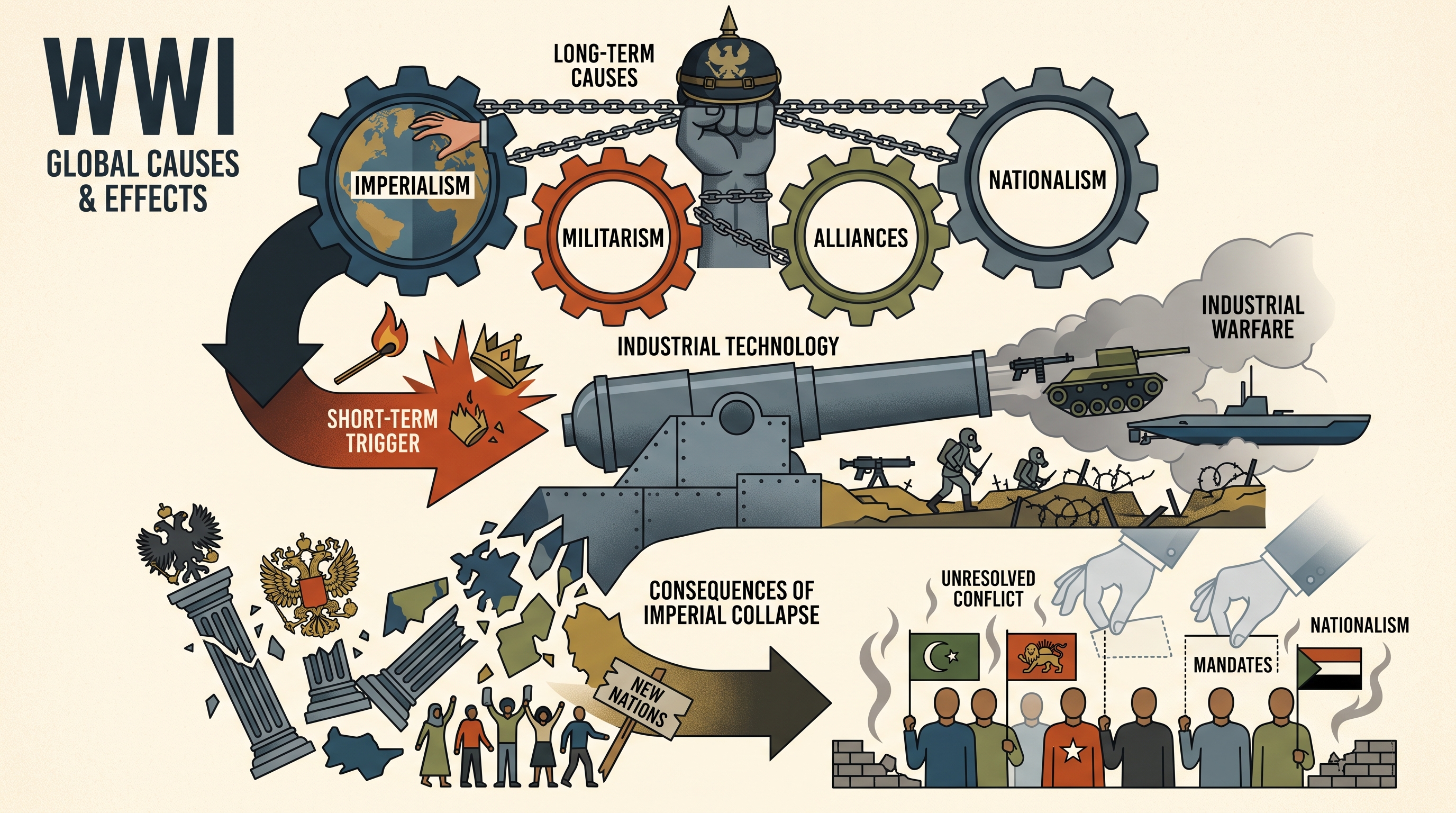
World War I became a global conflict because European rivalries were transformed by industrial technology, imperial connections, and nationalist politics into a war that reached far beyond Europe.
8.1 Contextualizing 20th-century global conflicts · 8.2 World War I
World War I became a global conflict because European rivalries were transformed by industrial technology, imperial connections, and nationalist politics into a war that reached far beyond Europe. Its central historical puzzle is therefore not “What single event caused the war?” but “How did long-term tensions and short-term decisions combine to make a general war possible?”
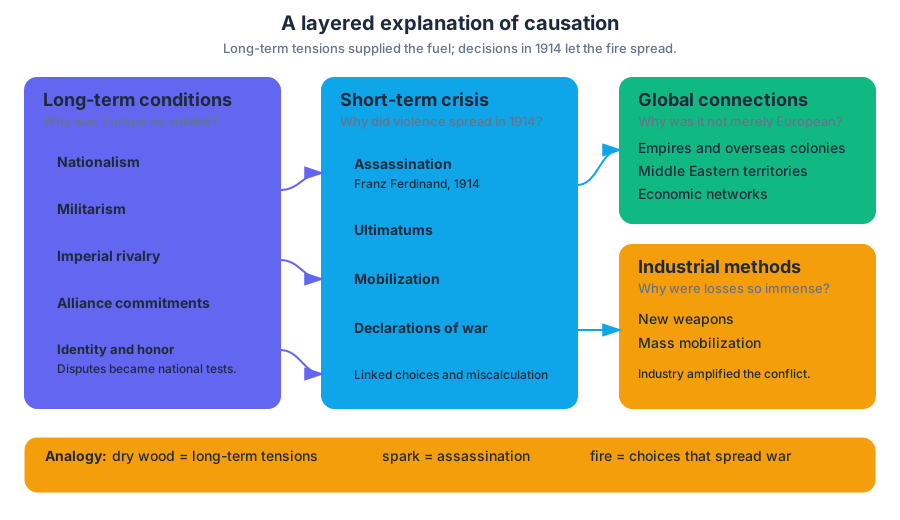
A layered explanation of causation
Long-term factors created the dangerous setting: competition among European states, imperial rivalry, militarism, alliance commitments, and nationalism. Nationalism—the belief that a people sharing an identity should possess political loyalty and often its own state—could unify populations, but it could also turn ethnic, territorial, and imperial disputes into tests of national honor.
Short-term factors converted that unstable setting into war. The assassination of Archduke Franz Ferdinand in 1914 was the immediate trigger, but the crisis expanded because governments made linked decisions involving mobilization, alliances, strategic fears, and diplomatic miscalculation. A useful analogy is a room filled with dry wood: long-term tensions supplied the fuel, while the assassination supplied the spark. The fire still required governments to make choices that allowed it to spread.
| Layer of causation | What it contributed | Historical question |
|---|---|---|
| Long-term conditions | Nationalism, militarism, imperial competition, alliances | Why was Europe so volatile? |
| Short-term crisis | Assassination, ultimatums, mobilization, declarations of war | Why did violence spread in 1914? |
| Global connections | Empires, overseas colonies, Middle Eastern territories, economic networks | Why was this not merely a European war? |
| Industrial methods | New weapons and mass mobilization | Why were losses so immense? |
Industrialized warfare and human loss
World War I demonstrated that industrialized warfare—war organized through factories, advanced weapons, mass armies, railways, and centralized states—could produce destruction on an unprecedented scale. New technologies confounded traditional military strategies and contributed to trench warfare and massive troop losses, a development identified in KC-4.1.I.B and connected to Unit 8: Learning Objective C: Explain how new technology altered the conduct of World War I.
The war’s consequences affected both victors and vanquished, exactly as stated in KC-4.1.I. Soldiers suffered mass death, injury, and psychological trauma; civilians faced displacement, shortages, disease, and political upheaval. Economies and social structures were disrupted, while governments expanded their control over production, information, and populations. Victory therefore did not mean that the victorious states escaped the war’s damage.
A peace built from competing goals
The postwar settlement reflected conflicting aims. Some negotiators promoted diplomatic idealism, including a new international order intended to reduce future conflict; others wanted to punish Germany, protect national interests, and secure territorial or economic advantages. KC-4.1.II captures the result: the peace settlement satisfied few because it attempted to combine principles of self-determination, security, punishment, and imperial preservation.
This conflict of goals helps explain why the peace did not create a stable political order. Nationalist and separatist movements continued to challenge multinational states, while ethnic conflict and ethnic cleansing—organized efforts to remove a population from a territory through coercion or violence—became recurring features of twentieth-century instability. The key misconception is “the war ended when the armistice was signed.” The fighting stopped, but imperial collapse, contested borders, and political resentment continued reshaping Europe and the wider world.
Imperial collapse and the Middle East
World War I contributed to the overthrow and transformation of European empires, especially the German, Austro-Hungarian, Russian, and Ottoman imperial systems. Their collapse created new states and borders, but it did not automatically produce self-government or ethnic harmony. National identity became both a source of political legitimacy and a reason for conflict when different groups claimed the same territory.
In the former Ottoman lands, the postwar system created mandate territories: territories administered by European powers under an international arrangement that claimed to prepare them for eventual self-government. These included Lebanon and Syria, administered by France, and Iraq and Palestine, administered by Britain. European interactions with the Middle East were also connected to oil, making the region important not only for strategic and political reasons but also for emerging energy interests.
Worked historical reasoning
Claim: World War I resulted from a complex interaction of long- and short-term factors, rather than from nationalism alone or one assassination alone. Evidence: Nationalist movements and imperial rivalries created persistent tensions; alliance systems and military planning made a local crisis dangerous; the assassination and subsequent government decisions activated those pressures. Connection: The war then weakened empires, intensified nationalist and ethnic conflicts, and produced mandate borders whose political consequences extended beyond Europe.
This reasoning practices Skill 1: Developments and Processes by tracing how the war developed over time; Skill 4: Contextualization by placing the 1914 crisis within wider imperial and nationalist conditions; and Skill 5: Making Connections by linking industrial warfare to social loss and imperial collapse to mandate politics. It also supports Unit 8: Learning Objective A: Explain the context in which global conflict developed in the 20th century.
Retrieval check
Name one long-term cause, one short-term trigger, one way industrial technology changed warfare, and one consequence of imperial collapse. Then explain in one sentence why the creation of mandates did not end nationalist conflict.
Source Materials
- AP European History Course and Exam Description
- AP European History Course and Exam Description Clarifications and Corrections
- AP European History Course Overview
- AP European History Course at a Glance
- AP European History Course at a Glance Poster
- AP European History
- AP European History
- AP European History Sample Syllabus 1
- AP European History-AP Students-College Board
- AP European History-Doves Library
- AP European History Cheat Sheets-Albert.io
- AP European History Study Guide-EBSCO