From the free course AP European History on Lykke
3.5 The Dutch Golden Age · 3.6 Balance of Power
Key concepts: Dutch Golden Age · Dutch East India Company · Balance of power · Competitive state system · Diplomacy and warfare · Military revolution · Nationalism and imperialism · Treaty of Westphalia · Congress of Vienna · European state formation
The Dutch Republic became powerful without becoming Europe’s largest kingdom. Its advantage came from combining maritime commerce, overseas empire, financial expertise, and a political system capable of supporting war.
3.5 The Dutch Golden Age · 3.6 Balance of Power
The Dutch Republic became powerful without becoming Europe’s largest kingdom. Its advantage came from combining maritime commerce, overseas empire, financial expertise, and a political system capable of supporting war. The same competitive state system that produced the Dutch Golden Age also made European politics a permanent contest: no state could safely allow one rival to become overwhelmingly powerful.
Unit 3: Learning Objective E: Explain how European states attempted to establish and maintain a balance of power on the continent throughout the period from 1648 to 1815.
The Dutch Golden Age: commerce becomes power
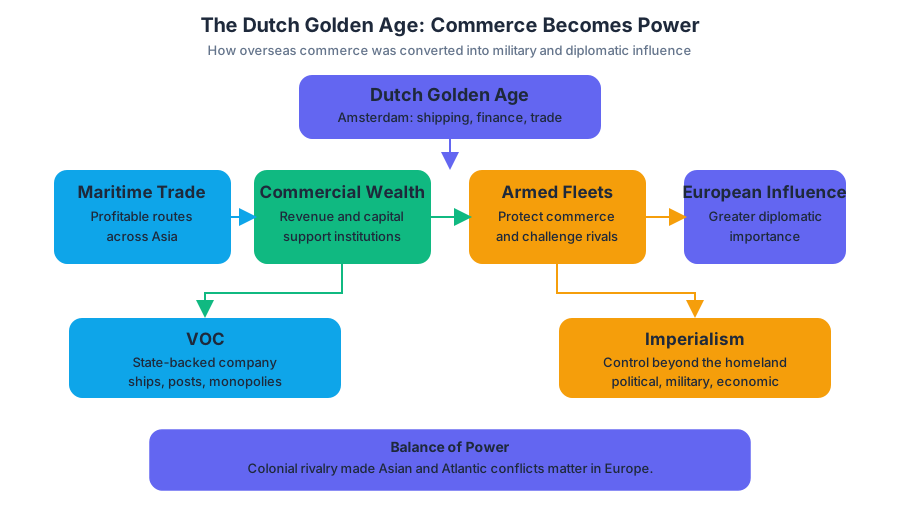
The Dutch Golden Age refers to the seventeenth-century prosperity and influence of the Dutch Republic. Amsterdam became a major center of shipping, finance, trade, and cultural production. The Dutch East India Company, commonly known as the VOC, is closely associated with this rise: it organized long-distance commerce in Asia, operated armed ships, established trading posts, and used state-backed privileges to compete with rival European powers.
The VOC shows why imperialism mattered to European power politics. Imperialism is the extension of a state’s political, military, or economic control over territories and peoples beyond its homeland. Dutch overseas expansion did not merely enrich merchants; it supplied strategic ports, commercial monopolies, naval experience, and revenue that strengthened the Dutch Republic’s position against European competitors. Colonial rivalry therefore became part of European diplomacy: a conflict over Asian trade or Atlantic possessions could alter the balance of power in Europe itself.
Worked example — from overseas trade to European influence:
Dutch control of profitable maritime routes generated wealth → wealth supported fleets and state institutions → fleets protected commerce and challenged Spain, Portugal, England, and France → Dutch prosperity increased the republic’s diplomatic importance. The chain is not “trade automatically creates power”; it is commercial wealth converted into military and political capacity.
Misconception check: The Dutch Golden Age was not simply a peaceful period of merchant prosperity. Dutch commercial success depended on armed shipping, colonial coercion, and competition with other imperial states.
The competitive state system
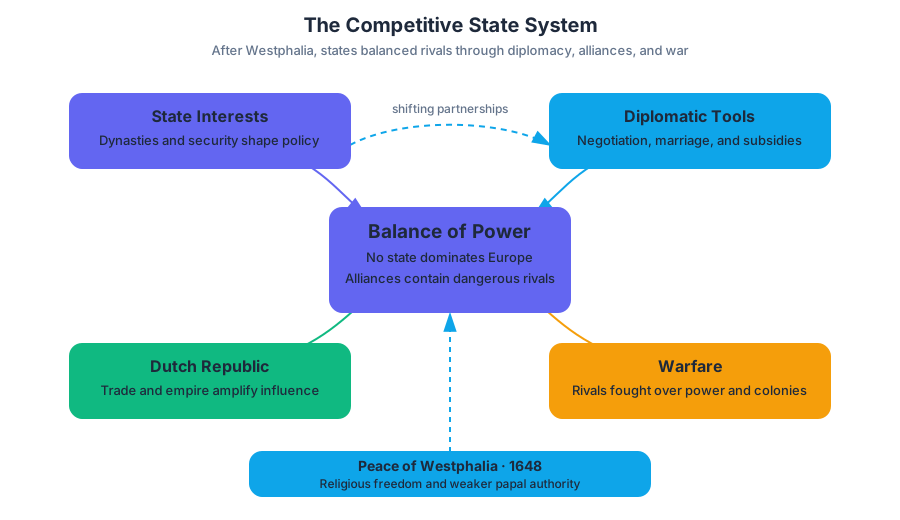
KC-1.5.II — The competitive state system led to new patterns of diplomacy and new forms of warfare. After the Peace of Westphalia, religion declined in importance as the main cause of warfare among European states. Dynastic interests, state interests, and expanding colonial empires increasingly shaped decisions about alliances and war.
The balance of power was the principle that no single European state should become strong enough to dominate the continent. States pursued this balance through shifting alliances, diplomatic negotiations, strategic marriages, subsidies, and warfare. A state might cooperate with a former enemy if that partnership helped contain a more dangerous rival.
KC-1.5.II.A connects the Peace of Westphalia to this new diplomatic logic. The settlement included provisions for religious freedom and marked a weakening of the pope’s role in European political affairs. It did not eliminate religion, but it strengthened the idea that European states could negotiate political arrangements without accepting the pope as the supreme authority over international affairs.
The military revolution and the tax state
The military revolution describes the interconnected changes in warfare and state organization that made armies more expensive and more demanding to maintain. Infantry armed with firearms, mobile cannon, and elaborate fortifications changed how battles and sieges were fought. These developments required heavier taxation, larger bureaucracies, improved logistics, and governments capable of mobilizing resources over long periods.
Military technology therefore affected diplomacy as well as battlefields. States able to collect taxes and administer territory could maintain larger forces; states unable to do so risked dependence, defeat, or partition. The weakness of the Polish monarchy illustrates this danger: its inability to consolidate authority over the nobility contributed to intervention by Prussia, Russia, and Austria, followed by Poland’s partition and disappearance from the map of Europe.
Causal chain: firearms and fortifications → larger, costlier armies → heavier taxation and bureaucracy → stronger centralized states → more intense competition for power.
Balance of power across time
The balance of power was repeatedly reshaped by nationalistic and imperialistic ambitions. Louis XIV’s nearly continuous wars, driven by dynastic and state interests, provoked coalitions determined to contain French expansion. After the Austrian defeat of the Turks at the Battle of Vienna in 1683, Ottoman westward expansion ceased, changing the strategic possibilities available to European powers.
The nineteenth century brought another major transformation. The unification of Italy and Germany created larger national states and altered the European balance of power. Nationalism could unite populations, but it could also intensify rivalry when states linked national prestige to military strength, territory, or imperial expansion.
After Napoleon’s defeat, the Congress of Vienna, held in 1814–1815, attempted to restore stability by reconstructing a balance of power. Its diplomats sought not merely to redraw borders but to contain future revolutionary and nationalistic upheavals. Their solution relied on cooperation among major powers, territorial adjustments, and the readiness to intervene when revolutionary movements threatened the established order.
AP reasoning: Claims and Evidence in Sources
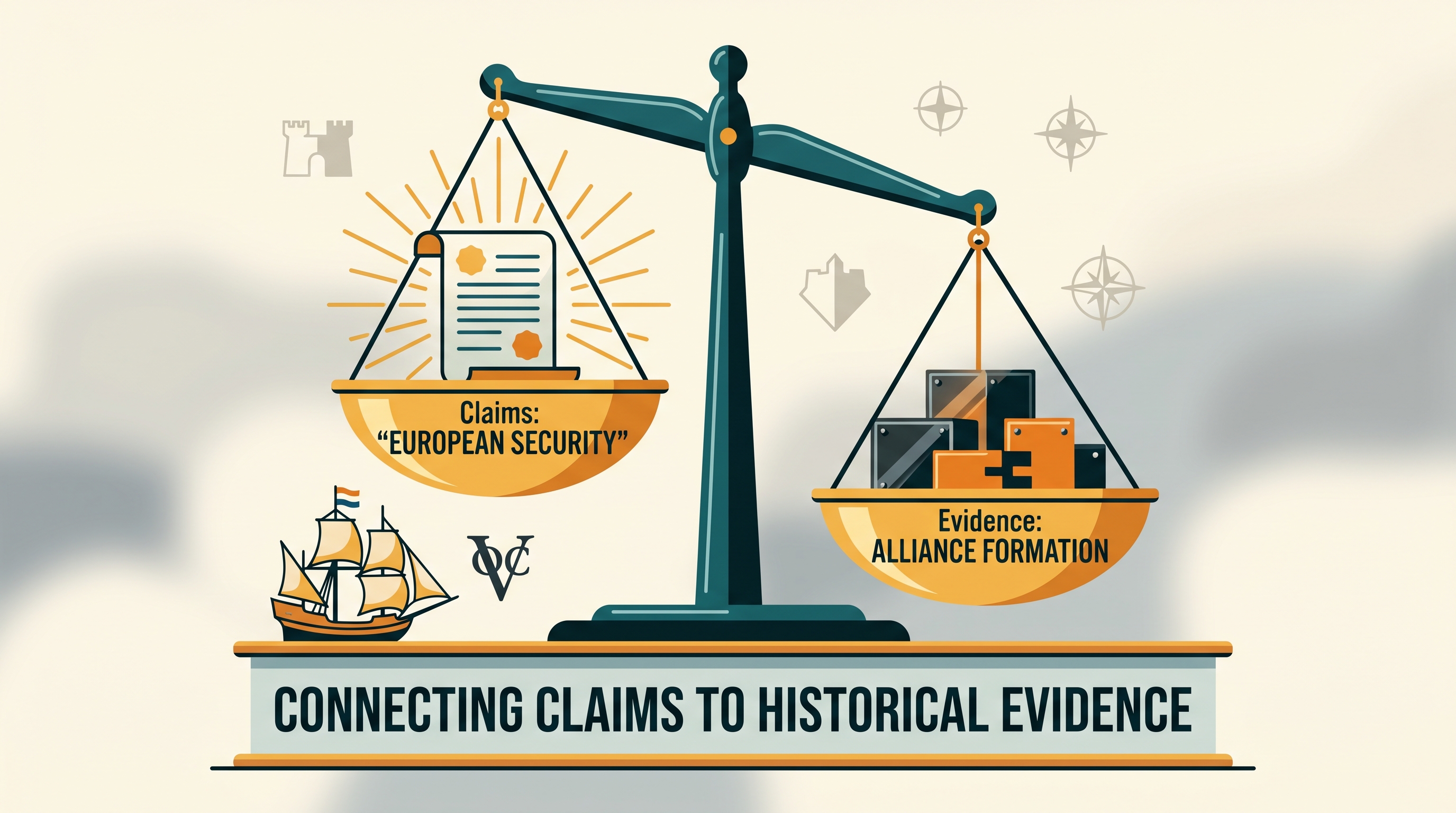
The suggested skill Claims and Evidence in Sources asks you to identify what a source argues and then connect that claim to specific historical evidence. For example, if a diplomatic document presents an alliance as necessary for “European security,” do not merely paraphrase it. Explain that the language reflects balance-of-power politics: states justified cooperation by claiming that a rival’s expansion threatened the wider European system.
Retrieval check: Why did the Dutch East India Company matter to European politics beyond trade? How did the military revolution strengthen some states while weakening others? Finally, explain why the Congress of Vienna treated nationalism as a threat to be contained rather than simply as a popular ideal.
Source Materials
- AP European History Course and Exam Description
- AP European History Course and Exam Description Clarifications and Corrections
- AP European History Course Overview
- AP European History Course at a Glance
- AP European History Course at a Glance Poster
- AP European History
- AP European History
- AP European History Sample Syllabus 1