From the free course AP European History on Lykke
9.3 The Cold War · 9.4 The emergence of two superpowers
Key concepts: Thirty Years’ War · Religious motivations in warfare · Political and national interests · Interconnection of religion and politics · Swedish interests in the Baltic region · Oxenstierna and Swedish political objectives · Cold War · Emergence of two superpowers · Cult of personality under Hitler and Stalin · Communism and Nazism: private property and regime stability
The Thirty Years’ War shows why religious and political motives cannot always be separated: rulers often defended faith, territory, dynastic authority, and strategic interests at the same time.
9.3 The Cold War · 9.4 The emergence of two superpowers
The Thirty Years’ War shows why religious and political motives cannot always be separated: rulers often defended faith, territory, dynastic authority, and strategic interests at the same time. The same analytical habit matters for understanding the Cold War, when the United States and Soviet Union turned military strength, economic systems, political influence, and competing ideologies into a bipolar world order.
Religion and power in the Thirty Years’ War
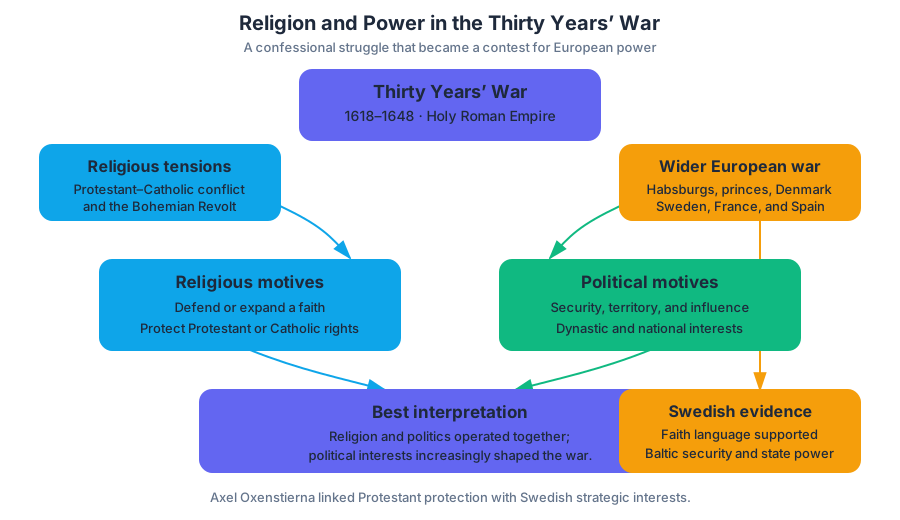
The Thirty Years’ War began in 1618 within the Holy Roman Empire, where Protestant and Catholic tensions had already destabilized politics. The conflict grew from the Bohemian Revolt into a wider European war involving the Habsburg monarchy, German princes, Denmark, Sweden, France, and Spain. Its broader context included the Protestant Reformation, the political fragmentation of the Holy Roman Empire, and the continuing struggle of monarchs to preserve or expand their authority.
Key distinction: Religious motivation concerns the defense or expansion of a faith; political motivation concerns power, security, territory, dynastic interests, and influence. In the Thirty Years’ War, the two usually operated together rather than as separate causes.
A defensible argument should therefore avoid the overly simple claim that the war was either “religious” or “political.” A stronger thesis might argue: Although the Thirty Years’ War began from religious conflict over the rights of Protestants and Catholics, political and national interests increasingly determined the actions of the major powers, making the war both a confessional struggle and a contest for European power.
Swedish involvement provides especially clear evidence of political motives. Sweden was a Protestant power, so it could present intervention as a defense of Protestantism. However, Swedish leaders also sought influence around the Baltic region, greater security against rivals, and a stronger position in northern Europe. Axel Oxenstierna, Sweden’s chancellor, represents this connection between religious language and strategic state-building: Swedish policy could protect Protestant interests while also advancing Swedish political objectives.
The best document-based reasoning does more than summarize a source. An open letter from Holy Roman Emperor Matthias to Protestant subjects in Bohemia can be used to show that religious freedom was a central public issue; its audience—Protestant subjects facing fears of repression—helps explain why religion mattered politically. A document associated with Swedish Chancellor Oxenstierna, by contrast, can support an argument about Sweden’s pursuit of interests in the Baltic region. The documents become evidence only when their content is connected to a claim.
Worked argument: religious or political?
A compact line of reasoning could develop in three moves:
- Religious origins: Conflicts over Protestant worship and Catholic authority helped trigger the Bohemian Revolt and drew rulers into the struggle.
- Political expansion: Sweden entered while pursuing strategic interests in the Baltic; France, although Catholic, opposed the Habsburgs, demonstrating that state security could override shared religion.
- Interconnection: Rulers used religious causes to legitimize intervention, while religious divisions supplied the political crisis that made intervention possible.
Misconception check — “If France was Catholic, it must have supported the Catholic Habsburgs.” France’s Catholic monarchy opposed Habsburg dominance because political rivalry and security concerns outweighed religious solidarity. This is powerful evidence that the war’s religious and political motivations were intertwined, not identical.
From wartime Europe to a bipolar Cold War
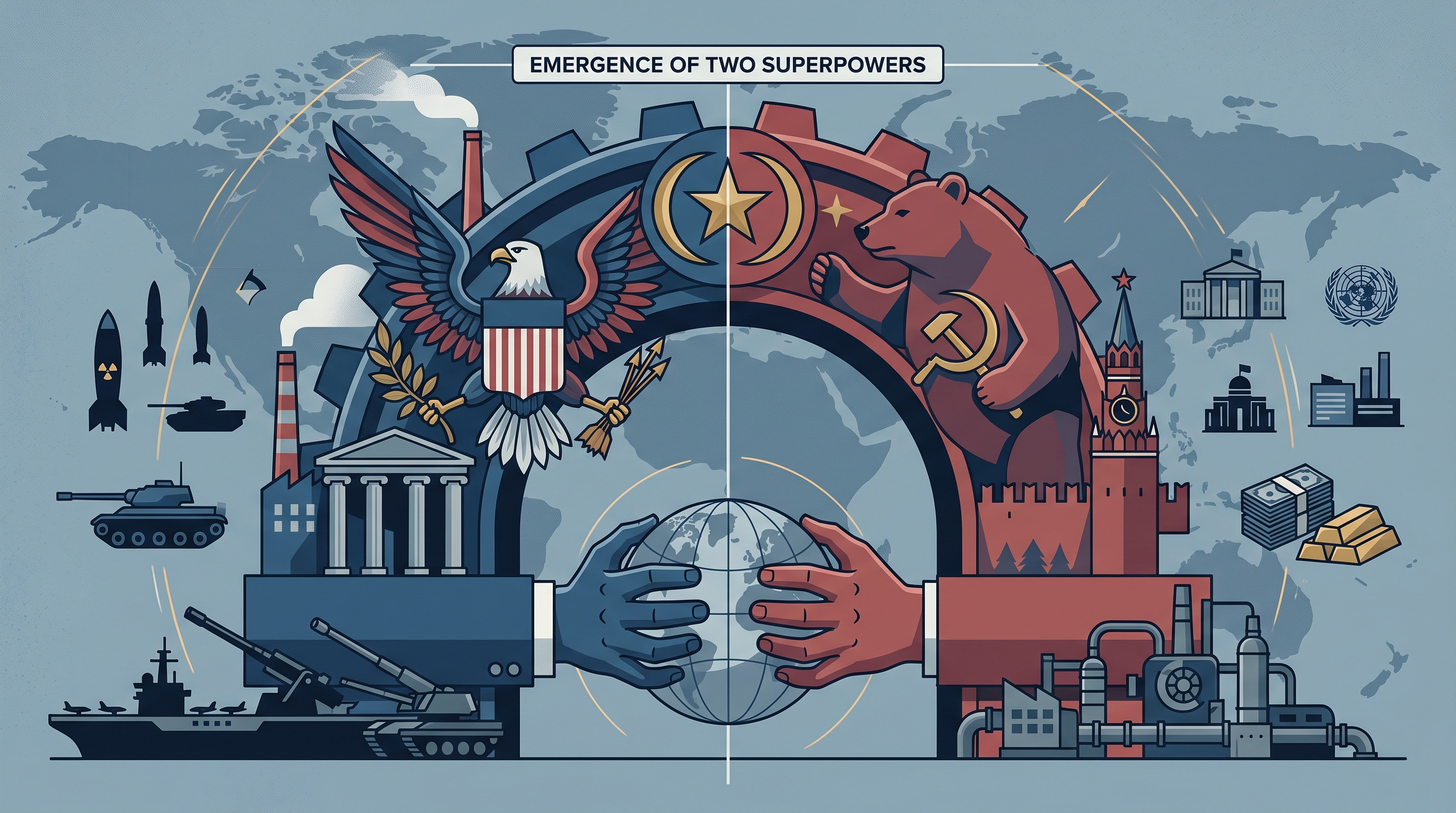
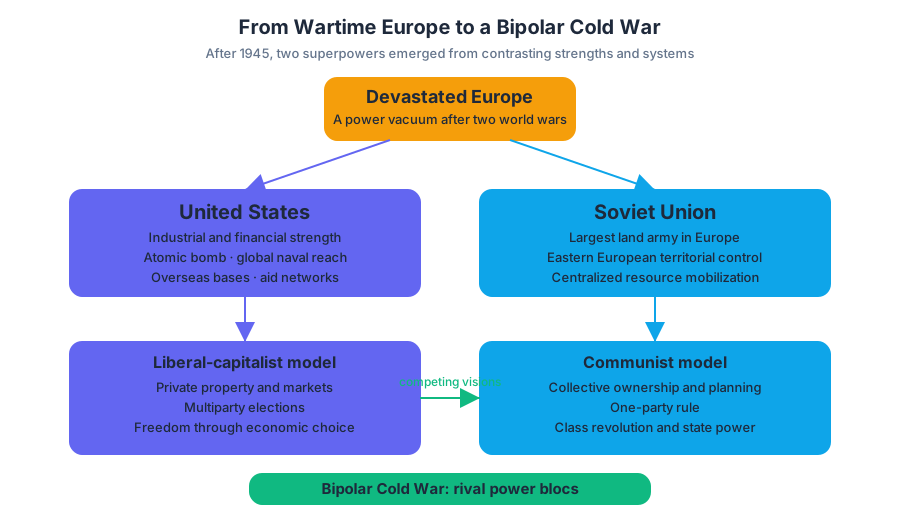
After 1945, the United States and Soviet Union emerged as the two superpowers—states with extraordinary military, economic, and diplomatic capacity. Europe had been devastated by two world wars, while the United States possessed immense industrial production, financial strength, and the atomic bomb. The Soviet Union had suffered enormous losses but maintained the largest powerful land army in Europe, occupied much of eastern Europe, and commanded a centralized political system capable of mobilizing resources for reconstruction and military competition.
Their power rested on different foundations:
| Dimension | United States | Soviet Union |
|---|---|---|
| Military position | Nuclear capability, global naval reach, and overseas bases | Massive conventional army and control of territory in eastern Europe |
| Economic position | Industrial capacity, financial power, and aid networks | Central planning and state-directed reconstruction |
| Political model | Liberal-capitalist democracy and multiparty elections | One-party communist rule |
| Ideological claim | Private property and market capitalism as foundations of freedom | Collective ownership and class revolution as foundations of equality |
| International goal | Contain communist expansion and protect a capitalist order | Secure a buffer zone and extend communist influence |
The Cold War was therefore not simply a disagreement between two leaders. It was a sustained rivalry between systems. The United States used economic influence, alliances, and political institutions to build a Western bloc; the Soviet Union consolidated communist governments across eastern Europe and created an opposing sphere of influence. Because neither side wanted direct war between its nuclear forces, competition often appeared through military alliances, economic pressure, propaganda, espionage, and conflicts involving other states.
Nazism and communism: a focused comparison
Both Hitler’s Nazi regime and Stalin’s Soviet regime relied on cults of personality, meaning political systems that presented the leader as uniquely wise, heroic, and necessary. Both also used censorship, propaganda, coercion, and one-party authority. Yet their treatment of private property revealed a major ideological difference: Nazism generally preserved private ownership while subordinating it to racial-national goals and state direction, whereas communism sought to abolish or sharply restrict private ownership of major productive resources through collectivization and state control.
This comparison matters because the Soviet Union’s power after 1945 rested less on Stalin’s personal image alone than on a durable party-state, centralized bureaucracy, industrial capacity, and control over territory. Those foundations helped the Soviet Union operate as a superpower even as leadership changed. The contrast with Nazi Germany clarifies why the postwar rivalry was fundamentally a competition between communist and capitalist blocs, not merely a repetition of fascist dictatorship.
Retrieval check
Was the Thirty Years’ War primarily religious or political? Answer with a qualified claim, then use Swedish interests in the Baltic region and Oxenstierna as evidence of political motives. Finally, identify one military, one economic, one political, and one ideological reason the United States and Soviet Union emerged as postwar superpowers.
Source Materials
- AP European History Course and Exam Description
- AP European History Course and Exam Description Clarifications and Corrections
- AP European History Course Overview
- AP European History Course at a Glance
- AP European History Course at a Glance Poster
- AP European History
- AP European History
- AP European History Sample Syllabus 1
- Private Collection© Look and Learn / Bridgeman Images