From the free course AP European History on Lykke
2.7 Art of the 16th Century: Mannerism and Baroque Art · 2.8 Causation in the Age of Reformation and the Wars of Religion
Key concepts: Mannerism and Baroque art · Baroque artists and musicians promoting religion or glorifying monarchs · Catholic theology from Augustine through the late Middle Ages · The Reformation and Counter-Reformation/Catholic Reformation · Religious documents and theological arguments · Monarchs’ control of religious institutions · The Peace of Westphalia and religious settlement · Causation in the Wars of Religion · Enlightenment intellectuals, including Voltaire and Diderot · Historical argumentation using claims and evidence
Explain and apply 2.7 Art of the 16th Century: Mannerism and Baroque Art · 2.8 Causation in the Age of Reformation and the Wars of Religion.
2.7 Art of the 16th Century: Mannerism and Baroque Art · 2.8 Causation in the Age of Reformation and the Wars of Religion
Art became a political and religious instrument when Europe’s rulers and churches faced a basic problem: how could institutions make invisible authority feel immediate and convincing? Mannerism answered with deliberate artificiality and tension; Baroque art answered with movement, emotional intensity, and theatrical spectacle. Both styles emerged from the Renaissance world, whose artists and scholars had revived ancient Greek and Roman ideas about proportion, drama, rhetoric, and civic power.
From classical balance to Mannerist tension
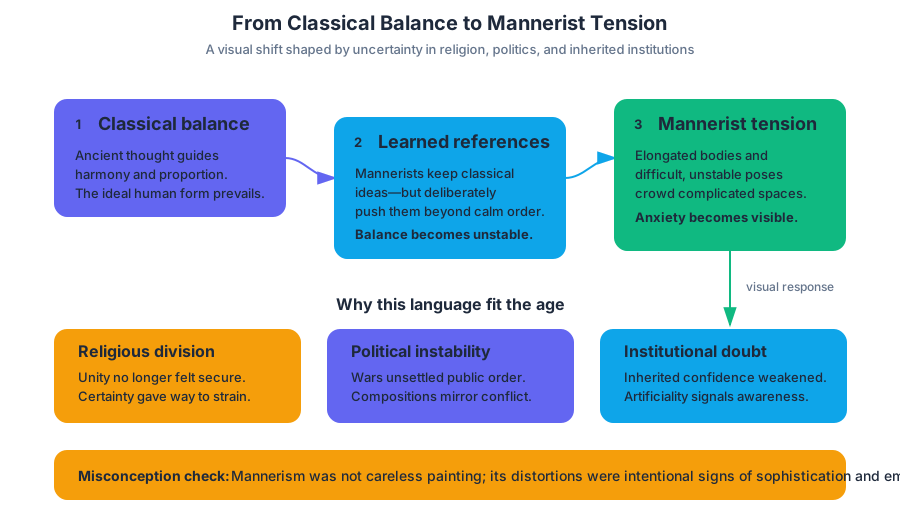
Renaissance artists used ancient thought to pursue harmony, realistic proportion, and the ideal human form. Mannerist artists, working especially in the later sixteenth century, kept the learned references but distorted the balance: figures became unusually elongated, poses became difficult or unstable, and crowded compositions created an atmosphere of anxiety. The result was not simply “bad realism.” It was a visual language suited to an age in which religious unity, political order, and confidence in inherited institutions had become uncertain.
Misconception check — “Mannerism means careless painting.” Mannerism was intentional. Its artificial bodies and complicated spaces signaled sophistication, emotional strain, and departure from the calm classicism associated with the High Renaissance.
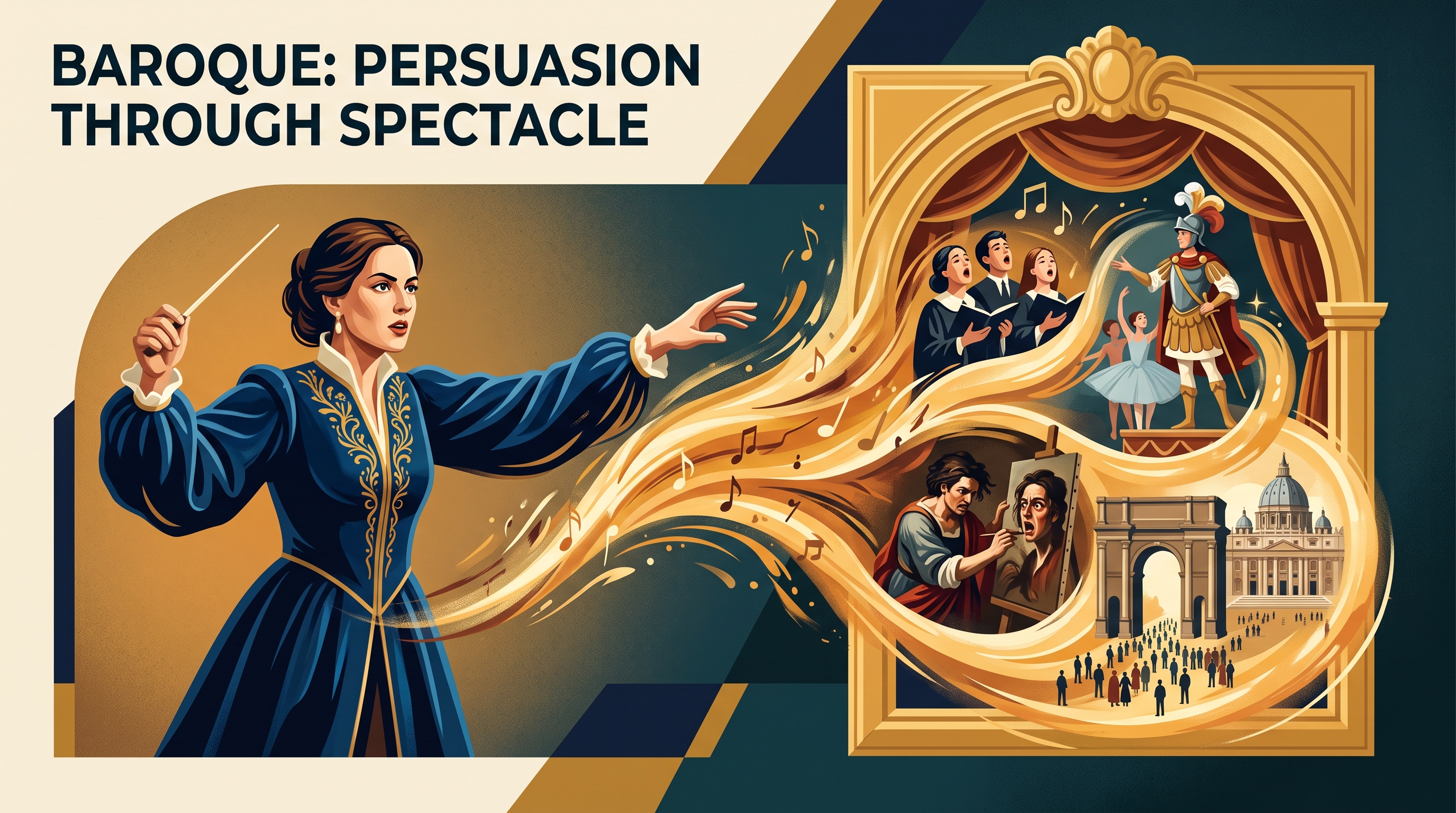
Baroque: persuasion through spectacle
Baroque art used dramatic lighting, diagonal movement, intense facial expression, and carefully staged scenes to involve the viewer emotionally. Churches could use such art to make Catholic belief vivid, while monarchs could use palaces, portraits, architecture, and ceremony to make royal authority appear natural, magnificent, and almost sacred.
Artemisia Gentileschi’s paintings, including her repeated treatment of Judith defeating Holofernes, combine biblical subject matter with physical force and emotional immediacy. Gian Lorenzo Bernini transformed Roman Catholic spaces through sculpture and architecture; the Ecstasy of Saint Teresa presents religious experience as overwhelming drama, while the design of Saint Peter’s Square directs crowds toward the papal center. Peter Paul Rubens similarly joined Catholic themes, dynastic magnificence, and diplomatic symbolism in large, energetic compositions. Their works show that religious art was not merely decoration: it shaped how viewers imagined faith, suffering, triumph, and authority.
Music served the same purposes. Claudio Monteverdi’s sacred compositions used contrasting voices, expressive harmonies, and dramatic textures to intensify worship and communicate religious feeling. Jean-Baptiste Lully composed court music and ballets for Louis XIV, turning performance into an audible display of royal order: the king appeared as the center around which coordinated bodies, rhythms, and ceremonies revolved. George Frideric Handel supplied both royal and religious spectacle; his Water Music celebrated the Hanoverian monarchy, while Messiah used biblical text and choral grandeur to promote Christian devotion. In each case, sound converted institutional power into an experience shared by an audience.
Why religious arguments became political conflicts
To understand why these artistic messages mattered, place them beside the longer history of Catholic theology. From Augustine through the late Middle Ages, Christian thinkers debated human sinfulness, salvation, grace, the authority of the church, and the relationship between spiritual and earthly power. Those accumulated arguments shaped later disputes: Reformation and Counter-Reformation documents did not invent every issue, but they gave older theological questions new urgency in a world transformed by printing, state building, and competing confessions.
A useful evidence method is to compare documents by claim, not merely by topic. One document might argue that religious authority rests primarily in scripture; another might defend church tradition and institutional authority; a third might address reform through discipline, education, or clerical renewal. The historian then asks: What does each document claim? What evidence or reasoning does it use? What audience and crisis shaped its argument?
Monarchs and control over religion
Religious conflict became especially dangerous when monarchs attempted to control religious institutions. The Huguenots in France, Puritans in England, and nobles in Poland illustrate different struggles over whether rulers, local elites, or religious communities would determine belief and church governance. These conflicts were never purely theological: control of appointments, taxation, courts, education, and public worship affected the strength of government institutions and the social order.
The Peace of Westphalia in $1648$ marked the end of the major phase of European religious wars and addressed the political problem of authority over religion. It did not create complete religious freedom or erase confessional divisions. Instead, it helped establish settlements in which territorial rulers gained recognized power to regulate religion within their lands, while diplomacy increasingly treated states as political actors whose agreements could restrain warfare.
2.8 Causation: from belief to war
Causation asks how and why a development occurred, distinguishing long-term conditions from immediate triggers and showing how institutions mediated the result. The wars of religion arose from interacting causes: theological disagreements, rulers’ attempts to strengthen authority, noble and urban resistance, competition among states, and social fears about disorder. Faith supplied genuine convictions, but political and institutional conditions determined how those convictions became rebellion, repression, or international war.
Worked example: A claim that “religious disagreement alone caused the wars of religion” is too narrow. Stronger reasoning argues that religious disputes provided the language and motivation for conflict, while monarchs’ efforts to control churches and nobles’ resistance converted doctrine into political struggle; rivalry among European states then prolonged and internationalized the wars. The Peace of Westphalia supports this causal explanation because its settlement addressed not only belief but also jurisdiction and state authority.
Later Enlightenment criticism redirected these questions. Voltaire attacked religious intolerance, while Denis Diderot and other thinkers associated with the Encyclopédie used organized knowledge to challenge inherited authority and encourage critical inquiry. Their arguments did not erase religion, but they reflected a continuing European debate over whether faith, institutions, monarchs, or reason should govern public life.
Retrieval check: Match each evidence item to the claim it best supports: Bernini’s Ecstasy of Saint Teresa; Lully’s court music for Louis XIV; the Peace of Westphalia; the Huguenot conflict in France. Then explain in one sentence why each item supports its claim. A complete answer must connect evidence to religious persuasion, monarchical glorification, state control, or the interaction of theology and political power—not merely identify the example.
Source Materials
- AP European History Course and Exam Description
- AP European History Course and Exam Description Clarifications and Corrections
- AP European History Course Overview
- AP European History Course at a Glance
- AP European History Course at a Glance Poster
- AP European History
- AP European History
- AP European History Sample Syllabus 1
- Figure — Sample Responses - LEQ 2 - Set 1 (p. 4)
- Figure — Sample Responses - LEQ 2 - Set 1 (p. 7)
- Figure — Sample Responses - LEQ 2 - Set 1 (p. 8)
- Figure — Sample Responses - LEQ 2 - Set 1 (p. 9)