From the free course AP European History on Lykke
8.5 The global economic crisis · 8.6 Fascism and totalitarianism
Key concepts: The global economic crisis and the Great Depression · The rise of fascism after World War I · Postwar bitterness and political instability · The rise of communism and fear of revolution · Fascist propaganda and the cult of personality · Authoritarian dictatorships in Central and Eastern Europe · The Soviet Union’s rapid economic modernization · Collectivization and the Five-Year Plan · Contrasts between Nazi and communist regimes · Economic recovery in Europe through the Marshall Plan
A financial crash in New York could destabilize governments across Europe because the postwar economy depended heavily on American lending. When the United States cut off capital flows after the 1929 stock-market crash, debt, unemployment, and political distrust intensified—creating conditions that extremist…
8.5 The global economic crisis · 8.6 Fascism and totalitarianism
A financial crash in New York could destabilize governments across Europe because the postwar economy depended heavily on American lending. When the United States cut off capital flows after the 1929 stock-market crash, debt, unemployment, and political distrust intensified—creating conditions that extremist movements could exploit.
The Great Depression: an economic crisis becomes a political crisis
The Great Depression was a prolonged collapse of production, employment, trade, and investment beginning after the 1929 crash. The crash did not mechanically cause fascism, but it sharply worsened conditions that already made democratic governments vulnerable: postwar bitterness, uncertain transitions to democracy, fear of communist revolution, and economic instability (KC-4.2.I).
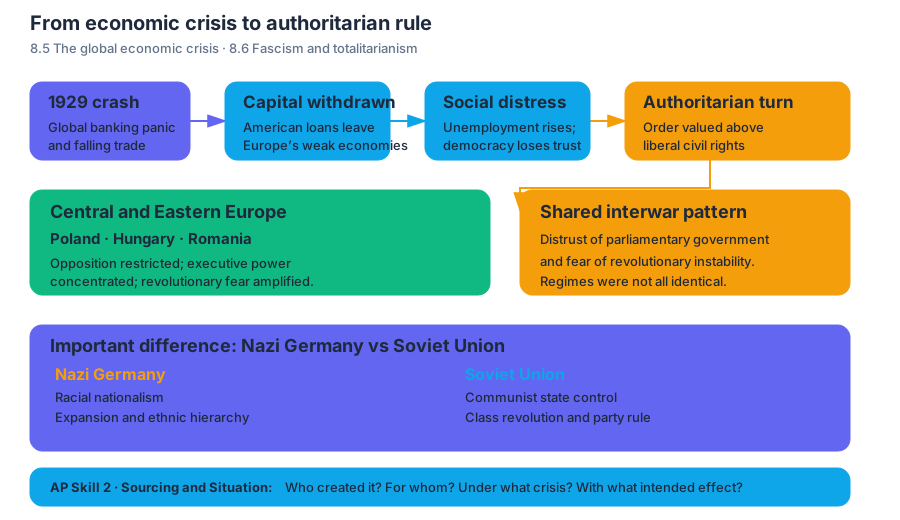
The mechanism was transnational:
U.S. stock-market crash
          ↓
American banks recall loans and reduce new lending
          ↓
European banks and governments lose access to capital
          ↓
Business failures + unemployment + reduced trade
          ↓
Public distrust of parliamentary governments
          ↓
Greater support for radical alternatives
Germany was especially exposed because foreign loans had helped stabilize its economy after World War I. As credit contracted, businesses failed and unemployment surged. Many voters did not abandon democracy because they had suddenly become committed fascists; they became more willing to support parties promising order, national recovery, and decisive leadership.
Key distinction: Economic crisis creates political opportunity; it does not determine a single political outcome.
Why fascism gained popularity
Fascism was an ultranationalist, authoritarian ideology that rejected liberal democracy, glorified war and national unity, and placed political power in the hands of a charismatic leader. Its roots reached into the pre-World War I era, but it gained mass appeal after the war in an atmosphere of humiliation, fear, social conflict, and unstable political transitions (Learning Objective 8.H; KC-4.2.II).
Fascist movements offered different promises to different groups. Veterans heard a language of restored honor; business owners heard protection from communist revolution; middle-class citizens heard promises to defeat strikes and disorder; nationalists heard demands to overturn humiliating settlements. This flexibility helped fascism build coalitions without requiring every supporter to share exactly the same economic program.
Mussolini, Hitler, and the capture of weak democracies
Benito Mussolini in Italy and Adolf Hitler in Germany rose by exploiting postwar bitterness and economic instability, using terror, and manipulating fledgling and unpopular democratic institutions (KC-4.2.II.B). Their movements did not simply seize power through one dramatic coup. They used elections, elite negotiations, intimidation, propaganda, and emergency powers to turn constitutional systems against themselves.
The critical sequence was:
- Crisis weakened confidence in parliamentary parties.
- Fascist organizations used violence and spectacle to appear powerful.
- Leaders presented themselves as national saviors.
- Conservative elites invited or tolerated them, believing they could control them.
- Once inside government, fascists dismantled opposition and concentrated authority.
Misconception check — “Hitler was elected dictator.” Hitler was appointed chancellor in 1933 after the Nazi Party became electorally powerful. He then used coercion and legal mechanisms, including emergency authority, to destroy political opposition and establish dictatorship. The election helped create access to power; it did not by itself complete the dictatorship.
Propaganda, technology, and the cult of personality
Fascist dictatorships used modern technology to make politics feel constant, personal, and emotionally overwhelming. Propaganda means organized communication designed to shape public beliefs and behavior. Radio carried speeches into homes; monumental architecture made the state appear permanent; mass rallies displayed unity; and the cult of personality represented the leader as the embodiment of the nation (KC-4.2.II.A).
Joseph Goebbels coordinated Nazi propaganda, while filmmaker Leni Riefenstahl used carefully staged images, movement, music, and monumental scale to present Nazi power as beautiful and inevitable. These techniques did not merely advertise policies. They narrowed the imaginable political world: criticism became betrayal, compromise became weakness, and war became a source of national renewal.
Fascist propaganda therefore worked through both attraction and exclusion. It promised belonging to a supposedly unified national community while defining minorities, political opponents, and alleged internal enemies as threats. The rejection of democratic institutions was presented not as tyranny, but as a cure for division.
Communism, Soviet modernization, and authoritarian alternatives
The rise of communism intensified fascist appeal among people who feared revolution and the destruction of private property. Yet Nazi Germany and the Soviet Union represented opposing extremist ideologies: Nazism centered on racial hierarchy, aggressive nationalism, and expansion, whereas Soviet communism claimed to organize society through class revolution and state ownership. Both developed authoritarian political systems, but “authoritarian” does not mean “ideologically identical.”
The Soviet Union pursued rapid economic modernization through collectivization, the forced consolidation of private farms into state-controlled collective agriculture, and the Five-Year Plan, a government program assigning production targets to accelerate industrial growth. These policies increased state control and industrial capacity but imposed immense human costs, including coercion, famine, repression, the Great Purges, Gulags, and secret-police terror.
Central and Eastern Europe
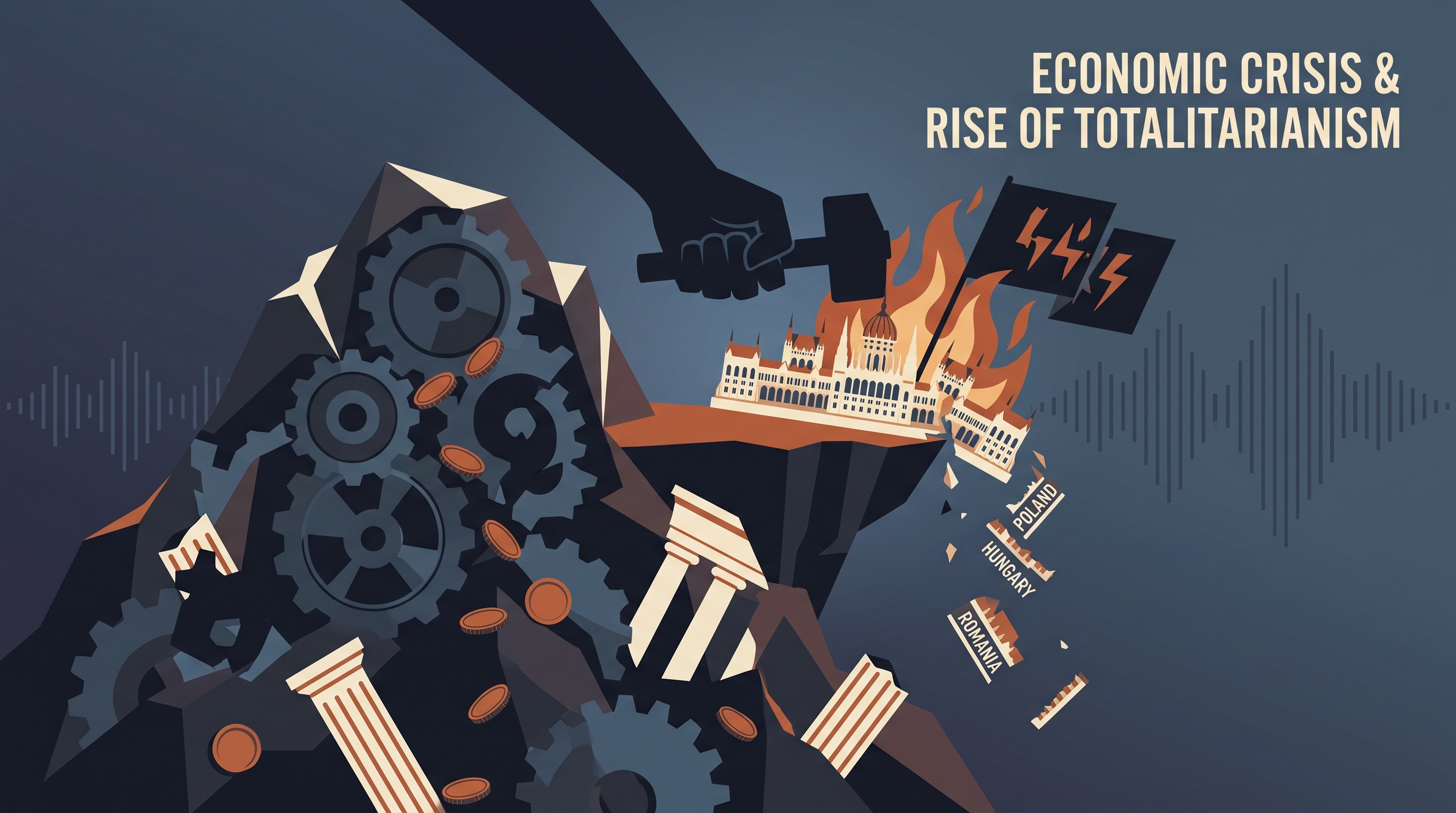
Democracy also weakened beyond Germany and Italy. Authoritarian dictatorships developed in Poland, Hungary, and Romania, where leaders restricted opposition, concentrated executive power, and treated political order as more important than liberal civil rights. These regimes were not identical to Nazi Germany or the Soviet Union, but they shared the broader interwar pattern of distrust toward parliamentary government and fear of revolutionary instability.
AP skill connection — Skill 2: Sourcing and Situation. When analyzing a fascist speech, poster, film, or radio address, ask: Who created it? For what audience? Under what crisis? With what intended effect? A Nazi rally film made under a dictatorship is not transparent evidence that society was genuinely unanimous; it is evidence of how the regime wanted unity to appear.
Retrieval check: Explain the chain connecting the 1929 crash to fascist popularity, then identify one important difference between Nazi Germany and the Soviet Union. A strong answer links the withdrawal of American capital to unemployment and distrust of democracy, and distinguishes Nazi racial-nationalist expansion from Soviet communist state control.
Source Materials
- AP European History Course and Exam Description
- AP European History Course and Exam Description Clarifications and Corrections
- AP European History Course Overview
- AP European History Course at a Glance
- AP European History Course at a Glance Poster
- AP European History
- AP European History
- AP European History Sample Syllabus 1