From the free course AP European History on Lykke
8.3 The Russian Revolution and its effects · 8.4 The Versailles Conference and peace settlement
Key concepts: Russian Revolution and its effects · Versailles Conference and peace settlement · Conflicting goals of peace negotiators · Diplomatic idealism versus punishment of Germany · League of Nations · Political, economic, and diplomatic crises · Overthrow of European empires · Globalization of World War I · Emergence of the United States as a world power · Discontent and revolution
The Russian Revolution and the Paris Peace Conference transformed the political map of Europe because they answered the same crisis in opposite ways: revolutionaries sought to overturn the existing order, while diplomats sought to rebuild it without allowing another general war.
8.3 The Russian Revolution and its effects · 8.4 The Versailles Conference and peace settlement
The Russian Revolution and the Paris Peace Conference transformed the political map of Europe because they answered the same crisis in opposite ways: revolutionaries sought to overturn the existing order, while diplomats sought to rebuild it without allowing another general war.
Revolution amid global war
World War I became a global conflict as fighting spread beyond Europe into the Middle East, Africa, and other non-European theaters. Its total mobilization placed extraordinary pressure on governments and societies: armies required more soldiers, factories required more workers, and civilians endured shortages, censorship, displacement, and mass death.
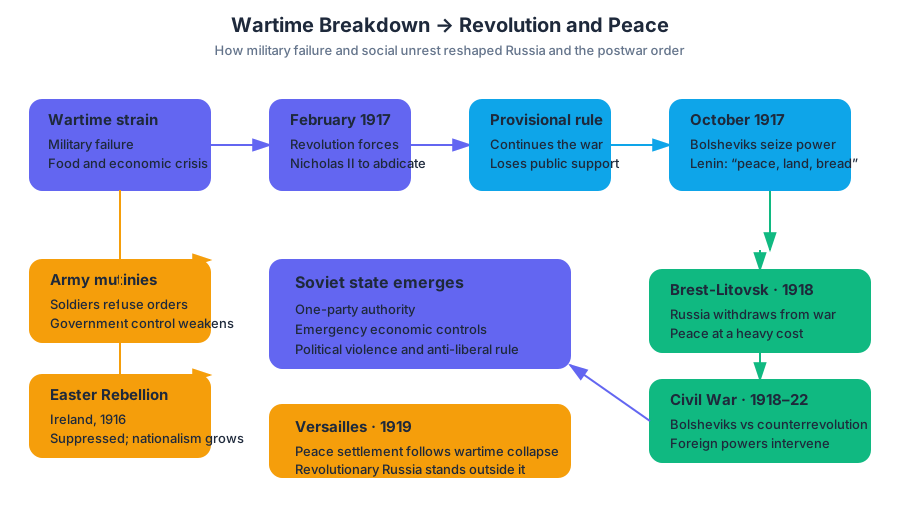
These pressures produced protest and insurrection in the belligerent nations. Army mutinies—refusals by soldiers to continue obeying military orders—revealed that governments could lose control even before they formally lost a war. The Easter Rebellion in Ireland in 1916 likewise expressed opposition to imperial rule, although it was suppressed at the time and only later helped strengthen Irish nationalism.
The Russian Revolution developed from this wider wartime breakdown. Military failure, food shortages, economic disruption, and anger at autocratic rule contributed to the February Revolution of 1917, which forced Tsar Nicholas II to abdicate. The provisional government continued the war, however, allowing the Bolsheviks under Vladimir Lenin to gain support with promises of “peace, land, and bread.” Their October seizure of power brought a revolutionary government to Russia and led to withdrawal from the war through the Treaty of Brest-Litovsk in 1918.
The revolution did not face only one opponent. Counterrevolutionaries included monarchists, liberals, moderate socialists, military leaders, and foreign powers that opposed Bolshevik rule. The resulting Russian Civil War established the Soviet state but also normalized political violence, one-party authority, emergency economic controls, and hostility toward liberal democracy.
The postwar map: idealism versus punishment
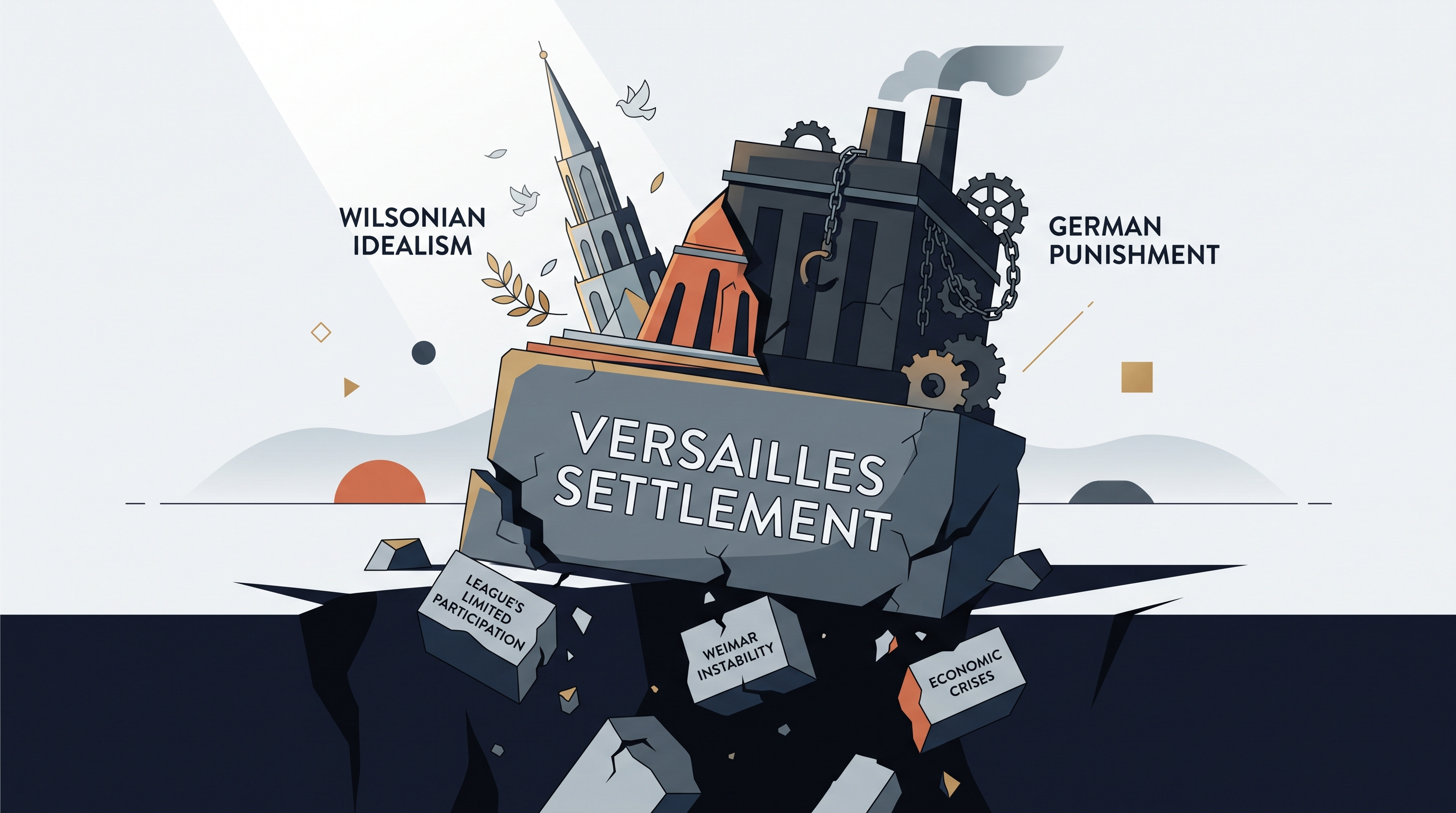
The peace negotiators who met in Paris after the war pursued conflicting goals. U.S. president Woodrow Wilson promoted Wilsonian idealism, including national self-determination, open diplomacy, and an international organization capable of preserving peace. France, especially Georges Clemenceau, prioritized security against future German aggression; Britain sought both European stability and protection of its imperial and economic interests.
The settlement therefore attempted to create a new order while punishing Germany. Germany accepted responsibility for the war through the war-guilt clause, paid reparations, surrendered territory, reduced its military, and lost its overseas colonies. These provisions satisfied neither side: many Germans considered them humiliating, while French leaders believed the restrictions were insufficient to guarantee security.
KC-4.1.II: The conflicting goals of the peace negotiators in Paris pitted diplomatic idealism against the desire to punish Germany, producing a settlement that satisfied few.
The settlement also dismantled the German, Austro-Hungarian, Ottoman, and Russian empires. Democratic successor states—including Poland, Czechoslovakia, and Yugoslavia—emerged from former imperial territories. Their borders contained multiple ethnic, linguistic, and religious communities, making national self-determination difficult to apply consistently.
| Competing priority | Intended result | Historical problem |
|---|---|---|
| Wilsonian idealism | Cooperation, self-determination, and lasting peace | National boundaries rarely matched ethnic settlement |
| Punishment of Germany | Security and compensation for the victors | Resentment weakened the new German republic |
| National self-determination | Legitimate nation-states | New minorities remained inside successor states |
| International cooperation | Collective resistance to aggression | Major powers refused or failed to participate fully |
A crucial institution was the League of Nations, created to prevent future wars through collective security: an attack on one member would theoretically concern all members. Yet the League was weakened from the outset because major powers, including the United States, Germany, and the Soviet Union, did not initially participate. The United States emerged from World War I as a world power, but its Senate rejected membership in the League, sharply limiting the organization’s authority.
Why the settlement remained unstable
The democratic successor states faced significant political, economic, and diplomatic crises. Political parties struggled to establish legitimacy; inflation, debt, unemployment, and war damage strained economies; and disputes over borders and minority populations created diplomatic tension. The Weimar Republic in Germany was especially vulnerable because the Versailles settlement linked the new democracy to military defeat, national humiliation, war guilt, and reparations.
The settlement did not single-handedly cause later dictatorships or another world war. Its importance lies in the interaction between punishment and weakness: the treaty damaged German political legitimacy, while the League lacked the participation and power needed to enforce a stable international order. The Russian Revolution and the peace settlement thus produced competing models of postwar politics—communist revolution and fragile parliamentary reconstruction.
Misconception check — “Self-determination created a map of pure nation-states.” It did not. The principle was applied selectively, and the new borders left many ethnic minorities inside states dominated by other national groups. This contradiction made the postwar order appear hypocritical to some populations and unstable to many governments.
Source analysis: propaganda and purpose
When analyzing a World War I propaganda poster, separate what the image shows from what it is trying to do. A poster depicting a threatened homeland may use exaggerated danger to recruit soldiers, raise money, encourage production, or demonize an enemy. Under Historical Thinking Skill 2.C: Sourcing and Situation, ask who created it, for which audience, under what wartime conditions, and how that purpose limits the poster as evidence of ordinary public opinion.
A useful chain of reasoning is: wartime crisis produced propaganda; propaganda shaped public interpretations of sacrifice; prolonged sacrifice encouraged mutiny and revolution; revolution and imperial collapse altered the balance of power; diplomats then attempted to construct a peace settlement that could contain those changes.
Retrieval check
Explain in two or three sentences why the Versailles settlement was unstable. A strong answer should identify the conflict between Wilsonian idealism and punishment of Germany, then connect the treaty’s weaknesses—including the League’s limited participation and the Weimar Republic’s legitimacy problems—to the broader political and economic crises of the postwar period.
Source Materials
- AP European History Course and Exam Description
- AP European History Course and Exam Description Clarifications and Corrections
- AP European History Course Overview
- AP European History Course at a Glance
- AP European History Course at a Glance Poster
- AP European History
- AP European History
- AP European History Sample Syllabus 1