From the free course AP European History on Lykke
5.7 The Congress of Vienna · 5.8 Romanticism
Key concepts: Congress of Vienna · Romanticism · Napoleonic Wars and the collapse of the Napoleonic Empire · Restoration of monarchies in Europe · Growth of nationalism in the 1800s · Liberalism and constitutionalism after 1815 · Revolutions of 1848 · National mobilization and wars of resistance · Dreyfus Affair · Franco-Prussian War and German annexation of Alsace-Lorraine
The Congress of Vienna tried to make Europe politically stable after the Napoleonic Wars, but the settlement could not erase the forces those wars had unleashed: liberalism, the belief in constitutional government and individual rights, and nationalism, the belief that people sharing a common identity should…
5.7 The Congress of Vienna · 5.8 Romanticism
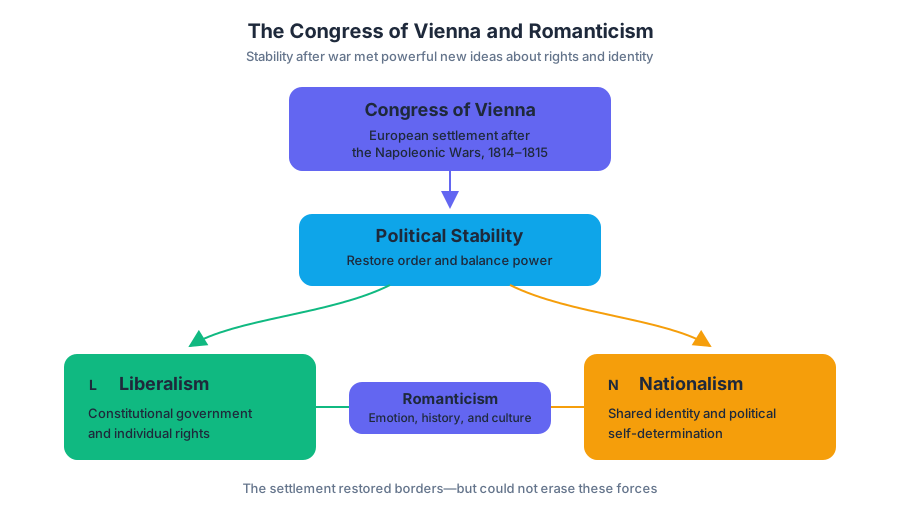
The Congress of Vienna tried to make Europe politically stable after the Napoleonic Wars, but the settlement could not erase the forces those wars had unleashed: liberalism, the belief in constitutional government and individual rights, and nationalism, the belief that people sharing a common identity should possess political self-determination.
A conservative settlement in a nationalist age
The Congress of Vienna met in 1814–1815 after Napoleon’s defeat and the collapse of his empire. Austria’s Klemens von Metternich, Britain, Russia, and Prussia sought to restore monarchies, contain France, prevent another continent-wide war, and suppress revolutionary movements. Their settlement was based on legitimacy—the return of traditional ruling families—and the balance of power, the principle that no single state should become strong enough to dominate Europe.
The settlement produced a Europe that looked conservative on the surface but was unstable underneath. The victorious powers created arrangements that helped contain France and formed the Concert of Europe, a system of consultation and cooperation through which conservative monarchies could respond to threats. When liberal or nationalist revolutions appeared, governments sometimes intervened militarily to preserve the existing order.
The central contradiction was simple:
| Conservative goal after 1815 | Opposing pressure |
|---|---|
| Restore dynastic monarchies | National groups demanded self-rule |
| Preserve multinational empires | Italians, Germans, Poles, and others sought unity or independence |
| Prevent revolution | Liberals demanded constitutions and civil rights |
| Maintain the balance of power | National mobilization altered the strength of states |
Why nationalism grew after Napoleon
Napoleon’s empire helped spread nationalism even while Napoleon himself ruled imperially. French conquest reorganized territories, weakened old privileges, and introduced legal and administrative changes; resistance to French occupation then encouraged people in Spain, Russia, and the German lands to mobilize around a shared identity. In other words, national feeling grew both from exposure to French power and from opposition to it.
National mobilization means organizing a population around a common identity for political or military action. Spanish guerrilla resistance and Russian resistance during Napoleon’s invasion demonstrated that war could become a struggle of “the people” against a foreign ruler. These conflicts made European politics increasingly nationalistic and helped transform resistance into a demand for national independence or unification.
Liberalism, nationalism, and the Revolutions of 1848
After 1815, liberalism and nationalism often worked together but were not identical. Liberals wanted constitutions, representative institutions, legal equality, and limits on arbitrary royal power. Nationalists wanted political borders to reflect a shared language, culture, or historical community. A movement could therefore be liberal, nationalist, or both.
The Revolutions of 1848 expressed these pressures across Europe. Protesters demanded constitutions and political participation, while national groups sought autonomy or unification. Most revolutions failed in the short term because monarchies retained armies and revolutionary coalitions divided over class, religion, and the boundaries of national states. Yet the uprisings demonstrated that restoration could delay political change without permanently preventing it.
Romanticism: emotion, history, and the nation
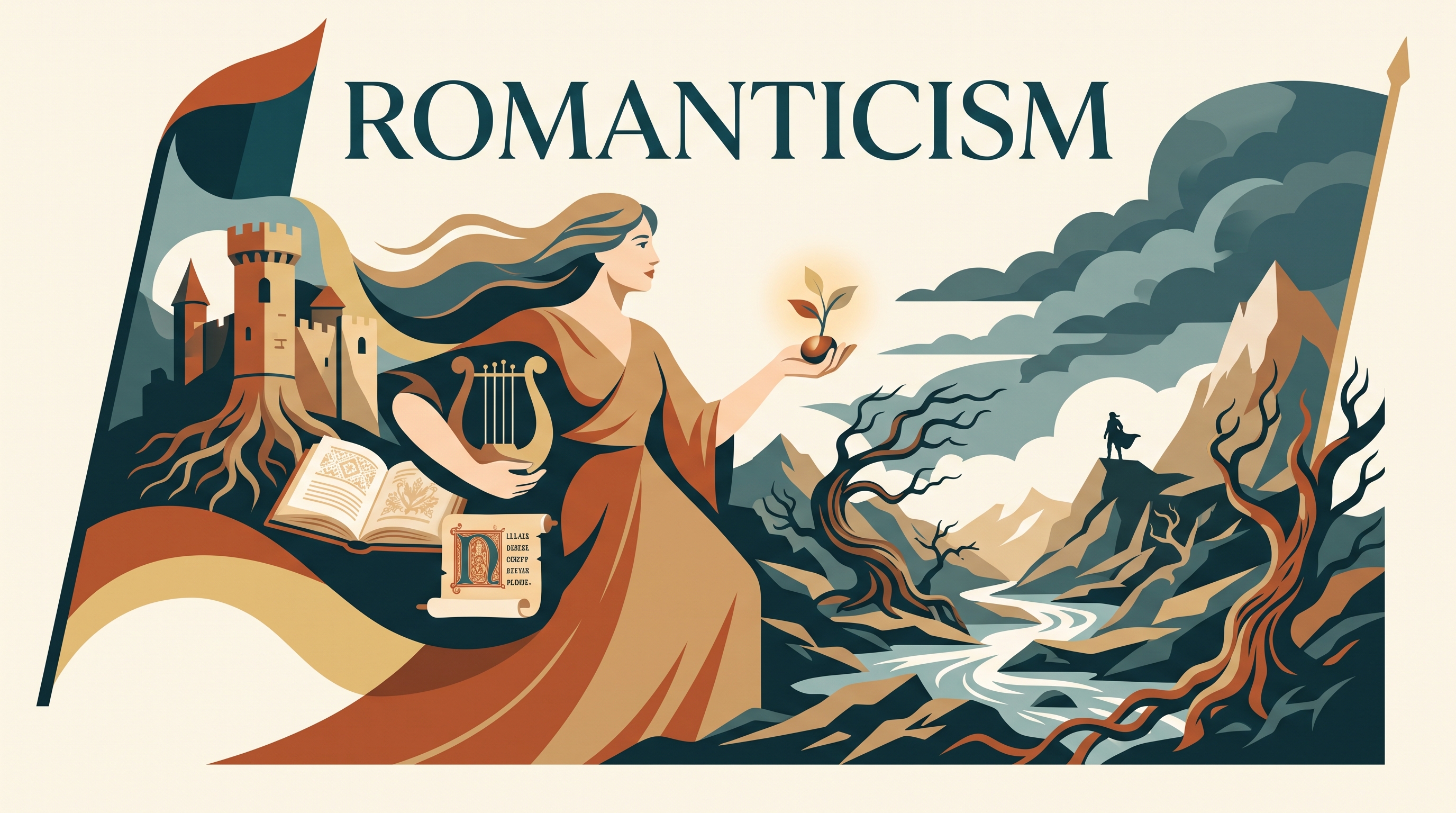
Romanticism was an artistic and intellectual reaction against the Enlightenment’s emphasis on universal reason and strict realism. Romantic writers and artists emphasized emotion, imagination, nature, individual experience, the medieval past, and the spiritual power of ordinary people. A stormy landscape, a heroic rebel, or a tragic historical scene could communicate truths that a purely rational system seemed unable to capture.
Romanticism strengthened nationalism by turning culture into evidence of a distinct national character. Writers collected folk songs, legends, fairy tales, and regional histories; poets elevated vernacular languages; composers drew on national melodies. These practices encouraged people to imagine the nation as an extended cultural family with a shared past, even when political unity did not yet exist.
Nationalism as both liberation and conflict
Nationalism could challenge empires, but it could also create new rivalries. German unification culminated in conflict with France during the Franco-Prussian War of 1870–1871. After Prussia’s victory, the new German Empire annexed Alsace-Lorraine, territories claimed by France as well as Germany. The annexation intensified French resentment and showed how national boundaries could turn identity into an international crisis.
The Dreyfus Affair later revealed nationalism’s domestic dangers. In France, the conviction of Jewish army officer Alfred Dreyfus for treason exposed conflicts over military authority, antisemitism, republican politics, and competing definitions of Frenchness. Nationalism could unite citizens against an outside enemy, but it could also exclude minorities and divide citizens within the same state.
Worked historical reasoning
Question: Why did the Congress of Vienna fail to eliminate political conflict in Europe?
Reasoning: The settlement restored monarchies and restrained France, but it did not satisfy liberal and nationalist demands. National mobilization during the Napoleonic Wars had already encouraged groups to imagine political communities based on shared identity. Thus, the Congress created short-term stability while leaving unresolved conflicts that appeared in the Revolutions of 1848 and later nationalist struggles.
This example uses Skill 1: Developments and Processes by tracing change over time; Skill 4: Contextualization by connecting the settlement to the Napoleonic Wars; Skill 5: Making Connections by linking diplomacy, ideology, and resistance; and Skill 6: Argumentation by making a defensible claim supported by specific evidence. A common misconception is that Vienna simply “returned Europe to the past.” It restored monarchies, but it could not restore the pre-Napoleonic political consciousness.
Retrieval check: Explain one way the Congress of Vienna promoted stability and one way Romanticism contributed to later nationalist movements. Then distinguish a liberal demand from a nationalist demand in the Revolutions of 1848.
Source Materials
- AP European History Course and Exam Description
- AP European History Course and Exam Description Clarifications and Corrections
- AP European History Course Overview
- AP European History Course at a Glance
- AP European History Course at a Glance Poster
- AP European History
- AP European History
- AP European History Sample Syllabus 1