From the free course AP European History on Lykke
AP Practice 6
A strong Long Essay Question (LEQ) answer does not recite everything known about Europe; it makes a defensible historical argument, supports it with specific evidence, and explains why that evidence proves the argument.
AP Practice 6
A strong Long Essay Question (LEQ) answer does not recite everything known about Europe; it makes a defensible historical argument, supports it with specific evidence, and explains why that evidence proves the argument. This original, unofficial practice focuses on Skill 6: Argumentation, while also requiring Skill 1: Developments and Processes, Skill 4: Contextualization, and Skill 5: Making Connections through the application of the three historical reasoning processes—especially causation and continuity and change.
The task
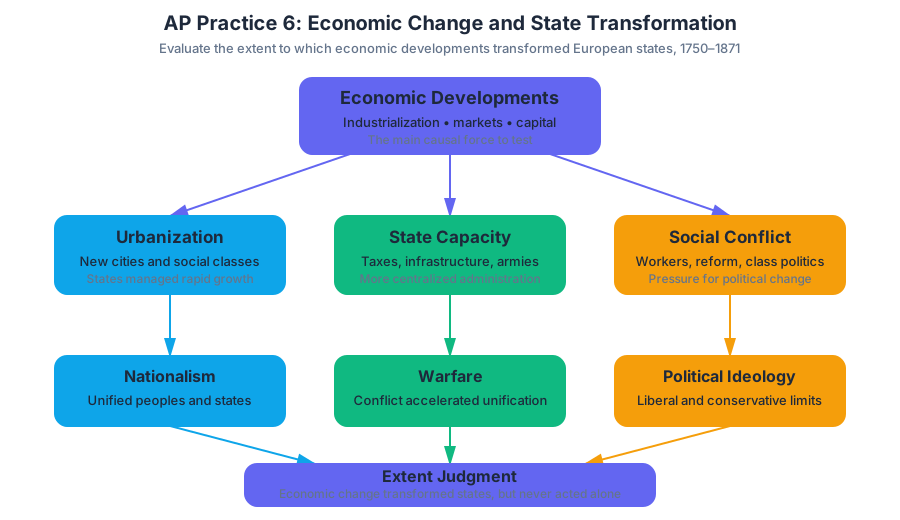
Prompt: Evaluate the extent to which economic developments transformed European states between $1750$ and $1871$.
This prompt asks for a judgment about extent. It does not ask whether economic developments mattered—they clearly did. It asks you to weigh their importance against other forces, such as nationalism, warfare, political ideology, or state administration.
A useful planning formula is:
$$ \text{Economic change} \rightarrow \text{state transformation} \quad \text{but also} \quad \text{limits and competing causes} $$
Step 1: Decode the argument
The time period begins during the expansion of global markets, commercial agriculture, and early industrialization. It ends after the spread of railways, mass industry, nationalism, and the political consolidation of Germany and Italy. The central historical problem is therefore not simply “Did economies change?” but “How did economic change alter what states could do, whom they served, and how power was organized?”
A defensible thesis might read:
Economic developments transformed European states to a considerable extent by increasing governmental capacity, encouraging infrastructure and administrative reform, and intensifying class conflict; however, economic change alone did not determine political outcomes, because nationalism, military competition, and revolutionary ideology shaped how states used new economic resources.
This thesis earns the argument point because it answers the prompt directly, establishes a degree of change, and previews a line of reasoning. The qualification—“economic change alone did not determine political outcomes”—creates an analytical framework rather than merely listing topics.
Step 2: Build contextualization
Before $1750$, European states had already expanded taxation, overseas commerce, and centralized administration. Mercantilist policies linked economic activity to state power, while the Scientific Revolution and Enlightenment encouraged governments to collect information, improve administration, and consider reform. These earlier developments created conditions in which industrialization could produce political consequences after $1750$.
The context must connect directly to the argument. A detached sentence such as “The Enlightenment happened before the Industrial Revolution” is background, not contextualization. The stronger version explains that earlier commercial and administrative growth gave states tools they later used to manage industrial economies.
Step 3: Select evidence and explain it
The following evidence could support the argument:
| Evidence | What it demonstrates |
|---|---|
| Britain’s industrialization | Economic growth increased state revenue, naval strength, and global influence. |
| Railways | States could move troops, goods, officials, and information more rapidly. |
| Factory labor and urbanization | Industrial society created new class tensions and pressure for reform. |
| Corn Laws and their repeal | Political decisions increasingly responded to competing economic interests. |
| German customs and industrial growth | Economic integration helped support national political unification. |
| Socialist movements | Industrial inequality generated organized challenges to liberal governments. |
Evidence becomes analytically useful only when the answer explains its significance. For example, “Railways expanded in the nineteenth century” is an identification. “Railways strengthened central governments because they allowed states to transport soldiers and officials quickly, making territorial administration more effective” is evidence plus reasoning.
Worked paragraph
One major way economic developments transformed European states was by expanding their administrative and military capacity. Industrial production generated wealth that governments could tax, while railways connected distant regions to political centers. Britain used its industrial economy to support naval power and imperial expansion, and other states invested in rail networks partly because rapid transportation improved military mobilization. Economic modernization therefore changed the practical reach of the state: governments could collect information, move forces, regulate markets, and integrate regions more effectively than before. However, this transformation was uneven, since states with weaker industrial bases often remained dependent on foreign investment and imported technology.
This paragraph does four things an examiner rewards: it identifies specific evidence, connects that evidence to state power, explains a broader historical consequence, and adds a qualification. It does not treat “industrialization” as a magic word; it shows the mechanism linking economic change to political transformation.
Step 4: Add a counterforce
A second paragraph could argue that nationalism and political conflict were equally important. Economic integration helped connect regions, but national unification also depended on diplomacy, warfare, and political leadership. In Germany, commercial cooperation through the Zollverein supported closer relationships among states, yet Prussian military power and Otto von Bismarck’s diplomatic strategy were necessary to turn economic connection into national unification.
This comparison strengthens the essay because it distinguishes enabling conditions from immediate causes. The economy made some political outcomes more possible; it did not automatically produce them.
Rubric-aligned checklist
For the standard six-point LEQ structure, aim for the following:
- Thesis: Make a historically defensible claim that answers “to what extent.”
- Contextualization: Explain relevant developments before, during, or around the period.
- Evidence: Use at least two specific historical examples; stronger responses use several.
- Analysis and reasoning: Organize the essay around causation, comparison, or continuity and change.
- Complexity: Explain multiple causes, consequences, perspectives, or limits rather than presenting a one-sided story.
Misconception check
Misconception: “More evidence automatically means a higher score.” Evidence earns value when it is accurate, specific, and connected to the argument. A paragraph packed with names but lacking explanation is less effective than one carefully developed example.
Timing and error review
Use approximately $5$ minutes to plan, $30$ minutes to write, and $5$ minutes to revise. During revision, underline the thesis, circle specific evidence, and draw an arrow from each major example to the claim it proves; any example without an explanatory arrow needs analysis.
Retrieval check: If your thesis claims that economic change transformed states “to a considerable extent,” name one economic development, one state consequence, and one non-economic factor that limited or redirected that consequence.

Source Materials
- AP European History Course and Exam Description
- AP European History Course and Exam Description Clarifications and Corrections
- AP European History Course Overview
- AP European History Course at a Glance
- AP European History Course at a Glance Poster
- AP European History
- AP European History
- AP European History Sample Syllabus 1
- AP European History-AP Students-College Board
- AP European History-Doves Library
- AP European History Cheat Sheets-Albert.io
- AP European History Study Guide-EBSCO