From the free course AP European History on Lykke
AP Practice 4
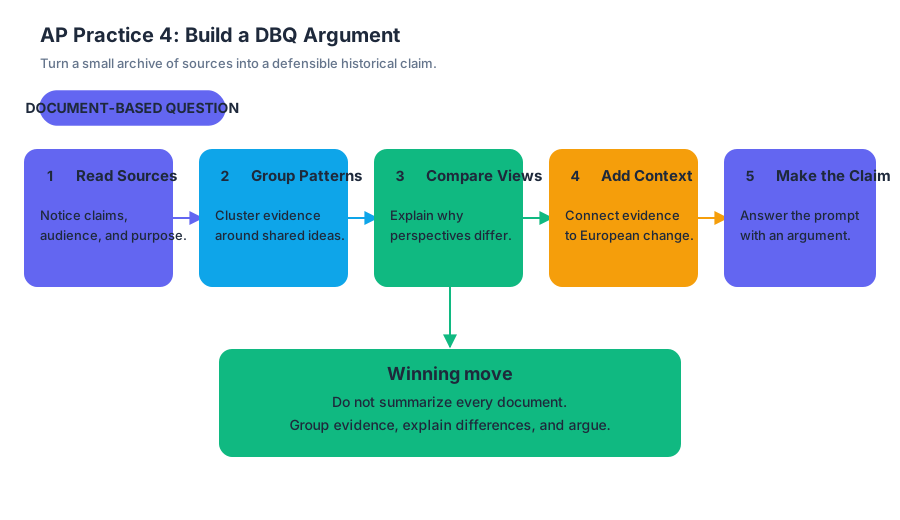
A DBQ asks you to turn a small archive of sources into a historical argument. The winning move is not to summarize every document; it is to group documents around a defensible claim, explain why their perspectives differ, and connect the evidence to broader European developments.
AP Practice 4
Task type: Document-Based Question (DBQ)
A DBQ asks you to turn a small archive of sources into a historical argument. The winning move is not to summarize every document; it is to group documents around a defensible claim, explain why their perspectives differ, and connect the evidence to broader European developments.
The prompt
Evaluate the extent to which Enlightenment ideas influenced political change in Europe and the Atlantic world from 1750 to 1825.
Suggested working time: spend about 15 minutes reading and planning and about 40 minutes writing. Underline the command—evaluate the extent—because the essay must judge influence, not merely list Enlightenment ideas or revolutionary events.
The documents
| Document | Source and central evidence |
|---|---|
| 1 | John Locke argues that legitimate government rests on the consent of the governed. |
| 2 | Denis Diderot’s Encyclopédie presents the testing of inherited knowledge as a path toward improvement. |
| 3 | Joseph II of Austria describes religious toleration and administrative reform as tools of effective monarchy. |
| 4 | A 1789 French revolutionary declaration asserts that citizens possess equal rights and that sovereignty belongs to the nation. |
| 5 | A formerly enslaved person in Saint-Domingue petitions for legal freedom, invoking universal natural rights. |
| 6 | Edmund Burke criticizes the French Revolution for destroying inherited institutions too rapidly. |
| 7 | Napoleon’s legal reforms establish equality before the law while preserving strong executive authority. |
The documents create a deliberate tension. Some show Enlightenment principles becoming revolutionary language; others show rulers adapting those principles to strengthen the state, while Burke and Napoleon reveal limits and contradictions.
A fast planning model
Build the argument before writing:
Context → Thesis → Document groups → Sourcing → Outside evidence → Complexity
Possible groups
- Political legitimacy: Documents 1 and 4 connect government to consent, citizenship, and national sovereignty.
- Reform from above: Documents 2, 3, and 7 show knowledge, toleration, legal equality, and administration being used by elites or rulers.
- Limits and contradictions: Documents 5, 6, and 7 expose the gap between universal principles, social inequality, and authoritarian power.
Worked thesis
Enlightenment ideas substantially influenced political change between 1750 and 1825 by supplying arguments for popular sovereignty, legal equality, religious toleration, and reform; however, their influence was uneven because monarchs used reform to preserve power, conservative critics defended inherited institutions, and revolutionary governments often applied universal rights selectively.
This thesis earns the thesis point because it makes a historically defensible claim, answers the extent question, and establishes a line of reasoning: substantial influence, limited by political power and exclusion.
Contextualization: establish the pressure before the change
Before 1750, European political authority was commonly justified through dynastic inheritance, social hierarchy, and—in many monarchies—divine-right traditions. At the same time, expanding print culture, scientific inquiry, commercial society, and Atlantic imperial competition created settings in which older institutions could be questioned. The Enlightenment did not appear from nowhere; it developed within these intellectual and economic changes.
That paragraph earns contextualization because it describes broader developments that precede and help explain the period’s political transformations. Merely writing “the Enlightenment happened before the revolutions” would not be enough.
Evidence and sourcing: make documents do argumentative work
A weak sentence says, “Document 1 discusses natural rights.” A stronger sentence explains its significance: Locke’s claim that government depends on consent gave later revolutionaries a vocabulary for challenging hereditary authority. The evidence now supports the thesis rather than sitting beside it.
For sourcing, explain how a document’s purpose, audience, historical situation, or point of view matters:
- Document 3: Joseph II’s support for toleration can be read as enlightened absolutism. His purpose was not necessarily to create popular democracy; reform could make the monarchy more efficient and obedient.
- Document 5: A petition from Saint-Domingue is powerful precisely because its author invokes universal rights against a system that denied freedom to enslaved people. The petition reveals both Enlightenment influence and the hypocrisy of selective rights.
- Document 6: Burke’s conservative perspective helps explain resistance to revolutionary change. His criticism shows that Enlightenment-inspired politics faced an organized defense of tradition, not merely passive confusion.
To earn the document-evidence points, use at least four documents accurately for the first point and at least six documents to earn the second. To earn the sourcing point, explain the significance of sourcing for at least three documents; naming an author or audience without explaining why it matters is not enough.
Outside evidence
A strong outside example could be the American Declaration of Independence, which applied natural-rights arguments to a rebellion against imperial authority. Another could be the Haitian Revolution, in which enslaved people transformed the language of liberty and equality into an attack on plantation slavery. Either example must be explained, not merely named.
Complexity: qualify the argument
The most sophisticated argument recognizes that Enlightenment influence worked in opposing directions. The same language of reason and reform could support expanded citizenship, as in revolutionary declarations, or centralized authority, as in Napoleon’s state-building. Enlightenment ideas therefore changed the terms of political debate without guaranteeing democratic outcomes.
This earns the complexity point because it demonstrates a nuanced relationship: ideas mattered, but institutions, class interests, empire, gender, and slavery shaped who benefited from them.
Misconception check
Misconception: “The Enlightenment caused democracy everywhere.” The more accurate claim is that Enlightenment ideas supplied arguments that different groups used selectively. Joseph II, French revolutionaries, enslaved petitioners, conservatives, and Napoleon could all respond to Enlightenment language while pursuing sharply different political goals.
Retrieval check
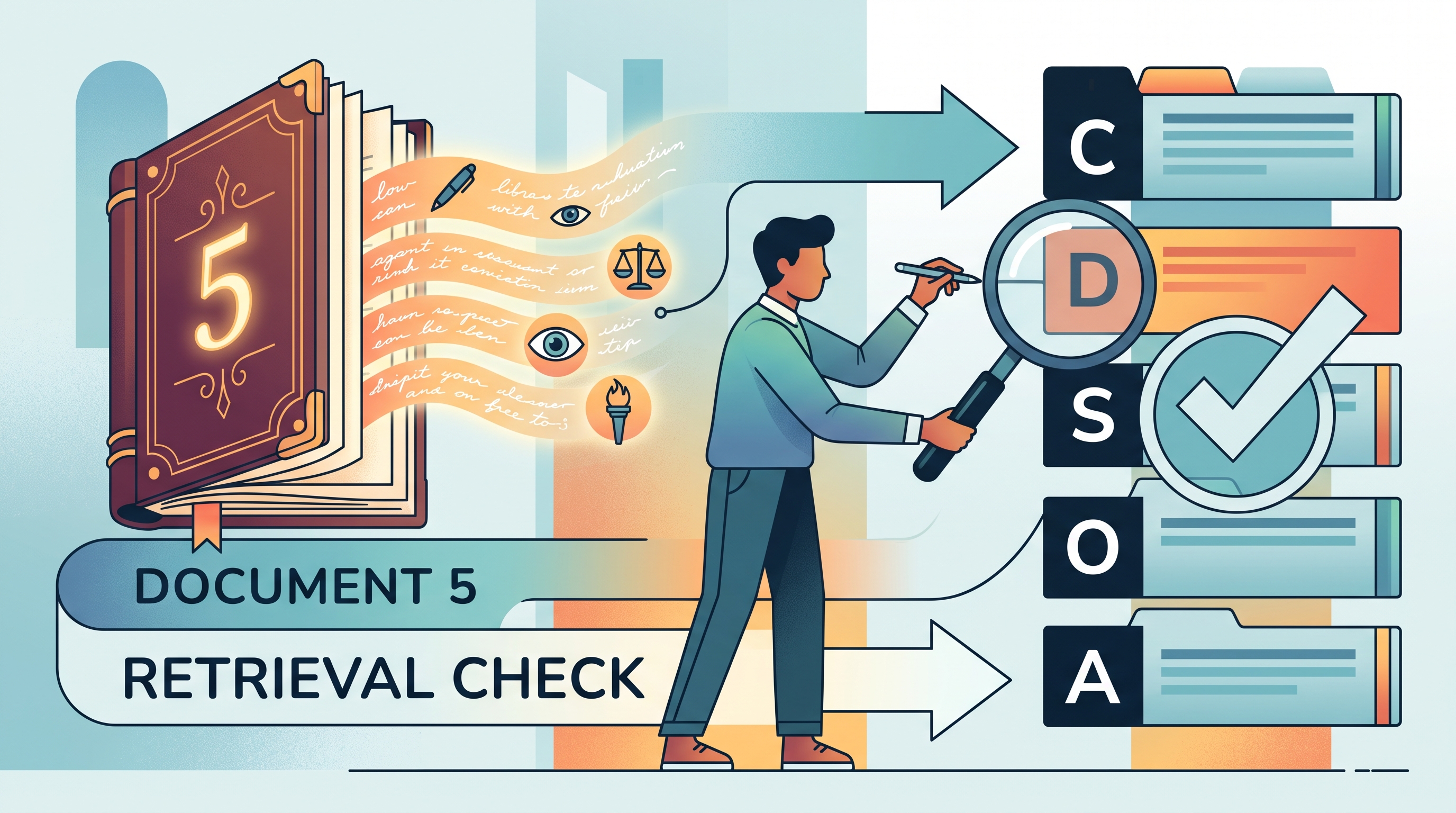
In one sentence, explain why Document 5 is more than evidence that Enlightenment ideas spread. A strong answer should say that it demonstrates both the power of universal-rights language and the contradiction between those ideals and Atlantic slavery.
Error-review routine: after writing, label each paragraph C for context, D for document evidence, S for sourcing, O for outside evidence, or A for argument. If a paragraph has only D, revise it by explaining how the evidence proves the thesis.
Source Materials
- AP European History Course and Exam Description
- AP European History Course and Exam Description Clarifications and Corrections
- AP European History Course Overview
- AP European History Course at a Glance
- AP European History Course at a Glance Poster
- AP European History
- AP European History
- AP European History Sample Syllabus 1
- AP European History-AP Students-College Board
- AP European History-Doves Library
- AP European History Cheat Sheets-Albert.io
- AP European History Study Guide-EBSCO