From the free course AP European History on Lykke
9.5 Postwar nationalism, ethnic conflict, and atrocities · 9.6 Contemporary Western democracies
Key concepts: Postwar nationalism · Ethnic conflict and atrocities · National and European Identity (NEI) · Contemporary Western democracies · The Cold War and Contemporary Europe · Causation (Skill 5.B) · Khrushchev’s reforms and de-Stalinization · Revolts in Eastern Europe · Nationalism and the collapse of the Soviet bloc · 20th-century cultural, intellectual, and artistic developments
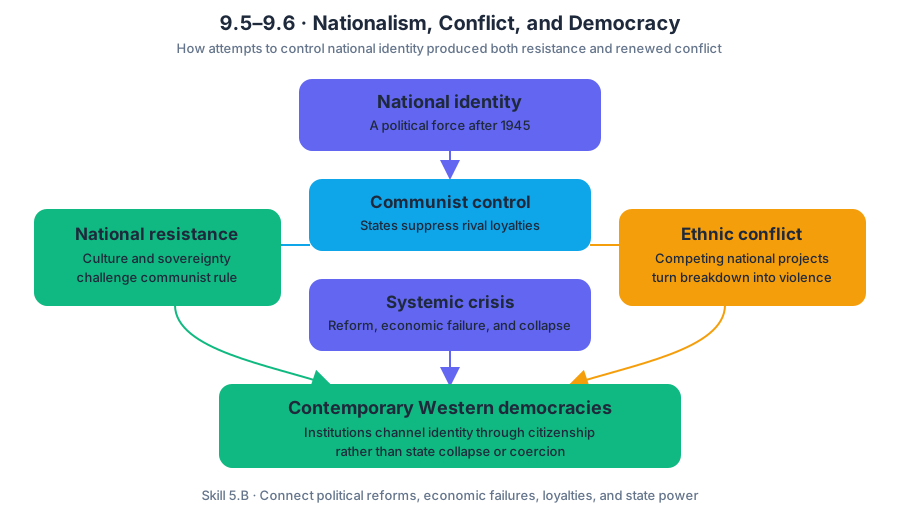
Nationalism did not disappear after 1945; in Eastern Europe, it became one of the forces that eventually weakened communist rule, while in parts of southeastern Europe it helped turn political breakdown into ethnic violence.
9.5 Postwar nationalism, ethnic conflict, and atrocities · 9.6 Contemporary Western democracies
Nationalism did not disappear after 1945; in Eastern Europe, it became one of the forces that eventually weakened communist rule, while in parts of southeastern Europe it helped turn political breakdown into ethnic violence. The central question is therefore causal: how did attempts to control national identity produce both resistance to communism and new conflict after communism?
Topic 9.5 belongs to the thematic focus National and European Identity (NEI) and emphasizes Skill 5.B: Making Connections—“Explain how a historical development or process relates to another historical development or process.” The key move is not merely identifying nationalism or describing a revolt, but tracing how political reforms, economic failures, national loyalties, and state collapse interacted.
Khrushchev’s reforms: reform from above, pressure from below
After Joseph Stalin’s death in 1953, Nikita Khrushchev attempted to loosen the most repressive features of Stalinism. His policy of de-Stalinization—the public rejection of Stalin’s personality cult, purges, and extreme terror—created expectations that communist governments might become less coercive and more responsive. Limited cultural openness and criticism of Stalin gave intellectuals, workers, and national groups new language with which to challenge the existing order.
The reform created a political contradiction. Communist governments wanted to preserve one-party rule, Soviet influence, and centralized economic planning, but de-Stalinization encouraged people to ask why political authority should remain immune from criticism. Reform therefore acted like opening a tightly sealed container: pressure that had been hidden became visible, even though the system was not prepared to release it.
Worked causal example: Khrushchev’s criticism of Stalin → greater public expectations for freedom and national autonomy → protests against economic and political control → Soviet or allied intervention to preserve communist authority. The pattern appeared in the Hungarian Revolution of 1956, where demands for political reform and national independence threatened Soviet control and were suppressed, and in the Prague Spring of 1968, when Czechoslovak leaders attempted “socialism with a human face” before Soviet-led forces intervened.
Why reforms produced revolt
Khrushchev’s reforms also failed economically and socially. Agricultural difficulties, shortages, uneven living standards, and frustration with bureaucratic rule undermined the promise that communism would deliver prosperity and equality. Because communist governments claimed to represent workers and national progress, visible failures damaged not only their performance but also their legitimacy.
The revolts in Eastern Europe were therefore not caused by economic hardship alone. Economic disappointment became politically explosive when combined with de-Stalinization, national resentment, and the refusal of communist governments to permit genuine independent political action.
Causation rule: A reform can weaken a regime when it raises expectations faster than the regime can satisfy them.
Named misconception — “De-Stalinization ended repression.” It did not. Khrushchev reduced some forms of terror and criticized Stalin, but the Soviet Union and its allies continued to restrict political opposition and used force when reform threatened one-party rule.
Nationalism, ethnic conflict, and atrocities
Nationalism became a catalyst for the eventual collapse of communist rule because communist states often suppressed or subordinated national identities in favor of class solidarity and centralized authority. When communist legitimacy weakened, people increasingly organized around Polish, Hungarian, Czech, Slovak, Croatian, Serbian, Baltic, or other national identities. National belonging offered an alternative source of loyalty when the communist state no longer appeared capable of delivering prosperity or political stability.
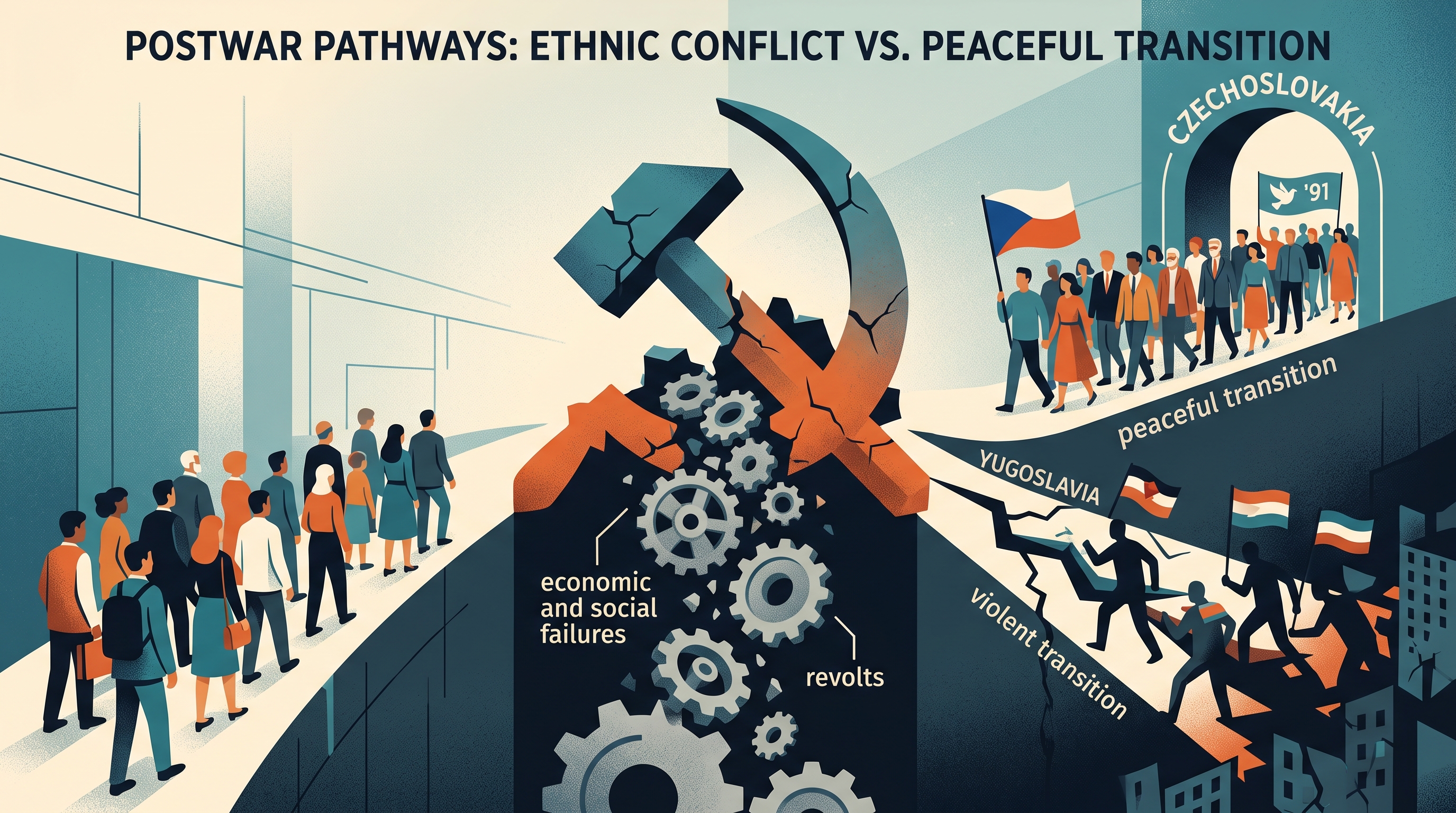
Nationalism could unite people against an imperial or communist center, but it could also divide populations within multinational states. The violent disintegration of Yugoslavia in the 1990s demonstrated this danger: competing national projects, political manipulation, territorial claims, and memories of historical victimization contributed to ethnic conflict and atrocities, including mass killings, forced displacement, and campaigns of ethnic cleansing.
The end of communist rule was not identical everywhere. In much of central and eastern Europe, communist governments collapsed through largely peaceful negotiations, elections, demonstrations, and transfers of power. Elsewhere, especially where political leaders linked state authority to exclusive ethnic nationalism, the transition produced instability, armed conflict, and atrocities.
9.6 Contemporary Western democracies
While eastern Europe experienced communist collapse and ethnic conflict, contemporary Western democracies developed through representative government, expanded welfare systems, economic recovery, and increasing political participation. Western European states still faced tensions involving class, migration, regional identity, and national sovereignty, but democratic institutions generally provided legal mechanisms—elections, parties, courts, and public debate—for managing conflict without the systematic one-party coercion characteristic of communist regimes.
Western Europe also faced a tension between national identity and European identity. Citizens could see themselves simultaneously as members of a nation and participants in a broader European political and economic community. This dual identity matters to NEI because postwar Europe was shaped both by powerful national loyalties and by efforts to prevent another cycle of nationalist war.
Retrieval check
Explain the chain connecting de-Stalinization, economic and social failures, revolts in Eastern Europe, and the later weakening of communist rule. Then distinguish one largely peaceful transition from one violent transition, explaining why nationalism produced different outcomes in each case. A strong answer uses Skill 5.B: Making Connections by linking each development rather than listing events.
Source Materials
- AP European History Course and Exam Description
- AP European History Course and Exam Description Clarifications and Corrections
- AP European History Course Overview
- AP European History Course at a Glance
- AP European History Course at a Glance Poster
- AP European History
- AP European History
- AP European History Sample Syllabus 1