From the free course AP European History on Lykke
4.5 18th-Century Culture and Arts · 4.6 Enlightened and Other Approaches to Power
Key concepts: 18th-century culture and arts · Enlightened and other approaches to power · Cultural and intellectual development · States and other institutions of power · Social organization and development · National and European identity · Printing and public opinion · Napoleon’s rise, dominance, and defeat · Domestic reforms and practices under Napoleon · Relations with other religious communities
In the eighteenth century, culture became a political force: books, newspapers, salons, paintings, theaters, and public debate helped Europeans decide which institutions deserved obedience. At the same time, rulers borrowed Enlightenment language to strengthen states—sometimes reforming government, sometimes simply…
4.5 18th-Century Culture and Arts · 4.6 Enlightened and Other Approaches to Power
In the eighteenth century, culture became a political force: books, newspapers, salons, paintings, theaters, and public debate helped Europeans decide which institutions deserved obedience. At the same time, rulers borrowed Enlightenment language to strengthen states—sometimes reforming government, sometimes simply making absolutism more efficient.
Culture moves into public life
Cultural and intellectual developments are changes in how people create, circulate, and evaluate ideas. In the eighteenth century, printing expanded the audience for political and philosophical discussion. Earlier books had often served courts, churches, or universities; increasingly, printed works reached merchants, professionals, urban residents, and literate members of the middle classes.
Printing did not automatically create democracy. It created a larger arena in which arguments could compete. Newspapers and pamphlets reported events, criticized officials, and shaped reputations. Salons and academies connected writers, scientists, artists, and patrons. Coffeehouses and reading societies allowed people to discuss ideas outside direct royal or ecclesiastical supervision.
Public opinion is the collective judgment formed through discussion, communication, and debate among members of society.
Public opinion therefore became a new source of cultural authority. A monarch might still control armies and courts, but rulers increasingly had to consider how policies appeared to educated readers. Public criticism could expose corruption, challenge religious intolerance, or turn a philosophical argument into a political demand.
The arts reflected this changing social world. Rococo art emphasized elegance, intimacy, decoration, and aristocratic leisure. Later eighteenth-century neoclassicism favored order, civic virtue, and models drawn from ancient Greece and Rome. These styles were not merely decorative choices: they communicated ideas about status, morality, authority, and the proper relationship between individuals and society.
States, institutions, and cultural production
States and other institutions of power shaped culture by funding academies, censoring publications, sponsoring artists, and regulating education. Royal patronage could make intellectual and artistic work possible, while censorship could restrict criticism. The same government might support scientific societies and public education yet suppress political dissent.
Social organization also influenced cultural development. Growing urban populations, expanding commercial wealth, and a more visible educated middle class created audiences for printed literature and public performances. Cultural change was therefore connected to Social Organization and Development (SCD): who had leisure, literacy, money, and access to institutions affected which ideas circulated.
Identity beyond the court
Cultural exchange helped Europeans imagine identities larger than the local community. Shared reading habits, intellectual correspondence, artistic styles, and elite travel encouraged a sense of belonging to a broader European cultural world. At the same time, languages, histories, religious traditions, and political loyalties supported emerging national identities.
National and European Identity (NEI) concerns how regional, cultural, national, and European identities develop and influence political and social order.
These identities could coexist, but they could also conflict. A writer might participate in a Europe-wide republic of letters while defending the customs of a particular kingdom. Religious and political divisions continued to challenge the idea of a unified Europe, even as shared cultural practices encouraged it.
Enlightened and other approaches to power
Enlightened absolutism describes rulers who retained concentrated political authority while adopting selected reforms associated with Enlightenment thought. They might centralize administration, improve taxation, reform courts, promote education, limit torture, or expand religious toleration. Their goal was usually stronger and more orderly government—not popular sovereignty.
The CED’s Learning Objective G asks students to explain how different forms of political power were influenced by Enlightenment thought from 1648 to 1815. The relevant historical development is KC-2.1.I.C, which identifies eastern and central European experiments with enlightened absolutism. Learning Objective H addresses how political and religious developments challenged or reinforced a unified Europe; KC-2.1.III.A connects this issue to the post-Westphalian rise of Prussia and the Habsburgs’ eastward shift.
Religious policy illustrates both reform and limitation. By 1800, many western and central European governments extended toleration to Christian minorities, and some granted civil equality to Jews, as identified in KC-2.3.IV.C. Yet toleration usually came from rulers rather than from equal political participation, and it could be reversed when leaders believed religious unity served state stability.
Worked example: Napoleon as reformer and authoritarian
Napoleon demonstrates how enlightened language could coexist with authoritarian power. As First Consul after 1799, he stabilized administration and consolidated authority; as emperor after 1804, he made personal rule explicit while presenting himself as the guardian of order and merit.
His enduring domestic practices included the Napoleonic Code, which standardized civil law, protected some forms of property ownership, and established legal equality for men while reinforcing patriarchal authority. He centralized administration through appointed officials, reorganized taxation, strengthened state education, rewarded service through careers open—at least in principle—to talent, and reached the Concordat of 1801 with the Catholic Church.
Napoleon also redefined relations with religious communities. The Concordat restored a public role for Catholicism but kept the Church subordinate to the state. His policies therefore combined compromise, toleration, and control: religion could support social order, but no religious institution could rival the government.
Misconception check: Napoleon was not simply an Enlightenment democrat. He preserved selected revolutionary and Enlightenment reforms while restricting political liberty, censoring the press, and building an imperial hierarchy.
Source reasoning: claims and evidence
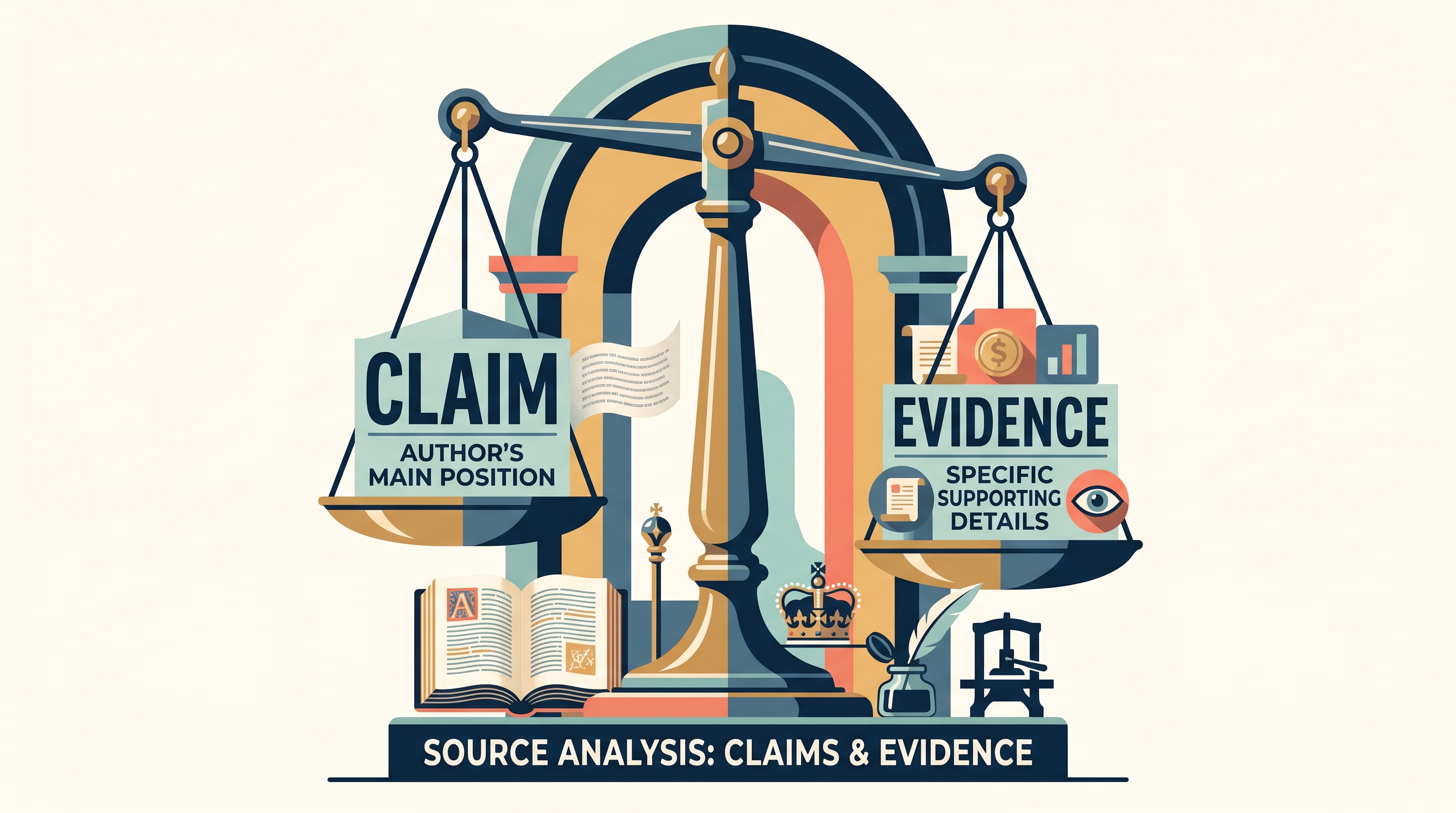
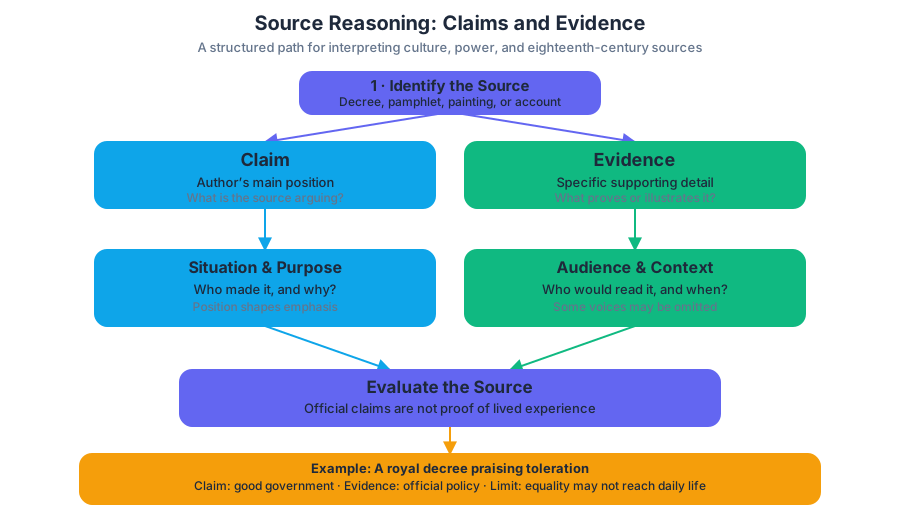
For a primary or secondary source about eighteenth-century culture or power, begin by separating claim from evidence. The claim is the author’s main position; evidence is the specific detail used to support it. Then evaluate how the author’s situation, purpose, audience, and historical context shape what is emphasized or omitted.
This applies Skill 2: Sourcing and Situation, Skill 3: Claims and Evidence in Sources, and Skill 4: Contextualization. For example, a royal decree praising religious toleration shows an official claim about good government; it does not by itself prove that minorities experienced equality in daily life.
Retrieval check: Why could printing strengthen public opinion without producing democracy? Name one way Napoleon preserved Enlightenment-influenced reform and one way he limited political freedom.
Source Materials
- AP European History Course and Exam Description
- AP European History Course and Exam Description Clarifications and Corrections
- AP European History Course Overview
- AP European History Course at a Glance
- AP European History Course at a Glance Poster
- AP European History
- AP European History
- AP European History Sample Syllabus 1